
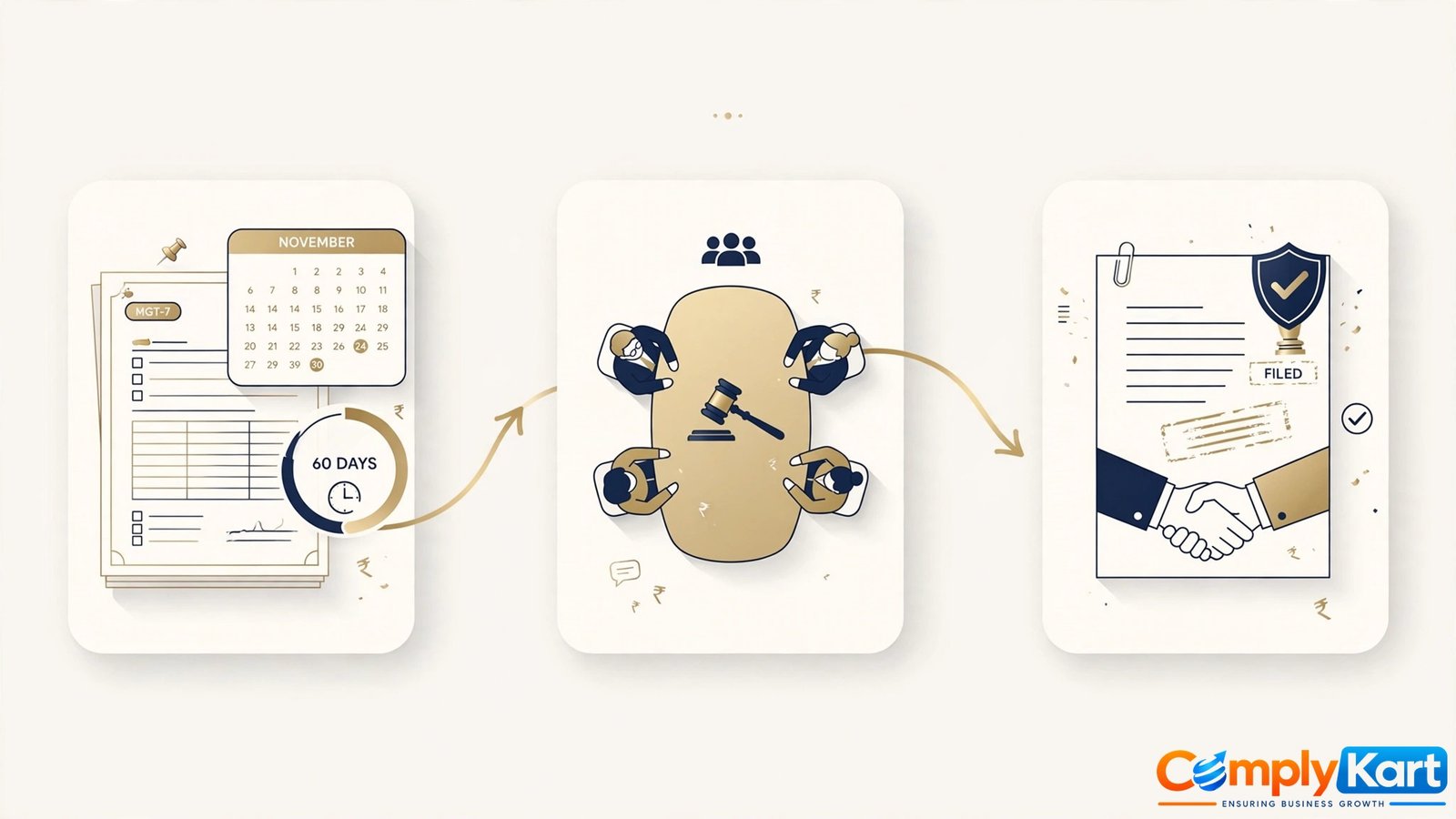
If AOC-4 is the company's financial autobiography, MGT-7 is its identity card. The annual return doesn't carry a single rupee of financials — it carries everything else: who owns the company, who runs it, how many times the board met, what they were paid. And for FY 2025-26, it's due on 29 November 2026.
The short answer: Every company must file its annual return within 60 days of the AGM under Section 92 of the Companies Act, 2013. For an AGM held on 30 September 2026, that means 29 November 2026. Regular companies file MGT-7; One Person Companies and small companies file the abridged MGT-7A. Late filing costs ₹100 per day with no cap.
MGT-7 or MGT-7A — which one is yours?
This is the first decision, and getting it wrong means refiling. MGT-7 is the full annual return for all companies except OPCs and small companies — including every private limited company above the small-company limits. MGT-7A is the abridged version for One Person Companies and small companies, introduced in 2021.
And the small-company definition changed recently. From 1 December 2025, a small company means paid-up capital up to ₹10 crore and turnover up to ₹100 crore (G.S.R. 880(E)). If your company slipped under those revised limits this year, you may have moved from MGT-7 to MGT-7A without realising it. Check before you file — the forms ask for different things.
What's actually inside the annual return?
More than most directors expect. Shareholding pattern — who holds what, including any changes during the year. Director and key managerial personnel details. The number of board and committee meetings held, with attendance. Remuneration of directors and KMP. Details of penalties or compounding during the year. Share transfers, debentures, and indebtedness.
The part that causes refilings: the return must agree with your statutory registers and with the financials already filed in AOC-4. Shareholding in MGT-7 that doesn't match the register of members is the classic mismatch, and the portal cross-checks more than it used to. Reconcile first, file second.
What does delay cost?
The additional fee is ₹100 per day with no upper limit, running separately from the AOC-4 meter. On top of that, Section 92(5) provides for penalties: ₹10,000 plus ₹100 per day of continuing default up to ₹2 lakh for the company, and ₹10,000 plus ₹100 per day up to ₹50,000 for every officer in default — halved for small companies and OPCs under Section 446B. Two consecutive years of non-filing can disqualify the directors for five years under Section 164(2).
File AOC-4 before MGT-7 — the portal expects that order, and the return builds on the filed financials. With AOC-4 due 30 October and MGT-7 due 29 November, the sequence is built into the calendar. Don't invert it.
One more form to know about: MGT-8. Listed companies, and public companies above the prescribed thresholds, need their annual return certified by a practising Company Secretary. If that applies to you, the PCS certification has to be arranged before filing — it's not something you bolt on the night before.
And a related warning: if the AGM itself wasn't held by 30 September, that's a separate default from a late filing. Filing MGT-7 doesn't cure a missed AGM. The meeting default and the filing default run on independent tracks with independent consequences. If your AGM didn't happen, talk to your CS about compounding before you worry about the return.
Why do MGT-7 filings get sent back?
Three refiling triggers account for most resubmissions. First, the shareholding mismatch — the return's capital structure doesn't agree with the register of members, usually because a transfer during the year was recorded in one place and not the other. Second, the wrong variant — MGT-7 filed where MGT-7A was due, or vice versa, under the revised small-company limits. Third, attachments that don't match: a board report dated differently from the AGM minutes, or figures that drift between the return and the filed AOC-4.
Each resubmission costs days, and days near 29 November are expensive days. The pre-filing reconciliation — registers, financials, minutes, all agreeing — is the cheapest insurance in this process.
The plan for the next six weeks
One: confirm whether you file MGT-7 or MGT-7A under the revised small-company limits. Two: pull the statutory registers and reconcile shareholding, directorships and meeting counts against the draft return. Three: file on MCA V3 by 29 November and keep the filed form with your annual records.
Six weeks sounds comfortable until you remember the registers haven't been updated since last year's filing. They never are. Start with the registers, and the return writes itself — or get our team to run the whole annual filing set for you, AOC-4 through MGT-7, in the right order.
MGT-7: quick answers
What happens if I miss the 29 November MGT-7 deadline?
The additional fee is ₹100 per day with no upper cap, running separately from the AOC-4 meter. On top of that, Section 92(5) provides ₹10,000 plus ₹100 per day of continuing default up to ₹2 lakh for the company, and ₹10,000 plus ₹100 per day up to ₹50,000 for every officer in default (halved for small companies and OPCs). Two consecutive years of non-filing can disqualify directors for five years.
How do I know whether to file MGT-7 or MGT-7A?
One Person Companies and small companies file the abridged MGT-7A; everyone else files MGT-7. From 1 December 2025, "small company" means paid-up capital up to ₹10 crore and turnover up to ₹100 crore — if you slipped under those revised limits this year, you may have moved variants without realising it.
What is MGT-8 and do I need it?
MGT-8 is a certification of the annual return by a practising Company Secretary, required for listed companies and public companies above the prescribed thresholds. If it applies to you, arrange the PCS certification before filing — it can't be bolted on the night before. New to the annual filing cycle? Our compliance fee calculator estimates the year's total filing costs.
Does filing MGT-7 fix a missed AGM?
No. If the AGM itself wasn't held by 30 September, that's a separate default from a late filing — the meeting default and the filing default run on independent tracks with independent consequences. Talk to your CS about compounding the AGM default before worrying about the return.
One last timing note: the ICSI has asked the MCA to extend annual filing dates, including MGT-7, to 31 December 2026 — but as of mid-October no extension circular exists. Plan for 29 November. If an extension arrives, it's a bonus, not a plan.



Comments
No comments yet — ask the first question below.
Join the discussion
Questions go straight to our expert desk. Comments appear after a quick review — no spam, no noise.