
IN BRIEF
A current account is the operating bank account a company uses for day-to-day business transactions, and banks in India reject new-company applications most often for fixable paperwork reasons — an address that does not match ROC records, an incomplete board resolution, director KYC gaps, or a missing beneficial-owner declaration. The RBI's KYC Master Direction, 2016, as amended on 28 April 2023, sets the document and ownership rules banks must apply.
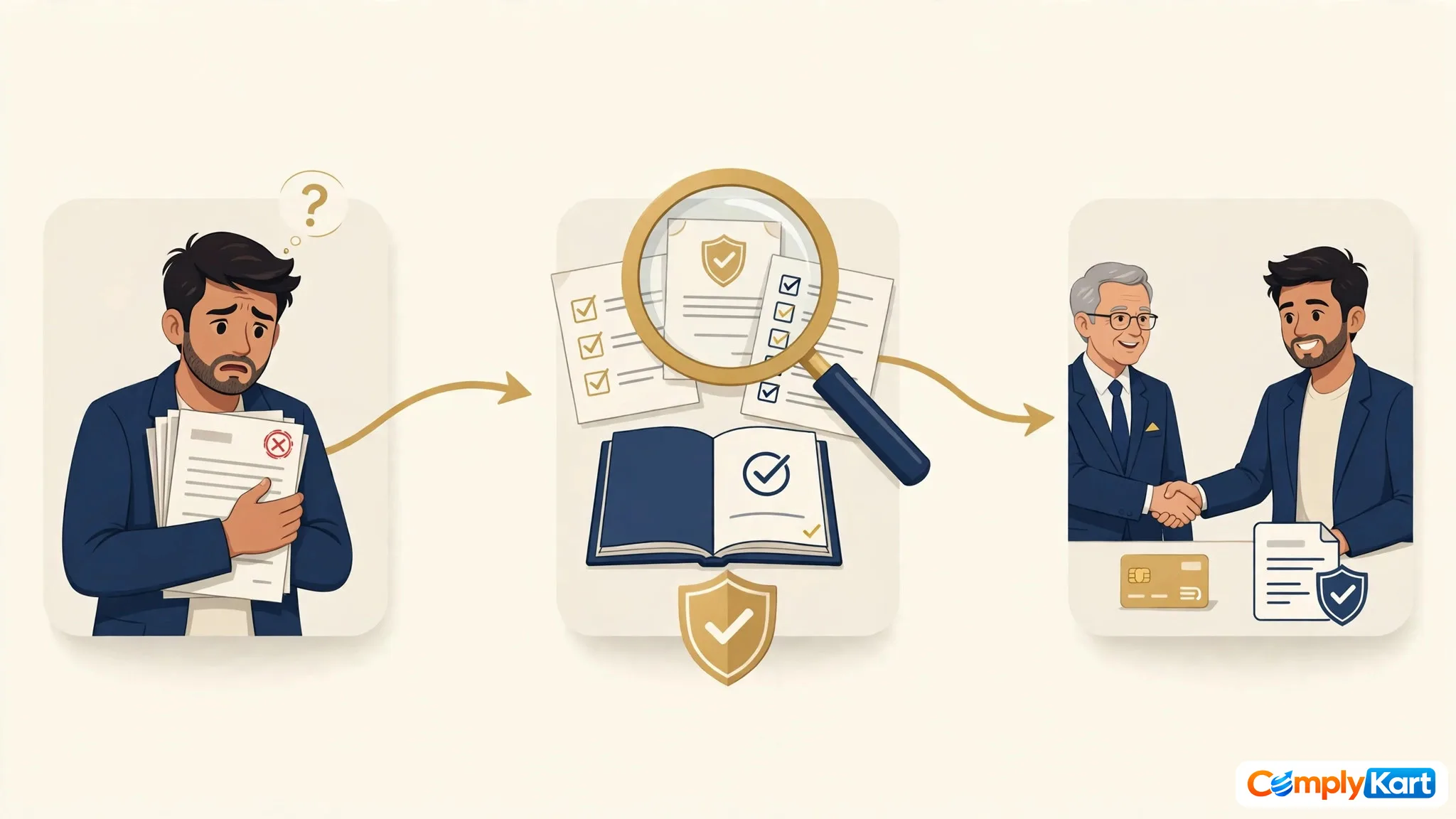
You did everything right. The company is incorporated, the certificate is downloaded, the PAN is in hand — and the bank sent your current-account application back. No clear reason, just a polite "unable to process" or a request for "further documents." It feels personal. It is not. Banks reject new-company current accounts for a small set of fixable reasons, and the same reasons hit almost every founder who walks in unprepared.
Short answer: Banks reject current-account applications from new companies most often because the registered-office address does not match ROC records, the board resolution is incomplete, a director's KYC does not line up across PAN and Aadhaar, or the beneficial-owner declaration is missing for someone holding 10% or more. Most rejections are paperwork — fix the mismatch and reapply.
Think of the bank like a landlord handing over shop keys. The landlord does not judge your business idea. They check three things: whether the name on the lease matches your ID, whether the address on the papers matches the shop they are standing in, and whether they know who really owns the place. A bank does the same three checks, in the same order. Every rejection below is one of those three checks failing.
First, the rule nobody tells you
No law says a company must have a current account. But no law needs to. The RBI's deposit directions bar banks from opening savings accounts for trading, business or professional concerns — a company, an LLP or a partnership firm cannot hold a savings account in the business name at all. So a current account is not one option among several. It is the only operating account your company can have. That is why a rejection stings: there is nowhere else to put the company's money.
Two reassurances before the reasons. First, nothing in the RBI's KYC rules requires your company to have started business before it opens an account. The certificate of incorporation, the memorandum and articles, the PAN and the board resolution are all available within days of incorporation. A brand-new company with zero revenue is not, by itself, a reason to say no. Second, no bank publishes its internal risk scoring, so some of what follows is bank policy rather than law — I say which is which as we go.
What does the bank actually check?
The RBI's Master Direction on Know Your Customer (2016, amended 28 April 2023) tells the bank exactly what to collect for a company account. Certified copies of the certificate of incorporation, the company PAN, the memorandum and articles of association, and a board resolution authorising the account and naming the people who may operate it. The names of the people in senior management. The registered office, and the principal place of business if it is different. PAN and Aadhaar for every director and authorised signatory. And a beneficial-owner declaration — every natural person who ultimately owns or controls 10% or more of the shares, capital or profits.
That list is the whole game. The bank lays your file next to the MCA record and the tax record and looks for daylight between them. Here is where the daylight usually appears.
Why does an address mismatch kill the application?
This is the most common reason, by a wide margin. The bank cross-checks the address on your proof document — a utility bill, a rent agreement — against the registered office recorded with the Registrar of Companies. One flat number different, one floor missing, a co-working address on the certificate and a home address on the bill, and the file stops.
Take a founder I would describe as typical: the certificate shows the registered office as a co-working space in Saket; the electricity bill she submits is for her flat in the same building, two floors up. Same building, different address on paper. The bank cannot reconcile them, so it sends the file back.
The fix depends on which side is wrong. If the company has actually moved, file INC-22 with the ROC first and let the record update — then apply with the new address. If the ROC record is right and your proof is wrong, submit proof that matches it: a utility bill or rent agreement in the company's name at the registered office. One practical snag: banks usually want a rent agreement of at least 11 months, registered where the state requires it. If the landlord will not register, a notarised lease plus an electricity bill in the firm's name is the alternative most branches accept.
What makes a board resolution "incomplete"?
A board resolution for a bank account has to do four things: authorise opening the account with the named bank and branch, name the authorised signatories, state how they operate (singly, jointly, with value limits), and cover internet banking and the cheque book. Banks are fussy about the wording because the resolution is their authority to let those people move the company's money. A resolution that names the signatories but not the operating limits, or names the bank but not the branch, comes back for correction — and a correction means another board approval cycle.
One thing that saves a week: a current account can be approved by a resolution by circulation under Section 175 of the Companies Act, 2013. You do not need to call a meeting for it. An overdraft or a fixed deposit is different — those need a meeting. So if your resolution was passed before the bank shared its exact format, do not wait for the next board meeting. Circulate a fresh one in the bank's format and get it signed.
Why does one director's PAN spelling matter?
The bank verifies every director's PAN against the issuing authority's records and matches it against Aadhaar and the incorporation documents. A name spelled "Vijay Kumar" on the PAN, "Vijaykumar" on Aadhaar and "Vijay Kr." on the certificate is three different people as far as the bank's system is concerned. An expired document does the same damage. So does an Aadhaar address that has not been updated since the director moved.
This is the cheapest rejection to prevent. Before you apply, put every director's PAN, Aadhaar and DIN details side by side and check the spelling, the date of birth and the address. Fix mismatches at the source — UIDAI for Aadhaar, the income-tax portal for PAN — then re-submit. A director who is unavailable during the bank's verification call also stalls the file, so tell every signatory the bank will call.
What is the 10% beneficial-owner rule?
Since the RBI's amendment of 28 April 2023, a bank must identify and verify every natural person holding 10% or more of a company's shares, capital or profits. Before that amendment the threshold was 25%. The change is deliberate: at 25%, a four-way equal split could hide every owner; at 10%, it cannot.
Founders trip on this in two ways. They leave a 10% shareholder off the declaration because "he is only a small investor." Or the shareholding runs through a holding company and nobody traces it to the natural person at the end of the chain. The bank will ask for the shareholding pattern and the group structure until it can see a human being at the end of every 10% line. Draw that chart before you apply — every person at 10% or more, with their PAN and Aadhaar ready. Listed companies and their subsidiaries are exempt from this identification; a new private company is not.
Why do banks flag some businesses as high-risk?
This one is bank policy, not RBI law, and the bank will rarely explain it in so many words. A company with no operating history and a large expected transaction volume draws a second look. So do businesses in categories banks treat as higher-risk — virtual digital assets and crypto, forex trading, investment advisory, lending-adjacent activity — and companies whose ownership runs through several layers of holding entities, especially with foreign shareholders.
You cannot change your business category, but you can change how the file reads. A short, honest note on what the company will actually do — who will pay you, roughly how much, and through which channels — answers the question the risk team is really asking: where will the money come from and where will it go. A file that says nothing about expected turnover invites the bank to imagine the worst. A file that says "₹15–20 lakh a month from domestic clients by bank transfer" gives them something to underwrite.
Does the ₹5 crore current-account rule affect a new company?
Almost never — but founders hear about it and worry, so here is the rule. The RBI's August 2020 circular on opening current accounts says that where a borrower has aggregate banking exposure below ₹5 crore, any bank may open a current account on the borrower's undertaking to inform the bank when exposure crosses ₹5 crore. At ₹5 crore and above, current accounts may be opened only by banks holding at least 10% of the exposure, or the bank managing the escrow account.
A new company with no loans has no exposure. The ₹5 crore test does not touch it. The rule only bites later, when the company borrows. If a bank cites it for a brand-new company with no credit facilities, ask them to show which exposure they are counting — the answer is usually that a different rule is the real reason.
Is GST mandatory for a current account?
No. This is the most repeated myth in the process. The RBI's KYC Master Direction does not list a GST certificate among the entity documents for a company account. The certificate of incorporation, PAN, memorandum and articles, and board resolution are the required documents; GST is optional proof of business activity. Some banks ask for it anyway as part of their own checklist. If you have GST, hand it over — it helps. If you do not, because your turnover is below the threshold or registration is still in process, the bank cannot treat its absence as a failed KYC check. Quote the Master Direction, escalate to the branch manager, or try another bank.
How do I fix a rejection and reapply?
Do it in this order, and do not reapply until every item is done — a second rejection for the same reason costs more time than the first.
First, get the reason in writing. Ask the branch for the specific deficiency, not a general "incomplete documents." If the person at the counter cannot say, ask for the operations or KYC desk. Second, fix the root cause, not the symptom: update the ROC address with INC-22 if the record is wrong; re-pass the resolution in the bank's format if the wording was the problem; correct the director's PAN or Aadhaar at the source if the spelling was the problem. Third, re-check the whole file against the Master Direction list before you walk back in — one fresh mismatch restarts the clock. Fourth, keep a copy of everything you submit, with the date.
With a clean file, most banks finish in a few working days; a file that bounces for corrections can take two to four weeks. Those are typical timelines from practitioner experience, not a rule — no regulation sets a deadline for opening an account.
What if the bank will not explain the rejection?
A bank is not obliged to open an account for everyone, but it is obliged to have a reason, and you are entitled to a proper hearing of your complaint. The ladder is short: the branch manager first, then the bank's nodal officer (every bank must publish the nodal officer's contact details), then the Reserve Bank — Integrated Ombudsman Scheme, which takes complaints about banks that have not resolved a grievance. One practical note: the Ombudsman route is strongest when you can show the paper trail — the deficiency letter, your corrected documents, the dates. Keep the trail from the first visit.
If the rejection was genuinely a risk-category decision rather than a paperwork failure, the honest answer is to apply elsewhere. Banks differ in appetite, and a rejection at one bank is not a black mark at another. What you must not do is reapply to five banks at once with the same broken file — the same mismatch will fail five times, and you will have spent a month learning nothing.
Check this before you submit
Run through this list with the file in front of you, not from memory. The address on your proof matches the ROC record, character for character. The board resolution names the bank and branch, the signatories, the operating mode and the limits. Every director's name, date of birth and address read identically on PAN, Aadhaar and the certificate. Every person at 10% or more is on the beneficial-owner declaration with KYC attached. The shareholding chart traces to a natural person at the end of every line. The company's PAN is in hand, and the certificate of incorporation is the downloaded MCA copy. And someone has written two lines on expected monthly inflows, so the risk team does not have to guess.
Frequently asked questions
Can I open a current account the same week my company is incorporated?
Yes. The documents the bank needs — certificate of incorporation, PAN, memorandum and articles, board resolution — are all available within days of incorporation, and nothing in the KYC rules requires the company to have started business first.
Do I need GST registration before opening a current account?
No. GST is not an RBI requirement for a company account. Some banks ask for it as part of their own checklist, and it helps if you have it, but its absence is not a failed KYC check.
Can a bank reject my application without giving a reason?
A bank can decline an account, but in practice it must record a reason internally, and you can ask for the specific deficiency in writing. If the branch will not give one, escalate to the nodal officer and then to the RBI Integrated Ombudsman Scheme.
Does a rejected application affect my company's credit or MCA record?
No. A current-account rejection is a bank decision, not a regulatory one. It does not appear on the MCA record and does not affect the company's credit history. What it costs is time — which is why fixing the root cause before reapplying matters.
Can an LLP or a partnership firm face the same rejections?
Yes, the same checks apply with different papers — an LLP agreement instead of a memorandum and articles, a resolution or authority letter instead of a board resolution, and the same 10% beneficial-owner rule. The address mismatch and KYC-gap reasons hit LLPs and firms exactly the same way. If you are still choosing the structure, the LLP vs sole proprietorship guide compares the options before you commit.
A rejected current account is usually a mismatch, not a judgement. Work out which of the seven reasons hit your file, fix it at the source, and reapply with a clean set of papers. If the company is still being set up, start with our private limited company registration team and the guide to downloading your certificate of incorporation, so the bank file is ready the day the certificate lands. And if the rejection came after a filing was missed, the INC-20A commencement guide and our GST registration service cover the two post-incorporation steps banks ask about most. If you want the costs of the filings that follow in one place, the compliance fee calculator puts the numbers together.





Comments
No comments yet — ask the first question below.
Join the discussion
Questions go straight to our expert desk. Comments appear after a quick review — no spam, no noise.