
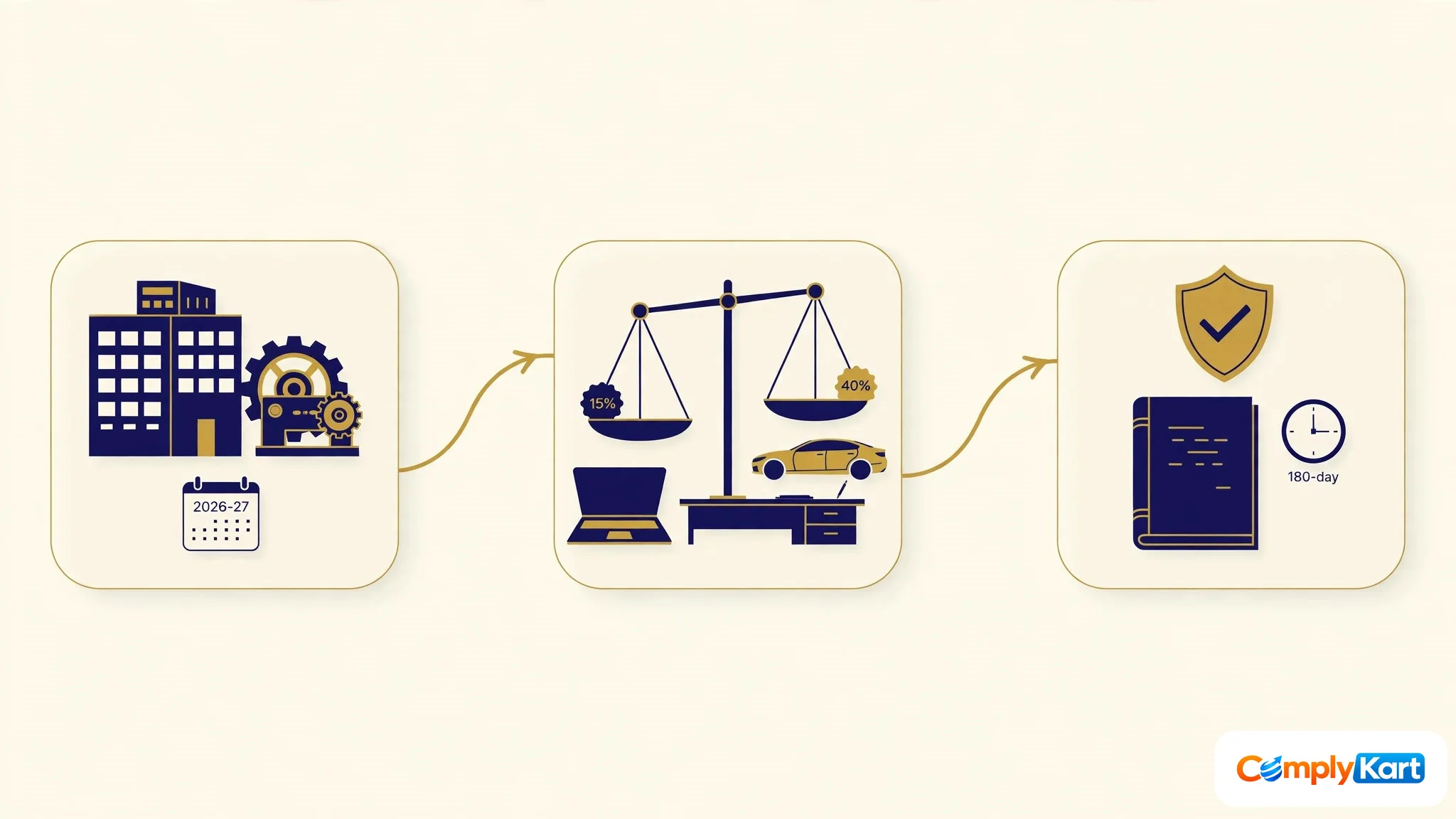
IN BRIEF
Depreciation rates for FY 2026-27 come from two laws: the Income-tax Act, 2025 charges depreciation under section 33 on blocks of assets at the Appendix I rates of the Income-tax Rules, 2026, while the Companies Act, 2013 charges it in the books over the useful lives in Schedule II. The tax rate decides what you claim in your return; the Schedule II life decides what your financial statements show.
Depreciation in FY 2026-27 comes from two laws that rarely agree. Income tax charges it under section 33 of the Income-tax Act, 2025, on blocks of assets at Appendix I rates from 5% to 40%. Your books charge it under Schedule II of the Companies Act, 2013, over a useful life of 3 to 60 years. Same asset, two numbers.
Why your books and your tax return never agree on depreciation
Think of it as two clocks. The books clock ticks by the day: buy a machine on 1 July, and the first year's charge covers 274 days, no more. The tax clock ticks in halves: use the asset for 180 days or more and you get the full rate; use it for 179 days and you get half, even if you bought it in April. Neither clock is wrong. They measure different things for different readers — your shareholders read the books, the tax department reads the return.
That is the whole confusion, really. People hunt for "the" depreciation rate as if one number exists. It doesn't. There is a tax rate and a book life, and the gap between them is not an error. It is a timing difference, and it shows up in your accounts as deferred tax. Once you see the two tables side by side, the rest of the subject gets much easier.
The income-tax rates: Appendix I, block by block
For tax, you never depreciate one asset at a time. Assets of the same class and rate go into a block, and the rate applies to the block's written down value: opening value, plus additions, minus sale proceeds. The rates below are from Appendix I of the Income-tax Rules, 2026, read with section 33 of the Income-tax Act, 2025. They are unchanged from the old Appendix I — the 2025 Act renumbered the section, it did not rewrite the rates.
| Block of assets | WDV rate | Examples |
|---|---|---|
| Buildings used mainly for residential purposes | 5% | Staff quarters, residential accommodation |
| Buildings not used mainly for residential purposes | 10% | Office, factory, warehouse, hotel buildings |
| Buildings — purely temporary erections | 40% | Wooden structures, temporary sheds |
| Furniture and fittings, including electrical fittings | 10% | Desks, chairs, lighting, fittings |
| Plant and machinery — general | 15% | Factory machinery, generators, compressors |
| Motor cars, other than those used in a hire business | 15% | Company cars, delivery vans not on hire |
| Motor buses, lorries and taxis used in a hire business | 30% | Commercial passenger and goods vehicles |
| Computers, including computer software | 40% | Desktops, laptops, servers, licensed software |
| Energy-saving devices | 40% | Solar equipment, energy-efficient plant |
| Books — annual publications owned by a professional | 40% | Professional libraries |
| Intangible assets — know-how, patents, copyrights, trademarks, licences, franchises | 25% | Patents, trademarks, franchise rights |
Three things to carry out of that table. First, land gets nothing — there is no depreciation on land, and no block for it. Second, goodwill is out. The Finance Act, 2021 took goodwill out of the intangibles block, so the tax charge on goodwill is nil however your books treat it. That gap never reverses. Third, the rate applies to the block, not the asset. Sell one machine out of a block and the sale proceeds come off the block's value; the block keeps depreciating on what is left.
The Companies Act side: Schedule II gives you a life, not a rate
Here is the sentence that saves people hours: Schedule II of the Companies Act, 2013 does not publish a depreciation rate anywhere. It publishes useful lives. You work the rate out from the life, and the method — straight line or written down value — is your company's own accounting policy. The schedule mandates neither.
The residual value is ordinarily capped at 5% of the asset's original cost, and the life "shall not ordinarily be different" from the life in Part C of the schedule. A different life is possible, but only on disclosure with technical advice behind it. The book charge runs pro rata by date from the day the asset is added.
| Asset class (Schedule II, Part C) | Useful life | SLM rate* | WDV rate* |
|---|---|---|---|
| Buildings — RCC frame structure | 60 years | 1.58% | 4.87% |
| Buildings — factory buildings | 30 years | 3.17% | 9.50% |
| Plant and machinery — general | 15 years | 6.33% | 18.10% |
| Plant and machinery — continuous process plant | 25 years | 3.80% | 11.29% |
| Furniture and fittings — general | 10 years | 9.50% | 25.89% |
| Motor cars, not run on hire | 8 years | 11.88% | 31.23% |
| Office equipment | 5 years | 19.00% | 45.07% |
| Servers and networks | 6 years | 15.83% | 39.30% |
| End-user devices — desktops and laptops | 3 years | 31.67% | 63.16% |
*The two rate columns are derived from the lives with a 5% residual value — straight line is 95 divided by the life, written down value is 1 minus the life-th root of 0.05. They are arithmetic, not statute. The law gives you the life; the rate follows from it.
Notice how the two tables sort assets differently. Schedule II splits buildings by construction — an RCC frame building gets 60 years, a factory building 30. Appendix I splits them by use — residential 5%, everything else 10%. So an RCC frame building used mainly for residential purposes keeps its 60-year life in the books but takes the 5% tax rate. Same building, two classifications, and both are right. If you force the tables to line up, you will get one of them wrong.
The same asset, both columns: year one on ₹10 lakh
Tables are useful. Rupees are better. Each asset below costs ₹10,00,000, is put to use on 1 July 2026, and is the only asset in its tax block. The book column is straight line over the Part C life to a 5% residual, charged pro rata for 274 days. The tax column is the full Appendix I rate, because 274 days clears the 180-day test.
| Asset | Book charge, year one | Tax charge, year one | Tax ahead by |
|---|---|---|---|
| Computer (desktop or laptop) | ₹2,37,717 | ₹4,00,000 | ₹1,62,283 |
| Furniture and fittings | ₹71,315 | ₹1,00,000 | ₹28,685 |
| Plant and machinery, general | ₹47,543 | ₹1,50,000 | ₹1,02,457 |
| Motor car, not on hire | ₹89,144 | ₹1,50,000 | ₹60,856 |
| Building, RCC frame | ₹11,886 | ₹1,00,000 | ₹88,114 |
Tax runs ahead in year one on every one of them. That is normal, and it is the reason your tax return shows a lower profit than your profit-and-loss account in the year you buy assets. It reverses later — the book charge keeps coming at the same amount every year while the tax charge shrinks as the written down value falls. On the computer the cumulative gap crosses nil in 2028-29. On the car, 2030-31. On general plant, 2040-41. On the RCC building, not before 2050-51. Your CA's deferred tax working is simply this table, carried forward.
One more worked pair, because these are the two assets most small companies actually buy. A general machine for ₹10,00,000 put to use on 1 April 2026: the books charge (₹10,00,000 − ₹50,000) ÷ 15 = ₹63,333, and tax charges 15% = ₹1,50,000. Tax ahead by ₹86,667 in year one. A computer for ₹5,00,000 put to use the same day: the books charge (₹5,00,000 − ₹25,000) ÷ 3 = ₹1,58,333, and tax charges 40% = ₹2,00,000. Tax ahead by ₹41,667. Run those two sums before you finalise a purchase and the year-end numbers hold no surprises.
The 180-day rule: one day can halve your first-year claim
For tax, an asset put to use for less than 180 days in the year of acquisition gets only half the prescribed rate in that year, and the half you lose is not carried forward. It is gone. The test counts days from the date the asset is put to use, not the date you bought it, and 180 days exactly takes the full rate.
Take general plant and machinery costing ₹10,00,000 in tax year 2026-27. Put it to use on 3 October 2026 — 180 days to 31 March — and the first-year tax charge is the full ₹1,50,000. Put it to use one day later, on 4 October 2026 — 179 days — and the charge is ₹75,000. One day moves the book charge by ₹174 and the tax charge by ₹75,000. If you are planning a purchase near the end of the year, that single date is worth more than any rate in the tables above. And the reverse matters too: an asset bought but not put to use at all in the year earns nothing for tax in that year, while the books may still charge once it is available for use.
Additional depreciation: 20% extra for manufacturers
If you manufacture or produce goods, or generate power, new plant and machinery earns additional depreciation of 20% on top of the normal rate — section 33(8) of the 2025 Act, which was section 32(1)(iia) of the old Act. It applies only to new plant and machinery, not to second-hand assets, and not to office equipment or vehicles.
The arithmetic is kind. New machinery costing ₹20,00,000, put to use on 1 April 2026: normal depreciation 15% = ₹3,00,000, plus additional depreciation 20% = ₹4,00,000, for a first-year tax charge of ₹7,00,000 — 35% of the cost in one year. Put the same machine to use for less than 180 days and both halves halve: normal 7.5% = ₹1,50,000 plus additional 10% = ₹2,00,000, a total of ₹3,50,000, with the remaining 10% of additional depreciation coming in the following year. The 20% is real money, but it rewards timing. Buy early in the year and the whole benefit lands at once.
What changed for 2026-27
Two things, one certain and one still in draft. The certain one: the Income-tax Act, 2025 is in force from 1 April 2026 and governs tax year 2026-27, replacing the previous year and the assessment year with a single tax year. Depreciation is now section 33, the block working is section 41(1)(c), and the rate table is Appendix I of the Income-tax Rules, 2026. The rates themselves carried forward unchanged. If a guide you are reading still cites section 32, it is using the old Act's numbering — the substance is the same, but the citation is a year out of date. Depreciation is also mandatory under section 33(7), whether or not you claim it. You cannot skip a year to save the deduction for later.
The draft one: the draft Income-tax Rules, 2026 propose a 40% cap on depreciation for taxpayers under the concessional tax regimes. That is a proposal in draft rules, not a final position, and I would not plan a purchase around it until the final rules are notified. If you are on a concessional regime, ask your CA to watch that notification before you sign off the year's depreciation working.
What the gap does to your accounts
On every asset except goodwill, the difference between the two charges is a timing difference. Tax takes more early, the books take more late, and over the asset's life the totals meet. Accounting Standard 22 and Ind AS 12 ask you to recognise that: while tax is ahead, you carry a deferred tax liability; once the books pull ahead, it becomes an asset. It is not a penalty and it is not a planning failure. It is the accounting system keeping the two clocks honest with each other.
The only permanent gap is goodwill. The books may amortise it; tax charges nothing on it, ever. If your balance sheet carries goodwill, that difference never reverses, and your deferred tax working should say so plainly rather than burying it.
Six mistakes that cost real money
- Mixing the two tables. Applying a Schedule II life to the tax return, or an Appendix I rate to the books. Each table belongs to its own law.
- Depreciating land. Land gets no depreciation under either law. If a property purchase bundles land and building, split the price and depreciate only the building.
- Forgetting the block. Tax depreciation runs on the block's written down value. Selling one asset does not end depreciation on the block — the sale proceeds come off the block and the rest keeps depreciating.
- Missing the 180-day cliff. A purchase put to use on 4 October instead of 3 October halves the first-year tax claim. Check the put-to-use date, not the invoice date.
- Claiming depreciation on an asset not yet put to use. For tax, use is the trigger. A machine still in its crate at 31 March earns nothing that year.
- Using the office-equipment rate that doesn't exist. Appendix I names no office-equipment rate, so office equipment takes the 15% residual plant and machinery rate against a 5-year book life — and on that asset the books charge more than tax in year one (₹1,90,000 against ₹1,50,000 on ₹10 lakh). If your working shows tax ahead on office equipment, check it.
Do you need a CA for this?
For a small business with a handful of assets, the tables above plus a careful put-to-use date will get you most of the way there. The point where I would bring in a professional is when any of these show up: a block with sales during the year, additional depreciation on new plant, a concessional-regime company watching the draft 40% cap, goodwill on the balance sheet, or a deferred tax working your auditor will actually read. Depreciation looks like a table. In practice it is a set of dates, and dates are where the money leaks.
Keep this chart beside your fixed-asset register when you close FY 2026-27. Check each asset's class, its put-to-use date, and which column the figure belongs in — and if a number looks too good, check which table it came from. Our explainer on the two depreciation systems covers the concepts behind these tables, and our guide to accrual versus cash accounting covers the other timing question that trips up year-end closings. For the bookkeeping itself, our bookkeeping service keeps the fixed-asset register and the depreciation working in step through the year, and if the return is due, our income-tax return filing service and tax audit service take the figures from the register to the return. The income-tax calculator and the compliance fee calculator will give you a quick sense of the year's numbers before you sit down with them.
What are the depreciation rates for FY 2026-27?
For income tax, the Appendix I written-down-value rates run from 5% for residential buildings to 40% for computers, software and energy-saving devices, with general plant and machinery at 15% and intangibles at 25%. For the books, Schedule II of the Companies Act gives useful lives instead of rates — 3 years for laptops, 8 for motor cars, 15 for general plant and machinery, 30 for factory buildings and 60 for RCC frame buildings.
What is the 180-day rule for depreciation?
Under section 33(4) of the Income-tax Act, 2025, an asset put to use for less than 180 days in the year it is acquired gets only half the normal depreciation rate in that year. Put to use for exactly 180 days, it gets the full rate. The half you lose is not carried forward to the next year.
Why is book depreciation different from tax depreciation?
Because two different laws measure the same asset differently. Your books follow Schedule II of the Companies Act, which spreads cost over a useful life. Your tax return follows Appendix I of the Income-tax Rules, which applies a fixed rate to a block of assets on written down value. The gap is a timing difference, recognised as deferred tax.
Can I claim additional depreciation on new machinery?
Yes, if you manufacture or produce goods or generate power. New plant and machinery earns additional depreciation of 20% on top of normal depreciation in the first year. If the asset is put to use for less than 180 days, the additional depreciation halves to 10% and the balance 10% comes in the following year.
Is there depreciation on land or goodwill?
No to both, for tax. Land is never depreciated under either law. Goodwill was removed from the intangibles block by the Finance Act, 2021, so the tax charge on goodwill is nil — a permanent difference that never reverses, even if your books amortise it.





Comments
No comments yet — ask the first question below.
Join the discussion
Questions go straight to our expert desk. Comments appear after a quick review — no spam, no noise.