
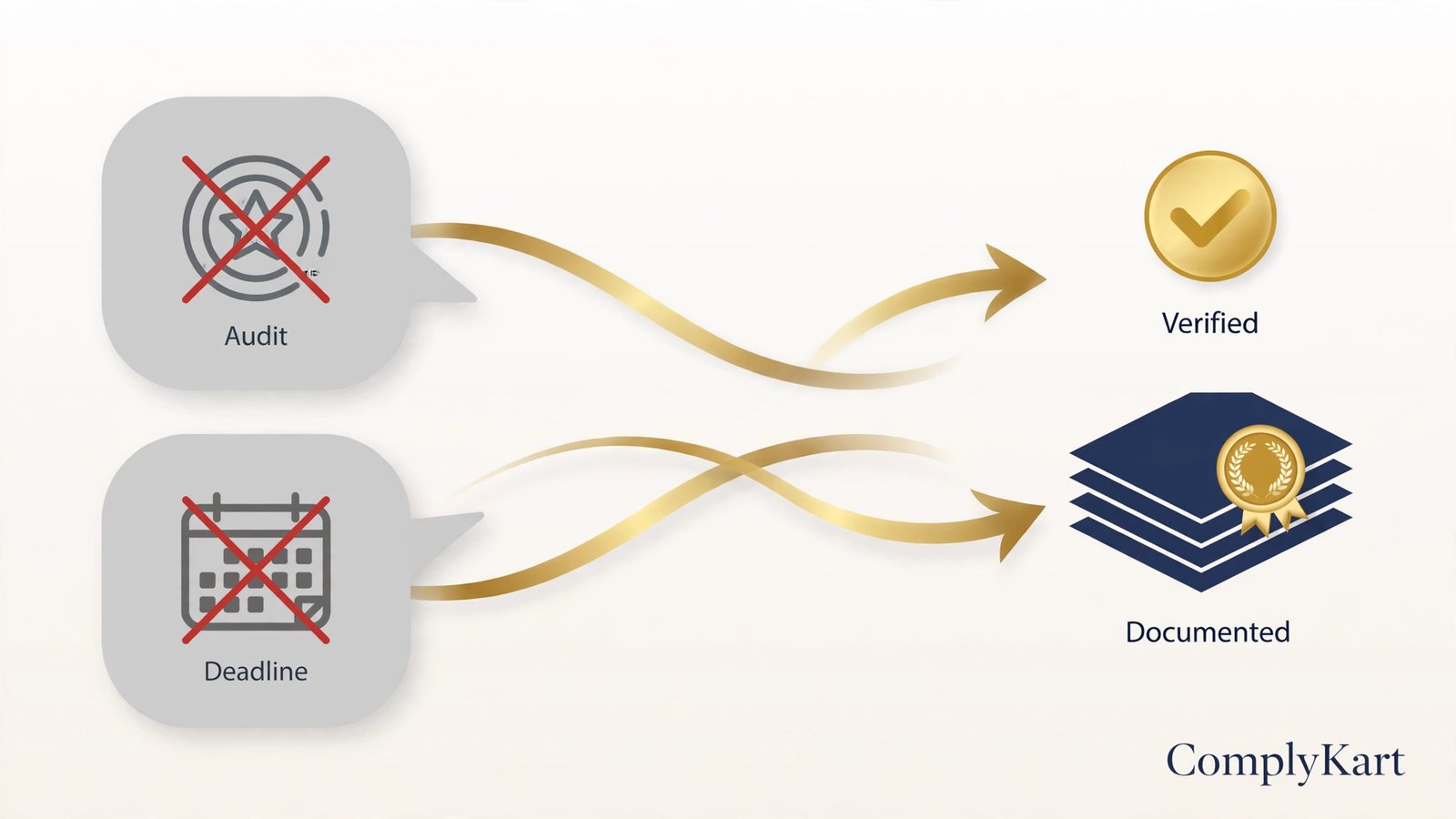
Short answer: a small company — paid-up capital up to ₹4 crore and turnover up to ₹40 crore — files ROC returns every year like everyone else: AOC-4 within 30 days of the AGM, MGT-7A (the simplified form) within 60 days. The reliefs are real — no CARO, no cash flow statement, abridged board report — but none of them cancel the filings.
Small company, small filings? Not quite.
First, the definition, because half the confusion starts here. You're a "small company" under the Companies Act if your paid-up capital is ₹4 crore or less and your turnover is ₹40 crore or less. Both conditions. And not if you're a holding or subsidiary company, a Section 8 company, or governed by a special Act.
The law gives small companies genuine reliefs — shorter forms, shorter reports, fewer disclosures. But over the years, those reliefs have mutated in founders' minds into something much bigger: the belief that small companies barely need to file at all. That belief is expensive. Let's take it apart.
Key takeaways
- A small company means paid-up capital up to ₹4 crore and turnover up to ₹40 crore — holding/subsidiary, Section 8 and special-Act companies are excluded.
- Every company needs a statutory audit; small companies skip CARO reporting and the cash flow statement — not the audit itself.
- OPCs and small companies file MGT-7A (not MGT-7) since FY 2020-21.
- For a 30 September 2026 AGM: AOC-4 by 29 October 2026, MGT-7A by 29 November 2026.
Myth 1: "We're small, so we don't need an audit"
Wrong. This is the costliest myth on this list, so let me be blunt: every company needs a statutory audit. There is no turnover threshold below which the audit disappears. Your two-person company with ₹8 lakh of revenue gets audited, same as everyone else.
What small companies do get: the auditor doesn't have to report under CARO, and there's no cash flow statement to prepare. The audit happens; the paperwork around it is lighter. Anyone telling you "small company, no audit" is confusing the reliefs with the requirement. They are not the same thing.
Myth 2: "We can skip the board's report"
Wrong. You can't skip it, but you can shrink it. The Companies (Accounts) Rules allow small companies an abridged board's report — a shorter format covering the essentials. Some directors read "abridged" as "optional." It isn't. An abridged report filed on time beats a full report nobody asked for, but a missing report beats nothing — it draws a penalty.
Myth 3: "We file MGT-7 like every other company"
Wrong — and this one trips up experienced accountants too. Since FY 2020-21, One Person Companies and small companies file their annual return in MGT-7A, not MGT-7. It's a shorter form: business activity, shareholding, directors, meetings. If your consultant filed MGT-7 for your small company last year out of habit, check — and switch this year.
One-line version: MGT-7A is the shorter ROC annual-return form for OPCs and small companies — business activity, shareholding, directors, meetings.
Myth 4: "The AGM can wait till we're ready"
Wrong, and the meter is already running. The AGM deadline is six months from the financial year end — 30 September for a March year-end — and the filing clocks start ticking from there: AOC-4 within 30 days (29 October 2026), MGT-7A within 60 days (29 November 2026).
"We'll hold it in December when things calm down" is a sentence I've heard before every penalty notice. Late AGMs don't just attract the ₹100-per-day additional fee on each form; they compress everything — audit, board report, filings — into a panicked fortnight. Hold it on time. Calm is a luxury; compliance is a date.
Myth 5: "Zero revenue this year — nothing to file"
The most human myth, and completely wrong. I understand the logic: nothing happened, so there's nothing to report. But annual filings don't report your success. They report your existence — who owns the company, who directs it, what the books say, even if the books say "not much."
A nil P&L still gets audited. A nil year still gets an AOC-4 and an MGT-7A. The ROC doesn't grade your performance; it checks that you're still there and still accountable. File the quiet year exactly like you'd file a loud one.
So which reliefs do small companies actually get?
None of this means small companies get nothing. The reliefs are genuine; they're just narrower than the myths. Your actual concessions: MGT-7A instead of MGT-7. An abridged board's report instead of the full one. No CARO reporting from your auditor. No cash flow statement. Two board meetings a year instead of four.
That's a meaningful lighter load — probably a third less paperwork than a regular private company. The mistake is rounding "a third less" down to "nothing." Take every relief on the list. Just don't invent new ones.
Frequently asked questions
My company had zero revenue. Do we still file?
Yes — and this is Myth 5 wearing a question mark. Filings report existence, not success. A nil P&L still gets audited, still gets an AOC-4 and an MGT-7A. The ROC checks that you're still there and still accountable, not that you performed.
We're a small company — can we skip the audit?
No, and this is the costliest myth of all. Every company gets a statutory audit regardless of turnover. What you skip as a small company: CARO reporting by your auditor and the cash flow statement. The audit happens; the paperwork around it is lighter.
MGT-7 or MGT-7A for a small company?
MGT-7A — since FY 2020-21, OPCs and small companies file the simplified form. If your consultant filed MGT-7 last year out of habit, pull up last year's filing, check the form code, and switch this year. Same deadlines, shorter form, less room for error.
What if we cross ₹40 crore turnover mid-year?
Small-company status is reassessed every year. The year you cross ₹40 crore turnover or ₹4 crore paid-up capital, the reliefs fall away — full board's report, MGT-7, the works. Growing out of it is a good problem; just don't keep filing like a small company afterwards.
Is DIR-3 KYC due this filing season?
No. Director KYC is now a once-in-three-years affair — next due 30 June 2028. It sits outside this season's calendar entirely, so don't let anyone sell you urgency around it. Spend the energy on AOC-4 and MGT-7A instead, where the deadlines bite.
One more thing: small isn't permanent
Here's what nobody mentions at incorporation: small-company status is reassessed every year. The year your turnover crosses ₹40 crore or your paid-up capital crosses ₹4 crore, the reliefs fall away — full board's report, MGT-7, the works. Growing out of it is a good problem to have. Just don't keep filing like a small company after you've stopped being one.
And a calendar note while you're here: DPT-3 was due 30 June, and director KYC is now a once-in-three-years affair — next due 30 June 2028. Neither should surprise you this season.
Five myths, one theme: the law lightened your load, it didn't lift it. File the abridged report, the shorter form, the quiet year — on time. And if you'd rather have someone who does this weekly keep your calendar, ComplyKart's team handles small-company filings start to finish.


Comments
No comments yet — ask the first question below.
Join the discussion
Questions go straight to our expert desk. Comments appear after a quick review — no spam, no noise.