
E-Way Bill Limits in India: Thresholds, State-wise Rules & When You Need One
Your truck is loaded, the driver is ready, and the goods are worth ₹60,000. There is one document standing between that truck and the highway — and if it isn't generated before the wheels turn, the penalty starts at ₹10,000 and the goods can be detained on the spot. That document is the e-way bill, and the rules around it are simpler than most transporters make them sound.
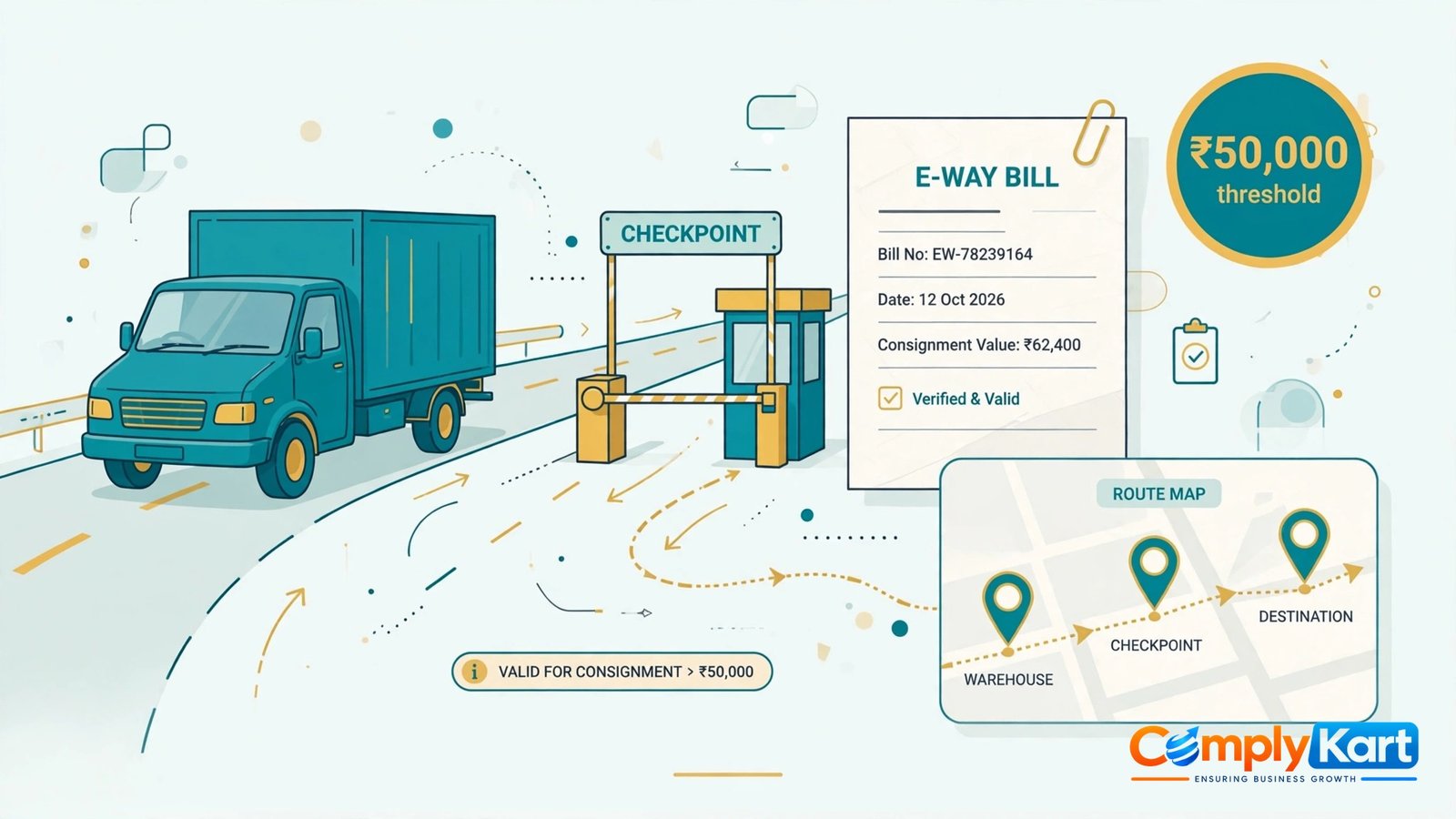
The short answer: You need an e-way bill when the consignment value exceeds ₹50,000 — counted per consignment, not per invoice. It stays valid for one day per 200 km of distance, and moving goods without a valid one risks a penalty of ₹10,000 or the tax sought to be evaded, whichever is higher, plus detention of the goods.
When exactly is an e-way bill required?
An e-way bill is mandatory when the consignment value exceeds ₹50,000. That is the national threshold for inter-state movement, set under Rule 138 of the CGST Rules. The value includes tax but excludes the exempt portion of the supply.
Two things people get wrong about this number. First, it applies per consignment, not per invoice — if one truck carries three invoices of ₹20,000 each to the same destination, the consignment is ₹60,000 and the e-way bill is required. Second, it applies even when there is no "sale": branch transfers, job-work movements and goods sent for exhibitions all count if the value crosses the line. (Moving goods as a registered business starts with GST registration — our cost guide breaks down what that involves.)
When the threshold is different
For movement within a state, the threshold isn't always ₹50,000. States can notify their own limits, and several have set higher ones — some going up to ₹2,00,000 for intra-state movement. Others apply the ₹50,000 limit to specific categories of goods.
This is the single most common source of confusion I see. A business moving goods from Delhi to Gurgaon assumes the inter-state rule applies; a business moving goods within Maharashtra assumes its home-state limit matches its neighbour's. Neither assumption is safe. Before you set your dispatch process, check your state's notification for intra-state thresholds. It takes five minutes and it is the difference between compliance and a detained truck.
How long is an e-way bill valid?
An e-way bill isn't open-ended. For normal cargo, it is valid for one day for every 200 km or part thereof. A 450 km journey gets 3 days. For over-dimensional cargo — the kind that needs special trailers — the rule is stricter: one day per 20 km.
The part that catches people: validity is counted from the time of generation, and if the goods are still in transit when it expires, you need an extension before it lapses. An expired e-way bill is treated the same as no e-way bill. Extensions are capped at 360 days from the original generation date, which sounds generous until a long-haul consignment with multiple halts eats through its validity.
Practical tip: generate the e-way bill as close to dispatch as reasonably possible, not the night before "to be safe." Every hour between generation and actual movement is validity you are spending for nothing.
Think of the e-way bill as a train ticket. The ticket is only good for the journey printed on it, on the date printed on it. Board the wrong train, travel a day late, and the ticket is worthless — you are travelling without one. An e-way bill works exactly the same way. It describes a specific consignment moving a specific distance inside a specific validity window. Let that window lapse mid-journey and, at a checkpoint, you are moving goods with no valid e-way bill.
Who generates the e-way bill — and what are its two parts?
The supplier generates it before movement begins, on the e-way bill portal in Form GST EWB-01. If the supplier is unregistered, the recipient generates it. Transporters can generate it too when neither party does.
The form has two parts, and this is where dispatch desks stumble. Part A carries the transaction details — GSTINs, invoice number and date, value, HSN code, reason for transport. Part B carries the vehicle number or transporter document number. Part A alone doesn't authorise movement. The goods cannot legally move until Part B is filled — which is why the vehicle number must be updated if the truck changes mid-journey.
What happens without one
Moving goods without a valid e-way bill attracts a penalty of ₹10,000 or the tax sought to be evaded, whichever is higher, under Section 122 of the CGST Act. Separately, the goods and the vehicle can be detained or seized under Section 129 — and if the owner comes forward, the penalty can go up to 200% of the tax payable.
Read that again: the penalty isn't just the ₹10,000. On a high-value consignment, "whichever is higher" does the real damage. And detention means your goods sit in a government yard while your customer waits. The e-way bill takes ten minutes to generate. The alternative takes weeks to unwind.
The mistakes that get trucks stopped
One: the 24-hour cancellation window. An e-way bill can be cancelled within 24 hours of generation if it isn't used. After that, it stays on the system. Generating duplicates "just in case" and forgetting to cancel the unused ones creates mismatches that officers love to question.
Two: vehicle number not updated. The truck breaks down, the transporter swaps vehicles, nobody updates Part B. The e-way bill now describes a vehicle that isn't carrying your goods. At a checkpoint, that reads as no valid e-way bill.
Three: invoice and e-way bill don't match. Different values, different HSN codes, different dates — any mismatch between the invoice and the e-way bill gives an officer reason to detain. The two documents should be generated from the same data, not typed separately by different people. Our GST invoice format guide covers the 16 mandatory fields so the source document is right first.
Four: assuming short distance means no e-way bill. Distance is irrelevant to whether you need one. A 5 km movement of ₹60,000 goods needs an e-way bill exactly as much as a 500 km movement does. The threshold is about value, not kilometres.
Five: the 180-day document rule. Since 1 January 2025, e-way bills can only be generated for documents dated within 180 days of generation. Backdating dispatches against old invoices will get rejected by the portal itself.
A dispatch-desk routine that works
The businesses that never have e-way bill trouble all do the same boring thing: one person owns the process, the e-way bill is generated from the invoice data (never retyped), Part B is updated the moment the vehicle is confirmed, and validity is checked against distance before dispatch — not after the truck is stopped.
E-way bill: quick answers
Is an e-way bill required for movement within a state?
Usually yes, but the threshold may differ. Inter-state movement follows the national ₹50,000 limit; intra-state limits are notified by each state and some go as high as ₹2,00,000. Check your state's notification before assuming the national figure applies.
What is the validity of an e-way bill?
One day for every 200 km or part thereof for normal cargo (a 450 km trip gets 3 days), and one day per 20 km for over-dimensional cargo. Validity runs from generation, so generate close to dispatch — and extend before expiry, since an expired e-way bill counts as no e-way bill.
What happens if my e-way bill expires while goods are in transit?
Apply for an extension on the portal before it lapses. If it has already expired, the movement is non-compliant and the goods can be detained under Section 129. Extensions are capped at 360 days from the original generation date.
Can I cancel an e-way bill after generating it?
Yes, within 24 hours of generation — provided it hasn't been verified in transit. After that window it stays on the system, so don't generate spares "just in case" without cancelling the unused ones.
What is the penalty for moving goods without an e-way bill?
₹10,000 or the tax sought to be evaded, whichever is higher, under Section 122 — plus detention or seizure of the goods and vehicle under Section 129. On high-value consignments the "whichever is higher" limb does the real damage. Running a transport or trading setup? Our GST return filing guide keeps the filing side of the business clean.
Ten minutes of discipline at dispatch saves you from the one phone call every business owner dreads: "Sir, the truck has been detained." If your dispatch process still runs on memory and WhatsApp forwards, tightening it up now is cheaper than learning it at a checkpoint. And if you want the year’s compliance costs mapped before they surprise you, run the numbers through our compliance fee calculator. Setting up a clean, documented routine is exactly what our team does for growing businesses every week.


Comments
No comments yet — ask the first question below.
Join the discussion
Questions go straight to our expert desk. Comments appear after a quick review — no spam, no noise.