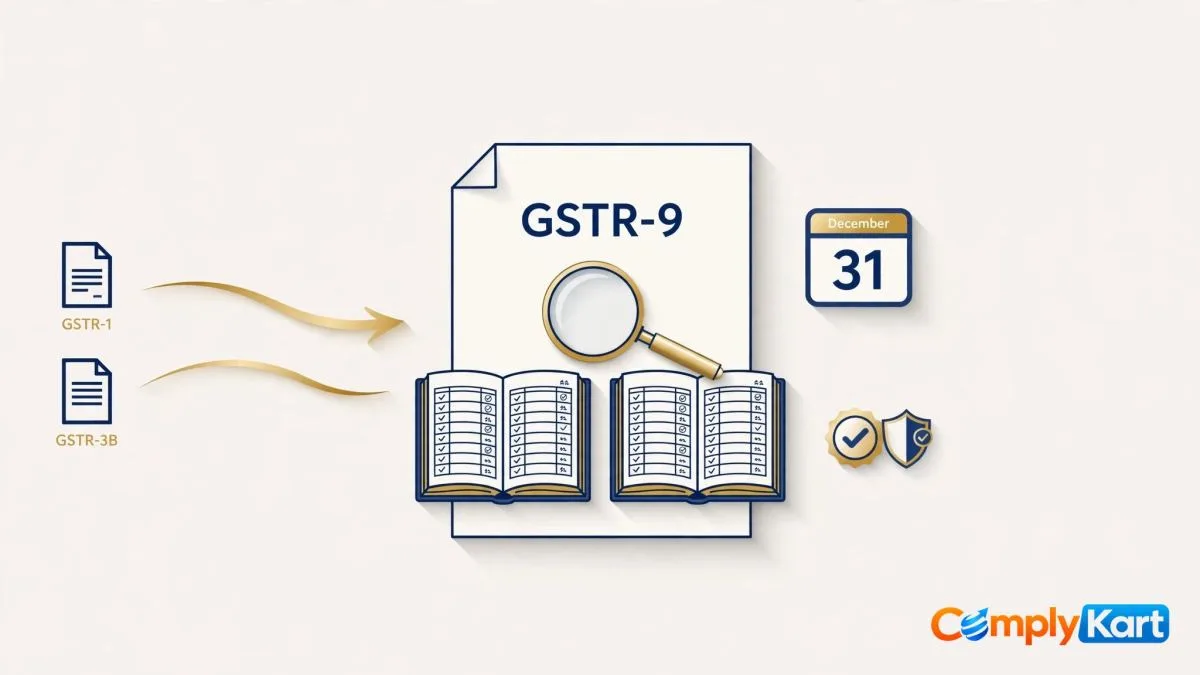
GSTR-9C reconciled to the rupee. Audited numbers, zero department questions.
Above Rs 5 crore turnover, the GST department wants more than your annual return - it wants a full reconciliation between your audited books and that return. We build the GSTR-9C from scratch, reconcile every difference, and file it with your GSTR-9.
CA/CS-guided reviewYour documents and structure are checked before anything is filed.
Written scope firstInclusions and payable charges are explained before work begins.
Support till it’s doneOne team owns your filing, from the first call to the final handover.
Price on request
This work is scoped case by case. You get a fixed written quote before any work starts — no charge for asking.
Five steps, no guesswork — you always know exactly what comes next. Tap a step to see what it involves.
12345
You pay securely. Payment is confirmed instantly, and your receipt with the written fee breakup lands in your inbox.
Overview
If GSTR-9 is the annual return, GSTR-9C is the annual interrogation. The form takes the two most authoritative documents a business produces — its GST annual return and its audited financial statements — and asks, line by line, why they do not match. Turnover per the books versus turnover per GSTR-9. Tax paid per the books versus tax paid per the return. Input tax credit per the books versus credit availed in the return. Every difference has to be stated, quantified and explained.
This is deliberate. Monthly GST returns are prepared by the accounts team; financial statements are audited by an independent professional. The two processes use different data, different cut-offs and different judgements. GSTR-9C forces them into the same room. For the tax department, it is the single most information-dense document in the GST system — which is why officers reach for it first in any serious scrutiny.
The compliance burden is real, and the history matters: before 1 August 2021, GSTR-9C required a full audit of accounts and certification by a chartered or cost accountant. That regime is gone. The statement is now self-certified — but "self-certified" does not mean casual. The reconciliation still has to be done, the differences still have to be explained, and the authorised signatory still puts their name to it.
Is GSTR-9C for You?
You must file GSTR-9C for a financial year if:
You are a registered regular taxpayer required to file GSTR-9, and
Your aggregate turnover in that financial year exceeds ₹5 crore.
You should check carefully before concluding you are outside:
The turnover test is the same PAN-based aggregate-turnover test as GSTR-9 — all GSTINs under the PAN count together, and exempt and export turnover is included.
"Exceeding ₹5 crore" means strictly above — turnover of exactly ₹5 crore does not trigger the mandate.
The filing is per GSTIN: once the PAN-level test is crossed, each GSTIN's reconciliation is prepared and filed separately, after its own GSTR-9.
You do not file GSTR-9C when:
Your aggregate turnover is ₹5 crore or below — even if you filed GSTR-9 voluntarily.
You are a composition taxpayer, ISD, TDS/TCS deductor, casual or non-resident taxable person — the form does not apply to these categories.
The ₹5 Crore Threshold and the Self-Certification Story — the Sections That Define This Form
Two facts define GSTR-9C, and both changed within living memory. The first is the threshold: aggregate turnover *exceeding* ₹5 crore in the financial year. The legal basis is Notification 30/2021-Central Tax read with Rule 80(3) of the CGST Rules. The turnover definition is Section 2(6) — the same PAN-aggregated, tax-exclusive figure used for GSTR-9, including exempt supplies and exports. A business with ₹4.5 crore of taxable turnover and ₹1 crore of exempt turnover crosses the line at ₹5.5 crore, even though its taxable turnover alone would not.
The second is the certification history, and this is where outdated advice still circulates. Before 1 August 2021, Section 44 required taxpayers above the then-threshold to get their accounts audited and furnish GSTR-9C *duly certified* by a chartered accountant or cost accountant. The Finance Act, 2021 removed the audit requirement, and from 1 August 2021 Rule 80(3) requires a *self-certified* reconciliation statement. The form still contains a Part V titled "auditor's recommendation" — a legacy label — but the certification is the taxpayer's own, signed by the authorised signatory.
What self-certification did *not* remove is the underlying work. The reconciliation still demands audited financial statements as the starting point, still requires every material difference to be explained, and still produces a document the department treats as an admission. Businesses that read "self-certified" as "simplified" learn otherwise in scrutiny. The practical effect of the 2021 change is that you no longer pay a CA to sign the form — but you still need CA-grade workings to fill it.
What Must Be Decided Before Filing
People: The authorised signatory who will self-certify; the accountant who prepared the GSTR-9; and whoever finalised the audited financial statements — the reconciliation lives or dies on these two people agreeing on what the numbers mean.
Decisions: The materiality threshold for investigation — the form gives a 5% tolerance for unexplained variances, but you still decide which differences get full workings. The treatment of contentious items: credit notes issued after year-end, debit notes received late, advances, and branch transfers all need a consistent position.
Documents: The filed GSTR-9 with ARN; the audited financial statements (balance sheet, profit and loss, schedules and notes); the trial balance mapped to GST-relevant heads; the GSTR-9 working papers; and the month-wise GSTR-1, GSTR-3B and GSTR-2B for reference when differences need tracing.
Why GSTR-9C Matters — Six Things the Reconciliation Actually Does
1. It is the department's primary scrutiny document
Ask any GST officer what they open first in a detailed scrutiny and the answer is consistent: GSTR-9, GSTR-9C and the financial statements, side by side. Unreconciled differences stated in your own hand are the shortest path to a notice.
2. It disciplines the books-to-returns gap every year
Most businesses run their GST compliance and their financial accounting as parallel processes that meet only at year-end. GSTR-9C is the annual meeting — and the differences it exposes (unbooked purchases, sales recognised differently, advances treated inconsistently) improve both processes the following year.
3. It quantifies the real ITC position
Part IV reconciles input tax credit per the audited books with credit availed in GSTR-9. Credits sitting in the books but never claimed, credits claimed but not in the books, reversals missed — the reconciliation produces the one true credit number.
4. It forces a position on every grey area
Credit notes, discounts, free samples, branch transfers, goods sent on approval, job-work challans — each has to be classified consistently between the books and the return, and the classification has to be defensible. GSTR-9C does not allow "we'll decide later."
5. It creates the additional-liability record
Part V requires the auditor's recommendation on additional liability arising from non-reconciliation. Amounts admitted here are typically paid via DRC-03 — voluntarily disclosing and paying at this stage is far cheaper than having the same amount discovered in audit.
6. It protects the honest filer
A clean reconciliation with documented reasons for minor differences is the strongest possible defence in scrutiny. It shows the department that the business knows its numbers, investigated the gaps, and has nothing to hide.
Documents Required
The two anchors: The filed GSTR-9 (with ARN) for the GSTIN and the audited annual financial statements for the financial year — balance sheet, profit and loss account, and all schedules and notes.
The bridge workings: Trial balance with GST-relevant ledger mapping; the GSTR-9 preparation workings; month-wise GSTR-1, GSTR-3B and GSTR-2B; sales and purchase registers; debit and credit note registers.
The difference file: For every unreconciled amount — the invoice-level or ledger-level workings, correspondence with vendors or customers where relevant, and the written reason that will go into Tables 6, 8, 10 or 13.
Access: GST portal login; DSC or EVC of the authorised signatory for the self-certification and submission.
GSTR-9C Process — Step by Step
Step 1 — File GSTR-9 first
The portal does not allow GSTR-9C filing until GSTR-9 for the GSTIN is filed. The reconciliation starts from the GSTR-9 figures, so a clean, final GSTR-9 is the prerequisite — errors in GSTR-9 compound in 9C.
Step 2 — Initiate filing on the portal
On the GST portal, open the GSTR-9C tile and choose Initiate Filing (or Prepare Offline with the utility). The form's five parts open with basic details pre-filled.
Step 3 — Reconcile turnover (Part II)
Start from turnover per the audited financial statements (Table 5) and apply the adjustment tables (5A–5O) — unbilled revenue, unadjusted advances, credit notes, and other standard book-to-return adjustments — to arrive at the turnover declared in GSTR-9. State reasons for any unreconciled turnover in Table 6, and explain tax-rate-wise differences in Tables 7–11.
Step 4 — Reconcile tax paid (Part III)
Table 9 compares tax payable per the books with tax paid as declared in GSTR-9. Table 10 carries the reasons for any unreconciled payment of tax. Differences here usually trace to interest, late fees, or DRC-03 payments not routed through the return.
Step 5 — Reconcile input tax credit (Part IV)
Table 12 states ITC per the audited financial statements; Table 12B states ITC availed as per GSTR-9; Table 12C is the unreconciled difference. Table 13 carries the reasons. Work through Rule 37/37A reversals, missed credits and booking differences invoice by invoice for material amounts.
Step 6 — Complete the auditor's recommendation (Part V)
Table 14 records the recommendation on additional liability arising from non-reconciliation. Where the reconciliation admits tax payable, arrange the DRC-03 payment — from FY 2024-25 this can use input tax credit.
Step 7 — Self-certify and submit
The authorised signatory reviews the complete statement, certifies it as true and correct, and submits with DSC or EVC. Download the ARN and archive the full working file — this is the document scrutiny will ask for first.
The Part-Wise Walkthrough — All Five Parts, in Plain Words
Part I — Basic details (Tables 1–4). GSTIN, legal name, financial year and the filing period. Pre-filled from the portal; verify against the registration certificate.
Part II — Reconciliation of turnover (Tables 5–11). The largest part. Table 5 starts with turnover as per the audited financial statements; Tables 5A–5O apply the standard adjustments (unbilled revenue at year-end, unadjusted advances, credit notes issued, and similar book-to-return bridges) to reach the turnover declared in the annual return. Table 6 states reasons for any unreconciled turnover. Tables 7–11 break down reasons for differences in taxable turnover across tax rates. Tables 5, 7 and 9 are among the four mandatory tables — they are filled even where everything reconciles.
Part III — Reconciliation of tax paid (Tables 9–10). Table 9 (mandatory) compares the tax payable as per the books with the tax paid as declared in GSTR-9, rate-wise and tax-head-wise. Table 10 is filled only where an unreconciled payment difference exists, with the reasons stated.
Part IV — Reconciliation of input tax credit (Tables 12–13). Table 12 (mandatory) has three legs: 12A is ITC as per the audited financial statements, 12B is ITC availed as per GSTR-9, and 12C is the unreconciled difference between them. Table 13 carries the reasons for the difference — missed availment, ineligible credits booked, reversals not passed in the books, and timing differences are the usual entries.
Part V — Auditor's recommendation (Table 14). The additional liability, if any, arising from the non-reconciliation — stated as a recommendation with the amount. In practice this is the voluntary-disclosure line: amounts admitted here and paid via DRC-03 close the matter far more cheaply than an audit finding later.
The 5% tolerance: the form's instructions allow variances within 5% to be left without detailed reasons. This is a practical relaxation, not a right to ignore differences — material items should still be investigated, and the tolerance does not protect against a departmental view that the difference reflects suppressed turnover.
How Long Does It Take?
Stage
Typical time
GSTR-9 finalisation (prerequisite)
2–6 weeks
Financial statements finalisation
Per audit cycle
Turnover reconciliation (Part II)
1–2 weeks
Tax-paid reconciliation (Part III)
3–5 days
ITC reconciliation (Part IV)
1–2 weeks
Recommendation, certification and filing
3–5 days
GSTR-9C cannot start in earnest until both GSTR-9 and the audited financials are final. Businesses whose audit closes in September face a genuine time crunch against the 31 December deadline — which is why the reconciliation workings should be built in parallel with the audit, not after it.
Fees and Packages
Indicative professional fees for GSTR-9C preparation and filing (practice estimates, against current market):
Starter
Growth
Scale
Best for
Single GSTIN, turnover ₹5–10 cr
2–3 GSTINs or turnover ₹10–50 cr
Multi-state, turnover above ₹50 cr
Indicative fee
₹19,999
₹34,999
₹59,999
Inclusions
Part-wise reconciliation, difference workings, self-certification filing and ARN
Everything in Starter, plus invoice-level ITC tracing, variance report with reasons, DRC-03 computation where admitted
Everything in Growth, plus multi-GSTIN consolidation, audit-coordination, scrutiny-ready working papers
The fee tracks the number and size of unreconciled differences more than turnover alone — a clean set of books reconciles fast at any turnover.
How ComplyKart Helps
Consulting: We confirm the ₹5 crore test across your GSTINs, plan the reconciliation alongside your statutory audit so the December deadline is met, and set the materiality framework before the workings begin.
Documentation: We build the book-to-return bridge workings for all five parts — turnover, tax paid and ITC — with invoice-level tracing for material differences and written reasons for every unreconciled amount.
Filing: We prepare the statement on the portal, walk the authorised signatory through each part before self-certification, and file with DSC/EVC with the ARN archived.
Follow-up: Where the reconciliation admits additional liability, we compute and process the DRC-03 payment; where it exposes process gaps, we advise on the monthly disciplines that shrink next year's differences.
What we do not do: We do not conduct the statutory audit of your financial statements — GSTR-9C starts from audited accounts prepared by your auditor. We do not sign the self-certification on your behalf; the authorised signatory certifies. And we do not suppress or smooth differences to make the reconciliation look clean — the statement must reflect the books as they are.
What Happens After Filing
Within 30 days: The ARN is filed with the financial-year records alongside GSTR-9. Any DRC-03 payments admitted in Part V are processed and the challans archived.
Within 6 months: The difference file becomes next year's prevention plan — vendor-master cleanup, monthly 2B discipline, advance-adjustment hygiene, and credit-note cut-off procedures. The businesses with the shortest GSTR-9C each year are the ones that fixed last year's differences instead of just explaining them.
Recurring Compliance
GSTR-9C is annual — one statement per GSTIN per financial year, every 31 December, for every year the ₹5 crore test is crossed. It moves in lockstep with GSTR-9 and the statutory audit cycle. A standing calendar that aligns audit closure (September), GSTR-9 (October–November) and GSTR-9C (November–December) is the difference between a controlled filing and a December scramble.
GSTR-9C vs GSTR-9 — the Comparison That Matters
GSTR-9
GSTR-9C
Legal basis
Sec 44(1), Rule 80
Sec 44 read with Rule 80(3)
Threshold
Aggregate turnover > ₹2 cr
Aggregate turnover > ₹5 cr
Nature
Annual return (19 tables)
Reconciliation statement (5 parts)
Compares
Monthly filings vs books
GSTR-9 vs audited financials
Certification
Self-prepared, self-submitted
Self-certified (since 01.08.2021)
Filing order
First
Only after GSTR-9
Deadline
31 December
31 December (same)
Late fee
Sec 47(2), tiered
No separate fee — combined with GSTR-9 per Circular 246/03/2025
Common Mistakes
Starting GSTR-9C before the audited financials are final, then redoing the whole reconciliation.
Treating "self-certified" as "light-touch" and filing with unexplained differences.
Using unaudited or provisional financials as the anchor — the form requires the audited statements.
Filling only the mandatory tables and leaving genuine differences unstated in Tables 6, 8, 10 and 13.
Reconciling to the trial balance instead of the audited financials — audit adjustments change the numbers.
Missing that the turnover test aggregates at PAN level, including exempt and export turnover.
Filing GSTR-9 on time and forgetting that GSTR-9C shares the same 31 December deadline.
Not keeping the invoice-level workings — and facing scrutiny with only the summary tables to defend.
Penalties
CBIC Circular 246/03/2025 settled the most argued question in this area: there is no separate late fee for GSTR-9C alone. The "annual return" under Section 44 comprises GSTR-9 *plus* GSTR-9C wherever the latter is required — so if GSTR-9 is filed on time but 9C comes late, the Section 47(2) late fee runs from the due date until *both* are furnished. The tiered late-fee structure (₹50/₹100/₹200 per day by turnover slab, subject to caps) applies to the combined delay. Interest at 18% per annum applies to any unpaid tax liability admitted or discovered.
FAQ
Frequently asked questions
23 answers from our consultants.
You pay for our expert's time — document checking, filing, follow-ups — not the government. The government fee goes to the government; our fee is for the work we do so you don't have to figure it out yourself.
If your annual turnover crosses ₹40 lakh (₹20 lakh for services, lower in some states), yes — it's mandatory. But many businesses register voluntarily below the threshold to claim input tax credit and deal with larger clients who insist on GST invoices.
With clean documents, the GSTIN usually comes through in 3-5 working days. Delays happen when the officer raises a query — typically about the address proof or business activity. We respond to queries the same day so nothing stalls.
31 December 2025 — the same statutory deadline as GSTR-9, since the two together constitute the annual return under Section 44.
No. The portal requires GSTR-9 to be filed first, because the reconciliation in 9C is drawn against the GSTR-9 figures.
Variances within 5% between the reconciled figures need not be accompanied by detailed reasons. It is a practical relaxation in the form's instructions — material differences should still be investigated and documented.
Tables 5, 7, 9 and 12 must always be filled. Tables 6, 8, 10 and 13 are filled only where there are unreconciled amounts to explain.
Yes. CBIC Circular 246/03/2025 clarifies that the annual return is not "furnished" until both forms are filed where 9C is required — the Section 47(2) late fee runs from the due date until the complete filing.
The audited annual financial statements — balance sheet, profit and loss account and schedules. The reconciliation bridges these with the GSTR-9 figures.
No. Since 1 August 2021 there is no separate GST audit requirement for 9C; the form reconciles against the financial statements as audited under the applicable law (Companies Act, Income-tax Act, etc.).
The auditor's recommendation on additional liability arising from non-reconciliation — in practice, the voluntary-disclosure line where admitted tax is quantified for payment via DRC-03.
The mandate applies where turnover *exceeds* ₹5 crore. At exactly ₹5 crore, GSTR-9C is not required.
Per PAN. Aggregate turnover under Section 2(6) adds up all GSTINs under the same PAN, including exempt supplies and exports, excluding GST taxes.
No. Like GSTR-9, there is no revision mechanism. Review the complete statement before the authorised signatory certifies it.
Unbilled revenue and unadjusted advances in turnover; interest and DRC-03 payments in tax paid; and in ITC — credits in the books never claimed in returns, Rule 37/37A reversals not passed in books, and timing differences on year-end invoices.
They are stated in Table 12C with reasons in Table 13. Where the difference represents tax actually payable, it is admitted in Part V and paid via DRC-03.
The statutory auditor finalises the financial statements; the GST consultant builds the reconciliation against GSTR-9. The two must agree on the treatment of audit adjustments — coordinate them in September, not December.
Yes. The portal offers Prepare Offline alongside Initiate Filing — the offline utility suits large datasets and multi-GSTIN consolidations.
No — the obligation and the reconciliation are annual. But last year's difference file is your best starting point: recurring differences usually have recurring causes, and fixing the cause beats explaining it again.
Registered regular taxpayers whose aggregate turnover in the financial year exceeds ₹5 crore. It is filed per GSTIN, alongside and after GSTR-9.
No — not since 1 August 2021. The Finance Act, 2021 removed the audit-and-certification regime; Rule 80(3) now requires a self-certified statement signed by the authorised signatory.
The test is at PAN level: if aggregate turnover exceeds ₹5 crore, GSTR-9C is filed per GSTIN — each registration's reconciliation is prepared and filed separately.
GSTR-9C reconciles against *audited* financial statements. Businesses below the audit thresholds under other laws should confirm the applicable position with their consultant before filing.
What clients say about working with us
Real stories from businesses we've worked with.
Trademark Registration“
Our Trademark was applied in all the classes with a short span of time by Complykart Trademark Experts and I can say the level of expertise and commitment they carry is remarkable. It's an A+ from my side. We are now sticking to ComplyKart only.
Company Registration“
I found the professionalism of the staff at complykart.com, a pleasure to work with. As a foreigner to India, they took the time to explain the documentation and assisted in every question I raised. I was pleased that complykart.com made it easy for my Business.
Merger & Acquisition“
Trust, Commitment, Dedication and responsiveness are the best things with ComplyKart. Thanks for handling our Merger assignment with so much care. After my business disputes, complykart handles all things with own sense of understanding.
GST Practice Lead · Goods and Services Tax · 11+ years experience
Abhishek Sharma leads ComplyKart’s GST practice. He handles GST registrations, monthly filings, input tax credit reconciliation, refunds and department notices for businesses across India. He has guided hundreds of companies through GST audits and assessments.
Last reviewed: 16 November 2026
Get a free consultation
Talk to a ComplyKart professional about GSTR-9C Filing. The first consultation is free.