
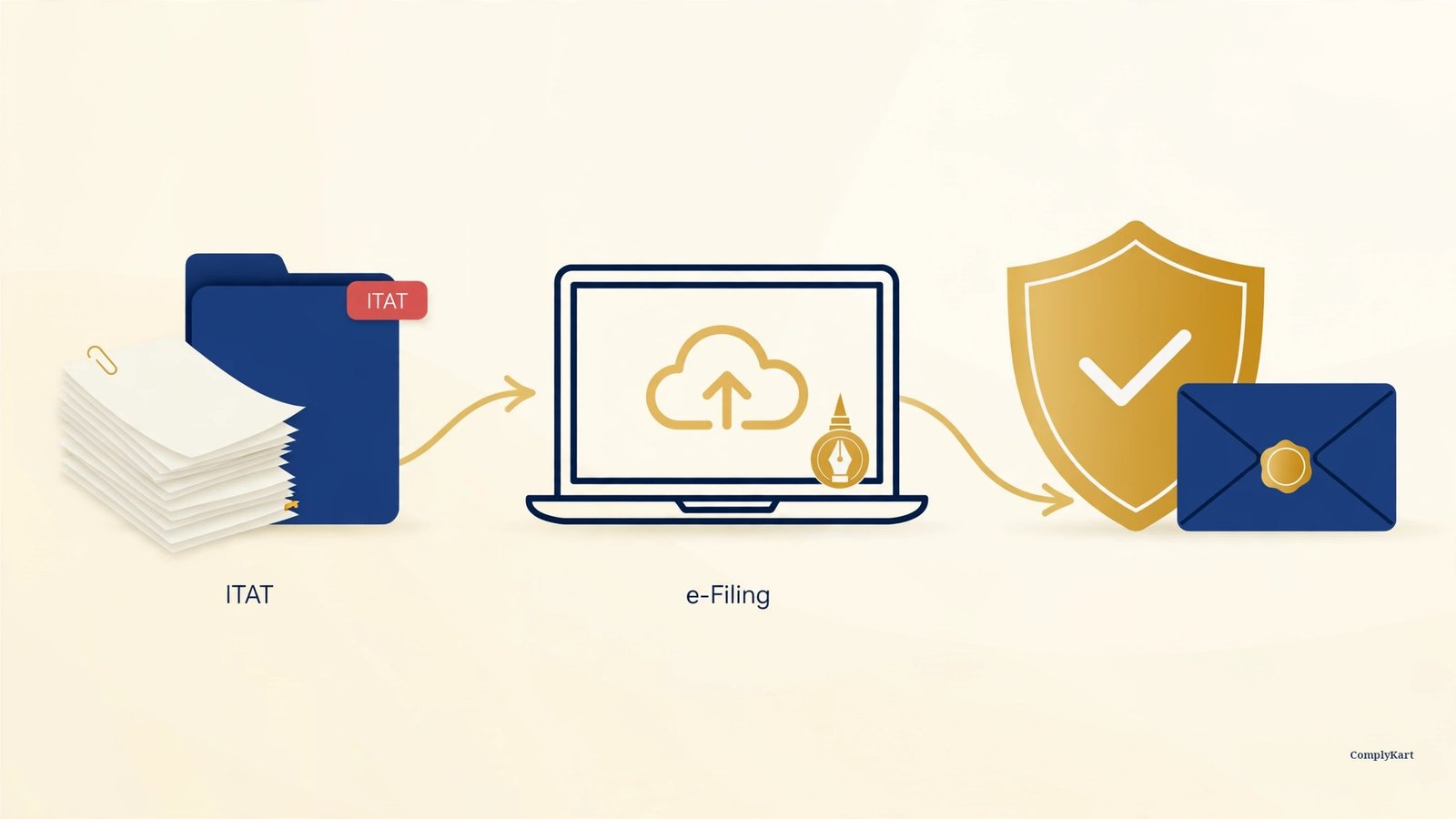
Your assessing officer passed an order you disagree with. You have sixty days to knock on the Income Tax Appellate Tribunal’s door. Until recently, that knock was a physical file carried to the ITAT Registry — the memorandum of appeal, the grounds, the paper book, all of it on paper.
That door has gone digital. And it is not a polite suggestion.
On 30 September 2026, the Income Tax Appellate Tribunal uploaded a Practice Note (F.31-AT/Gen. Adm./Central/Delhi/2025-26) prescribing how appeals must be filed from here on. Effective 1 October 2026, every memorandum of appeal must be presented electronically through the designated ITAT e-Filing Portal. Miss the portal, miss the prescribed form, or miss the signature requirements — and the Registry will not register your appeal at all. No registration means no appeal number. No appeal number means your challenge does not exist.
What exactly changed
Nothing about your right to appeal changed. The route to the Tribunal changed.
The Practice Note was issued under Section 255(5) of the Income-tax Act, 1961, read with Rule 6 of the Income Tax (Appellate Tribunal) Rules, 1963 — the rule that was amended in 2025 to require appeals to be filed under a digital signature. So the signature requirement is not a surprise bolted on last month; the legal foundation was laid last year. What the September Practice Note does is operational: from 1 October, the e-Filing Portal is the only counter that is open.
Think of it the way a railway station works now. Your old paper ticket was a document you carried. The e-ticket is a record that lives on the server, and your travel only begins when the system recognises it. ITAT appeals work the same way now: your appeal only begins when the portal’s record is complete and verified. A neatly printed file sitting on your desk is just paper.
What counts as “filed” under the new rule
This is the part that matters most, so read it slowly.
Under the Practice Note, the date of upload of the duly signed and verified memorandum of appeal is treated as the date of presentation. Three adjectives, and all three have to be true: filed through the portal, in the prescribed form, signed and verified in the prescribed manner. If any one of them fails, the appeal is not registered.
So your limitation clock is protected by the upload timestamp — but only if the upload is a complete, verified one. An appeal uploaded without the digital signature, or uploaded in the wrong format, is not “filed early with a minor defect.” It is not filed at all. The Registry will not assign it a number, and the limitation period will keep running against you while you fix it.
This is the single biggest behaviour change. Earlier, a physical appeal reached across the Registry counter was date-stamped and the defects were pointed out later. Now the defect screen comes first.
What you need ready before you log in
The Practice Note makes three identifiers the keys to the portal: the assessee’s PAN or TAN, the appellant’s mobile number, and the appellant’s email ID. Where a PAN or TAN is available, these particulars are mandatory for using the portal. You will also be asked for the respondent’s email ID and mobile number wherever available — the department’s side of the file.
Then comes the digital signature. Every memorandum of appeal and every accompanying document that requires the appellant’s signature must be digitally signed and verified before upload. The 2025 amendment to Rule 6 defines digital signature by reference to Section 3 of the Information Technology Act, 2000. In plain terms: you need a working DSC for the person filing the appeal — the appellant or their authorised agent. If your DSC has expired, or the authorised signatory changed and nobody updated it, sort that out before the sixty days start running out. Not during.
Paper books, cross objections, stay applications — same door
The electronic procedure is not limited to the memorandum of appeal. Paper books, documents, and petitions relating to appeals filed electronically must also be furnished only through the e-Filing Portal. Cross objections under Section 253(4), stay applications, and miscellaneous applications follow the same digital route.
One transition rule protects the older cases: paper books and documents relating to appeals that were filed physically before 1 October 2026 continue to be furnished physically. So if your appeal was already registered in the paper world, you finish it in the paper world. Everything new from October goes through the portal.
After preliminary scrutiny, the Registry registers the appeal and emails a Registration Summary within two working days. Watch your inbox — and your spam folder. That email is your proof of registration.
A practical checklist before you hit upload
- Confirm the appeal deadline from the date the order was communicated. The sixty-day clock does not pause while you set up portal access.
- Get the assessee’s PAN/TAN, the appellant’s mobile number, and a working email ID — all three verified.
- Ensure the DSC of the appellant or authorised agent is valid and loaded.
- Prepare the memorandum in the prescribed form — concise grounds, numbered, in English, as the Rules require.
- Digitally sign and verify every document that needs the appellant’s signature before uploading.
- Upload, then confirm the upload date — that is your date of presentation.
- Keep the Registration Summary email safe once it arrives (within two working days).
- If the portal throws errors, write to the ITAT Registry e-Filing Helpdesk named in the Practice Note — and keep a copy of that email. It may matter if limitation is ever questioned.
Two traps practitioners are already whispering about
The first trap is the last-day upload. Under the old system, a courier reaching the Registry on the sixtieth day counted. Under the new system, the upload must be complete, signed, and verified — and servers have bad days. Filing on the sixtieth evening through a portal you opened that morning is how deadlines die. Aim for a week before. Really.
The second trap is assuming the department’s email address is optional forever. The Note asks for the respondent’s email ID and mobile “wherever available.” Practitioners who deal with the department regularly have these on file. If you don’t, leave the field as the portal allows — but don’t invent them. A wrong official email on record can bounce a notice back into your own file.
The honest bottom line
This change is good news wearing an unfamiliar face. Once you are in, tracking your appeal, filing paper books, moving stay applications — all of it becomes searchable, timestamped, and paperless. The Registry’s two-working-day registration summary is faster than the old physical acknowledgement dance.
But the transition period is exactly when good appeals get lost to bad logistics. The rule is simple now: no portal filing, no signature, no verification — no appeal. Get the three identifiers and the DSC ready on day one, not day fifty-nine. Your right to challenge the order is intact. Just make sure the knock lands on the right door.



Comments
No comments yet — ask the first question below.
Join the discussion
Questions go straight to our expert desk. Comments appear after a quick review — no spam, no noise.