
IN BRIEF
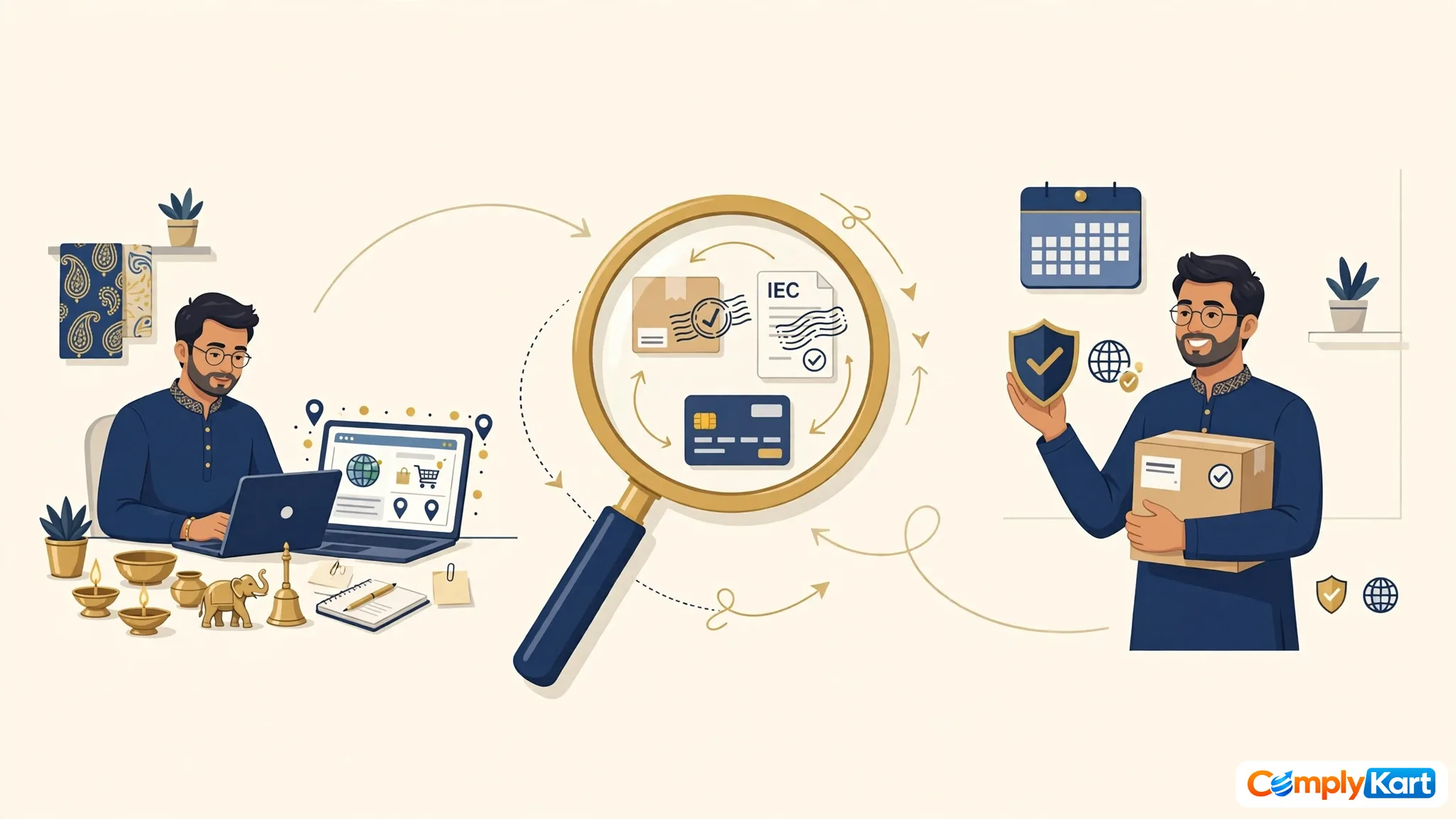
An Importer Exporter Code (IEC) is a 10-digit registration issued by the Directorate General of Foreign Trade (DGFT) against a business's PAN, and it is the basic permission an Indian seller needs to export goods commercially through Amazon Global Selling, Etsy, eBay or an own website. Without an active IEC, customs cannot clear an export parcel and banks cannot receive the export payment.
You can list products on Amazon Global Selling or Etsy tonight and still not be ready to ship a single order. The listing is the easy part. The hard part is the paperwork that sits between your shelf and a buyer in Ohio — and most of it is decided before the parcel leaves your pin code.
If you sell physical goods from India to buyers abroad, you need an Importer Exporter Code (IEC) from the Directorate General of Foreign Trade (DGFT), a bank AD code registered with customs, and a GST route for zero-rated exports. The IEC costs ₹500, takes a few working days, and lasts for life.
An IEC works like a driving licence for exports. Customs checks it at every border your parcel crosses, your bank needs it before it can accept foreign payments, and your courier needs it on the shipping bill. No licence, no legal road. Everything in this guide follows from that one fact.
Do Amazon, Etsy and eBay sellers actually need an IEC?
Yes — for commercial exports. The marketplaces differ only in when they ask for it.
| Marketplace | Does it ask for an IEC? | How you usually fulfil | How you get paid |
|---|---|---|---|
| Amazon Global Selling | Yes — Amazon lists the IEC as a core export document at onboarding | Amazon fulfilment or self-ship | Paid to your Indian bank account |
| Etsy | Not at shop opening — but customs and your courier need it for the first commercial parcel | You ship each order directly, usually by courier or India Post | Through Etsy's payment partner to your bank account, with currency conversion |
| eBay, Shopify, own website | Not at listing — needed the moment a parcel goes through customs | You ship directly, or through a shipping aggregator | Through PayPal, a payment gateway or your bank |
Notice the pattern. Etsy never asks for your IEC while you set up the shop. That fools a lot of new sellers into thinking they don't need one. Then the first order arrives, the courier asks for the IEC and AD code details, and the parcel sits on your desk while you scramble for a DGFT login. Get the registrations done before the first sale, not after it.
Two things the IEC is not. It is not a substitute for GST registration, product certification or your bank's requirements — it sits alongside them. And selling only inside India needs no IEC at all. If every buyer is on Amazon.in, skip this guide entirely.
The four registrations that decide whether your parcel leaves India
Four systems have to agree about every parcel you send: customs, GST, your bank, and the marketplace. Each one has its own registration, and a gap in any of them stops the parcel or the payment.
1. IEC — the export permission. A 10-digit code issued by DGFT against your PAN. One PAN, one IEC — you cannot hold two. Proprietors apply in their own name and PAN; companies and LLPs apply in the entity's name with an authorised signatory. The government fee is ₹500, paid once online. The IEC is valid for life, but every holder must confirm or update the details online between April and June each year, even when nothing changed. The update itself is free. Miss it and DGFT can deactivate the IEC, which means your next parcel does not clear until you file a modification request to reactivate it. Put April in your calendar the day the IEC arrives.
2. AD code — the bank's stamp. Your bank gives you a 14-digit Authorised Dealer code. That code then has to be registered with customs at every port or airport your parcels leave from, through the ICEGATE portal. The registration is port-specific: shipping from both Mumbai and Delhi means registering at both. Without a registered AD code, customs cannot generate a shipping bill in your name, and your bank cannot match the incoming payment to an export. Ask your bank for the AD code letter the day you open the current account — it is the document sellers most often discover late.
3. GST registration and LUT — the tax route. DGFT does not make GST registration a condition for issuing an IEC. Amazon does list it among its onboarding requirements, and you need a GSTIN for the Letter of Undertaking (LUT) that lets you export without paying IGST. File the LUT on the GST portal once every financial year — it is free. Without it, you pay IGST on every export invoice first and claim the refund later, which ties up your cash for weeks. With it, you export at the zero rate and claim a refund of the input tax credit instead. GST registration is therefore the second form to file, not an optional extra.
4. Export council membership (RCMC) — usually not needed for small parcels any more. Until recently, many small sellers were told they needed membership of an export promotion council before they could ship. Since 15 September 2026, DGFT Notification 36/2026-27 says no RCMC is needed for a consignment whose FOB value is up to ₹3 lakh. Most marketplace orders sit far below that line. Above it, the council relevant to your product applies — and if you sell food or agri products, read our guide on whether APEDA registration also applies to your product before you pick a council.
One more check before you file anything: the legal name on your PAN, GSTIN, bank account and IEC must match character for character. A mismatch is the single most common reason IEC applications get rejected — we wrote a full guide on why IEC applications get rejected over a PAN name mismatch because it happens that often.
How to get your IEC in six steps
The whole process is online on the DGFT portal. Keep your PAN, Aadhaar, a cancelled cheque or bank certificate, address proof and your entity document (incorporation certificate or partnership deed) scanned before you start.
Step 1 — Register on the DGFT portal. Create an account with your email ID and mobile number. The IEC module sits under Services, then IEC Profile Management.
Step 2 — Enter your PAN. The portal verifies your PAN against the income-tax database, pulls your name and date of birth or incorporation, and asks you to verify your mobile and email with OTPs.
Step 3 — Fill in the business details. Nature of concern, business address, branch details if any, and your bank account details. This is where a wrong PIN code or a bank branch mismatch creates a rejection — copy from the documents, don't type from memory.
Step 4 — Upload documents. PAN, Aadhaar, bank proof and address proof as PDFs. Companies and LLPs also upload the incorporation certificate and the authorised signatory's ID proof.
Step 5 — Sign it. A company or LLP needs a Class 3 Digital Signature Certificate; a proprietor can use Aadhaar-based e-sign. If you don't have a DSC yet, Aadhaar e-sign is the faster route for a first-time applicant.
Step 6 — Pay ₹500 and submit. The fee is paid online. A clean application is usually generated within one to three working days; Amazon's own guide suggests planning for ten to fifteen days, so apply at least a fortnight before you need to ship. The IEC certificate downloads from the portal — save it with your business documents and send a copy to your bank the same day, because the bank needs it for the AD code letter. If you would rather have the filing handled for you, our IEC registration service covers the application end to end.
What changed in 2026 — three rules that help small sellers
Three changes this year made life materially easier for marketplace exporters. The competitor guides written before them are now out of date, so check the date on anything you read.
The courier value cap is gone. Until 31 March 2026, a commercial export consignment sent by courier could not exceed ₹10 lakh. DGFT Notification 67/2025-26 and CBIC Circular 17/2026-Customs removed that cap from 1 April 2026. A high-value order no longer has to move to cargo because of an arbitrary ceiling.
Small consignments need no export council membership. As above, DGFT Notification 36/2026-27 (15 September 2026) removed the RCMC requirement for consignments up to ₹3 lakh FOB. For a seller shipping ₹5,000 orders, that is one membership fee and one renewal you no longer carry.
Postal exports now earn the same incentives as courier. From 15 January 2026, CBIC Notification 07/2026-Customs (N.T.) and Circular 01/2026-Customs let postal exports claim duty drawback, RoDTEP and RoSCTL electronically through the Postal Bill of Export. India Post's Dak Niryat Kendras are now a genuine low-cost route for small parcels, not a paperwork dead end. Courier exports have been able to claim drawback and RoDTEP since September 2024 — but only if the claim is made on the shipping bill at the time of export.
One distinction decides whether any of those incentives reach you: the shipping bill your courier files. A commercial export goes on a CSB-V, which carries your IEC, GSTIN, AD code, HS code and invoice. A CSB-IV is for gifts, samples and non-commercial parcels. Filing a sale on a CSB-IV is like posting a business order as a birthday gift — it arrives, but the tax office never sees a sale, so there is no IGST refund, no LUT route and no drawback to claim. Ask your courier, in writing, which form they file for your parcels. If the answer is CSB-IV for a paid order, change courier.
The money maths: what a ₹10,000 order really costs you
Take a real order. You sell a set of handmade brass diyas to a buyer in the US for ₹10,000. Assume 18% GST on the product for this illustration — your rate depends on your HS code, so check it, don't assume it.
Without an LUT, you charge ₹1,800 IGST on the invoice, pay it to the government, and claim it back after the shipping bill and the bank realisation certificate are in place. Your ₹1,800 sits with the government for weeks while you have already paid your artisan and your courier. With an LUT filed, you charge no IGST at all — the export goes at the zero rate — and you claim a refund of the input tax credit on your materials instead. Same order, same profit, but ₹1,800 stays in your account from day one.
Now the other side of the maths. The government's one-time cost for the whole set-up is the ₹500 IEC fee. The LUT costs nothing. The AD code registration costs nothing at customs, though your bank may charge for the letter — ask before you open the account, because charges vary. The recurring costs are the ones nobody puts on a poster: courier freight per parcel, marketplace commission, currency conversion on the payout, and the annual April–June IEC update, which costs nothing but an hour of your time if you miss the window and the IEC gets deactivated.
One honest line: nobody can quote you a fixed RoDTEP rate for your product, because the rate depends on your HS code. Any guide that prints one number for all products is guessing. What you can do is claim it on the shipping bill at export and check the rate for your code on the DGFT portal — the claim costs nothing extra if the paperwork is right. If you want a quick sense of the government fees on any filing before you commit, the compliance fee calculator lists them without a sales call.
Getting paid: FIRA, e-BRC and the nine-month rule
The parcel is only half the job. The money has to come back through your bank in a way that can be matched to the shipping bill, or the export is not complete in the eyes of the law.
Every inward remittance should produce proof. On the Amazon route, your bank issues a Foreign Inward Remittance Advice (FIRA) against each payment. On Etsy, the payment partner gives you its own remittance advice — ask your bank for the FIRC if you need a bank-stamped version for your records or a GST refund. From the bank's inward remittance message, you generate the e-BRC on the DGFT portal yourself; there is no bank fee for it under self-certification.
Then the clock. Under the FEMA (Export and Import of Goods and Services) Regulations, 2026, in force from 1 October 2026, export proceeds must be realised and repatriated within nine months of shipment — twelve months where the export is invoiced or settled in rupees. Marketplace payouts usually land in days, so this rarely bites an Etsy or Amazon seller. It bites the seller who takes a direct bank transfer from an overseas buyer and forgets to chase it. Nine months sounds generous until a buyer goes quiet in month seven.
Five mistakes that stop parcels at customs
1. A name mismatch across documents. Your PAN says "Kumar", your GSTIN says "Kumarr", your bank account says "Kumar Enterprises". Customs and the bank both stop. Match every document to the PAN before you file anything.
2. The courier files CSB-IV instead of CSB-V. Your refund and drawback vanish for that parcel, and you find out a month later when the refund doesn't arrive. Confirm the form in writing, every time you change courier.
3. The April–June IEC update gets missed. The IEC looks permanent, so nobody diaries it. Then the first parcel after June doesn't clear. Set a recurring reminder for the first week of April.
4. The AD code is registered at the wrong port. Registration is port-specific. If your parcels leave from Delhi but the AD code is registered only at Mumbai, the shipping bill fails. Register at every port you actually use.
5. No HS code, or a wrong value, on the parcel. Every SKU needs its correct 8-digit HS code and its true transaction value. Wrong codes and undervalued parcels are the most common cause of delays and returns — and for handmade goods, check the code for the specific material, because a brass diya and a terracotta diya do not share one.
If your product is a handicraft, the council question has one more layer: our guide for handicraft exporters on EPCH registration and the EPCG scheme covers the export promotion council that actually applies to your craft, and the duty benefits that come with it.
Your first-order checklist
- IEC issued by DGFT (₹500, one-time) and a copy with your bank
- AD code letter from your bank, registered with customs at each port you ship from via ICEGATE
- GST registration active and LUT filed for the current financial year
- HS code confirmed for every SKU you list, with the true transaction value on each invoice
- Courier confirmed in writing that commercial parcels go on CSB-V, not CSB-IV
- RCMC checked — not needed up to ₹3 lakh FOB per consignment since 15 September 2026; council membership only above that or for product-specific schemes
- April–June IEC update diarised, and your trademark filed if the brand matters to you — marketplaces ask for it in brand protection programmes, and our trademark registration service covers it
Frequently asked questions
Do I need an IEC to open an Etsy shop?
No. Etsy does not ask for an IEC when you open the shop. You need one before your first commercial parcel ships from India, because customs and your courier need it on the export declaration. Open the shop if you like — but apply for the IEC the same week.
Can I export as an individual or a sole proprietor, or do I need a company?
You can export as an individual or a proprietor. The IEC is issued in the proprietor's name against their PAN — no company, LLP or partnership is required. Many Etsy and Amazon sellers start exactly this way and incorporate later, when the volumes justify it.
How long does it take to get an IEC?
A clean online application is usually generated within one to three working days. Amazon's own guide suggests planning for ten to fifteen days, so apply at least a fortnight before you need to ship, and don't promise a buyer a dispatch date until the certificate is in your hand.
Do I need RCMC membership for a ₹50,000 order?
No. Since 15 September 2026, DGFT Notification 36/2026-27 says no export council membership is needed for a consignment whose FOB value is up to ₹3 lakh. A ₹50,000 order is well inside that exemption.
What happens if I miss the April–June IEC update?
DGFT can deactivate the IEC. Your parcels stop clearing until you file a modification request on the DGFT portal to reactivate it. The update itself is free and takes minutes — the deactivation is what costs you days.
The first order is the hardest because every registration happens at once. After that, the routine is small: file the LUT each April, update the IEC between April and June, confirm the CSB-V on every parcel, and match every payment to its shipping bill. Do those four things and the border stops being the part of the business you worry about. If you want the filings handled while you focus on the products, ComplyKart's IEC registration service takes the application, the AD code coordination and the LUT filing off your desk.



Comments
No comments yet — ask the first question below.
Join the discussion
Questions go straight to our expert desk. Comments appear after a quick review — no spam, no noise.