
IEC for Handicraft Exporters: Costs, EPCH Registration, EPCG and Duty Benefits
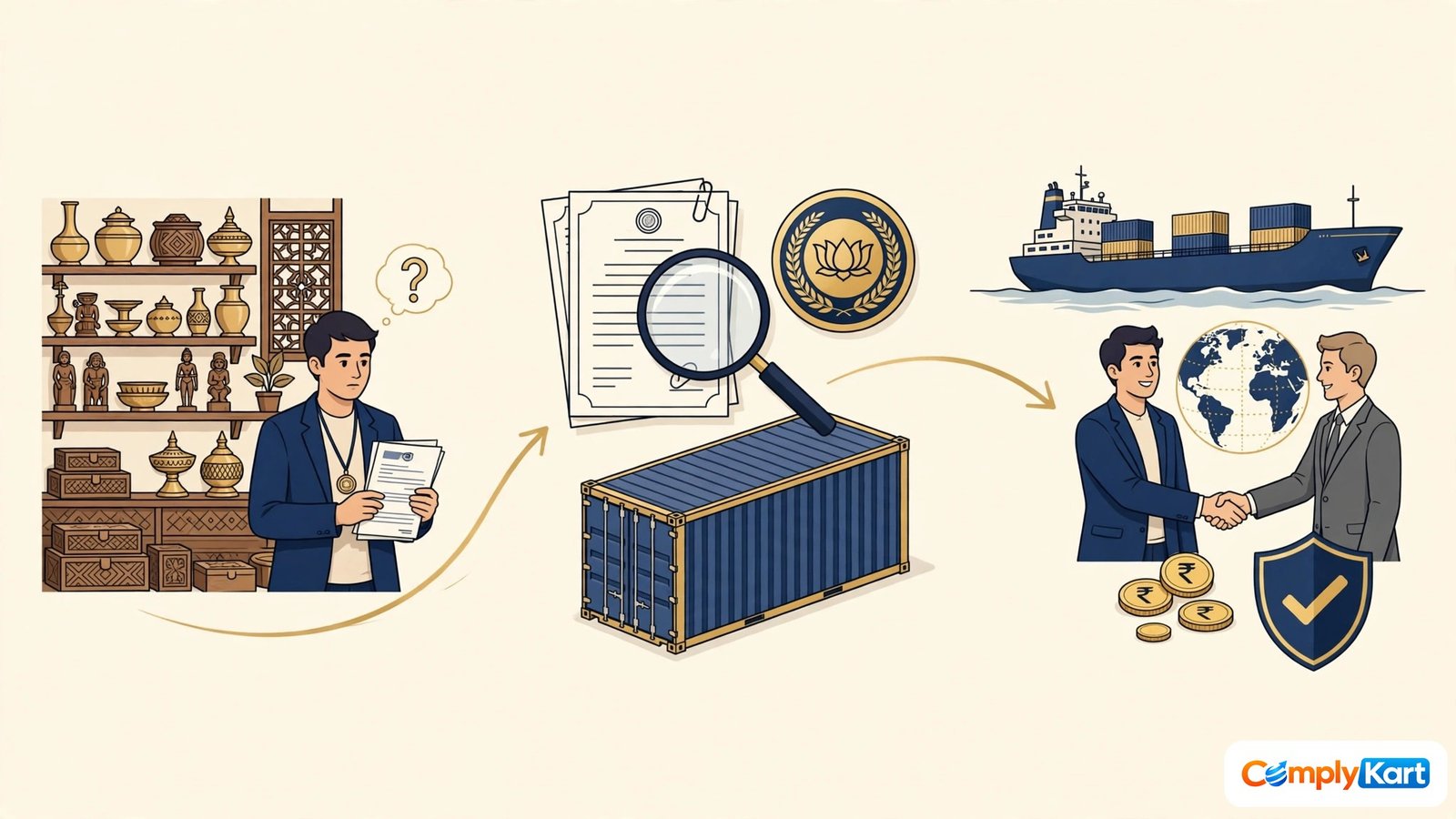
Quick answer: A handicraft exporter needs three things: an Importer-Exporter Code from DGFT (₹500, 1–2 working days), an EPCH registration-cum-membership certificate (₹8,850 in year one, valid 5 years), and the right benefit claim on each shipping bill — duty drawback or RoDTEP (roughly 0.8–3.0% of FOB for handicraft lines). EPCG adds zero-duty machinery against a 6x-duty-saved export obligation over 6 years.
You make brass lamps in Moradabad or carved boxes in Saharanpur, and a buyer in Hamburg wants a container. The craft is the easy part. I have watched exporters ship for years at full cost and discover duty drawback only when a competitor undercuts them by 8%.
How much does IEC registration cost, and how long does it take?
The Importer-Exporter Code is a 10-digit number the Directorate General of Foreign Trade (DGFT) issues against your PAN.
Apply online on the DGFT portal for ₹500. Keep ready: the entity's PAN, a cancelled cheque or bank certificate, address proof, and the signatory's Aadhaar for e-sign (companies and LLPs use a Class 3 DSC). The certificate arrives digitally in one to two working days if details match PAN records exactly.
One rule catches people every year. Every IEC holder must complete a free annual update on the DGFT portal between April and June — even when nothing has changed. Miss it and DGFT deactivates the code, blocking customs clearance and benefit claims until restored. The late update costs ₹200; the lesson costs a stuck shipment.
ComplyKart handles IEC registration end-to-end if you would rather not fight the portal yourself.
What does EPCH registration cost a handicraft exporter?
The Export Promotion Council for Handicrafts (EPCH), under the Ministry of Textiles, is the apex body for handicraft exporters. Its registration-cum-membership certificate — the RCMC — makes Foreign Trade Policy benefits available to your product line: drawback, RoDTEP, EPCG, Advance Authorisation. Without a valid RCMC, most of those claims are simply not open to you.
Order: EPCH membership precedes the RCMC, and your IEC is the mandatory document for membership. IEC first, then EPCH.
Fees: ₹2,500 entrance plus ₹5,000 annual subscription, plus 18% GST — ₹8,850 all-in for year one, ₹5,900 a year after (due by 30 June). The RCMC is valid five years and typically issues in three to five working days.
Register as a merchant exporter, a manufacturer exporter, or a merchant-cum-manufacturer. Most handicraft exporters start as merchant exporters — they aggregate from artisan clusters and do not own the kilns or workshops. Keep ready: IEC, GST certificate, Udyam registration, a CA-certified turnover certificate, and your partnership deed or MOA/AOA.
Membership also opens the IHGF Delhi Fair and EPCH buyer-seller meets — a fair stall often beats a year of cold emails.
Duty drawback or RoDTEP: which one actually pays you?
RoDTEP and duty drawback are two cashback offers from two different counters of the same store. Both reward you for exporting, but they refund different cost layers — on a given shipment you claim the one your 8-digit HS line supports.
Duty drawback refunds customs and excise incidence on inputs. The All Industry Rates schedule sets product-wise rates — brass artware 15% capped at ₹113/kg; copper artware 15% capped at ₹150/kg.
RoDTEP — Remission of Duties and Taxes on Exported Products — refunds embedded taxes no other mechanism refunds: state levies, mandi taxes, electricity duties, fuel taxes baked into logistics. Rates range from 0.3% to 3.9% of FOB, with handicraft lines at indicative 0.8–3.0%. The credit lands as a transferable e-scrip in your ICEGATE ledger. One non-negotiable rule: the claim must be declared item-by-item in the shipping bill itself. DGFT has extended RoDTEP for DTA, Advance Authorisation, SEZ and EOU exports to 31 December 2026.
What is EPCG, and when should a handicraft exporter use it?
EPCG lets you import machinery at zero customs duty — pre-production, production, and post-production equipment. In return: export goods worth 6 times the duty saved within 6 years. Fall short and the duty saved becomes payable with 15% per annum interest from the date of import.
For handicrafts this is a growth-stage tool — a CNC router, dyeing plant, or kiln. Duty saved on a ₹40 lakh machine can be ₹8–10 lakh, meaning a ₹48–60 lakh export obligation over six years. Model that against 70–80% of your realistic forecast. When done, DGFT issues a Discharge Certificate releasing your bond and guarantee.
Do you still need a GST LUT when you export handicrafts?
Yes. Export of goods is zero-rated: pay IGST and claim it back, or file a Letter of Undertaking and export without paying it. The LUT keeps cash in your account — on a ₹1 crore shipment at 18%, that is ₹18 lakh not locked up for months. The full walkthrough is in our GST LUT filing guide for exporters. On pay-and-refund, follow the GST refund application process; LUT filing is available as a standalone service.
Five mistakes that cost handicraft exporters real money
1. Skipping the April–June IEC update. Deactivation mid-shipment is the most expensive free compliance in Indian trade. It costs nothing to update on time.
2. Exporting without an RCMC, then claiming benefits. Drawback, RoDTEP and EPCG all assume a valid RCMC. Get it before the first shipment, not the tenth.
3. Filing the shipping bill without the RoDTEP declaration. No declaration, no RoDTEP. It must sit in the bill at item level — your CHA cannot add it later.
4. Claiming on the wrong 8-digit HS code. Brass and copper artware sit on different drawback lines with different caps. Match the code to the product, every shipment.
5. Taking EPCG against a forecast, not an order book. Track the 6-times obligation quarterly and apply for the discharge certificate the moment you qualify.
Run your own shipment's numbers on the compliance fee calculator before quoting your next buyer — the benefits stack changes your floor price.
FAQs
Do I need an IEC if I only export through Etsy or Amazon Global?
Yes. Marketplaces and courier-mode exports still need an IEC on record for customs clearance and foreign remittance. At ₹500 and 1–2 days, it is trivial against a held remittance.
Merchant exporter or manufacturer exporter — which EPCH registration?
Manufacturer exporter only if you own the production facility. Exporters who aggregate from artisan clusters register as merchant exporters; a merchant-cum-manufacturer category also exists. The fee is the same.
Can I claim both duty drawback and RoDTEP on the same shipment?
They refund different cost layers, and you claim the scheme your HS line supports, declared in the shipping bill. Your CHA should match the 8-digit code against the AIR schedule and Appendix 4R before filing.
What happens if I miss the April–June IEC annual update?
DGFT deactivates the IEC, blocking customs clearance and benefit claims until you complete the update. The late update costs ₹200; the real cost is a shipment stuck at port.
Is EPCG worth it for a small handicraft unit?
Only when machinery changes your capacity and you can absorb a 6-times obligation within six years. Pure trading exporters do better with drawback and RoDTEP.


Comments
No comments yet — ask the first question below.
Join the discussion
Questions go straight to our expert desk. Comments appear after a quick review — no spam, no noise.