Five steps, no guesswork — you always know exactly what comes next. Tap a step to see what it involves.
12345
You pay securely. Payment is confirmed instantly, and your receipt with the written fee breakup lands in your inbox.
Overview — the legal framework in plain words
Sections 54 to 58 of the CGST Act form the refund chapter — Section 54 is the workhorse (who can claim, within what time, on what grounds), 55 covers notified persons like UN bodies and embassies, 56 gives interest on departmental delay, and 57—58 create the Consumer Welfare Fund for refunds where the tax incidence was passed on.
The procedure sits in Rules 89 to 97A: Rule 89 is the master rule (how to apply, what to attach, how the amount is computed), Rules 90—93 handle acknowledgement, deficiency memos, provisional refunds, and re-credit, and Rule 96 covers IGST paid on exports, where the shipping bill doubles as your application.
Three things to internalise first.
The clock. Every claim must be filed within two years of its "relevant date" — Section 54(1) read with 54(14), defined per category in Explanation 2 to Section 54. Getting it wrong is the single most common reason claims die.
The debit. Filing RFD-01 immediately debits the claimed amount from your electronic credit ledger (ITC refunds) or cash ledger (Rule 89(3)). On rejection or withdrawal it is re-credited — parked, not lost, while the claim is pending.
The deadline. The officer has 60 days from the complete application to pass the sanction or rejection order (Section 54(7)); past that, 6% per annum interest runs under Section 56. The law puts a price on delay.
Who can claim — the refund categories
Not every credit balance is refundable — the law opens the refund door only for specific situations.
1. Exports without payment of tax (LUT/bond). Ship goods or services out of India without charging IGST; accumulated ITC refunded under Rule 89(4), Statements 3/3A — the most common refund in India.
2. Exports with payment of IGST. Pay IGST on the export invoice and claim it back: for goods the shipping bill is deemed your application (Rule 96, no RFD-01); for services, RFD-01 with Statement 2.
3. Supplies to SEZ units and developers. Zero-rated like exports (Section 16, IGST Act); the supplier files after full admission into the SEZ, endorsed by the specified officer.
4. Inverted duty structure. Inputs taxed higher than outputs (18% on raw material, 5% on the finished product), so credit piles up with no output liability to absorb it. Claim it under Section 54(3), first proviso, clause (ii) via the Rule 89(5) formula.
5. Deemed exports. Domestic supplies treated as exports — to EOUs, against advance/EPCG authorisations, specified gold supplies (Notification 48/2017-CT). Recipient or supplier files, with undertakings against double claims.
6. Excess cash-ledger balance. Unused advances, wrong challans, any cash beyond liability. No two-year limitation, no prescribed relevant date — claim any time, even with your return.
7. Tax paid under the wrong head. IGST on an intra-state supply, or CGST/SGST on an inter-state one. Pay the correct head first, then claim it back under Section 77 (Section 19, IGST Act). The two-year limitation doesn't apply — the refund is mandatory.
8. Other cases. Tax on supplies never provided, excess tax paid, refunds from appellate/court orders, unutilised advance tax of casual/non-resident persons, unregistered persons in cancelled-contract cases (Circular 188/20/2022-GST). Same RFD-01 route, each with its own statement.
No-go zones: accumulated ITC where outputs are nil-rated or fully exempt, where exported goods attract export duty, or where you've claimed drawback or IGST refund on the same supplies — the provisos to Section 54(3) draw these lines.
Categories in detail
Exports without payment of tax — the LUT route
Section 16(1) of the IGST Act defines zero-rated supply: exports, and supplies to SEZ units or developers. Section 16(3) gives two routes — pay IGST and claim it back, or export under bond/LUT without paying IGST and claim the accumulated ITC instead.
Most regular exporters choose the LUT route: no tax paid upfront, working capital stays free. File it in Form RFD-11 under Rule 96A — valid one financial year only, fresh every year before your first export invoice. Let it lapse and every zero-rated invoice becomes an IGST liability from the invoice date. Anyone registered can file except those prosecuted for tax evasion above ₹2.5 crore (Notification 37/2017-CT); no bank guarantee needed.
Two timelines, and missing them is expensive: export goods within three months of the invoice date, realise service proceeds within one year — miss either and you pay the IGST with 18% interest within 15 days of expiry.
The refund follows the Rule 89(4) formula:
Refund Amount = (Turnover of zero-rated supply of goods + Turnover of zero-rated supply of services) × Net ITC ÷ Adjusted Total Turnover
Net ITC here covers inputs and input services — unlike the inverted-duty formula. File with Statement 3 (invoices, shipping bills) and Statement 3A (computation). No refund if you availed drawback on the CGST portion or claimed IGST refund on the same supplies — one benefit per supply.
Exports with payment of IGST — the tax-paid route
Some exporters prefer paying IGST on the export invoice — no LUT maintenance, no timeline compliance.
For goods, Rule 96 makes it automatic: the shipping bill filed with customs is deemed your refund application — no RFD-01. But "deemed" has conditions: it counts as filed only when your GSTR-3B is furnished, the carrier has filed the export manifest, and invoice details match between the shipping bill and your GSTR-1. ICEGATE–GSTN mismatches (the SB001/SB006 errors) are the main reason these refunds stall — get GSTR-1 right and the refund moves untouched by any officer.
For services, file RFD-01 with Statement 2 — invoices plus BRC/FIRC numbers proving the forex came in. If the export price rose after shipment and you paid additional IGST, Circular 226/20/2024-GST allows a supplementary refund via RFD-01 "Any Other" with Statements 9A/9B, debit notes, and the FIRC.
Supplies to SEZ units and developers
Treat SEZ supplies like exports — zero-rated under the same Section 16(1), and the supplier files, not the SEZ unit. For goods, file only after full admission into the SEZ for authorised operations, endorsed by the zone's specified officer. For services, attach evidence of receipt for authorised operations, proof of payment, and the endorsement. Two tracks: with payment (Statement 4) and without payment under LUT (Statement 5, computation in 5A) — the latter needs the Rule 89(2)(f) declaration that the SEZ unit hasn't availed ITC.
One honest flag: Explanation 2 to Section 54 names no separate relevant date for SEZ supplies — the conservative practice is two years from the supply period. Confirm the position for your facts.
Inverted duty structure — the Rule 89(5) formula
The refund manufacturers, pharma, and textiles claim most: GST on inputs is higher than on outputs, so credit accumulates monthly. Section 54(3), first proviso, clause (ii) authorises it — excluding nil-rated/fully exempt outputs and notified supplies.
The formula was rewritten on 5 July 2022 by Notification 14/2022-CT, and again from 1 November 2026 by Notification 05/2026-CT:
Maximum Refund Amount = {(Turnover of inverted rated supply of goods and services) × Net ITC ÷ Adjusted Total Turnover} − {Tax payable on such inverted rated supply}
Three things matter. First, Net ITC now covers ITC on inputs and eligible input services — input-service ITC counts where it was availed on or after 1 November 2026. The inputs-only reading from VKC Footsteps (2021) governed until then; capital-goods ITC joins Net ITC only from 1 April 2027. Second, the subtraction term is now simply the tax payable on the inverted rated supply — the 2022 ratio claw-back, which netted off output tax in the ratio of input-goods ITC to total ITC, applied to earlier periods. Third, the amendment is prospective only — for pre-5 July 2022 periods the old formula applied, settled when the Supreme Court dismissed the department's SLP in Tirth Agro (July 2025).
If your cost basket is mostly input services — commissions, software, logistics — this refund used to shrink fast, sometimes to nothing. From 1 November 2026 that changes: input-service ITC availed on or after that date counts in Net ITC, so the refund now rewards inversion in services as well as in physical inputs — raw materials, packing, consumables. File with Statement 1 (computation) and Statement 1A (invoice details). Relevant date: the GSTR-3B due date for the claim period — Explanation 2(e), amended by the Finance Act 2022 from October 2022.
Deemed exports
Deemed exports are domestic supplies the law treats as exports — against advance authorisations, to EOUs/EHTPs/STPs/BTPs, against EPCG authorisations, specified gold supplies (Notification 48/2017-CT). Not zero-rated: tax is charged and paid, but refundable.
Who files? Either the recipient or the supplier — the third proviso to Rule 89(1) allows both (Circular 147/03/2021-GST). The non-filing party gives the undertaking (Notification 49/2017-CT): no claim made or to be made, no ITC availed on those supplies. A recipient filing with Statement 5B additionally declares the claim doesn't exceed the ITC availed in the valid return for the period.
For EOU supplies the recipient must give prior Form-A intimation to the supplier and both jurisdictional officers before supply (Circular 14/14/2017-GST) — skip it and the claim gets difficult. Relevant date: the return-filing date — Explanation 2(b).
Excess balance in the electronic cash ledger
The simplest refund: cash beyond your liability, claimed through the return or RFD-01. No two-year limitation, no prescribed relevant date — the ₹1,000 floor still applies.
Tax paid under the wrong head
Pay the correct head first, then claim the wrong-head amount under Section 77 (Section 19, IGST Act) with Statement 6. The two-year limitation does not apply — the refund "shall be granted."
What must be decided before filing
1. Which category, exactly. "Export refund" is not a category — "export of goods without payment under LUT for March 2026" is. It decides your statement, formula, and relevant date; file under the wrong one and you'll get an RFD-03, or a rejection after weeks of waiting.
2. Which tax period. Computed period by period — each on its own Net ITC and turnover.
3. LUT or IGST-paid. LUT keeps cash free but demands annual renewal and timeline discipline; the paid route costs working capital but has no LUT compliance — and for goods it is nearly automatic through customs.
4. Supplier or recipient, for deemed exports. Agree in writing before anyone files — both filing guarantees a rejection for one of you.
5. Whether your ITC reconciles. The officer checks claimed Net ITC against GSTR-2B and GSTR-3B — fix returns first; a refund application magnifies every gap.
6. Timing against the relevant date. Compute the two-year deadline and file with margin, not in the final week. An RFD-03 excludes the filing-to-memo period from the two years (Notification 15/2021) — but don't plan around that relief.
7. Whether any demand is pending. A sanctioned refund can be adjusted against outstanding demands (RFD-07) — expect the adjustment and litigate the demand separately.
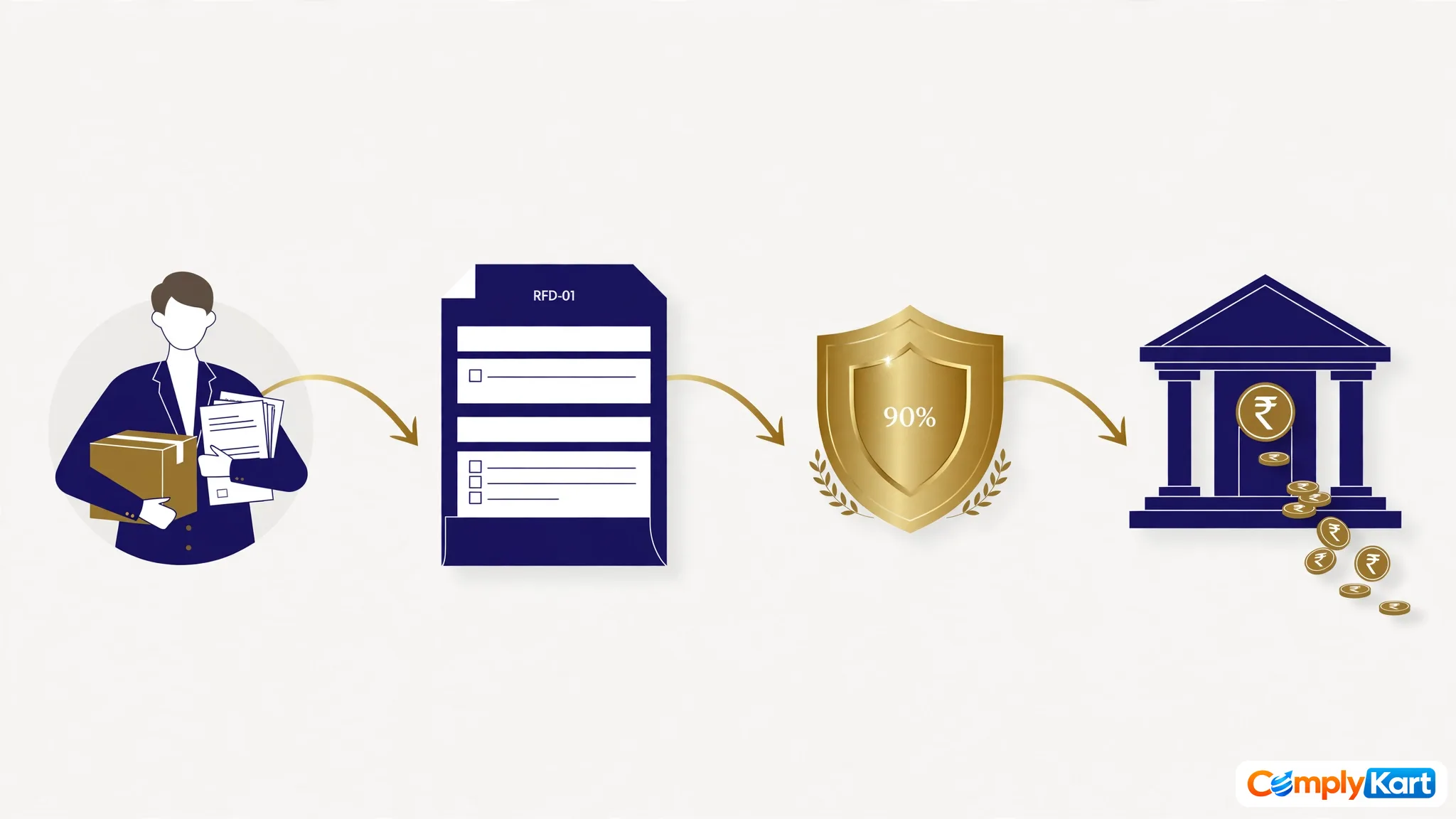
8. The provisional refund. For zero-rated and inverted-duty claims, 90% can come within 3 working days of acknowledgement — the portal generates it on the system's risk evaluation.
Documents required — per category
Rule 89(2) lists the documentary evidence per category and Circular 125/44/2019-GST's Annexure-A standardised what officers ask for; the portal shows the exact statement when you select your category.
Category
Portal statement
Core documents
Export of goods, without payment (LUT)
Statement 3 + 3A
Export invoices, shipping bills with EGM details, LUT copy, BRC/FIRC, GSTR-1 and GSTR-3B
Export of services, without payment (LUT)
Statement 3 + 3A
Service invoices, BRC/FIRC proving forex realisation, LUT copy, agreements
Export of services, with IGST payment
Statement 2
Invoices, BRC/FIRC, proof of IGST payment
Export of goods, with IGST payment
No RFD-01 — Rule 96
Shipping bill (deemed application); GSTR-1, GSTR-3B, and export manifest must match
SEZ supplies, without payment
Statement 5 + 5A
Invoices, specified officer's SEZ-admission endorsement, declaration of no ITC by SEZ unit (Rule 89(2)(f))
SEZ supplies, with payment
Statement 4
Endorsed invoices, proof of tax payment
Deemed exports (recipient or supplier)
Statement 5B
Invoices, undertakings under Notification 49/2017-CT, EOU approval/Form-A intimation
Declarations depend on amount: ₹2 lakh or less needs only your self-declaration that the tax incidence hasn't been passed on (Rule 89(2)(l)); above ₹2 lakh, a CA or cost-accountant certificate (Rule 89(2)(m)). Also standard: the undertaking on Sections 16(2)(c) and 42(2), and the declaration under the provisos to Section 54(3).
The RFD-01 process — step by step
Step 1 — Prepare and reconcile
Close the period's GSTR-1 and GSTR-3B, reconcile claimed ITC with GSTR-2B, compute the refund — 89(4) for zero-rated, 89(5) for IDS — assemble the statement and documents, and confirm you're inside limitation.
Step 2 — File RFD-01 on gst.gov.in
Services → Refunds → Application for Refund: select the type and period, fill the statement, upload documents, verify with EVC/DSC, submit. The portal immediately debits the claimed amount from your credit ledger (ITC refunds) or cash ledger (Rule 89(3)) and issues an ARN.
Step 3 — Acknowledgement (RFD-02) or deficiency memo (RFD-03)
The officer has 10 days to check completeness against Rule 89(2)–(4): pass, and you get RFD-02 — the processing clock runs from its date. Fail, and the officer issues RFD-03 (Rule 90(3)), the debit is re-credited (Rule 93(1)), and you file fresh after fixing the gaps. If neither arrives within 10 days, the application is deemed acknowledged and the portal issues RFD-02 (Rule 90(3A)).
Step 4 — Provisional refund (RFD-04), zero-rated and inverted-duty claims
For zero-rated supplies and inverted-duty claims, the portal generates the 90% provisional refund (Section 54(6), Rule 91) through RFD-04 within 3 working days of acknowledgement, on the system's risk evaluation, paid via RFD-05. Not available if you were prosecuted for tax evasion above ₹2.5 crore in the preceding five years.
Step 5 — Verification and the final order (RFD-06)
The officer verifies eligibility — formula, documents, reconciliations, unjust-enrichment requirements — and within 60 days of the complete application issues RFD-06: sanction in whole or part, or rejection. Before rejecting, the officer must issue RFD-08 (Rule 92(3)), give you 15 days to reply in RFD-09, and hear you. No rejection without that hearing — the Madras High Court struck down a limitation-based rejection that skipped the SCN in September 2026.
Step 6 — Payment (RFD-05)
On sanction, RFD-05 credits the bank account validated on the portal — usually within days. Withholding or adjustment against a pending demand comes separately in RFD-07.
Step 7 — After the order
Sanctioned in part: decide if the balance is worth an appeal. Rejected: the debit is re-credited — file fresh after curing defects (if still within limitation) or appeal in APL-01 within three months under Section 107. You can also withdraw any time before sanction or SCN through RFD-01W (Rule 90(5)).
How long does it take — the timeline
Stage
Statutory position
What usually happens
Filing to acknowledgement (RFD-02)
10 days' scrutiny (Rule 90)
3–10 days for clean applications
Provisional refund (RFD-04), zero-rated and inverted-duty
3 working days from acknowledgement (Rule 91)
Often within the week if documents are complete
Final order (RFD-06)
60 days from the complete application (Sec 54(7))
30–60 days; longer where pendency is heavy
Payment after sanction (RFD-05)
No separate statutory deadline
Usually within days of the order
Interest on delay
6% p.a. from day 61 till payment (Sec 56)
Mandatory, not discretionary, per the courts
The 60-day clock runs from the complete application — the one that earned the RFD-02. An RFD-03 restarts it with a fresh 60 days: every deficiency memo costs you a full cycle.
How ComplyKart helps
Before filing: we map your facts to the right category, compute the relevant date, reconcile ITC with GSTR-2B and GSTR-3B, and run the Rule 89(4) or 89(5) computation — so the number you claim is the number the formula produces. We check LUT validity and bank-account validation first; both are common silent killers.
Filing: we prepare the correct statement, assemble the Rule 89(2) documents and declarations, arrange the CA certificate where the claim exceeds ₹2 lakh, and file RFD-01 right the first time.
Follow-up: we track the ARN, answer RFD-03 memos precisely, pursue the provisional refund where available, reply to RFD-08 notices inside the 15-day window, and handle APL-01 appeals.
What we don't promise. We don't promise sanction — the proper officer decides. We don't promise the 60-day timeline in every jurisdiction; we track it and claim the Section 56 interest when it slips. We don't advise inflating claims, stuffing input-service ITC into IDS computations, or filing after limitation hoping nobody notices. If your facts don't support a refund, we'll tell you before you file — not after the rejection.
Common rejection reasons — and how to avoid them
Filing after the relevant date. Time-bar is the biggest killer — the officer must reject via RFD-08/RFD-06, not a deficiency memo (Madras High Court, 2026). Compute the relevant date on day one and file with months to spare: 3B due date for IDS (not the financial year-end), ship/aircraft leaving date for exported goods, forex realisation date for services.
Return mismatches. The officer's first check is GSTR-1 vs GSTR-3B — amend before filing, not after. Same for ITC your supplier never reported in GSTR-2B: chase the supplier or trim the claim.
Input services in the IDS formula. Net ITC under Rule 89(5) is inputs only — including input services gets the excess disallowed and tells the officer the computation was not reviewed. Same for nil-rated or exempt outputs mixed in: carve exempt turnover out.
LUT problems. A lapsed LUT, one filed after the export invoice, or missed 3-month/1-year timelines — any of these turns the claim into an IGST demand at 18% interest.
BRC/FIRC gaps for service exports. No forex proof, no refund — follow up with your bank.
Double claims in deemed exports. Both sides filing, or the recipient availing ITC and claiming refund too — coordinate in writing first.
Wrong statement or missing computation. Statement 3 without 3A, Statement 1 without the Rule 89(5) working. The portal accepts it; the officer rejects it.
Claims below ₹1,000. Not paid, per tax head — consolidate periods instead. (The exception: tax paid on goods exported with payment of tax, where the floor no longer applies from 1 November 2026.)
Unjust enrichment paperwork. Missing declarations or the CA certificate above ₹2 lakh — the paperwork proves the money is yours.
Interest on delayed refunds
Section 56: if the refund ordered under Section 54(5) isn't paid within 60 days of the application, interest runs from the day after those 60 days until payment — 6% per annum (Notification 13/2017-CT), mandatory per the courts.
The 9% rate in the proviso is widely misstated: it applies only where the refund arises from an order of an adjudicating authority, appellate authority, tribunal, or court that has attained finality, and even that refund isn't paid within 60 days of the consequent application. It is not a higher rate for zero-rated supplies — ordinary export and IDS refunds earn 6%.
What happens after sanction
Payment. RFD-05 is credited to the bank account validated on the portal. Update bank details before the order, not after — a failed credit means correspondence, not cash.
Provisional vs final. The final RFD-06 settles the balance after the 90% provisional; if lower, the excess is recoverable with interest. Don't spend the provisional amount as if the final figure is guaranteed.
Re-credit on rejection or withdrawal. The filing debit reverses to your credit or cash ledger on rejection (Rule 93) or withdrawal via RFD-01W (Rule 90(6)) — the credit isn't forfeited, but the limitation clock kept running, so act promptly.
Adjustment against demands. Sanctioned refunds can be adjusted against outstanding demands (RFD-07) — dispute the demand separately; the adjustment doesn't settle it.
The Consumer Welfare Fund. Where unjust enrichment applies (Section 54(8)) and the tax incidence was passed on, the refund goes to the Fund. Unutilised-ITC refunds on zero-rated and inverted-duty supplies, and excess cash balances, are paid directly to the claimant — which is why the declarations and the CA certificate matter.
Mistakes and risks — the honest list
Filing in the final week of limitation. One RFD-03 and you're racing the calendar.
Claiming ITC refund on exempt or nil-rated outputs. The law excludes them.
Treating the LUT as one-time. It's annual — diary it for March.
Assuming the shipping bill alone secures the IGST refund. It does — but only if GSTR-1, GSTR-3B, and the export manifest agree. The system decides, not a person.
Deemed-export claims from both sides. Two applications, one rejection.
Spending the 90% provisional refund before the final order — a lower final sanction means the difference comes back with interest.
Ignoring a pending demand. Your sanctioned refund can be adjusted against it first.
Letting service-export realisation cross a year under LUT. The refund becomes a demand at 18% interest.
FAQ
Frequently asked questions
21 answers from our consultants.
You pay for our expert's time — document checking, filing, follow-ups — not the government. The government fee goes to the government; our fee is for the work we do so you don't have to figure it out yourself.
Any registered person with a valid ground — unutilised ITC on zero-rated supplies or inverted duty structure, excess cash balance, wrong-head tax payment, deemed exports, SEZ supplies, or refunds from orders. File RFD-01 within two years of the relevant date.
Two years from the relevant date (Section 54(1) read with 54(14)): ship-leaving date for exported goods, forex realisation for services, 3B due date for inverted duty structure, return-filing date for deemed exports. Miss it and the claim fails on limitation alone.
Per tax period, each on its own Net ITC and turnover — most claimants file monthly or quarterly, matching their return periods.
LUT route (Section 16(3)(a), Rule 96A): export without paying IGST, claim accumulated ITC via RFD-01. IGST-paid route (Section 16(3)(b)): pay IGST on the export invoice and claim it back — for goods, the shipping bill itself is the application under Rule 96. LUT saves working capital; the paid route avoids LUT compliance.
One financial year — file a fresh RFD-11 every year before your first export invoice. There is no renewal.
The supply is treated as taxable: IGST becomes payable from the invoice date, with interest if LUT timelines are also breached. File the LUT first.
Maximum Refund = (Inverted-supply turnover × Net ITC ÷ Adjusted Total Turnover) − Tax payable on inverted supply. Net ITC covers inputs and eligible input services — input-service ITC counts where it was availed on or after 1 November 2026 (Notification 05/2026-CT). The inputs-only reading from VKC Footsteps (2021) governed until then; the 2022 formula was Notification 14/2022-CT.
Since 1 November 2026, input-service ITC counts in Net ITC where it was availed on or after that date — so a service-heavy cost base can now produce a real refund. Before that date the formula yielded little or nothing on services, because input-service ITC was excluded (VKC Footsteps, 2021).
No — the first proviso to Section 54(3) excludes nil-rated and fully exempt outputs. Only inverted-rated taxable turnover generates a refund.
For zero-rated and inverted-duty claims, the portal generates the 90% provisional refund (Section 54(6), Rule 91) via RFD-04 within 3 working days of acknowledgement, on the system's risk evaluation, paid through RFD-05 — unless prosecuted for tax evasion above ₹2.5 crore in the preceding five years. The balance follows verification.
Fix every listed deficiency and file fresh — the original is closed and the debit is re-credited automatically. The filing-to-memo period is excluded from the two-year limitation, but the 60-day clock restarts.
Either, but only one. The third proviso to Rule 89(1) allows both; the non-filer gives the undertaking of no-claim and no-ITC (Notification 49/2017-CT). Agree it in writing before filing.
Refunds below ₹1,000 are not paid (Section 54(14)), per tax head separately — ₹900 CGST plus ₹900 SGST will not be paid even though the total is ₹1,800. One exception since 1 November 2026: the ₹1,000 floor does not apply to a refund of tax paid on goods exported out of India with payment of tax.
6% per annum from the day after 60 days of the application until payment (Section 56, Notification 13/2017-CT) — mandatory, per the courts. The 9% rate covers only refunds flowing from final adjudication, appellate, tribunal, or court orders.
Yes — sanctioned refunds can be withheld or adjusted against outstanding demands (RFD-07). Dispute the demand separately; the adjustment does not settle it.
The debit is re-credited to your ledger. File fresh after curing defects (if still within limitation) or appeal in APL-01 within three months of the RFD-06 order under Section 107. A rejection without an RFD-08 notice and hearing is challengeable.
Yes — any time before RFD-04, RFD-06, RFD-05, RFD-07, or the RFD-08 notice, via RFD-01W. The debit reverses to the ledger it came from.
No. No relevant date is prescribed for cash-ledger refunds — claim any time, including with your return. The ₹1,000 floor still applies.
Pay the correct tax (CGST+SGST) first, then claim the wrong-head IGST under Section 77 (Statement 6). The two-year limitation does not apply — the refund is mandatory once the correct tax is paid.
Above ₹2 lakh — a CA or cost-accountant certificate that the tax incidence has not been passed on (Rule 89(2)(m)). At ₹2 lakh or below, your self-declaration suffices (Rule 89(2)(l)).
What clients say about working with us
Real stories from businesses we've worked with.
Trademark Registration“
Our Trademark was applied in all the classes with a short span of time by Complykart Trademark Experts and I can say the level of expertise and commitment they carry is remarkable. It's an A+ from my side. We are now sticking to ComplyKart only.
Company Registration“
I found the professionalism of the staff at complykart.com, a pleasure to work with. As a foreigner to India, they took the time to explain the documentation and assisted in every question I raised. I was pleased that complykart.com made it easy for my Business.
Merger & Acquisition“
Trust, Commitment, Dedication and responsiveness are the best things with ComplyKart. Thanks for handling our Merger assignment with so much care. After my business disputes, complykart handles all things with own sense of understanding.
GST Practice Lead · Goods and Services Tax · 11+ years experience
Abhishek Sharma leads ComplyKart’s GST practice. He handles GST registrations, monthly filings, input tax credit reconciliation, refunds and department notices for businesses across India. He has guided hundreds of companies through GST audits and assessments.
Last reviewed: 16 November 2026
Get a free consultation
Talk to a ComplyKart professional about GST Refund Application. The first consultation is free.