
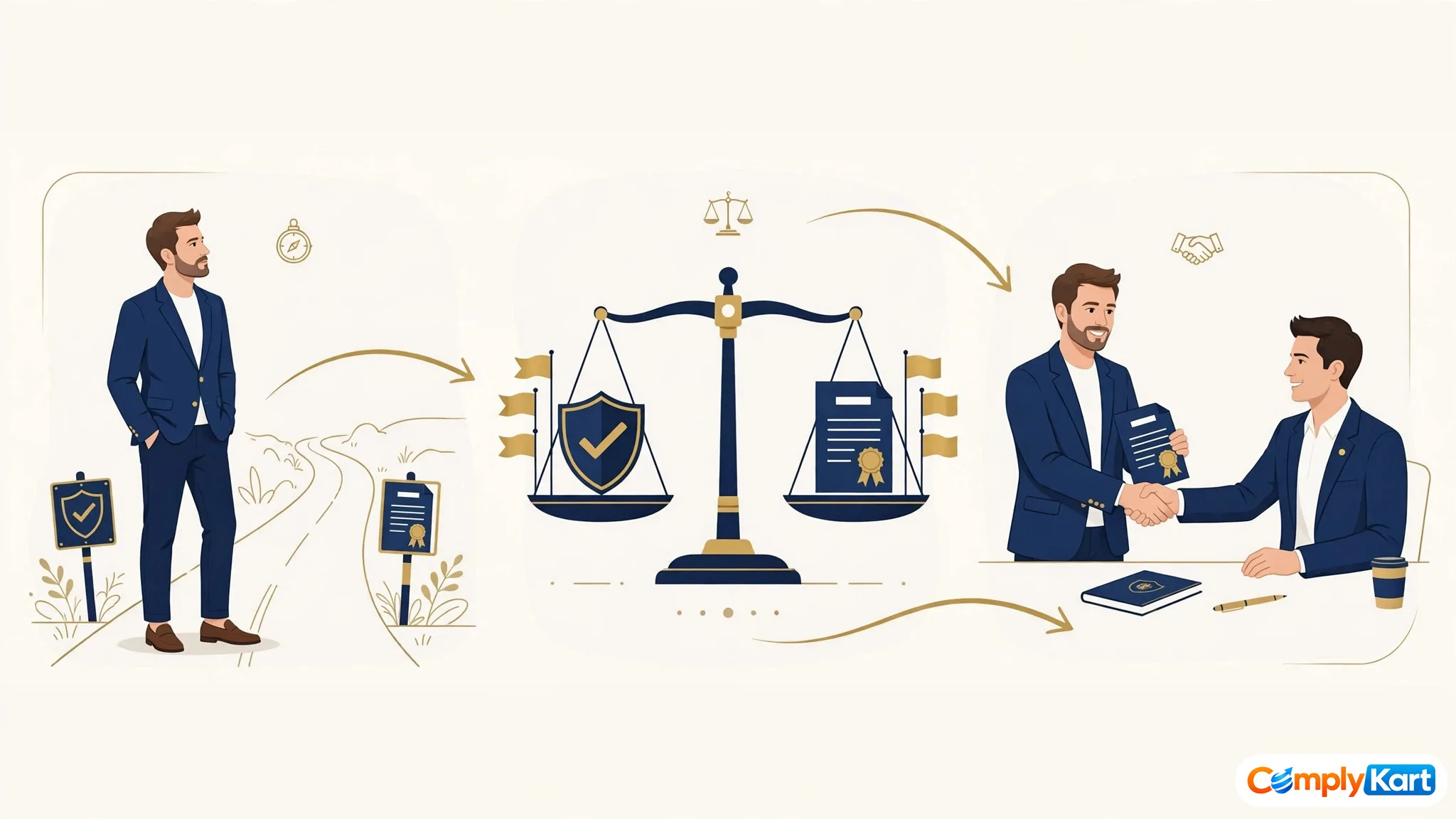
IN BRIEF
ISO 27001 and SOC 2 are two different proofs of information security: ISO 27001 is an international certification of a company's information security management system, issued by an accredited certification body under ISO/IEC 27001:2022 and valid for three years, while SOC 2 is an attestation report by a licensed CPA firm that a service organisation's controls meet the AICPA Trust Services Criteria over a defined period.
Pick the one your buyers ask for. US enterprise buyers want a SOC 2 Type II report; European, British, Asian buyers want an ISO 27001 certificate. One is a certificate, the other is a report, and the controls behind them overlap by roughly two-thirds — so the question is which document closes the next deal, not which framework is stronger.
Founders get this question backwards more often than any other in security assurance. They ask which framework is better, or tougher, or more respected. Those are the wrong questions. Neither framework is a prize. Each one is a document your buyer asked for, in a format their procurement team recognises, and the fastest route to a signed deal is the document already named in their questionnaire.
This guide explains what each one actually is, who asks for which, what each costs and takes, and how to sequence them if you end up needing both. The prices are in rupees for ISO 27001 and dollars for SOC 2, because that is how the market charges for them — and that difference alone tells you something about who each framework was built for.
What is ISO 27001?
ISO 27001 is an international standard for an information security management system, the ISMS. A company builds the system — risk assessment, policies, controls, internal audit, management review — and an accredited certification body audits it against ISO/IEC 27001:2022. Pass, and you receive a certificate valid for three years, with a surveillance audit every year in between.
The certificate covers the management system, not the product. It does not say your code has no bugs. It says you run a system that finds security problems, fixes them on a schedule, and can prove it did. The scope statement says exactly what the certificate covers, and buyers read the certificate and the scope together. Our ISO 27001 guide for SaaS companies explains how to draw that scope around a product rather than an office.
The standard's requirements sit in clauses 4 to 10, and the control catalogue in Annex A holds 93 controls across four themes: organisational, people, physical, and technological. You choose the controls that fit your risks and record the choice in the Statement of Applicability — including the controls you exclude, with the reason. That document discipline is part of what the auditor examines.
What is SOC 2?
SOC 2 is an attestation, not a certification. A licensed CPA firm examines your controls against the AICPA's Trust Services Criteria and issues a report saying whether those controls meet the criteria. The report is shared with customers under NDA.
The criteria come in five categories. Security is mandatory in every report — it covers protection against unauthorised access, logical and physical. The other four are optional and you add them only if your customers care: Availability (is the system up when it should be?), Processing Integrity (is processing complete, valid, accurate, timely and authorised?), Confidentiality (is data marked confidential actually protected?), and Privacy (is personal information handled the way your privacy notice says it will be?).
SOC 2 comes in two types, and confusing them is the costliest mistake in this whole area. A Type I report checks whether your controls are suitably designed at a single point in time — a snapshot. A Type II report checks whether those controls actually operated effectively over a period, usually three to twelve months. Enterprise buyers want Type II. A Type I report is a stepping stone: useful to unblock a deal now, while the Type II observation window runs in the background.
That observation window is the part nobody can compress. The auditor needs evidence that controls ran month after month, not that they existed on the day of the audit. A first Type II report takes six to twelve months from kickoff to report in most 2026 guides; one puts the full decision-to-report journey at nine to eighteen months. Plan around the window, not around the audit week.
A certificate or a report: the difference that decides everything
Think of it this way. An ISO 27001 certificate is like a driving licence: a public credential, issued by an accredited body, that you show to anyone who asks. A SOC 2 report is like a mechanic's inspection report on your car: detailed, specific to your vehicle, written for the person who asked for it, and shared privately. Neither is better in the abstract. You show a licence at a checkpoint and hand over an inspection report to a buyer. The question is which checkpoint you are standing at.
A US procurement team that asked for "your latest SOC 2 Type II report" will not accept a certificate in its place. A European tender that lists ISO 27001 will not accept a SOC 2 report either. Some buyers accept either; most ask for one by name. Read the questionnaire before you spend anything.
ISO 27001 vs SOC 2, side by side
| ISO 27001 | SOC 2 | |
|---|---|---|
| What it is | Certification of an information security management system | Attestation report on controls |
| Issued by | Accredited certification body | Licensed CPA firm |
| What you receive | Public certificate, valid 3 years, annual surveillance audits | Report shared under NDA; Type I is a snapshot, Type II covers 3–12 months |
| Measured against | ISO/IEC 27001:2022 — clauses 4–10 and 93 Annex A controls | AICPA Trust Services Criteria — Security mandatory, four others optional |
| Main market | Europe, UK, Asia, India, public sector, international tenders | United States and Canada, especially SaaS procurement |
| Typical first timeline | 4–9 months from gap assessment to certificate | Type I: 2–4 months; Type II: 6–12 months to report |
| Typical first cost | Consultancy ₹14,999–₹29,999 plus certification-body fees at actuals | First Type II audit roughly $10,000–$45,000; all-in totals vary widely |
Who asks for what: the buyer map
If your buyers are mostly in the United States, SOC 2 is the default ask. Large US enterprises ask for a SOC 2 Type II report; US mid-market buyers accept a Type I to start and expect Type II by renewal. US healthcare buyers ask for SOC 2 plus a HIPAA agreement; large US financial firms ask for SOC 2 Type II.
If your buyers are in Europe, the UK, Asia or India, ISO 27001 is the default. European enterprises ask for it across most industries; UK enterprises ask for ISO 27001, with Cyber Essentials Plus often the baseline before it in public-sector procurement; APAC enterprises lean the same way. Indian enterprise buyers and public-sector tenders usually ask for ISO 27001. A company selling into both markets ends up with both.
The practical test is the security questionnaire in front of you. If the first question from your largest prospects is "Are you ISO 27001 certified?", the choice is made. If it is "Please share your SOC 2 Type II report", it is made the other way. And if your next ten strategic buyers split down the middle, start with the one the largest deal in the pipeline demands, and add the second in the next cycle.
The overlap: build once, evidence twice
Here is the good news. The two frameworks test largely the same working reality: who can access what, how incidents are handled, how suppliers are vetted, whether systems are monitored and patched, and whether anyone checks that any of it actually happened. One practitioner guide puts the overlap at roughly two-thirds of the ISO 27001 Annex A controls — an estimate, not a measured figure, but it matches what teams that have done both report in practice.
That overlap is why the second framework is always cheaper and faster than the first. The access reviews, the incident log, the vendor assessments, the change records, the monitoring evidence — all of it carries over. What changes is the format: a scope statement and Statement of Applicability on one side, a system description and Trust Services Criteria mapping on the other. Do the first one properly, with evidence filed as you go, and the second is a mapping exercise rather than a rebuild. Do the first one as a paper exercise and the second will expose every gap the first one hid.
What each one costs, and how long each takes
On the ISO 27001 side, keep the two parts separate, as our ISO 27001 cost guide for IT companies and startups explains. ComplyKart's ISO 27001 consultancy starts at ₹14,999 for companies up to 25 employees and ₹29,999 for 26 to 100 employees, covering the consultancy: scope, risk work, documents, and audit preparation. Certification-body audit fees sit outside it, charged at actuals, and they vary with scope, sites, and headcount. For budgeting, one published Indian roadmap puts a typical small-to-mid company's first-year total — consultancy plus audit fees plus tooling — at roughly ₹3–15 lakh. The honest range for a small team is four to nine months from gap assessment to certificate, with three months of operating records needed before the Stage 2 audit. Our ISO 27001 process guide walks through those stages in order.
On the SOC 2 side, the money is in dollars, because the auditor is a US CPA firm. Published 2026 cost guides put a first SOC 2 Type II audit at roughly $10,000–$45,000, with a Type I audit cheaper at roughly $5,000–$20,000. The all-in first-year totals in those guides run from about $25,000 to well over $100,000 depending on readiness work, automation tooling, and penetration testing — the range is wide because the scope is yours to set. The timeline is dominated by the observation window: two to four months for a Type I report, six to twelve months from kickoff to a Type II report.
One cost rarely appears in either quote: your team's time. Both frameworks demand evidence collected month after month. Budget for that honestly — a framework your team cannot sustain lapses at the first surveillance audit, and a lapsed certificate is worse than none at all.
Three questions that settle it
First, where do your next ten buyers sit? If eight of them are in the US, start with SOC 2. If eight are in Europe, the UK, Asia or India, start with ISO 27001. Geography is the single strongest predictor of which document gets asked for.
Second, what exactly did they ask for? A certificate and a report are different documents, and a buyer who asked for one by name usually cannot accept the other. If the questionnaire says "SOC 2 Type II report", that is the requirement. If the tender says "ISO 27001 certificate", that is the requirement. Guessing wrong here costs the price of a whole second programme.
Third, what is your deadline? If a deal closes in three months and the buyer will accept a Type I report as a bridge, SOC 2 Type I is the only route that fits — ISO 27001 cannot be rushed below four months, and a Type II report cannot be rushed below its observation window. If the deadline is a tender six months out, ISO 27001 fits comfortably. Match the programme to the calendar, not the other way round.
Sequencing: start with one, add the second properly
Most companies that sell globally end up with both, and the order matters less than the discipline of doing the first one well. Start with the framework your largest prospects ask for. If that is SOC 2, take the Type I report as a bridge, start the Type II observation window immediately after, and begin the ISO 27001 scope work during the second SOC 2 cycle — by then your controls, your evidence habits, and your risk register already exist, and the ISO work is mostly documentation and a different audit format.
If that is ISO 27001, run the certification, keep the evidence discipline alive through the first surveillance audit, and then map the same controls to the Trust Services Criteria for a SOC 2 Type I, with the Type II window starting from the records you already hold. The companies that struggle are the ones that try to run both from a standing start at the same time, with one small team, and finish neither.
Before you sign with any certification body, check how to verify an ISO certificate is genuine — the same care applies to choosing the body as to choosing the framework. And if the scope still feels hard to draw, the ISO 27001 certification service page carries the current consultancy prices, and the compliance fee calculator can help you line up the year's filing costs beside the certification budget.
What is changing: the AICPA's 2027 SOC 2 proposal
One more thing worth knowing if you are planning a SOC 2 programme now. On 28 October 2026 the AICPA published exposure drafts proposing updated SOC 2 Trust Services Criteria, adding seven AI-specific points of focus — AI governance, model monitoring, prompt manipulation, data poisoning, transparency of AI-generated outputs, training data management, and risks from automated decision-making. The five criteria themselves stay unchanged. Public comments close on 15 January 2027, and if the proposal is approved the new criteria would apply to engagements beginning on or after 31 December 2027, with early adoption permitted.
None of this is a reason to wait. The proposal is not final, and the current criteria remain the ones auditors use. If your product leans on AI features, ask your auditor how they already test those areas — a control set built with AI governance in mind will not need rebuilding when the new criteria land.
Five mistakes companies make
- Buying the framework a vendor sells instead of the one their buyers ask for — the vendor's preference is not evidence.
- Treating a SOC 2 Type I report as the finished job, then losing a renewal when the buyer asks for the Type II report that was always the real requirement.
- Assuming the cloud provider's ISO 27001 certificate covers them — the provider's certificate covers the provider's side of the shared-responsibility line, not yours.
- Starting a Type II observation window before the controls are actually running, then discovering in month five that half the evidence does not exist.
- Chasing both frameworks at once from a standing start, with one small team, and finishing neither.
Find out what your next ten buyers ask for, by name. Start with that one. Build the controls properly, keep the evidence as you go, and the second framework becomes a mapping exercise instead of a second mountain. The certificate and the report are both just documents — what matters is the system behind them, and whether it is still running a year from now.
FAQs
Is SOC 2 a certification?
No. SOC 2 is an attestation report issued by a licensed CPA firm. It says your controls meet the AICPA Trust Services Criteria; it does not certify you against a standard the way ISO 27001 does. There is no SOC 2 certificate, and anyone selling you one is selling you a misunderstanding.
Can ISO 27001 replace SOC 2 for US buyers?
Usually not. Some US buyers accept an ISO 27001 certificate, but most US procurement teams ask for the SOC 2 Type II report by name, and their process is built around receiving it. Ask the specific buyer before assuming — a one-line email now is cheaper than a second audit programme later.
Can I do ISO 27001 and SOC 2 at the same time?
You can, but most small teams should not. The controls overlap by roughly two-thirds, so the second framework reuses the first one's evidence — but running both at once doubles the audit load. Sequence them: finish the one your largest prospects ask for, then map the same controls to the second.
How long does each one take?
ISO 27001 takes four to nine months from gap assessment to certificate for a small team, with three months of operating records before the Stage 2 audit. SOC 2 Type I takes two to four months; a Type II report takes six to twelve months from kickoff, because the observation window cannot be compressed.
Does SOC 2 or ISO 27001 cover GDPR or DPDP compliance?
Neither. SOC 2's Privacy criterion checks whether personal information is handled the way your own privacy notice says it will be; ISO 27001 certifies your security management system. Neither one is a legal compliance finding under the GDPR or India's DPDP Act, and neither should be presented to a buyer as one.



Comments
No comments yet — ask the first question below.
Join the discussion
Questions go straight to our expert desk. Comments appear after a quick review — no spam, no noise.