
IN BRIEF
ISO 27001 certification for IT companies is proof that a company runs an information security management system (ISMS) meeting ISO/IEC 27001:2022, covering a risk assessment, a Statement of Applicability across its 93 Annex A controls, and evidence that those controls operate. It applies to companies handling client data, is issued by an accredited certification body after Stage 1 and Stage 2 audits, and lasts three years with surveillance audits.
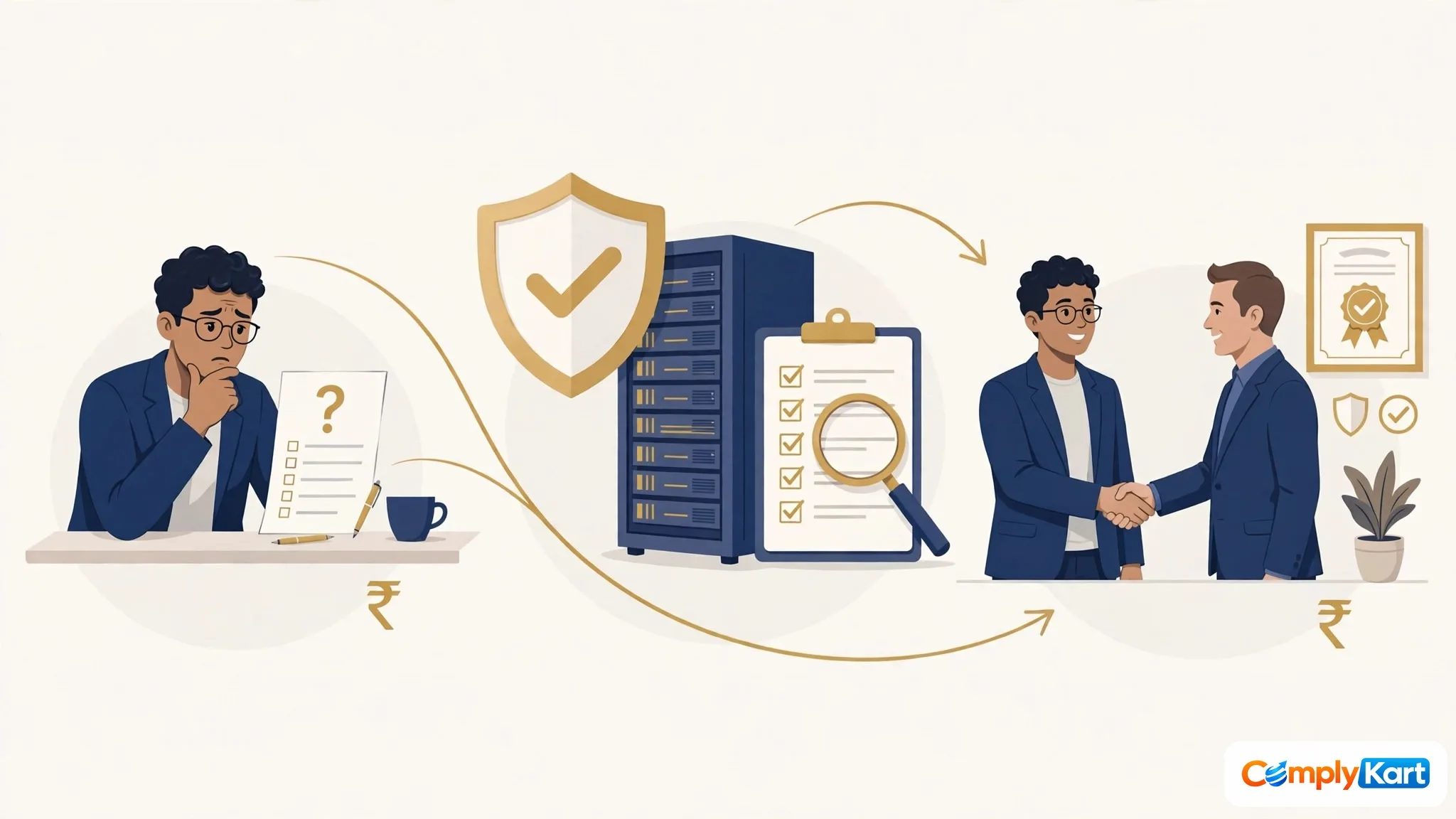
It usually starts with a questionnaire. A big client, or a prospect you really want to win, sends a vendor security form. Somewhere on page three sits the question: "Are you ISO 27001 certified?" You answer honestly — not yet — and the deal slows down. That is the moment most IT founders start asking what the certificate actually costs. The answers they find online are not much help. One page says ₹2 lakh. Another says ₹20 lakh. Both sound sure of themselves. Neither explains why they disagree.
Here is the short answer, with the honest caveat attached.
How much does ISO 27001 certification cost in India?
ISO 27001 certification for a small Indian IT company typically costs ₹2–4 lakh all-in in year one, according to one 2026 cost guide — roughly ₹1–3 lakh for consultancy and ₹80,000–₹1,20,000 for the certification body's audit. Other guides quote higher bands. The honest answer is that there are two separate bills, and your scope decides where you land.
That last sentence is the whole article, really. Everything below is just the working out.
Why there are always two bills, never one price
ISO 27001 certification has two parts, and two different organisations charge for them. First, somebody has to build your information security management system — the ISMS. That means a gap assessment against the standard, a risk assessment, policies, a Statement of Applicability, and an internal audit before the real audit. That is consultancy work, and you pay a consultant for it. Second, an accredited certification body has to audit that system and issue the certificate. The body charges its own audit fee, directly, and no consultant can issue the certificate for you. Anyone offering you a single flat "certificate price" with no audit is selling you a document, not a certification. Enterprise clients who check will find that out, and so will you, at the worst possible moment.
Keep the two bills apart in your head and every quote you receive becomes easier to read. A cheap consultancy quote paired with a large audit fee is not a bargain. An expensive consultancy quote that includes hand-holding through the audit may be cheaper than it looks. Ask every vendor the same question: which of the two bills does your number cover?
What the market actually quotes
No certification body publishes a fixed tariff, so there is no official price list to settle this. What exists is a set of published guides from firms that do this work, and they disagree with each other. That disagreement is useful information, not noise — it tells you how much of the price is scope, not standard.
Tranquility Cybersecurity's 2026 cost guide puts a typical 10–100 person company at ₹2–4 lakh all-in in year one: ₹1–3 lakh for consultancy plus about ₹0.8–1.2 lakh for the certification body's audit, with surveillance audits at ₹40,000–₹80,000 a year after that. Univate gives small organisations under 50 employees a wider ₹2–5 lakh band, and mid-size companies ₹5–15 lakh. Prowise puts small businesses of 10–50 employees at ₹2.5 lakh and above. LegalDev, writing about the audit fee alone, says a small Indian company often lands between ₹1.5 lakh and ₹5 lakh across the three-year cycle for the certification body's charges.
Read those together and the picture is consistent, even though the numbers differ. Year one for a small IT company sits somewhere between ₹2 lakh and ₹5 lakh all-in. The guides that quote the lower end are usually picturing a small, single-office company with some security practices already in place. The guides that quote higher are picturing a larger scope, more sites, or a company starting from nothing. None of them is lying. They are pricing different jobs. Your written quote from a certification body — for your headcount, your sites, your scope — is the only number that settles it for you.
What ComplyKart charges, stated plainly
Our consultancy for ISO 27001 costs ₹14,999 for companies up to 25 employees and ₹29,999 for companies with 26 to 100 employees. That covers the consultancy side: gap assessment, documentation, risk assessment, Statement of Applicability, internal audit support and preparation for the certification audit. The certification body's audit fee is extra, at actuals — the body quotes it for your scope and bills you directly, and we do not mark it up or hide it inside our number.
I am stating this plainly because the cheapest number in this market is usually the one that leaves the audit fee out. A ₹14,999 consultancy quote next to a ₹1 lakh audit fee is a ₹1,14,999 project, not a ₹14,999 project. Any vendor who will not split the two bills for you is telling you something about how they sell.
The three-year total, worked out in the open
Year one is the wrong number to budget on. The certificate lasts three years, with a surveillance audit in each of years two and three and a recertification audit when it expires. Here is a worked illustration for a small IT company, with every assumption on the table so you can change it:
Consultancy in year one: ₹14,999 (our Standard tier, up to 25 employees). Certification body initial audit: ₹1,00,000 — the middle of Tranquility's ₹0.8–1.2 lakh band. Surveillance audits in years two and three: ₹60,000 each — the middle of Tranquility's ₹40,000–₹80,000 band. Total across three years: ₹2,34,999.
That is an illustration, not a quote. If your audit fee comes in at ₹80,000 and surveillance at ₹40,000, the total drops to ₹1,74,999. If you have two sites and a wider scope, it climbs. The point of the exercise is not the final figure. It is that the three-year total, not the year-one headline, is what you should compare when two vendors quote against each other.
What moves your quote up or down
Five things decide where you land inside those bands. First, scope. A certificate that covers only your head office, and not the cloud product your clients actually use, is cheaper — and worthless for the client who asked for it. I come back to scope below, because it is the most expensive mistake in this whole process. Second, headcount in scope. Audit days are priced off the number of people inside the scope, so a 15-person product team costs less to audit than a 90-person services company. Third, what you already have. Univate notes that companies holding SOC 2 Type 2 or PCI DSS controls typically find 40–60% of the Annex A controls already in place — their claim, not a rule, but the direction is right: existing policies, access controls and logging cut implementation time. Fourth, sites. Each additional location adds audit days. Fifth, remediation. If the gap assessment finds no incident response plan, no access reviews and no backups being tested, somebody has to build those things, and that is where timelines stretch.
The scope fence: the check that decides whether the certificate is worth anything
Think of scope as a fence around a plot of land. The certificate covers only what sits inside the fence. If your fence runs around the office Wi-Fi and the HR laptop, but your client's data lives in a cloud product outside the fence, the certificate does not cover the thing your client cares about. And clients check this. The scope statement is printed on the certificate itself, and a procurement team that knows what it is doing reads it before anything else.
The fence is drawn in two documents. The scope statement says which parts of the organisation, which locations and which services are covered. The Statement of Applicability — the SoA — lists all 93 Annex A controls of ISO/IEC 27001:2022, grouped into four themes (37 organisational, 8 people, 14 physical, 34 technological), and justifies each one as applicable or not, against your risk assessment. You do not have to implement all 93. You do have to justify every exclusion. A scope that quietly excludes your production environment, or an SoA that marks access control "not applicable" for a SaaS company, will not survive a serious audit — or a serious client.
So when a vendor quotes you a suspiciously low number, ask what scope it assumes. A narrow fence is the oldest way to make a quote look small.
How the process runs, and how long it takes
The route is the same shape for every company: gap assessment against the 93 controls, risk assessment and treatment plan, policies and SoA, implementation and evidence collection, an internal audit and a management review, then the certification body's Stage 1 documentation review followed by the Stage 2 audit of how controls actually operate. Fix any nonconformities Stage 2 finds, and the certificate issues.
On time, the guides disagree again. Tranquility says 12–16 weeks for a typical company. LegalDev says 4–8 months for a small or mid-sized organisation. Both can be right: a 15-person SaaS team with Google Workspace, GitHub and AWS already in decent shape moves fast; a 90-person services company with three offices and no written policies does not. For planning, assume three to six months for a small IT company, and treat anything faster as a sign that the scope is narrow, not that the vendor is brilliant.
Checking the certificate is genuine — and the 2013 trap
Two checks before you pay anyone. First, the certification body must be accredited — in India by the National Accreditation Board for Certification Bodies (NABCB), or by another member of the International Accreditation Forum. An unaccredited certificate is not accepted by clients who verify, and verification is exactly what enterprise procurement does. Second, check the version. The current edition is ISO/IEC 27001:2022, published in October 2022. The 2013 edition's transition window closed on 31 October 2025, so certificates still referencing the 2013 standard are no longer recognised, and every new certification runs against the 2022 edition. If a vendor offers you a 2013 certificate in late 2026, walk away.
The same check applies in reverse when you are the buyer: if a supplier waves a certificate at you, read its scope line and its accreditation mark before you read anything else.
Is SOC 2 the same thing?
Not quite, and the difference matters when a US client asks. ISO 27001 certifies that you run a management system meeting the standard, and the certificate lasts three years with annual surveillance. SOC 2 is an auditor's attestation report on your controls over a period of time, usually requested by US customers, and it is re-issued per reporting period. Some clients accept either. Some ask for one by name. If your client asked for ISO 27001, a SOC 2 report does not answer them, however good it is.
Five mistakes that cost real money
One, buying on the cheapest headline number without asking which of the two bills it covers. Two, accepting a narrow scope that excludes the product your clients use. Three, starting Stage 1 with no operating evidence — auditors test controls that have been running, not documents written the week before. Four, treating the certificate as the finish line and letting evidence go stale before the first surveillance audit, which is when certificates quietly get suspended. Five, picking an unaccredited body because its fee is lower; the certificate it issues is the most expensive kind, because you pay twice — once for it, and again for a real one.
Questions founders actually ask
How much does ISO 27001 certification cost for a startup? For a small team, budget ₹2–5 lakh all-in for year one, then roughly ₹40,000–₹80,000 a year for surveillance in years two and three. On our worked illustration above, the three-year total comes to ₹2,34,999 — but get the certification body's written quote for your scope before you commit to any figure.
Can I get ISO 27001 without a consultant? Yes, if someone in-house can run a gap assessment, write the SoA and conduct an internal audit. Most small teams cannot spare that person for three months, which is what the consultancy fee buys back.
How long does ISO 27001 certification take? Typically three to six months for a small IT company, depending on how much security practice already exists. Twelve to sixteen weeks is achievable for a small, well-organised team; eight months is normal for a larger or messier starting point.
Is ISO 27001 legally mandatory in India? No. It is not a government licence. It is client-driven: enterprise customers, tenders and vendor onboarding ask for it, and that commercial pressure is the reason most IT companies certify.
What happens after I get the certificate? Surveillance audits in years two and three check the system is still operating, and a recertification audit at the end of the three years renews it. Miss a surveillance audit and the certificate can be suspended — which is exactly when a client tends to ask for it.
The certificate is not the point. The point is being able to answer that vendor questionnaire without slowing the deal down, and to mean it. Budget for both bills, draw the fence around the product your clients actually use, and check the accreditation mark before you pay. Do that, and the number — whatever it turns out to be for your scope — is money spent on something a client can verify, which is the only kind of certificate worth having.
If you want a written quote for your scope, our ISO 27001 certification page sets out the two tiers and what the consultancy covers. Companies certifying more than one standard at once often run the audits together — our ISO 9001 certification page explains the combined route. For the cost picture on the quality side, see our guide to ISO 9001 certification cost in India. And if you want to sanity-check the total before you commit, the compliance fee calculator gives you a first estimate to compare against a written quote.


Comments
No comments yet — ask the first question below.
Join the discussion
Questions go straight to our expert desk. Comments appear after a quick review — no spam, no noise.