
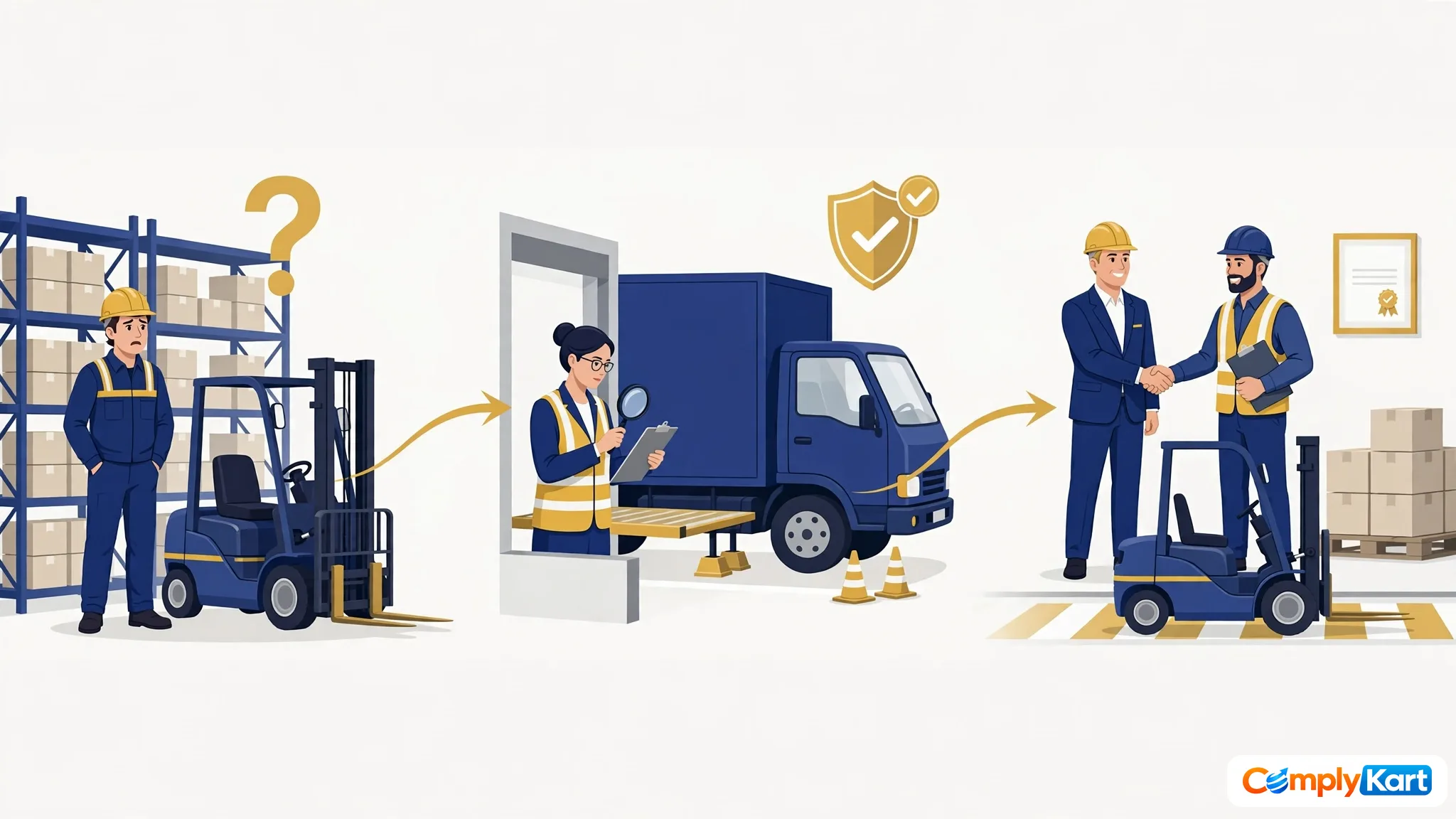
IN BRIEF
ISO 45001 for warehouses and logistics is the application of the ISO 45001:2018 safety management system to storage and distribution work: controlling forklift and pedestrian movement, loading-bay discipline, racking integrity, manual handling and contractor work through hazard identification under clause 6.1.2 and contractor controls under clause 8.1.4.
A warehouse is the one workplace where a normal day involves tonnes of steel moving past people on foot, loads stacked three levels high, and strangers — drivers, agency hands, repair crews — walking through the middle of it all. That mix is why a generic safety poster never survives contact with a real shift. ISO 45001 works in a warehouse only when it is built around the five places where people actually get hurt: the forklift aisle, the loading bay, the racking, the picking face, and the contractor's first hour on site.
Short answer: ISO 45001 for warehouses and logistics means running a documented safety system under ISO 45001:2018 that controls forklift and pedestrian movement, loading-bay discipline, racking integrity, manual handling, and contractor work through hazard identification (clause 6.1.2), competence records (clause 7.2) and contractor controls (clause 8.1.4). Certification takes most warehouses two to four months from a standing start.
Why a warehouse needs its own version of the standard
Most safety systems fail in warehouses for the same reason. They are written for a building, and a warehouse is not one building doing one thing. It is a yard, a dock, a store, and a transport hub sharing one roof. The risk changes by the hour: a quiet morning shift, a truck arriving late, a seasonal crew that started yesterday, a rack bay damaged by a bump nobody reported. Clause 6.1.2 asks you to identify hazards across all of that — routine work, non-routine work, and the people who are not your employees. If your hazard list mentions "forklifts" once and stops, it has not done the job.
Think of it like air-traffic control rather than a speed-limit sign. A sign tells one driver one rule. Air-traffic control separates everything moving in the same space, all the time, and it has a plan for the aircraft that arrives unannounced. That is the trickiest idea in this whole guide: ISO 45001 is a separation system, not a list of rules. Every control below is about keeping moving things, falling things, and people apart.
Where the risk actually sits: five zones
Walk your site with this table in hand. If a zone has no named owner and no written control, that is your gap, and an auditor will find it before your buyer does.
| Zone | What goes wrong | The control that matters most |
|---|---|---|
| Forklift aisles | Pedestrian struck, load tipped, blind-corner collision | Marked pedestrian lanes, authorised drivers only, daily truck checks |
| Loading bay | Trailer moves during loading, fall from the dock edge, dock board failure | Chock, brake and dock-lock sequence before anyone enters a trailer |
| Racking | Overloaded bay, damaged upright, falling pallet | Rated-load notices, damage reporting, written inspection rhythm |
| Picking and manual handling | Back and shoulder strain, falling stock, slips on damaged pallets | Pick-face height discipline, broken-pallet removal, rotation on heavy lines |
| Contractors, drivers and visitors | Uninducted worker in a live aisle, hot work near stock, driver wandering the floor | Induction before entry, a driver waiting area, permit-to-work for high-risk jobs |
Forklifts: authorised drivers, checked trucks, separated people
Three controls carry almost the whole forklift risk. First, only trained and authorised drivers touch a truck, and the authorisation is written down. Clause 7.2 requires competence evidence, so "he has driven one for years" is not a record. Keep the training certificate, the internal authorisation, and the refresher date in one place, and pull a driver's authorisation the day it lapses. Second, a daily pre-use check before the first shift — tyres, forks, chains, brakes, horn, lights, hydraulic leaks — with defects reported and the truck parked until fixed. A truck with a known fault that keeps running is the finding auditors write up first, because it proves the system is decoration.
Third, separate people from trucks physically. Painted pedestrian lanes, marked crossings at aisle ends, mirrors at blind corners, and a rule that pedestrians never walk an aisle a truck is working in when a lane exists. Speed limits help, but a painted line nobody enforces is worse than no line at all: it tells a walker they are safe when they are not. Loads travel low, within the truck's rated capacity on its data plate, and nobody rides on forks or on a load. Ever. That last rule sounds obvious until a busy shift finds a reason to break it.
Loading bays: the sequence before the doors open
The loading bay is where your operation meets the outside world, and it is where discipline slips fastest. A trailer that creeps forward while a forklift is inside it, or a driver who pulls away because nobody told him loading had started, is a known warehouse accident pattern. The fix is a sequence, done in the same order every time: vehicle positioned, brakes set, wheels chocked, dock leveller or dock lock engaged where fitted, and only then does anyone enter the trailer. The driver gets a clear instruction on where to wait and a signal for when loading is finished. No signal, no movement.
Check the dock board or plate before use — fastened in position, within its rated capacity, never used as a ramp for a heavier truck than it was made for. Keep the dock edge guarded when no vehicle is docked, and keep the area behind a reversing vehicle clear; reversing alarms help, but a banksman on a blind reverse helps more. Drivers stay in the waiting area, not wandering the floor looking for a signature. Every one of these points belongs in your bay procedure, and the bay procedure belongs in the induction every new starter actually reads.
Racking: the quiet risk nobody reports
Racking fails slowly and then all at once. A bent upright from a small bump, a beam overloaded because a heavier product moved into that bay, a missing safety clip — each one sits there for weeks until the wrong pallet goes on top. Put the rated load on a notice at the end of each run, not in a file in the office. Make damage reporting easy and blame-free: a worker who reports a bent upright should get a thank-you and a repaired bay, not a lecture about careless driving. If reporting gets punished, reporting stops, and you will learn about the damage from the collapse instead.
Set a written inspection rhythm and keep the records. A weekly visual walk by a trained supervisor, looking for damage, missing clips, overloaded bays and blocked sprinkler clearance, plus a periodic inspection by a competent person who can judge whether a damaged component stays in service. Unload and isolate a damaged bay until it is repaired or replaced. "We will keep an eye on it" is not a control, and an auditor will treat it as one of the weakest sentences in your whole system.
Picking, handling and the strain nobody counts
Not every warehouse injury involves a vehicle. Repetitive picking at the wrong height, heavy cartons stored above shoulder level, broken pallets left in circulation, and slippery floors around a leaking pallet all add up to the slow injuries: backs, shoulders, knees. Put fast-moving heavy stock at waist height, keep pick faces tidy, pull broken pallets out of circulation the moment they are spotted, and rotate people off the heaviest lines through a shift. These are small controls, but they are the ones your own workers will judge the system by. A safety system that only talks about forklifts while pickers hurt their backs every month has lost the floor.
Contractors, agency staff and the 3PL question
This is the section most warehouse guides skim, and it is where ISO 45001 is most specific. Clause 8.1.4.2 requires you to coordinate with contractors: identify the hazards their work brings into your site, the hazards your work creates for their people, and the hazards their work creates for everyone else in the workplace. Then make sure your system's requirements are actually met by contractors and their workers, with safety criteria applied when you select them. In plain terms: a contractor's safety record and method statement belong in the buying decision, not in a folder nobody opens after the contract is signed.
On the floor, that means induction before entry for every contractor, agency worker and regular driver — site rules, pedestrian routes, muster point, who to report damage or a near miss to — and a permit-to-work for hot work, work at height, and work on live equipment. Seasonal and agency workers get the same induction as permanent staff, on day one, not "when things quieten down". A worker who started yesterday and does not know the pedestrian route is the person most likely to be in the wrong aisle at the wrong time.
If you outsource warehousing to a third-party logistics provider, clause 4.3 forces a scope decision you cannot dodge. Either the 3PL site is inside your certified scope, in which case you must show control over it, or it sits outside, in which case your own system's outsourced-process controls (clause 8.1.4.3) still have to show how you assure its safety performance. "It is their warehouse, not ours" is not an answer to either question. Put the safety criteria in the 3PL contract — incident reporting to you, audit access, induction standards — and check them, or the certificate covers a promise your supply chain does not keep.
On Indian law, keep the legal register honest. Your register must name the law that actually applies to your establishment and your state, and the labour-code transition means that answer has changed recently and still varies by notification and state rules. Do not copy a foreign checklist — an American OSHA list or a British guidance note — into your register and call it compliance. List the applicable Indian requirements, the person who owns each one, and the review date. When the law changes, the register changes first, and the site rules follow it.
What certification looks like, and what it costs
Certification follows the usual ISO 45001 path, already covered in our ISO 45001 documents checklist: a documented system built around clauses 4 to 10, a Stage 1 document review, then a Stage 2 on-site audit where the auditor samples the floor against the file. For a warehouse, Stage 2 will spend most of its time in the aisles and at the dock, not in the meeting room. Auditors watch a forklift move, ask a picker where the pedestrian route runs, and check whether the damaged bay from last week has a record. Prepare for that audit by running your own floor walk first, with the same eyes.
The timeline most warehouses should plan around is two to four months from a standing start, longer if the system has to be built from nothing or if several sites are in scope. ComplyKart's consultancy for ISO 45001 starts at ₹9,999 for the Standard tier (up to 25 employees) and ₹19,999 for Growth (26–100 employees); certification-body audit fees are extra at actuals, and the full cost picture is in our ISO 45001 certification service page. The same system thinking applies on a building site — see our guide for ISO 45001 for construction companies — and if you run quality and environmental systems too, our integrated ISO 9001 + 14001 + 45001 guide explains when one combined system costs less than three separate ones. You can also run the numbers through our compliance fee calculator.
Six mistakes that fail warehouse audits
- Authorisations on paper, strangers on trucks. A driver whose refresher lapsed still driving is a competence finding, not a paperwork slip.
- Damage reported nowhere. If the bent upright has no report, the auditor assumes nobody looks — because nobody wrote it down.
- The dock sequence skipped under pressure. One rushed load without chocks teaches the whole shift the sequence is optional.
- Contractors inducted after they start. Induction given at the end of day one protects nobody on day one.
- Pedestrian lanes painted, never enforced. Walkers in truck aisles and trucks in walkways mean the separation system exists only as paint.
- A 3PL in the chain, outside the system. An outsourced warehouse with no safety criteria in its contract is an uncontrolled process, whatever the certificate says.
Frequently asked questions
Does ISO 45001 require a specific forklift licence in India?
ISO 45001 itself requires competence evidence under clause 7.2, not one named licence. Your system must define what competence means for your trucks — training, authorisation, refresher — and hold the records. Check your legal register for any licence or training requirement that applies to your establishment and state, and write that requirement into the competence rule rather than assuming a foreign licence answers it.
How often should racking be inspected?
The standard requires monitoring and measurement under clause 9.1.1 but does not fix one universal inspection interval. Your system must set its own written rhythm — a frequent visual walk plus periodic competent inspection — and follow it. What fails audits is having no rhythm at all, or a rhythm written down and never done.
Who is responsible for a contractor's worker injured on my site?
Under clause 8.1.4.2 you must ensure your system's requirements are met by contractors and their workers, and coordinate the hazards in both directions. That does not replace legal advice on liability in any specific incident, but it does mean "the contractor handles safety" is never an acceptable system answer. The contract, the induction, and the supervision on the day are all part of your control.
Can one certificate cover several warehouses?
Yes, if the scope is defined under clause 4.3 to include them and the system genuinely operates across all of them. Auditors sample sites, so a site that runs its own undocumented rules while headquarters holds the certificate will surface at sampling. Multi-site certification works when the controls are the same everywhere, not when the paperwork is.
Is ISO 45001 worth it for a small warehouse with ten people?
It depends on who asks. If your customers, a 3PL contract, or a tender require it, the certificate pays for itself in retained business. If nobody asks and your risk is low, a simpler documented safety routine may serve you better for now — and our ISO 45001 certification page can help you weigh that honestly before you commit.
A warehouse safety system earns its keep on the worst day, not the audit day. Build the separation between people, machines and falling stock into the floor markings, the dock sequence, the racking notices and the contractor's first hour — and then write down that you did. That is the whole system. Everything else is evidence.




Comments
No comments yet — ask the first question below.
Join the discussion
Questions go straight to our expert desk. Comments appear after a quick review — no spam, no noise.