
IN BRIEF
ISO 14001 for chemical and pharmaceutical units is the application of the ISO 14001 environmental management system to plants whose main risks sit in solvents, effluent, air emissions and hazardous waste. It requires the unit to name its environmental aspects, track its consents and authorisations under Indian environmental law, control its high-risk operations, and prove the system with records and audits.
Short answer: Chemical and pharmaceutical units carry the heaviest environmental load of any factory type, because their risk sits in solvents, effluent, air emissions and hazardous waste at the same time. ISO 14001 helps these units by turning that load into a managed system: every stream named, every permit tracked, every spill rehearsed. For most chemical and bulk-drug units this is not optional polish. It is how buyers, lenders and pollution boards judge whether the plant is under control.
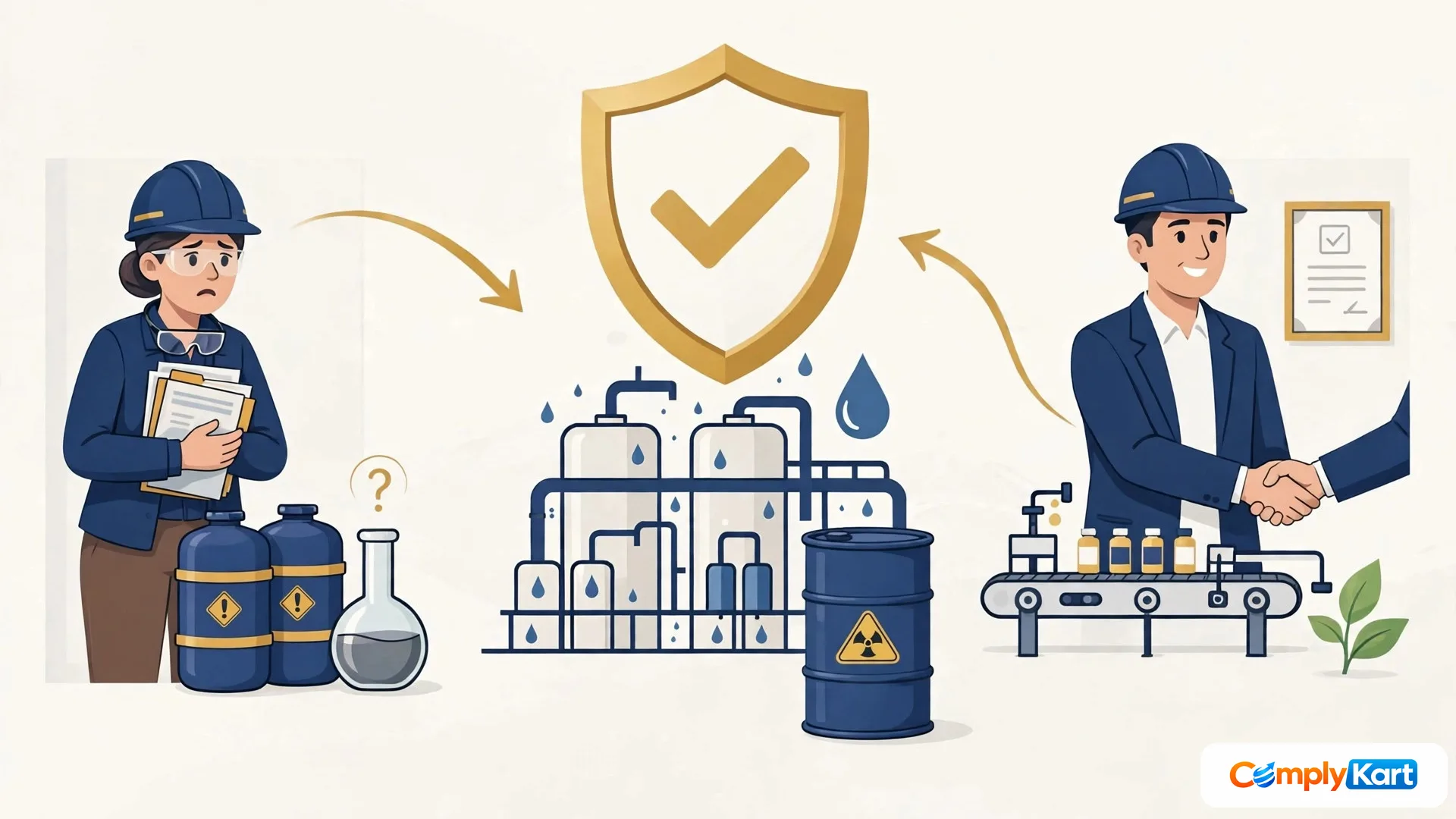
Walk into a chemical plant and the first thing you notice is not the machinery. It is the smell of solvents, the drums lined up in the yard, the effluent treatment plant humming at the back. A pharmaceutical plant looks cleaner, almost clinical. The risk is quieter there, but it is no smaller. A solvent leak, a failed effluent batch, a drum stored past its limit — any one of these can stop production, draw a board notice, or cost a buyer contract. This guide looks at where that risk actually sits, and what ISO 14001 asks such a unit to do about it.
Why are chemical and pharma units treated differently?
India's pollution boards sort industries by a Pollution Index, a score from 0 to 100 based on air, water and hazardous-waste potential. A score of 60 or above puts a unit in the Red category, the most closely watched group. Basic chemicals, bulk drugs and active pharmaceutical ingredients typically land in Red. Formulation-only pharmaceutical units — plants that press tablets or fill syrups from bought ingredients, without synthesis — often land in Orange instead. The category depends on your exact process, so confirm yours with your State Pollution Control Board rather than assuming it from a neighbour's certificate.
Red category status changes the paperwork rhythm of a plant. Consent to Establish comes before construction, Consent to Operate before production, and both need renewal on the board's schedule. For a chemical or bulk-drug unit, the consent is not a one-time file. It is a living permission, tied to production capacity, effluent quantity and emission points. Expand capacity without amending it, and the plant is operating outside its permission.
ISO 14001:2015, the environmental management standard, does not replace any of this. It gives the plant a system for keeping it all straight: which law applies, which permit expires when, who owns each control, and what the records prove. Clause 6.1.2 asks the unit to identify its environmental aspects — the ways its activities touch the environment — and clause 6.1.3 asks it to list the compliance obligations that apply to each one. For a chemical unit, that list is long. That is exactly why the system matters more here than in a low-risk unit.
Where does the risk actually sit?
Five places carry almost all of it. Get these five under control and the rest of the system falls into place. Leave one loose and it will be the one an auditor or an inspector finds.
First, solvents. Solvents are the working fluid of chemical and pharma production, and the hardest stream to account for. Some goes into the product. Some is recovered and reused. Some escapes as vapour, spills on a floor, or leaves in wash water. A solvent account is like a household cash book: every litre that enters the plant must show up somewhere — product, recovery, waste, or loss. When the book does not balance, nobody can say whether the missing litres went up a stack, down a drain, or into the ground. Auditors start here because unaccounted solvent is usually the first sign of a control that exists on paper only.
Second, effluent. Chemical and pharma effluent is rarely one stream. Process washings, scrubber water, cooling blowdown and floor washings each carry different loads, and mixing them carelessly can make treatment harder, not easier. The effluent treatment plant is the plant's kidney: if it fails, everything downstream shows it. Records that matter are the daily inlet and outlet readings, chemical dosing logs, and sludge disposal slips — not just the final treated-water report.
Third, hazardous waste. Under the Hazardous and Other Wastes (Management and Transboundary Movement) Rules, 2016, a generator needs authorisation from its State Pollution Control Board, must keep records of what it generates, and must file an annual return. Storage is the weak point in most units I see: drums without labels, incompatible wastes stored side by side, a storage yard that quietly holds more than the authorised quantity. Waste leaves the plant only through an authorised transporter to an authorised treatment, storage and disposal facility, with a manifest that travels with it. A manifest that does not match the gate register is a finding waiting to happen.
Fourth, air emissions. Stacks, vents, boilers and fugitive emissions from open handling all count. Consent conditions usually set limits per stack, and the monitoring reports must match the stacks that actually run. A stack added during an expansion but never added to the consent is a common gap in growing units.
Fifth, emergencies. A chemical plant's worst day is a spill, a fire, or a release that reaches a drain. Clause 8.2 of the standard asks for emergency preparedness: what can go wrong, what the response is, who does what, and whether the drill actually happened. A drill register with one entry a year, signed by the same person who wrote the plan, tells an auditor the plan was never tested.
Which permits and authorisations does a chemical or pharma unit actually hold?
The set varies by process, but a typical unit holds Consent to Establish and Consent to Operate under the Water (Prevention and Control of Pollution) Act, 1974 and the Air (Prevention and Control of Pollution) Act, 1981, a hazardous-waste authorisation under the 2016 Rules, and, where it draws groundwater, permission from the Central Ground Water Authority. Some large chemical and bulk-drug projects also need prior environmental clearance under the EIA Notification, 2006 — check the notification's schedule for your project category rather than assuming it does or does not apply.
Pharma units carry one extra layer. A formulation unit holds drug manufacturing licences under the Drugs and Cosmetics Act framework, and a bulk-drug unit may hold additional product permissions. Those licences are not environmental permits, but an ISO 14001 auditor will still ask how the unit keeps them in view, because a licence condition — a change in process, a new solvent, a new product — often creates a new environmental aspect. The legal register is where these threads meet: one place where every obligation, environmental or adjacent, is listed with its owner and its date. Our guide to building an ISO 14001 legal register walks through the columns each row needs.
A note on the edition: ISO 14001:2026 is now current
If you are starting certification now, ask your certification body one question before you sign: which edition will you be certified to? ISO published ISO 14001:2026 on 15 April 2026, replacing the 2015 edition. Existing 2015 certificates remain valid during the transition, which runs to 30 April 2029, but certification bodies stop issuing new certificates to the 2015 edition from 31 October 2027. A unit certified to the 2015 edition in early 2027 would therefore face a transition audit within two years. Starting on the current edition avoids that repeat exercise. Confirm the position with your own certification body, since accreditation timelines in India follow the body's own transition plan.
What does an auditor actually look for in these units?
Auditors in chemical and pharma plants spend less time on the policy document than most managers expect, and far more time on the floor. They check whether the aspects register names real streams — the solvent store, the reactor wash, the scrubber — or just generic phrases like "water usage". They check whether the legal register holds the unit's actual consents and authorisations, with expiry dates that match the certificates on file. They check operational controls: labelled drums, segregated storage, secondary containment under tanks, a working effluent plant with logs that match the discharge reports.
They also check the records that prove the system runs when nobody is watching: waste manifests matched to gate entries, stack monitoring reports for the stacks that run, emergency drill records with honest notes on what went wrong, and a management review that actually discusses the plant's environmental performance. The documents checklist in our ISO 14001 documents guide covers the full set an auditor will ask for.
One more check matters more here than elsewhere: contractor control. Tanker drivers, waste transporters, maintenance contractors and housekeeping staff all handle the plant's risk. If a contractor spills solvent and nobody on your side knows the response plan, the system has a hole exactly where the risk is highest.
Five mistakes chemical and pharma units keep making
- Treating the consent as a wall certificate. The consent's capacity, effluent and emission conditions are operating limits. Production beyond them is a compliance failure, even if the certificate is still in date.
- Storing waste by convenience, not compatibility. Acids beside oxidisers, unlabeled drums, a yard that fills past its authorised quantity — storage is where small decisions become findings.
- Running the effluent plant for the inspector's visit. Logs that show perfect readings every day, with no variation, no maintenance entry and no sludge slip, read as fiction. Real plants vary. Honest logs are easier to defend than perfect ones.
- Writing an emergency plan nobody has rehearsed. A plan that lives in a file, with no drill record and no lessons learned, fails the clause and fails the plant on the day it matters.
- Certifying to an edition about to be replaced. Starting on the 2015 edition in 2027 without a transition plan buys a second audit within two years. Ask the question before signing.
What does ISO 14001 certification cost for a chemical or pharma unit?
ComplyKart's ISO 14001 certification consultancy costs ₹9,999 for a unit with up to 25 employees and ₹19,999 for 26 to 100 employees. That covers building the system — aspects and impacts, legal register, procedures, internal audit and audit preparation. Certification-body audit fees are extra at actuals, and they vary with headcount, site count and risk profile: a bulk-drug plant with high-risk processes will be quoted differently from a small formulation unit, and any honest quote says so upfront. The certificate itself is not a government licence, and it guarantees no order or tender — what it proves is that an independent auditor found a working environmental system.
Timeline follows the same honesty rule. A unit whose consents, waste records and effluent logs are already in order moves faster than one starting from a blank file, because the consultant is organising evidence rather than creating it. If your hazardous-waste authorisation has lapsed or your consent does not cover your current capacity, fix those first — no auditor will certify a system built on expired permissions. Our ISO 14001 guide for factories sets out the full sequence from first gap check to certificate.
If you run a chemical or pharma unit and the five risk spots above feel familiar, the next step is a gap check against your current consents and records — not a certificate purchase. Find what is expired, what is unaccounted and what is unrehearsed, and the certification plan writes itself from there. You can also run the numbers through our compliance fee calculator to see the full compliance cost picture before you commit.
Frequently asked questions
Does a formulation-only pharma unit need ISO 14001? Need is the wrong word — nothing in the standard itself is compulsory. The question is whether your buyers, lenders or board ask for it, and whether your effluent, solvent and waste streams are complex enough that a system pays for itself. Formulation units with solvent handling and effluent treatment usually answer yes to both.
Is ISO 14001 a substitute for pollution board consent? No. Consent to Establish and Consent to Operate are legal permissions from your State Pollution Control Board. ISO 14001 is a management system that helps you meet those permissions. An auditor will ask to see your consents; a certificate never replaces one.
What happens to our existing 2015 certificate? It remains valid during the transition period, which ends on 30 April 2029. Plan the transition audit with your certification body well before that date, and confirm whether your body will conduct it alongside a surveillance audit.
Do we need an effluent treatment plant before certification? You need whatever treatment your consent requires, working and logged, before an auditor can verify your system. Certification organises and evidences your controls — it does not stand in for treatment infrastructure your consent already demands.
Can a small chemical unit afford ISO 14001? The consultancy tiers above are set for small units, and certification-body fees scale with headcount and risk. The expensive route is usually the other one: a board notice, a buyer audit failure, or a shutdown that a working system would have prevented.




Comments
No comments yet — ask the first question below.
Join the discussion
Questions go straight to our expert desk. Comments appear after a quick review — no spam, no noise.