
IN BRIEF
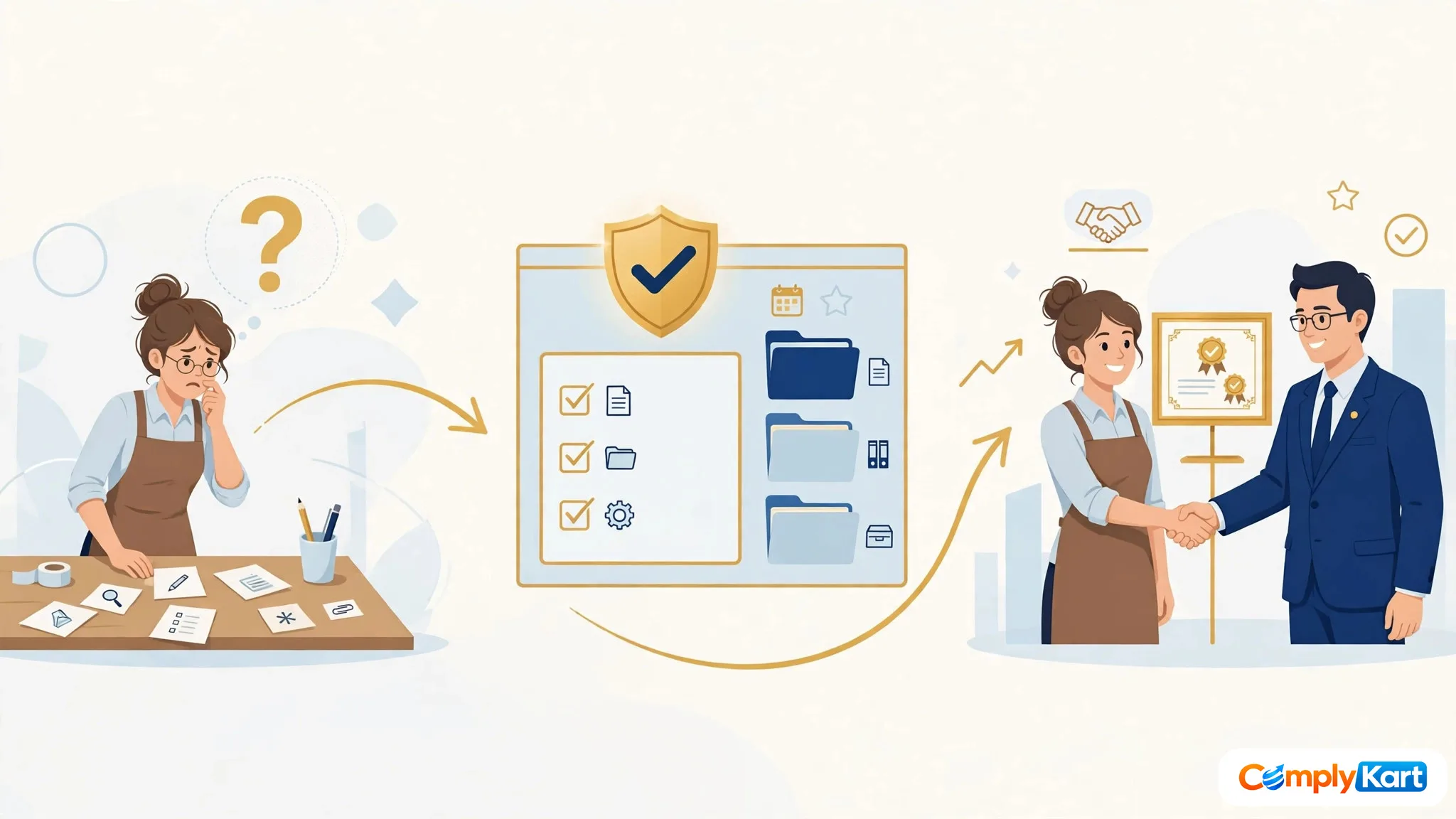
ISO 9001 for small businesses and startups is the same quality management system certification larger companies hold, scaled to a small operation's size and complexity, under a standard that sets no minimum headcount. It pays when a buyer, tender, export market or repeat quality problem makes a third-party-audited system worth its cost, and it is worth postponing when none of those triggers exists yet.
ISO 9001 is worth it for a small business when a buyer, a tender, an export market or a repeat quality problem makes an audited system pay for itself — and not worth it yet when none of those triggers exists. There is no minimum company size. The question is what it earns you, and what it costs to keep.
Owners ask me this in two moods. The first is hopeful: a big buyer just sent a vendor form with an ISO 9001 checkbox on it. The second is nervous: a competitor's website carries the badge, and the owner wonders whether they are falling behind. Both moods deserve the same honest answer, because the certificate is a tool, not a trophy. Bought for the wrong reason, it becomes an annual bill attached to a binder nobody opens.
What "small" actually means here
Three different yardsticks get mixed up, so let me separate them. First, ISO 9001 itself sets no headcount test. The standard says it applies to any organisation, regardless of size or sector. A five-person workshop and a five-hundred-person plant are judged against the same clauses — but the system each one builds looks completely different, because the standard asks for documentation that fits the size and complexity of the business. A small firm's quality manual can be a dozen pages. Nobody sensible writes two hundred.
Second, the MSME classification, which many owners confuse with a headcount test, is actually an investment-and-turnover test. Since 1 April 2025, under notification S.O. 1364(E) dated 21 March 2025, a micro enterprise is one whose investment in plant, machinery or equipment does not exceed ₹2.5 crore and whose turnover does not exceed ₹10 crore; a small enterprise stays within ₹25 crore of investment and ₹100 crore of turnover. Both ceilings must hold at once. Headcount appears nowhere in that definition. A 40-person services firm with low equipment investment can be micro; a 12-person precision unit with expensive machines may not be.
Third, our own pricing tier: ComplyKart's Standard tier for ISO 9001 consultancy covers up to 25 employees, Growth covers 26 to 100. That is a pricing band, not a legal threshold and not a rule about who may certify. I mention it because owners sometimes read a tier as a gate. It is not one.
When it pays: five triggers
1. A tender or a buyer asks for it. This is the cleanest trigger of all. Many government tenders and large-company vendor lists treat ISO 9001 as an entry condition — not a legal requirement, but a practical one. If a tender worth ₹50 lakh a year needs the certificate and you do not have it, you are not competing. The maths answers itself.
2. A big customer is auditing you anyway. When a large buyer starts sending its own quality questionnaires and site visits, a certificate answers most of those questions in advance. One audit by an accredited body replaces a dozen customer audits. Your team stops filling in the same form twelve different ways.
3. You are selling abroad. An overseas buyer cannot walk your factory floor before the first order. An accredited certificate, issued by a certification body recognised under the IAF system, is the shorthand they trust. It does not replace product testing or samples. It gets you past the first filter.
4. The same mistake keeps happening. Rework, returns, a dispatch sent to the wrong address twice in a quarter — when errors repeat, the business usually lacks a written way of doing the job, not better intentions. A quality system forces the fix to be written down, assigned to someone, and checked later. That discipline is the part of ISO 9001 that pays even if no buyer ever asks.
5. Growth is about to make informal working dangerous. A founder who holds every process in their head is a single point of failure. The day they fall ill or hire ten people at once, the unwritten system breaks. Documenting the core processes before that moment is cheaper than rebuilding them during it.
If none of these five is true for you right now, keep reading — the next section is the one most guides skip.
When to wait: four honest reasons
You have no buyer asking, and no tender in sight. A certificate that nobody in your market checks is a framed document. Spend the money on the customer who will ask for it first, or on the process fix that is actually costing you orders today.
Your processes are still changing every week. Certifying a system you are about to redesign means auditing a moving target. Stabilise the core way you work for a few months first. The certificate should freeze a good system, not photograph a draft.
You cannot spare one person to own it. A quality system needs an owner — someone who keeps the documents current and chases the actions from audits. In a tiny team that person is usually the founder, and if the founder has no hours for it, the system will rot between audits. Wait until the owner exists.
You are buying it only because a competitor has it. A badge on a rival's website is not a business case. Ask what that badge earns them: a tender, a buyer, an export order. If you cannot name the same prize for yourself, you are buying a decoration.
Waiting is not the same as ignoring quality. You can write your core processes down, fix repeat errors, and keep simple records today without any certificate. When a trigger arrives, that groundwork cuts months off the certification timeline.
What it actually costs
Two bills, kept separate. The consultancy — someone who helps you build the system, write the documents and prepare for audit — is where our published tiers sit: ₹9,999 for the Standard tier (up to 25 employees) and ₹19,999 for Growth (26 to 100). The certification body's audit fees sit on top, charged at actuals, because they depend on your headcount, sites and scope. Anybody quoting you one all-in number without asking those questions is guessing.
For a sense of the market as a whole: published guides put the all-in cost for a small Indian company — consultancy plus certification-body fees — roughly in the ₹75,000 to ₹2,50,000 band. Treat that as a market range, not a quote. The certificate then runs for three years, with a surveillance audit each year, so budget for those annual audits too. A certificate that lapses in year two because nobody budgeted the surveillance visit is money spent for eighteen months of value. Our ISO 9001 certification page carries the current consultancy tiers, and our cost guide breaks down what you actually pay for ISO 9001 certification in India, including the three-year view.
What you actually have to build
Less than you fear, more than a binder. A small firm's system is usually a short quality manual, a handful of procedures for the work that matters — order handling, production or service delivery, checking the output, handling complaints — and records that prove the work happened as written. Think of it like a recipe card box in a small kitchen. The head cook knows every dish by heart, but the cards mean anyone on the team can cook the same dish the same way when the head cook is away. The cards are not the cooking. They are what keeps the cooking consistent when the kitchen grows.
Two pieces deserve attention because auditors test them directly. The first is the documents themselves — our ISO 9001 documents checklist walks through the manual, procedures and records an auditor will actually ask for. The second is the internal audit: Clause 9.2 requires you to audit your own system at planned intervals, with auditors who do not audit their own work. That last rule is the one small teams trip over, and our ISO 9001 internal audit guide solves it honestly for companies where one person wears several hats.
How long it takes
For a small company with reasonably stable processes, three to six months from starting to certificate is typical: a month or two to write the system down and start using it, an internal audit, a management review, then the certification body's two-stage audit. It runs longer when the processes are still being invented, and shorter when the groundwork — written procedures, kept records — already exists. Anybody promising a certificate in a fortnight is selling you the trap in the next section, not a system.
The cheap-certificate trap
You will meet offers far below the market band: a certificate in days, no audit worth the name, a body nobody has heard of. These certificates fail exactly when they matter — a tender desk checks the accreditation, a buyer looks up the certification body, and the certificate does not survive the check. Our guide on how to check if an ISO certificate is genuine shows the verification steps: confirm the certification body is accredited by NABCB or another IAF-recognised accreditation body, and confirm the certificate details match. A genuine certificate costs more because a real audit happened. That audit is the product.
The five-question test
Run this before you spend anything. Answer honestly; three or more yes answers mean the case is strong.
- Has a specific buyer, tender or export opportunity asked for ISO 9001, or will one in the next twelve months?
- Does the same error or complaint recur at least once a quarter?
- Is one person's memory the only record of how a core process works?
- Can you name one person who will own the system between audits?
- Can you fund the certificate for three years, including the annual surveillance audits, not just year one?
Five yes answers and you should start now. Three or four, start the groundwork — write the processes, keep the records — and certify when the trigger firms up. Fewer than three, wait, and spend the money on the trigger itself: the buyer visit, the tender bid, the process fix.
Five mistakes small firms make
Copying a big company's manual. A 200-page system written for someone else's factory will be ignored by your team and questioned by your auditor. Write yours for your size.
Letting the consultant own the system. A consultant can build it, but your team must run it. If nobody inside understands the documents, the first surveillance audit exposes it.
Auditing your own work. The founder auditing their own process is not impartial because they tried hard. The rule is structural: no auditor audits their own work.
Treating the certificate as the finish line. Certification day is the start of a three-year cycle, not the end of a project. The surveillance audits are where systems quietly die.
Buying the cheapest certificate on offer. See the trap above. A certificate that fails verification is worse than no certificate — it costs money and credibility together.
A note on the 2026 edition
ISO 9001:2026 was published on 16 September 2026, replacing the 2015 edition. If you certify now, ask your certification body which edition your audit will be against: from 31 March 2028, new and initial accredited certifications will be issued only to the 2026 edition, and organisations certified to the 2015 edition have until 30 September 2029 to transition. For a small firm starting today, certifying to the current edition avoids paying for a transition later. Confirm it in writing before you sign.
So: is ISO 9001 worth it below 25 people? When a trigger exists, yes — and the smaller you are, the more the discipline itself is worth, because a small firm feels every repeat error in its margins. When no trigger exists, the honest answer is wait, build the groundwork, and certify when the prize is real. Either way, the decision should come from your order book, not from a competitor's website. If a trigger is on your horizon, the next step is a short conversation about your scope and headcount — that is what fixes the certification-body fee at actuals and turns the range in this guide into your number.
Frequently asked questions
Is there a minimum number of employees for ISO 9001?
No. The standard applies to organisations of any size. A one-person business can be certified. What changes with size is how much documentation the system needs — a small firm's system is shorter, not simpler in intent.
Is ISO 9001 mandatory for small businesses in India?
Not by law for most businesses. It becomes practically necessary when a tender, a large buyer or an export market requires it. That distinction matters: you are not breaking any rule by operating without it.
How long does ISO 9001 certification take for a small company?
Typically three to six months, assuming stable processes and a team that can give the project a few hours a week. Firms that already keep written procedures and records move faster; firms inventing their processes as they go move slower.
Can a startup get ISO 9001 before its first big customer?
Yes, and some do it to open enterprise doors. But without a trigger — a buyer asking, a tender in view — the certificate is a cost looking for a reason. Build the processes first, certify when the door you need it for appears.
Does the certificate expire?
It runs for three years, with a surveillance audit each year and a recertification audit at the end of the cycle. Missing a surveillance audit puts the certificate at risk, so the three-year cost, not just the first-year cost, is the number to budget.




Comments
No comments yet — ask the first question below.
Join the discussion
Questions go straight to our expert desk. Comments appear after a quick review — no spam, no noise.