
IN BRIEF
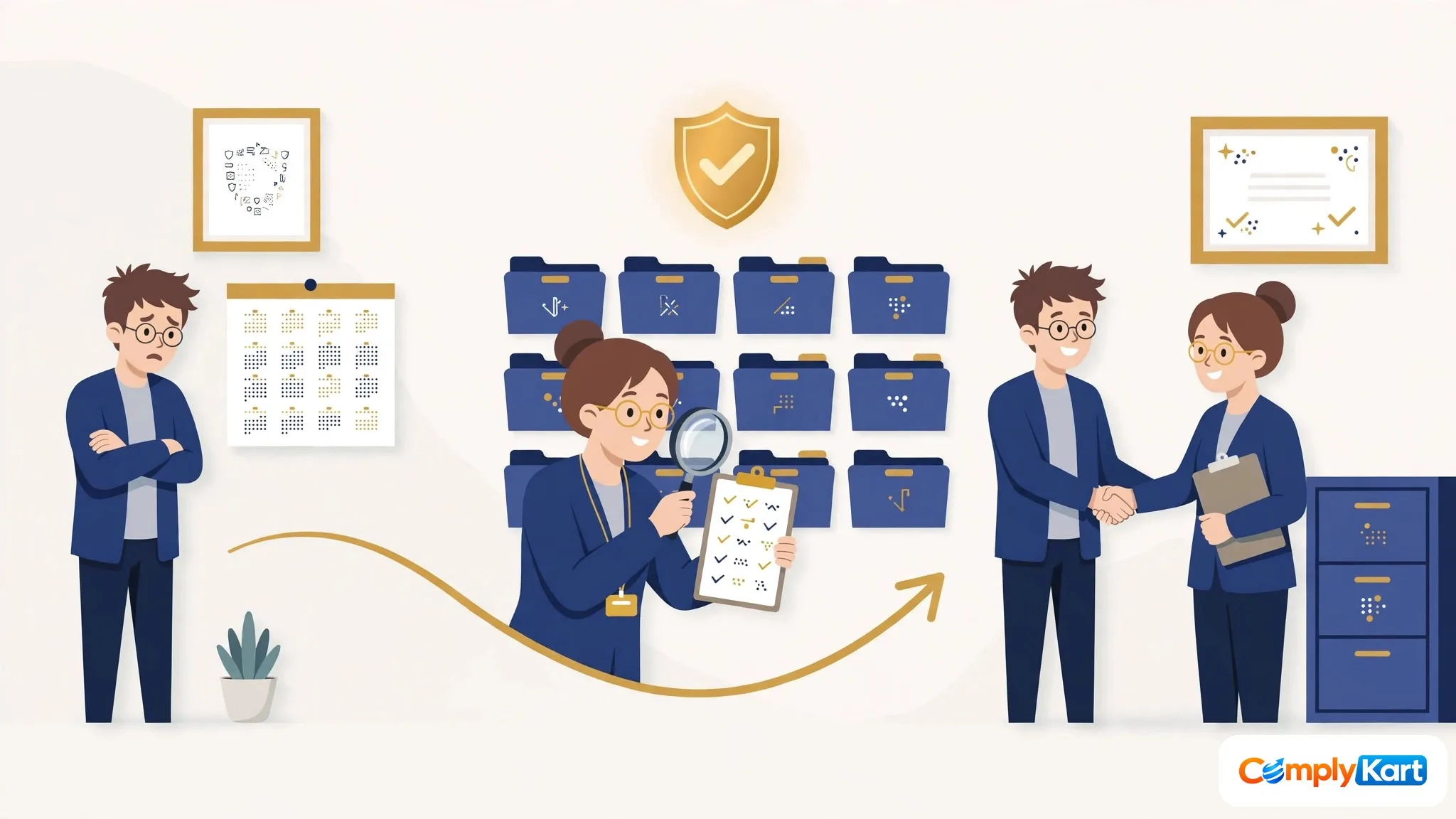
ISO 9001 surveillance and renewal is the three-year audit cycle that keeps a quality management certificate valid after initial certification. A certification body visits once a year for a surveillance audit in years one and two, then runs a full recertification audit before the certificate expires, and a company that passes starts a fresh three-year cycle under ISO/IEC 17021-1.
The certificate on your wall has an expiry date, and that date is not decoration. An ISO 9001 certificate runs for three years, and the certification body comes back every year to check the system still works. Miss a visit, or fail one badly, and the certificate can be suspended. Pass the cycle, and a fresh three years begins.
Short answer: An ISO 9001 certificate is valid for three years. The certification body audits you once a year: a shorter surveillance audit in each of the first two years, then a full recertification audit before the certificate expires. Surveillance checks a sample of your system; recertification judges the whole three years. Pass recertification and a new three-year cycle starts.
What is a surveillance audit, really?
A surveillance audit is the certification body's yearly visit between your first certification and your renewal. The auditor does not re-examine your entire system. They sample it. Every visit covers a few things that never get skipped: your internal audits, your management review, how you handled complaints, and whether last year's findings actually got fixed. Around that core, they rotate through the rest of your processes, so that across the two surveillance years, most of the system gets looked at at least once.
Think of it like a car. Initial certification is the full roadworthiness test. A surveillance audit is the annual service: the mechanic checks the brakes, the oil, the lights, and anything that was flagged last time. They do not strip the engine down. That is what year three is for.
One rule shapes the whole timetable. Under ISO/IEC 17021-1, the standard that governs certification bodies, a surveillance audit must happen at least once per calendar year, except in the recertification year, and the first one must fall within twelve months of the certification decision. Your certification body will usually book the first visit a little before the anniversary, not after it, because a late visit squeezes everything that follows.
The three-year cycle, with real dates
Dates make this concrete. Say your certificate is issued on 15 March 2027. Your cycle looks like this:
First surveillance audit: by March 2028, roughly a year after certification. Second surveillance audit: by March 2029. Recertification audit: completed, with its decision taken, before 15 March 2030, when the certificate expires. Pass it, and your new certificate runs to March 2033, and the whole pattern repeats.
Certification bodies usually schedule recertification sixty to ninety days early, so a major finding still leaves time to fix it before the old certificate lapses. A recertification booked in the final fortnight leaves no room for that, and a lapsed certificate is a gap your buyers will notice.
For a small company, a surveillance visit is usually a short affair, often half a day to a day on site, against a longer Stage 2 audit at initial certification. The auditor's time is set by the certification body's rules, based on headcount, sites and complexity, not by how nervous you are. If you are still deciding whether certification is worth it at your size, our guide to ISO 9001 for small businesses and startups works through the same cost-versus-trigger question from the other side.
What the auditor checks at a surveillance visit
Expect the visit to open with the same questions every year. What changed since last time? New sites, new processes, new key people, a big new customer, a product line dropped? Change is where systems quietly break, and auditors know it. Then they follow the trail: internal audit reports and whether the findings closed, the management review minutes and whether the decisions in them actually happened, customer complaints and how each one was handled, and the corrective actions from the previous external audit.
Then comes the sampling. The auditor picks a handful of processes and follows them from start to finish: an order, a complaint, a supplier problem, a training record. They are not looking for perfection. They are looking for evidence that what your documents say matches what your people actually do. The single most common surveillance embarrassment is a beautiful procedure nobody follows. If your documented process says every complaint gets logged within a day, and the log shows a three-week gap, that gap is the finding, not the complaint itself.
Minor finding, major finding: what each one costs you
Not every finding threatens the certificate. A minor nonconformity is a single slip: one record missing, one step skipped, one procedure not quite followed. You agree a correction and a corrective action, you show evidence, and the auditor closes it, often without another visit.
A major nonconformity is different. It means a whole requirement is missing, or the system has broken down in one area, or the same minor keeps coming back. A major puts the certificate at risk. Certification bodies commonly give up to three months to close a major with evidence, and they may verify it with a follow-up visit. If the evidence does not arrive, or the fix does not hold, the body can suspend the certificate. Suspension means you cannot claim certification or use the mark until it is lifted. Leave it unresolved, and suspension turns into withdrawal, and withdrawal means starting over with a fresh initial certification audit.
The practical lesson is unglamorous: close minors fast, and never let a minor repeat. A repeated minor is how a small problem becomes a major at the next visit, because the auditor now has evidence that your corrective action process itself does not work.
Recertification: the audit that judges the whole three years
Recertification is not a longer surveillance audit. Under ISO/IEC 17021-1, it must evaluate the overall performance of your quality management system across the entire certification cycle. The auditor reviews both surveillance reports, every corrective action across the three years, complaints received, and whether the system improved or merely survived. Every part of the system gets audited again, the way it did at Stage 2.
That is why your file for the cycle matters more than your file for the year. Before recertification, gather the two surveillance reports, the internal audit reports for all three years, the management review minutes, the complaint log with closures, and the evidence for every corrective action. Our ISO 9001 documents checklist lists exactly the records an auditor will ask for, so you can check your file against it before the visit. If a finding from year one was closed with "training given", the recertification auditor may ask who was trained, when, and whether the problem recurred. "We fixed it" is a claim. The record is the proof.
What surveillance and renewal cost
Two bills arrive across the cycle, and they are separate. The certification body charges for each audit visit: surveillance visits cost less than Stage 2 or recertification because they take less auditor time, and the fee depends on your size, sites and complexity. Those fees are charged by the body at its own rates, and any honest quote will show them separately rather than folding them into a single number.
Our own consultancy pricing for ISO 9001 stays the same frame as at certification: ₹9,999 for up to 25 employees and ₹19,999 for 26 to 100 employees, with certification-body audit fees extra at actuals. If you want help preparing for a surveillance or recertification visit, ask for that support before the visit is booked, not after the auditor's report lands. Preparation after a major finding is damage control; preparation before it is just good planning.
Budget for the cycle, not the year. A company that prices only the first certificate and forgets two surveillance visits and a recertification audit has under-budgeted by roughly half the three-year cost. Put all four visits in the diary on the day the first certificate arrives. If you are mapping the full cost of staying compliant, our compliance fee calculator helps you put the recurring filings and audits in one place.
The 2026 edition twist: transition rides on this cycle
If your certificate is to ISO 9001:2015, your cycle now carries a second job. ISO 9001:2026 was published on 16 September 2026, and under the transition rules set by Global ACI, every ISO 9001:2015 certificate must move to the new edition by 30 September 2029. From 31 March 2028, new and initial certificates can only be issued to the 2026 edition.
The useful part: transition does not need its own audit. It can be assessed at a scheduled surveillance audit or at recertification. If your recertification falls between late 2027 and mid-2029, that is usually the cheapest moment to transition, because the auditor is already examining everything. But do not leave it to a recertification in the summer of 2029. A major finding then leaves almost no time to fix it before the 30 September 2029 deadline, and the deadline does not move for one company.
One trap deserves a plain warning. A certificate issued to the 2015 edition in early 2028, before the March cut-off, still has to transition by September 2029. That is a transition within about eighteen months, not a full three-year cycle. If you are certifying for the first time now, ask your certification body to run the audit against the 2026 edition from the start, and save yourself the double work.
Five mistakes that put certificates at risk
First, treating surveillance as a formality. Companies that coast into year two with no internal audit since certification are the ones that get surprised. Second, letting the management review become a signature exercise. If the review never produces a decision, the auditor will notice, because the standard requires the review to drive action.
Third, closing findings on paper. A corrective action that says "staff reminded" with no evidence and no follow-up check will not survive the next visit. Fourth, hiding a change. A new site or a dropped process that the certification body first hears about from the auditor is a scope problem, not a surprise worth keeping. Fifth, booking recertification late. The companies that lapse are rarely the worst-run. They are the ones that left sixty days of slack and then found a major finding in week one.
Getting ready: the month before the visit
A month before a surveillance audit, run your own short rehearsal. Read the last external report and check every finding is closed with evidence, not just words. Run the internal audit you had planned for this period, even if it is a small one, and record it properly. Check the complaint log is complete and every complaint has a closure note. Confirm the management review happened and its decisions were carried out. Brief the people the auditor will speak to: they should answer from what they actually do, not recite the manual. If someone's real process differs from the documented one, fix the document before the visit, or fix the process. Either is fine. The gap between them is the problem.
For recertification, add one more step: read all three years together. Look for the pattern across your findings. If the same kind of slip appears in each year, fix the pattern, not the instance, and be ready to show the auditor what changed. That is the difference between a company that holds a certificate and a company that runs a system.
FAQs
How often are ISO 9001 surveillance audits?
At least once per calendar year, except in the recertification year, under ISO/IEC 17021-1. The first surveillance audit must fall within twelve months of the certification decision. A standard three-year certificate therefore has two surveillance audits, one in each of the first two years, before recertification in year three.
What happens if I miss a surveillance audit?
Talk to your certification body immediately, before the due date passes. A short delay can sometimes be rescheduled, but a missed surveillance visit puts the certificate at risk of suspension, because the body cannot confirm continued conformity without it. A suspended certificate cannot be claimed or used in tenders until it is restored.
Is recertification the same as starting over?
No. Recertification is a full audit of the whole system, like Stage 2, but it builds on your three-year history: surveillance reports, corrective actions and complaints across the cycle. Starting over after a withdrawal, by contrast, means a fresh initial certification audit with no history carried forward.
Can I change certification bodies at renewal?
Yes, and recertification is the cleanest moment to do it. The new body will review your current certificate, past audit reports and any open findings before accepting the transfer. Open major findings and a certificate close to expiry both complicate a transfer, so start the conversation early.
Do I need to transition to ISO 9001:2026 at my next audit?
Not necessarily at the very next one, but the clock is fixed: all ISO 9001:2015 certificates must transition by 30 September 2029, and transition can be assessed at a surveillance audit or at recertification. Plan it for a visit with enough slack afterwards to close any findings, and never for a recertification in the summer of 2029.
A certificate is not a trophy for a project you finished. It is a promise you renew every year, in front of an auditor, with evidence. Companies that treat the surveillance years as part of the system, rather than an interruption to it, are the ones whose recertification feels routine. Put the four visits in the diary now, keep the records honest between them, and the renewal takes care of itself. If you want help preparing for a surveillance or recertification visit, our ISO 9001 certification team can walk through your last audit report with you before the next visit is booked.




Comments
No comments yet — ask the first question below.
Join the discussion
Questions go straight to our expert desk. Comments appear after a quick review — no spam, no noise.