
IN BRIEF
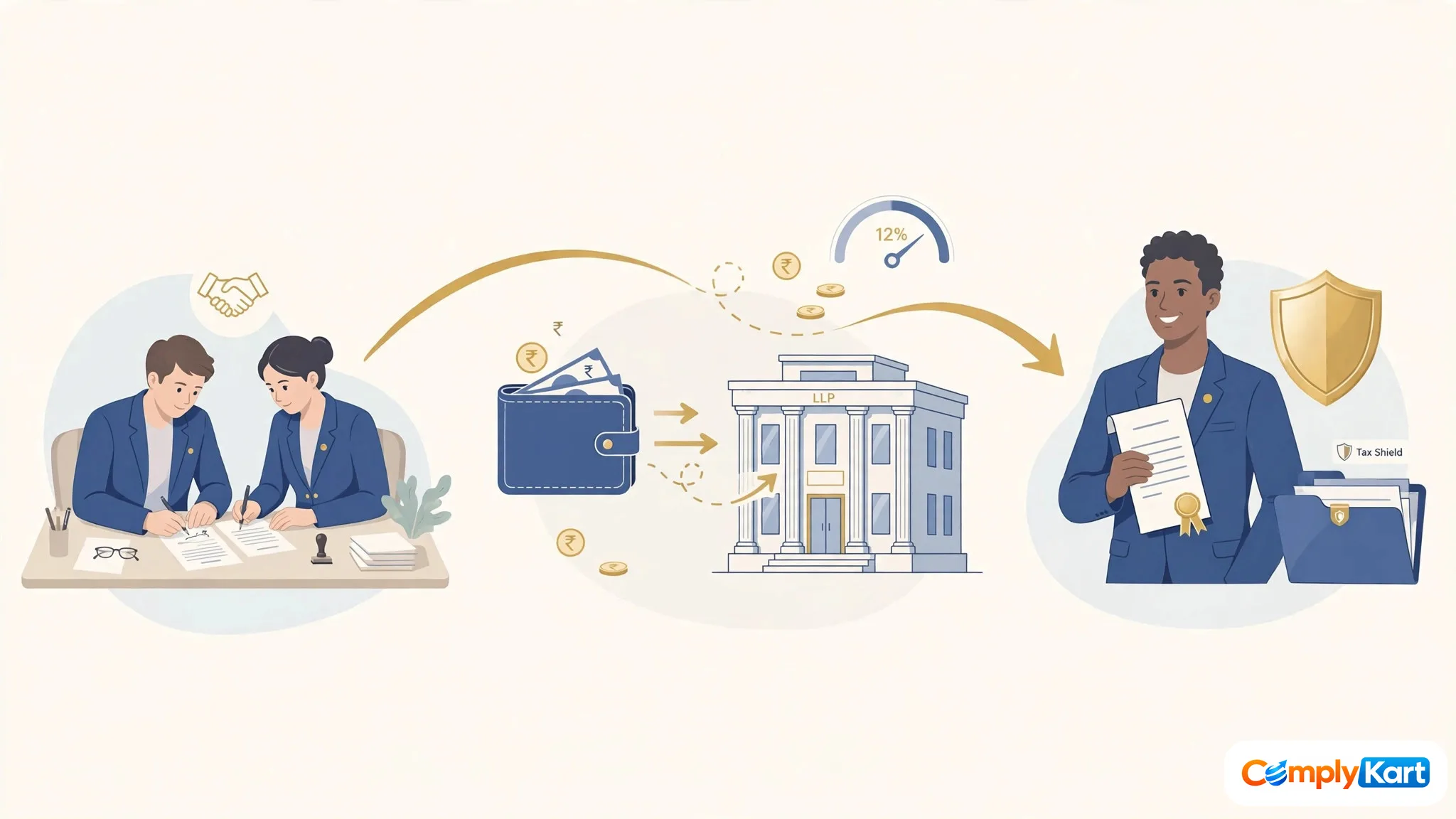
A partner loan in an LLP is money a partner lends to the Limited Liability Partnership under a written loan agreement, repayable with or without interest, instead of adding to the partner's capital contribution. The LLP Act, 2008 does not prohibit it, but interest is deductible only up to 12% a year under section 40(b) of the Income-tax Act, and TDS applies under section 194T.
Your LLP needs ₹20 lakh, and it needs it this month. One partner has the money sitting in a savings account. The obvious move is to borrow it from them — no bank queue, no collateral, no dilution. It works, and plenty of LLPs do exactly this. But a partner loan is not free money, and it is not equity wearing a different name. The tax rules put a hard ceiling on the interest, TDS now applies where it never used to, and a cash handshake can cost you the entire amount as a penalty.
Yes. An LLP can borrow from its partners — the LLP Act, 2008 does not prohibit it, and the terms are set by the LLP Agreement. But a partner loan is debt, not equity: it does not change the profit-sharing ratio, it cannot bring in an outside investor, and interest is deductible only up to 12% a year under section 40(b) of the Income-tax Act.
What does "equity" actually mean in an LLP?
It means nothing, strictly speaking. An LLP has no shares. There is no share capital, no preference shares, no convertible notes. The closest thing to equity is a partner's capital contribution — the money recorded against their name in the LLP Agreement. An LLP and a private limited company raise money in completely different ways, and that difference is the whole point of this article.
That contribution earns a share of the profits, not a fixed return. And the profit share does not have to match the contribution. One partner can put in 20% of the capital and still take 40% of the profits, if the agreement says so. The agreement is the whole constitution here: it decides who puts in what, who gets what, and who decides what.
A loan sits on the other side of that line. It is money the LLP owes, on a date, with interest. It does not buy a bigger share of the business. It does not give the lending partner a bigger vote, unless the agreement separately gives them one. Confusing the two is where most partner-loan disputes start — a partner who lent ₹10 lakh and later argues it should count as capital, or a partner who contributed capital and later demands it back like a loan.
Can an LLP legally borrow from its partners?
Yes. Nothing in the LLP Act, 2008 stops it, and the Act sets no numerical limit on how much an LLP can borrow from a partner. Any limit comes from the LLP Agreement itself, or from conditions a bank has put on the LLP.
That freedom has one condition that matters more than the freedom itself: the LLP Agreement has to allow it. If your agreement is silent on partner loans, or silent on paying interest to partners, fix the agreement before the money moves. Amending it means filing Form 3 with the Registrar within 30 days of the amendment. The loan itself needs no separate ROC filing — it appears as a liability in the LLP's accounts and in the Statement of Account and Solvency, Form 8, which is part of the LLP's annual filing due by 30 October each year.
One more thing the LLP Act does not have: the Companies Act's deposit regime. Section 73 of the Companies Act restricts companies from accepting deposits. The LLP Act has no equivalent. A loan from a partner is a borrowing under the agreement, not a deposit. That does not make it unregulated — the tax rules below are strict — but it does mean nobody is going to ask you for a deposit circular. If your LLP is a trading business, the funding question usually arrives alongside IEC and GST — the trading-LLP guide walks through that sequence in order.
Partner loan vs capital contribution
| Basis | Partner loan | Capital contribution |
|---|---|---|
| Nature | Debt the LLP owes the partner | Ownership stake in the LLP |
| Return | Interest at the agreed rate | Share of profit, plus interest on capital if the agreement allows it |
| Repayment | On the dates fixed in the loan agreement | Normally only on retirement, exit or winding up |
| Effect on profit share | None | Can change the profit-sharing ratio |
| Interest deduction for the LLP | Up to 12% a year | Up to 12% a year |
| Documents | Loan agreement, plus an enabling clause in the LLP Agreement | Amendment to the LLP Agreement |
| ROC filing | None for the loan itself | Form 3 for the change in contribution |
| Where it appears | As a liability in the accounts and in Form 8 | As partners' contribution |
The 12% rule: how much interest can the LLP actually deduct?
Section 40(b) of the Income-tax Act sets the ceiling. Interest paid to a partner is deductible only if the LLP Agreement authorises it, and only up to 12% simple interest a year. The ceiling covers interest on a partner's loan and interest on capital alike. Pay more, and the excess is added back to the LLP's taxable income.
Two conditions, both enforced. First, the agreement must authorise the payment — the Kerala High Court held in Novel Distributing Enterprises v DCIT that interest on current-account balances the deed did not authorise was not deductible at all. Second, the rate must stay at or under 12%. Here is what that looks like on real numbers.
A partner lends ₹15 lakh for a full year at 15% interest. The LLP pays ₹2,25,000 in interest. Only ₹1,80,000 of it — 12% of ₹15 lakh — is deductible. The remaining ₹45,000 is added back to the LLP's income and taxed at the LLP rate. And TDS at 10% applies on the full ₹2,25,000 paid, which is ₹22,500 — the TDS follows the payment, not the deductible part.
There is a second test running alongside the interest cap, and partners who take both interest and remuneration trip over it. Remuneration to working partners is deductible only within the limits section 40(b) sets on book profit: the higher of ₹3,00,000 or 90% of the first ₹6,00,000 of book profit, plus 60% of the balance. Take a book profit of ₹30 lakh. The remuneration ceiling is 90% of ₹6 lakh (₹5,40,000) plus 60% of ₹24 lakh (₹14,40,000) — ₹19,80,000 in all. A partner taking ₹6 lakh as remuneration is comfortably inside it. But the interest and the remuneration are tested separately, and each needs the agreement to authorise it. One clause covering both, written before the year starts, is the cheapest insurance in this whole arrangement.
The tax maths most partners miss
Here is the part nobody tells you at the signing table. A partner loan does not make the interest disappear from the tax system. It moves it.
Take an LLP with ₹30 lakh of profit before interest. A partner lends ₹20 lakh at 12%, so the LLP pays ₹2,40,000 in interest. The LLP's taxable profit falls to ₹27,60,000. At the LLP rate of 30% plus 4% cess — 31.2% — the tax is ₹8,61,120, against ₹9,36,000 without the loan. The LLP saves ₹74,880.
Now look at the partner's side. That ₹2,40,000 of interest is taxed in the partner's hands as business income, to the extent the LLP was allowed the deduction. At the 30% slab, the partner pays ₹72,000 plus 4% cess — ₹74,880. To the rupee, the same number. At the top slab, the loan is a wash: the tax leaves the LLP and arrives at the partner. At a lower slab, the partner keeps some of the saving. That is the honest arithmetic, and it is the reason a partner loan is a timing and cash-flow tool, not a tax-saving scheme.
Think of it like borrowing from a family member to fix the roof. The money helps today, and the roof gets fixed. But the loan still has a date on it and interest on it. Putting money into the house itself — capital — is a different thing entirely: you only get it back when you sell or move out.
TDS under section 194T: the rule that changed in 2025
Interest paid by a firm to its partners used to be exempt from TDS. That ended on 1 April 2025. Section 194T, inserted by the Finance (No. 2) Act, 2024, requires the firm — and a firm includes an LLP — to deduct 10% TDS on salary, remuneration, commission, bonus and interest paid or credited to a partner, once the total for that partner crosses ₹20,000 in a financial year.
Three details catch people out. First, the ₹20,000 threshold is an aggregate across all five kinds of payment to the same partner. A partner credited with ₹15,000 of remuneration and ₹12,000 of interest has received ₹27,000 in total — over the threshold — so TDS of 10% applies on the entire ₹27,000, which is ₹2,700. Each item alone was under ₹20,000. That does not matter.
Second, TDS applies at the earlier of credit or payment — and a credit to the partner's capital account counts. An LLP that credits interest on 31 March and pays it in June still deducts the TDS in March. Third, if the partner has not furnished a PAN, the rate doubles to 20%.
The compliance tail is real: deposit the TDS on time, file the quarterly TDS return, and give the partner their certificate so they can claim the credit. Late deduction draws interest at 1% a month, late payment at 1.5% a month, and 30% of the interest expense can be disallowed. A late TDS return costs ₹200 a day, capped at the TDS amount.
The cash rule: ₹20,000 is the line
Sections 269SS and 269T of the Income-tax Act say a loan or deposit of ₹20,000 or more must be taken and repaid only by account-payee cheque, account-payee bank draft or electronic transfer through a bank. The test counts the amount already outstanding from the same person, so a second cash loan of ₹6,000 when ₹15,000 is already outstanding is still a breach.
The penalty is the part that makes partners go quiet. A breach of section 269SS draws a penalty under section 271D equal to the amount taken in cash. A cash repayment in breach of section 269T draws the same under section 271E. The penalty is about the mode of payment, not about whether the money was accounted for — a genuine, fully recorded loan taken in cash still attracts it, though section 273B gives relief where the taxpayer can show reasonable cause.
So the rule for a partner loan is simple: bank to bank, both ways, every time. No cash at either end, not even a small part of it.
Section numbers change from 1 April 2026
The Income-tax Act, 2025 is in force from 1 April 2026. The rules above do not change in substance, but their numbers do. If you are reading an older article — or filing for tax year 2026-27 onwards — use the new numbers:
| Rule | Income-tax Act, 1961 | Income-tax Act, 2025 |
|---|---|---|
| TDS on partner payments | Section 194T | Section 393 |
| Cash loans banned | Section 269SS | Section 185 |
| Cash repayments banned | Section 269T | Section 188 |
| Penalty for cash loan | Section 271D | Section 450 |
| Penalty for cash repayment | Section 271E | Section 453 |
Transactions up to 31 March 2026 are still dealt with under the 1961 Act, so the old numbers will keep appearing in notices and assessments for earlier years. The deduction rules in section 40(b) also carry into the new Act under new section numbers — confirm the current reference before you file.
What the loan agreement must say
A partner loan with no paperwork is a dispute waiting for a trigger — usually an exit, a death, or an assessment. The loan agreement does not need to be long. It needs to be complete:
- The amount, and the date it moves from the partner's bank account to the LLP's bank account.
- The interest rate — fixed at or below 12% a year if you want the full deduction — and whether it is simple interest.
- The tenure and the repayment schedule: dates, instalments, and what happens on a missed instalment.
- Whether the loan is secured, and if so, against what.
- Whether the partner can demand early repayment, and on how much notice.
- What happens if the partner exits or dies — who the loan is owed to, and when.
- Whether the loan ranks behind any bank loan. Banks lending to LLPs commonly ask that partner loans stay in the business until the bank loan is repaid.
- A clause in the LLP Agreement itself authorising partner borrowing and interest — without it, the deduction fails even if the loan agreement is perfect.
Get the loan agreement stamped as per the stamp law of your state before signing. Keep a separate ledger for each partner's loan and capital — never mix the two in one account.
The six steps, in order
Step 1. Check the LLP Agreement. Make sure it permits loans from partners and payment of interest. If not, amend it and file Form 3 within 30 days.
Step 2. Fix the terms in writing. Amount, rate within the deductible limit, tenure, repayment dates, and security if any — all in a signed loan agreement.
Step 3. Transfer the money electronically. From the partner's bank account to the LLP's bank account. No cash, not even part of it.
Step 4. Record it properly. In the books as a loan, separate from the partner's capital account. Keep the bank statements and the lending partner's source-of-funds proof.
Step 5. Deduct TDS on the interest. Under section 194T where the partner's payments cross ₹20,000 in the year. Deposit it on time and file the quarterly TDS return.
Step 6. Repay through the bank. Report the loan in the LLP's accounts, in Form 8, and in the income tax return (ITR-5).
Which funding route should you pick?
| Route | Ownership effect | Right for |
|---|---|---|
| Partner loan | None | A short internal gap — a delayed client payment, a seasonal spike |
| More capital from existing partners | Can change the profit share | Permanent funding the business will keep |
| New partner with a contribution | Dilutes the existing partners' share | Bringing in a working or funding partner |
| Bank or NBFC loan | None, but personal guarantees are likely | Working capital and growth, with a repayment discipline |
| Convert to a private limited company | Equity for new investors | Raising outside equity, ESOPs, a future venture round |
The loan wins when the need is temporary and the money is already in the room. It loses when the need is permanent — a loan that never gets repaid is capital in disguise, and the accounts will eventually say so. And it cannot do the one thing founders usually want most: bring in an outside investor. An outsider who wants ownership has to become a partner and contribute capital, or the LLP has to convert into a private limited company, which is the structure venture money understands. If you are still weighing the LLP against running the business on your own, the funding difference is stark — a sole proprietor has no separate entity to borrow from at all. Before you commit to any route, it is worth running the numbers through the compliance fee calculator so the filing costs sit next to the funding costs in one picture.
What happens to the loan when the lending partner exits or dies?
The loan does not disappear with the partner. It is a liability the LLP owes, and on exit it is repayable on the terms in the loan agreement — not on the terms of the partner's exit. That is why the agreement should say what happens on exit: immediate repayment, repayment over a fixed period, or set-off against the partner's capital balance.
On death, the amount is owed to the partner's legal heirs, and the LLP's accounts have to show it as a loan, separate from the deceased partner's capital. An undocumented loan at that point is almost impossible to separate from capital, and the family and the remaining partners end up arguing over the same pile of money. A one-page loan agreement written today is what prevents that argument. And if the LLP itself is closing down rather than losing one partner, the loan ranks as a liability in the winding-up — it is paid before any capital is returned.
Six mistakes that turn a good tool into a liability
Taking cash from a partner because it is easy. A ₹4 lakh cash loan can draw a ₹4 lakh penalty. The bank transfer takes five minutes.
Paying 18% interest and deducting all of it. Only 12% is deductible. The rest is added back, and TDS still applies on the full payment.
Missing TDS because it used to be exempt. Section 194T is in its second year now. Partner interest without TDS is an increasingly common notice trigger.
Treating a loan as if it will turn into equity. It will not, by itself. An LLP cannot issue convertible instruments. Turning a loan into capital needs an agreed amendment to the LLP Agreement, or a conversion to a company.
Mixing the loan with the partner's capital account. One ledger for the loan, one for the capital. Mixed accounts are how recharacterisation disputes start.
Paying interest the LLP Agreement does not authorise. The deduction fails entirely, not just the excess. Check the agreement first.
FAQs
Can an LLP take an interest-free loan from a partner?
Yes. Interest is not compulsory. With no interest there is no deduction for the LLP and no TDS on interest — but the loan should still be documented and received through the bank, and the interest-free terms should be written down so nobody later argues about it.
Is there a limit on how much an LLP can borrow from partners?
No. The LLP Act sets no limit. Any limit comes from the LLP Agreement or from conditions set by the LLP's bank — and banks often cap partner loans or ask them to stay subordinated until the bank loan is repaid.
Can an LLP borrow from a partner's relative or an outsider?
Yes, if the LLP Agreement permits it. The 12% cap and section 194T apply only to partners, but the ban on cash loans of ₹20,000 or more applies to every lender, and TDS on interest may apply under the general provisions. Document it the same way.
Does a partner loan need to be reported to the ROC?
Not as a separate filing. The loan appears as a liability in the LLP's accounts and in the Statement of Account and Solvency (Form 8). Form 3 is needed only if the LLP Agreement is amended.
Can an NRI partner give a loan to an LLP?
That is governed by FEMA and the RBI's rules on borrowing from non-residents, which were revised in February 2026. A loan from a non-resident is treated as external borrowing, not as a partner contribution. Take professional advice before accepting one — and note that foreign investment in an LLP comes in as capital contribution, under the automatic route only in sectors where 100% FDI is permitted.
A partner loan is a legitimate, common way for an LLP to bridge a funding gap. Paper it properly, keep the interest within 12%, avoid cash, and deduct the TDS. And if the real goal is ownership money from outsiders, ask the harder question: is an LLP still the right structure? The answer decides whether you need a loan agreement or a fresh look at how your LLP is set up.





Comments
No comments yet — ask the first question below.
Join the discussion
Questions go straight to our expert desk. Comments appear after a quick review — no spam, no noise.