
IN BRIEF
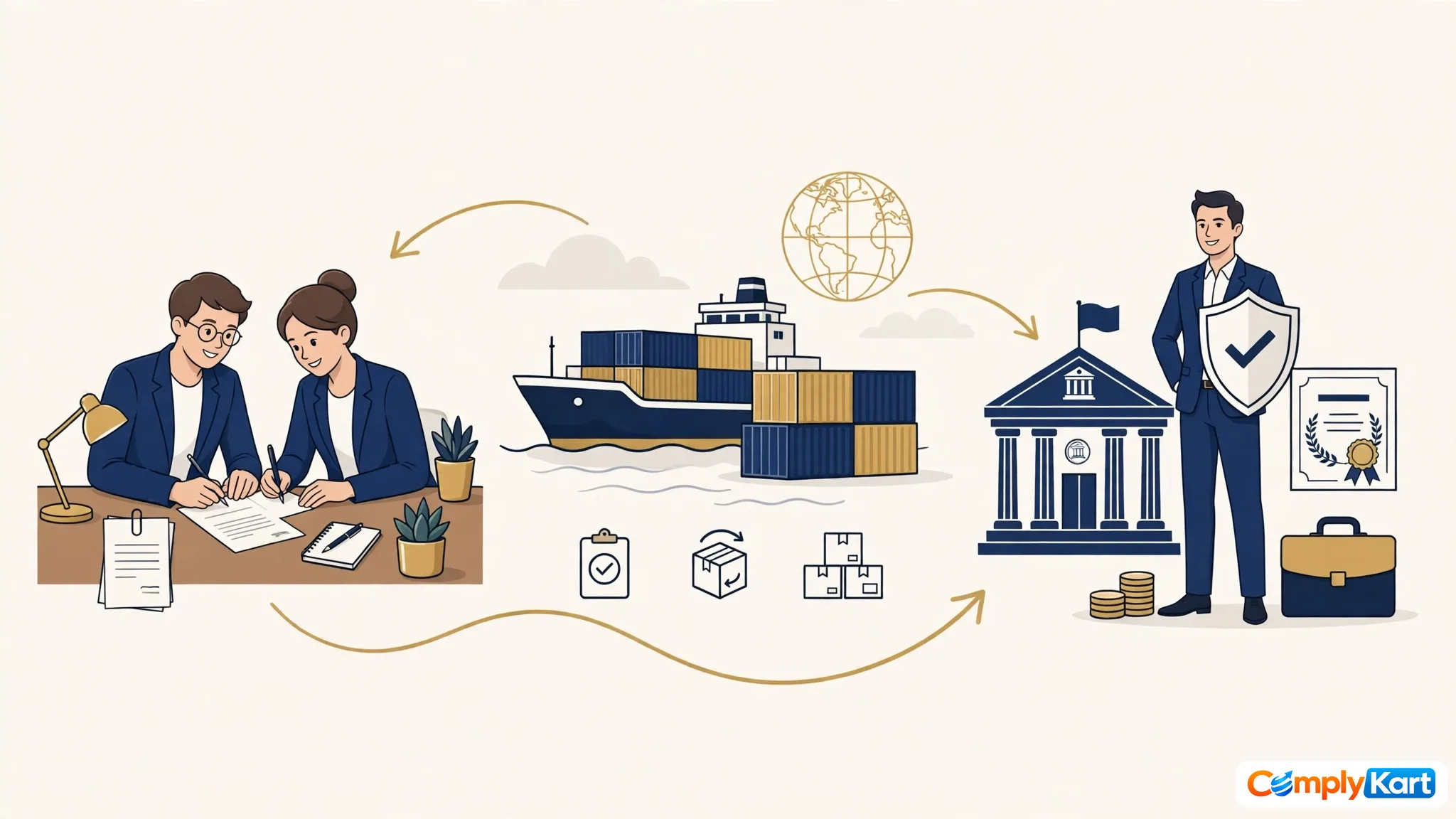
An LLP for trading and import-export is a Limited Liability Partnership registered under the Limited Liability Partnership Act, 2008, whose business is buying and selling goods within India or across its borders. It needs an Importer-Exporter Code from the DGFT and GST registration, a Letter of Undertaking for exports, and it must bring export proceeds home within the time limits in the FEMA Regulations, 2026.
Short answer: Yes. A Limited Liability Partnership can run a trading or import-export business in India, and for two or more partners it is often the most sensible structure. You register the LLP, get an Importer-Exporter Code from the DGFT, register for GST, file a Letter of Undertaking before your first export, and bring export proceeds home within nine months.
Can an LLP actually run a trading or import-export business?
Yes — and the law is plain about it. An LLP is a body corporate under the Limited Liability Partnership Act, 2008, with a legal identity separate from its partners. It can own stock, sign supplier contracts, open a current account, issue invoices and sue or be sued in its own name. The MCA's own FAQs say an LLP must be formed for a lawful business with a view to earning profits. Trading and import-export clear that test easily.
What an LLP cannot do is everything. It cannot raise equity from investors the way a company can, and it cannot issue shares or ESOPs. If your plan is to raise venture money in two years, stop here and register a private limited company instead. If your plan is two or three partners buying and selling goods together, keep reading.
One condition matters at incorporation: the LLP's business must be lawful and profit-seeking. That sounds obvious, but it is the reason the FiLLiP form asks for your NIC code — the code tells the Registrar what you actually do. A trading LLP picks a wholesale or retail code, not a consultancy code, and the code should match the business you go on to run.
Why traders pick an LLP — and when they shouldn't
Trading runs on credit. You buy stock on 30-day terms, sell on 60-day terms, and somewhere in between a buyer defaults or a shipment is delayed. In a proprietorship or a traditional partnership, that gap can reach your house. In an LLP, your liability stops at your agreed contribution — unless you have personally done something wrongful. That single fact is why family trading firms have moved to LLPs in large numbers.
The second reason is flexibility. The LLP agreement decides who puts in what, who earns what, and who signs what. A working partner and a money partner can be treated differently. A company forces you into shares, board meetings and a fixed governance rhythm. An LLP lets the partners write their own rules, and change them with a Form 3 when the business changes.
| Question | LLP | Private limited company | Proprietorship |
|---|---|---|---|
| Who runs it? | Partners, as the agreement says | Board of directors | You alone |
| Your personal assets at risk? | No, beyond your contribution | No, beyond your shares | Yes, fully |
| Can it raise equity or issue ESOPs? | No | Yes | No |
| Annual compliance load | Light — two MCA filings, no AGM | Heavy — board meetings, AGM, audit | Lightest — mostly tax only |
| Statutory audit | Only if turnover crosses ₹40 lakh or contribution crosses ₹25 lakh | Mandatory every year | Only the tax audit, if triggered |
| Right for | Partner-funded traders and merchant exporters | Funded startups, many investors | A solo trader testing the waters |
The honest test is simple. If you need outside equity, an LLP is the wrong vehicle and no amount of flexibility fixes that. If you need bank limits, supplier credit and a structure that survives a partner retiring, an LLP is usually the right one. If you are alone, read our LLP vs sole proprietorship guide before deciding — a one-person business cannot be an LLP at all, because an LLP needs two partners.
The launch sequence: ten steps in the right order
Order matters here. File things in the wrong sequence and you wait weeks for a correction that a morning's planning would have avoided.
- Agree the deal between partners first. Capital, profit share, who buys, who signs, who handles the bank. Write it down before you spend a rupee.
- Reserve the name through RUN-LLP (₹200, up to two names, reserved for 90 days) — or reserve it inside FiLLiP itself.
- File FiLLiP for incorporation, with the NIC code, partner details, registered office proof and contribution. The same form applies for PAN and TAN.
- Sign and file the LLP agreement in Form 3 within 30 days of incorporation. This is the step people miss, and the late fees are slab-based now, not a flat daily charge.
- Open the current account in the LLP's name with a bank that handles foreign trade — you need an authorised dealer bank for import and export payments.
- Apply for the IEC on the DGFT portal (₹500). It comes in the LLP's name, on the LLP's PAN.
- Register for GST. For a goods trader this is compulsory from the first rupee — exports and inter-state supplies do not get a threshold. See the GST section below.
- File the LUT in Form GST RFD-11 before your first export shipment. Without it, you pay IGST on the export and wait months for the refund.
- Register the AD code at your port through ICEGATE, so shipping bills and bills of entry can be filed.
- Take the RCMC from your Export Promotion Council if your product has one — it is the key to most export benefits. Small exporters shipping up to ₹3 lakh FOB are exempt from the RCMC requirement since 15 September 2026.
Product licences sit outside this list and catch people out. Food imports need FSSAI, drugs need a drug licence, and agricultural exports may need APEDA registration. If you are unsure whether your product needs one, check before the first order, not after it is stuck at the port. Our APEDA vs IEC guide explains which registration comes first for farm products.
What does it cost to set up?
Government fees for an LLP are slab-based, and the slab follows your contribution. Here is the table that matters:
| Step | Fee |
|---|---|
| RUN-LLP name reservation | ₹200 |
| FiLLiP incorporation (contribution up to ₹1 lakh) | ₹500 |
| FiLLiP (₹1–5 lakh) | ₹2,000 |
| FiLLiP (₹5–10 lakh) | ₹4,000 |
| FiLLiP (₹10–25 lakh) | ₹5,000 |
| FiLLiP (₹25 lakh–₹1 crore) | ₹10,000 |
| FiLLiP (above ₹1 crore) | ₹25,000 |
| Form 3 — LLP agreement filing | ₹50 to ₹600 by contribution |
| IEC application (DGFT) | ₹500, one-time |
| Stamp duty on the LLP agreement | State subject — check your state |
Take a concrete case. Two partners put in ₹10,00,000 between them and register in Maharashtra. RUN-LLP costs ₹200. FiLLiP falls in the ₹5–10 lakh slab: ₹4,000. Form 3 for a ₹10 lakh contribution costs ₹150. The IEC costs ₹500. Stamp duty in Maharashtra runs at 1% of the contribution — ₹10,000 on ₹10 lakh, inside the ₹15,000 cap. Total: ₹14,850 before professional fees. That is the whole government cost of a trading LLP, and it is worth knowing before anyone quotes you a package.
Two warnings. First, stamp duty is a state subject, so the Maharashtra figure above is not your figure if you register in Delhi or Tamil Nadu — ask your professional for your state's rate before signing. Second, a Small LLP — contribution up to ₹25 lakh and turnover up to ₹40 lakh — pays lower fees and lower penalties across the board. If you qualify, say so on the forms; the relief is not automatic if you file as a regular LLP.
For a quick sense-check of the total before you commit, the compliance fee calculator on this site works out MCA filing fees from your contribution figure.
Pick the right NIC code
FiLLiP asks for the NIC-2008 code of your main activity, and this is where trading LLPs most often file the wrong thing. The code is a five-digit number, not a description. For a general wholesale trader, the code is 46909 — other non-specialised wholesale trade. A textile wholesaler uses 46411, a metals trader 46620, and an e-commerce seller holding its own stock uses 47912.
The division underneath tells you whether you are in the right family: Division 46 is wholesale trade, Division 47 is retail trade. If your code sits in Division 46 and you sell to businesses, you are in the right place. If you later add a genuinely different line — say you start manufacturing what you used to trade — that is a change worth recording, because the NIC code on your incorporation record is what banks, buyers and the ROC see when they look you up. If you are registering an LLP and the code choice is unclear, settle it before filing, not after the certificate arrives.
IEC: the one registration you cannot skip
The Importer-Exporter Code is a ten-digit number issued by the DGFT, tied to the LLP's PAN. No IEC, no import or export of goods — customs will not clear a consignment without it, banks will not process the payment, and the shipping bill cannot be filed. It costs ₹500, it is issued in the LLP's name (never in a partner's name), and it lasts for life.
Lifetime does not mean maintenance-free. Every IEC holder must confirm or update its details online between April and June each year, even if nothing has changed. Miss the window and the IEC is deactivated — and a deactivated IEC stops shipments. The update itself costs nothing and takes minutes; the deactivation costs you a consignment. Put the April–June window on the same calendar as your LLP filings.
Service exporters get a small carve-out: if you export only services and claim no Foreign Trade Policy benefits, you may not need an IEC at all. The moment you claim a benefit, or export goods, you need one. Our IEC guide for Amazon, Etsy and e-commerce exporters walks through the application step by step, and our IEC service page covers the documents you will need.
GST for a trading LLP: registered from the first rupee
Here is the rule that surprises new traders. A domestic-only goods business gets a ₹40 lakh turnover threshold before GST registration becomes compulsory. A trading LLP that imports or exports does not. Exports are inter-state supplies under section 7(5) of the IGST Act, and section 24(i) of the CGST Act makes registration compulsory for anyone making an inter-state taxable supply, regardless of turnover. Your first export order needs a GSTIN behind it. The same applies to inter-state sales inside India.
Once registered, exports are zero-rated under section 16 of the IGST Act. Zero-rated does not mean exempt — it means you charge 0% GST and keep the right to claim input tax credit on everything that went into the export. There are two ways to export:
With an LUT. File the Letter of Undertaking in Form GST RFD-11 on the GST portal before the first shipment. It is free, it is valid for one financial year, and it lets you ship without paying IGST at all. Think of it as a season ticket: one filing, and every export for the year travels tax-free at the border. Our GST LUT guide for exporters covers the filing itself, and our LUT filing service handles it if you would rather not do the portal work.
Without an LUT. You pay IGST on the export and claim it back as a refund under Rule 96. That is the single-ticket route: pay every time, queue for a refund every time. Refunds typically take two to six months, and that is two to six months of your working capital sitting with the department.
Put numbers on it. A ₹12,00,000 export order in an 18% IGST class of goods carries ₹2,16,000 of IGST. With an LUT, that ₹2,16,000 never leaves your account. Without one, it does — and you wait months to get it back. For a trading LLP running on thin margins, that single filing is often the difference between a comfortable month and a cash-flow scramble. The LUT also carries a clock of its own: goods must be exported within three months of the invoice date, and for services the export proceeds must be realised within one year.
One more thing the GST portal will ask about: the composition scheme is not available to you. It bars inter-state supplies, and your business is inter-state by definition. Do not let anyone file a CMP-02 for a trading LLP.
The import side: IGST at customs, credit after
Imports work the other way round. When your goods land, customs charges IGST on the assessable value plus the Basic Customs Duty — not on the invoice value alone. That IGST is then available to you as input tax credit, provided you are GST-registered and the goods go into taxable supplies.
Work it through once. You import stock with an assessable value of ₹10,00,000 and a Basic Customs Duty rate of 10%. The duty is ₹1,00,000. IGST at 18% applies to ₹11,00,000 — the value plus the duty — which is ₹1,98,000. You pay ₹2,98,000 at the port (before the small Social Welfare Surcharge on the duty), and the ₹1,98,000 of IGST comes back to you as credit to set off against the GST on your sales. The duty itself is a cost; the IGST is not, as long as your paperwork is straight and your GSTIN is correctly linked to the IEC and the AD code.
That linking is practical, not theoretical. Customs, the GST portal and your bank all need to agree on who you are: the same PAN on the IEC, the GSTIN and the bank account, the same registered-office address, and the AD code registered at the port where your goods arrive. A mismatch in any one of them is the most common reason a first import stalls — our IEC guide covers the name-match trap in detail.
FEMA: two clocks that changed on 1 October 2026
This is the section most guides get wrong, because the rules changed recently. The Foreign Exchange Management (Export and Import of Goods and Services) Regulations, 2026 came into force on 1 October 2026 and replaced the 2015 Regulations. Two clocks matter for a trading LLP:
| Clock | The rule now | What changed |
|---|---|---|
| Export proceeds — goods | Realise and repatriate within 9 months of shipment | Same 9 months, but now in a single consolidated regulation |
| Export proceeds — invoiced in rupees | 12 months from shipment or invoice | The rupee-invoicing extension is now in the regulation itself |
| Export proceeds — services | 9 months from the invoice date | Unchanged in substance |
| Import payments | Within the period in your contract with the supplier | The old fixed six-month rule is gone — the contract governs |
| Merchanting trade | Gap between the two legs must not exceed 6 months | Retained from the earlier framework |
Three practical consequences follow. First, the nine-month export clock runs from the shipment date for goods, so a buyer who pays late is your problem to manage — your authorised dealer bank can extend the period if you ask with reasons, but you have to ask. Second, if export proceeds stay unrealised for more than a year past the due date, the LLP can only take further export orders against full advance payment or an irrevocable letter of credit. Third, the import side is now genuinely contractual: negotiate the payment period in the purchase contract, because the contract is what your bank will enforce. Keep every remittance certificate, shipping bill and bill of entry together — your bank closes its EDPMS and IDPMS entries on those documents, and for entries up to ₹10 lakh it can close them on your declaration alone.
Foreign partners add one more layer. Foreign investment in an LLP is permitted only in sectors where 100% FDI is allowed under the automatic route, without performance-linked conditions. If your overseas partner's sector carries a condition, the LLP route closes and you need a company. At least one designated partner must still be resident in India — someone who has stayed in India for at least 120 days during the financial year.
What tax does the LLP pay — and what do partners pay?
An LLP is taxed as a firm. It pays a flat 30% on its total income, plus a 12% surcharge where income crosses ₹1 crore, plus a 4% health and education cess. Up to ₹1 crore that works out to 31.2% effective. There is no concessional 22% company rate for LLPs, and no slab benefit. The partners' share of the profit is then exempt in their hands under section 10(2A) — the profit is taxed once, at the LLP level, and not again.
That flat rate looks worse than a company's 25.17% under section 115BAA, and on a straight comparison it is. Take a ₹20,00,000 profit. The LLP pays 30% — ₹6,00,000 — plus 4% cess of ₹24,000, a total of ₹6,24,000. A company on the 22% route pays ₹5,03,360 on the same profit. But the LLP has a lever the company does not: remuneration to working partners, deductible under section 40(b) within limits.
Run the same ₹20,00,000 with a ₹6,00,000 remuneration to the working partners. The section 40(b) ceiling on a ₹20 lakh book profit is ₹13,80,000 — 90% of the first ₹6 lakh plus 60% of the balance — so ₹6,00,000 is comfortably inside it. The LLP's taxable income falls to ₹14,00,000, and its tax to ₹4,20,000 plus cess of ₹16,800: ₹4,36,800. The partners pay tax on the ₹6,00,000 as business income; under the new regime a ₹6 lakh income after the standard deduction works out to no tax after the rebate. Combined tax: ₹4,36,800 against ₹6,24,000 without the lever — a saving of ₹1,87,200 on the same profit. The conditions are real, though: the remuneration must be authorised by the LLP agreement, paid only to working partners, and within the ceiling. Interest on capital is deductible only up to 12% a year, simple interest, and only if the agreement authorises it. Get the agreement right and the tax follows; get it wrong and the deduction fails. The LLP files its return in ITR-5 — by 31 July if no audit applies, by 31 October if a tax audit applies.
The LLP agreement clauses a trading LLP cannot skip
Most LLP disputes I see are not about the law. They are about two partners who never wrote down who could do what. For a trading LLP, the agreement needs ten things, and the generic templates cover about four of them.
- Capital contribution — who puts in what, in cash or kind, and when further capital can be called.
- Profit-sharing ratio — and whether it changes if one partner puts in more later.
- Purchase authority — who can buy stock, up to what value, and who negotiates with suppliers.
- Banking power — who signs, what the single-transaction limit is, and who operates the foreign-currency account.
- Credit sales policy — customer credit limits, payment terms, and who bears a bad debt.
- Stock and procurement policy — how inventory is recorded, who approves a new supplier, and how often stock is counted.
- Export documentation — who prepares the invoice, packing list, bill of lading and certificate of origin, and who checks them.
- Remuneration and interest — the section 40(b) authorisation, without which the tax deduction fails.
- Exit and admission — how a partner leaves, how a new one joins, and what the outgoing partner is paid.
- Dispute resolution — arbitration or courts, and where. Supplier lists, customer data and prices should also be covered by a confidentiality clause — in a trading business, the customer list is the business.
Family trading firms should read our LLP for family business guide alongside this one — it covers the succession and ownership questions that matter when the partners are also relatives. And remember the filing rule: the agreement goes to the ROC in Form 3 within 30 days of incorporation, and every change to it goes in Form 3 again within 30 days of the change.
The annual calendar
| When | What |
|---|---|
| 1 April | Renew the LUT for the new financial year, before the first export invoice |
| April–June | Annual IEC update on the DGFT portal (even if nothing changed) |
| 30 May | Form 11 — LLP annual return |
| 31 July | ITR-5, if no audit applies |
| 30 October | Form 8 — Statement of Account and Solvency (audit if turnover crosses ₹40 lakh or contribution crosses ₹25 lakh) |
| 31 October | ITR-5, if a tax audit applies |
| Every 3 years | DIR-3 KYC for designated partners (triennial now; next due 30 June 2028) |
Forms 8 and 11 are due every year even if the LLP did no business at all. That is the filing people forget, and the late fees are slab-based multiples of the normal fee — beyond 360 days they run to 25 times the normal fee for a Small LLP and 50 times for others. The old "₹100 a day" line you still see on many websites stopped being the rule on 1 April 2022. For the full annual picture, our GST registration service and the ROC filing pages on this site cover the return side; the calendar above is the minimum a trading LLP must never miss.
Six mistakes that cost real money
- Choosing an LLP to raise equity. It cannot issue shares. If funding is in your plan, register a company.
- Filing the wrong NIC code. A consultancy code on a trading LLP confuses banks, buyers and the ROC. Pick the wholesale or retail code that matches what you sell.
- Skipping Form 3. The agreement is not filed, or filed late, and the slab late fees start running. Thirty days from incorporation — put it in the calendar on day one.
- Exporting without an LUT. The ₹2,16,000 in the example above is real money, stuck for months, for want of a free filing.
- Forgetting the April–June IEC update. A deactivated IEC stops the next shipment. The update is free and takes minutes.
- Ignoring the FEMA clocks. Nine months sounds generous until a buyer pays late and your bank starts asking questions. Chase export proceeds like you chase any other debtor — the regulation gives you a deadline, not a grace period.
Frequently asked questions
Can a company be a partner in a trading LLP?
Yes. A body corporate can be a partner, but only an individual — or the nominee of a body corporate — can be a designated partner. The LLP still needs two designated partners who are individuals, and one of them must be resident in India.
Can an LLP import goods without an IEC?
Generally no. An IEC is required to import or export goods, with only narrow exemptions such as government imports. Customs will not clear a commercial consignment without one.
Does a service-exporting LLP need an IEC?
Only if it wants benefits under the Foreign Trade Policy. A pure service exporter with no FTP claim can operate without one, but the moment it claims a benefit — or starts exporting goods — the IEC becomes mandatory.
Is GST registration needed if my turnover is below ₹40 lakh?
For exports and inter-state supplies of goods, yes — section 24(i) of the CGST Act makes registration compulsory regardless of turnover. The ₹40 lakh threshold protects only intra-state domestic sales of goods.
What happens if export proceeds are not realised in nine months?
Ask your authorised dealer bank for an extension with reasons before the clock runs out — the bank can allow it. If proceeds stay unrealised for more than a year past the due date, further exports can only be made against full advance payment or an irrevocable letter of credit.
A trading LLP is a practical vehicle, not a fashionable one. It gives two or more partners limited liability, a flexible agreement and a light compliance load, and it asks in return for discipline: the agreement filed on time, the IEC kept live, the LUT renewed every April, and the FEMA clocks watched like any other payment deadline. Get those four right and the structure does its job quietly for years.




Comments
No comments yet — ask the first question below.
Join the discussion
Questions go straight to our expert desk. Comments appear after a quick review — no spam, no noise.