
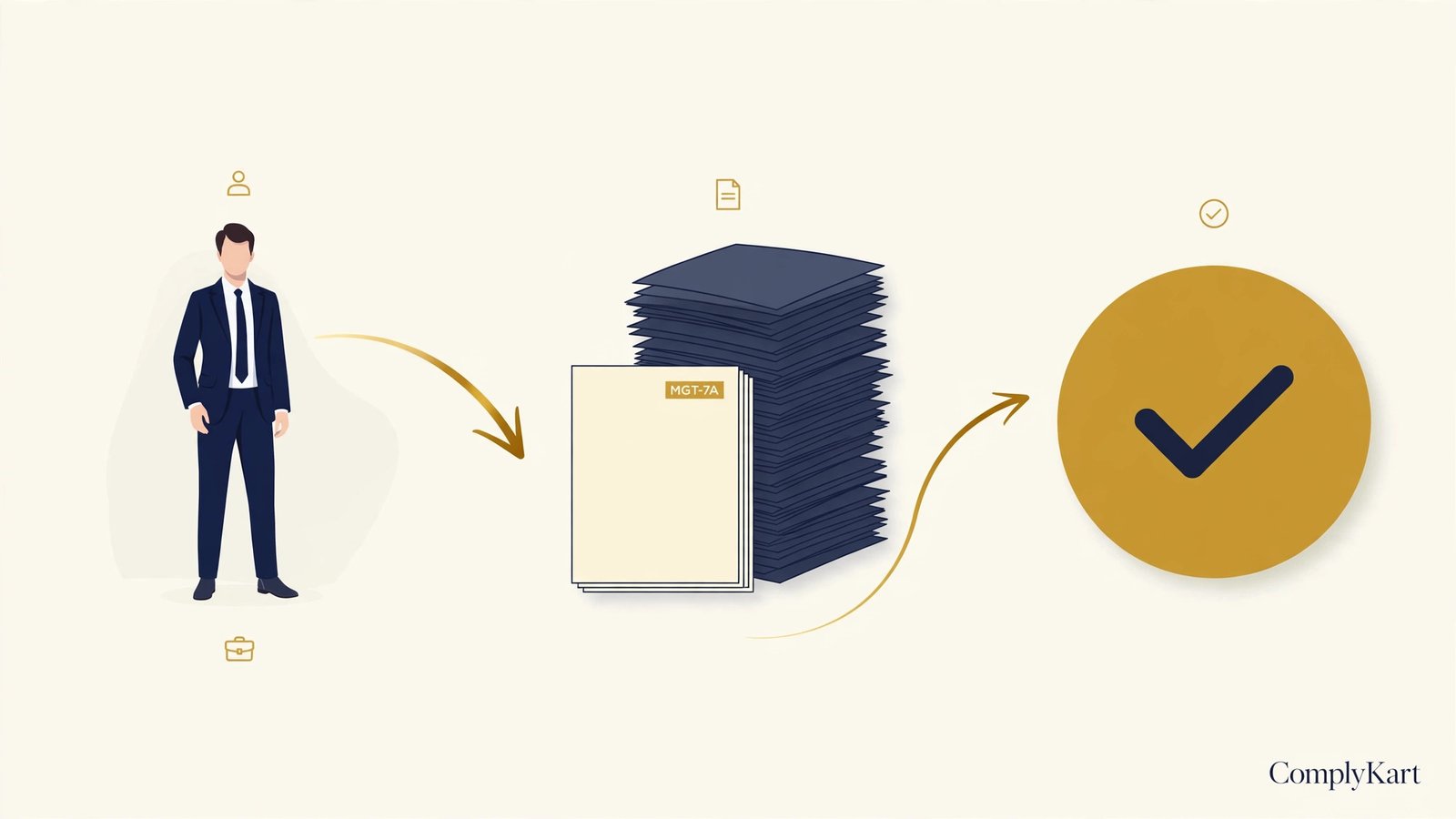
Short answer: a One Person Company files two ROC forms every year — AOC-4 (financial statements) by 29 October 2026 and MGT-7A (the simplified annual return) by 29 November 2026. OPCs don't hold AGMs; both deadlines run from 30 September. A day late costs ₹100 per form.
The whole OPC filing list, minus the noise
You run a One Person Company. One member. One nominee waiting in the wings. Your annual filing list is shorter than everyone else's.
Shorter. Not zero. Here's the entire thing, in order.
Key takeaways
- An OPC files AOC-4 and MGT-7A every year — never MGT-7, the longer form meant for regular companies.
- OPCs are exempt from holding AGMs, but both filing deadlines still run from 30 September.
- No professional certification is needed on MGT-7A for OPCs — the director's signature suffices.
- Cross ₹2 crore paid-up capital or ₹20 crore turnover and the OPC must convert to a private or public company within six months.
Step 1 — Confirm your year
FY 2025-26: 1 April 2025 to 31 March 2026. Done.
Step 2 — Get the accounts audited
Statutory audit is compulsory for OPCs. No exemption, no matter how small the turnover.
What you don't need: a cash flow statement (OPCs are specifically exempt), and CARO reporting (doesn't apply to OPCs). Your auditor's report will be shorter than a private limited company's. The audit itself still happens.
Step 3 — Board approval, minus the board drama
You're the only director. Hold your board meeting, approve the financial statements, approve the board's report. One signature. Record it in the minutes book.
Two reliefs to use: OPCs don't hold AGMs at all, and your board's report can be the abridged version — shorter format, same legal standing. Don't file a full-length board report out of habit. Use the shorter one; it's yours by right.
Step 4 — File AOC-4 by 29 October 2026
Financial statements go to the ROC in Form AOC-4. Since there's no AGM, the clock runs from the last date an AGM could have been held — 30 September. Thirty days from there: 29 October 2026.
Attachments: audited financials, auditor's report, abridged board's report.
Step 5 — File MGT-7A by 29 November 2026
Not MGT-7. MGT-7A. That's the simplified annual return written specifically for OPCs and small companies, in use since FY 2020-21. One-line definition: MGT-7A is the shorter ROC annual return — business activity, shareholding, directors, meetings. File the wrong form and you'll be redoing it.
MGT-7A asks for less: principal business activity, shareholding (you, plus your nominee's details), director information, board meetings held. Sixty days from 30 September: 29 November 2026.
Step 6 — Check your nominee details
The nominee's name, consent, and particulars go into the return. If your nominee changed during the year and the paperwork didn't follow, fix it now — not after filing.
Step 7 — ADT-1, only if the auditor changed
Same auditor continuing? Nothing to do. Appointed a new one? Report it in ADT-1 within 15 days of the appointment.
Step 8 — Watch the conversion triggers
An OPC stops being an OPC when paid-up capital crosses ₹2 crore or turnover crosses ₹20 crore. Cross either line and you convert to a private or public company within six months. Check your numbers before you file — filing as an OPC when you've outgrown it creates a mess that's painful to unwind.
Step 9 — The two calendar entries for next year
DPT-3 (return on deposits and borrowings) was due 30 June 2026. Put 30 June 2027 in your calendar now. DIR-3 KYC for directors runs once every three years — next due 30 June 2028, so nothing to do this season. And keep your books and filing receipts for eight financial years; Section 128 requires it, and a future buyer, lender, or tax officer will ask.
What actually goes into MGT-7A
Since the form is the whole point of the OPC route, know its fields before you sit down to file:
- Registration and business activity — CIN, company name, registered office, one principal business activity code.
- Shareholding — your shares, your nominee's particulars, any change during the year.
- Directors — you, plus any change in directorship.
- Meetings — board meetings held and attended. Yes, even a one-director company records these.
- Certification — signed by the director. No professional certification needed for OPCs, unlike larger companies.
Gather these five blocks before you open the form and the filing takes an hour, not a week.
Which mistakes do OPCs keep making?
Filing MGT-7 instead of MGT-7A. The MCA portal will accept the wrong form more readily than you'd like. The simplified form exists for you — use it.
Treating "no AGM" as "no deadline." I see this every season. No AGM doesn't mean no due date; the dates still run from 30 September. The penalty meter doesn't care that you had no meeting to miss.
Forgetting the nominee. The nominee isn't decorative. If they withdrew consent or their details changed and your return still names the old one, that's a defective filing. Five minutes of checking now saves a correction later.
What does skipping OPC filings cost?
Additional fee: ₹100 per day, per form, from the day after the deadline. No notice, no grace period. On two forms, a month's delay costs roughly ₹6,000 — for paperwork that takes a professional a few days.
That's the full list. Nine steps, two forms, two dates that matter: 29 October and 29 November 2026.
Want it handled without the calendar-watching? ComplyKart's team files OPC annual returns round the year — hand us the books and we'll close the loop.
Frequently asked questions
Does an OPC need to hold an AGM?
No. The Companies Act exempts One Person Companies from AGMs entirely. But exemption from the meeting is not exemption from the calendar — AOC-4 and MGT-7A deadlines still run from 30 September each year, and the penalty meter runs with them.
MGT-7 or MGT-7A — which one do I file?
MGT-7A. Always. It's the simplified annual return written for OPCs and small companies. MGT-7 is the longer form for regular companies. Filing MGT-7 as an OPC means redoing the filing — check the form code before you submit, because the portal won't stop you from picking the wrong one.
Do I need a CA to certify MGT-7A?
No. OPCs don't need professional certification on MGT-7A — the director's signature suffices. That's one of the genuine OPC reliefs, and it's yours by right. The financial statements behind AOC-4 still need a statutory audit, though. Two different forms, two different rules — don't confuse them.
What happens if my turnover crosses ₹20 crore?
The OPC must convert to a private or public company within six months of crossing ₹20 crore turnover or ₹2 crore paid-up capital. Check the numbers before filing — filing as an OPC after outgrowing it creates a painful unwind.
Is DIR-3 KYC due for OPC directors this year?
No. Director KYC moved to a three-year cycle in March 2026, so the next due date is 30 June 2028. OPC directors follow the same cycle — nothing to do this season. Keep your attention on the two ROC forms, where the deadlines are real.


Comments
No comments yet — ask the first question below.
Join the discussion
Questions go straight to our expert desk. Comments appear after a quick review — no spam, no noise.