
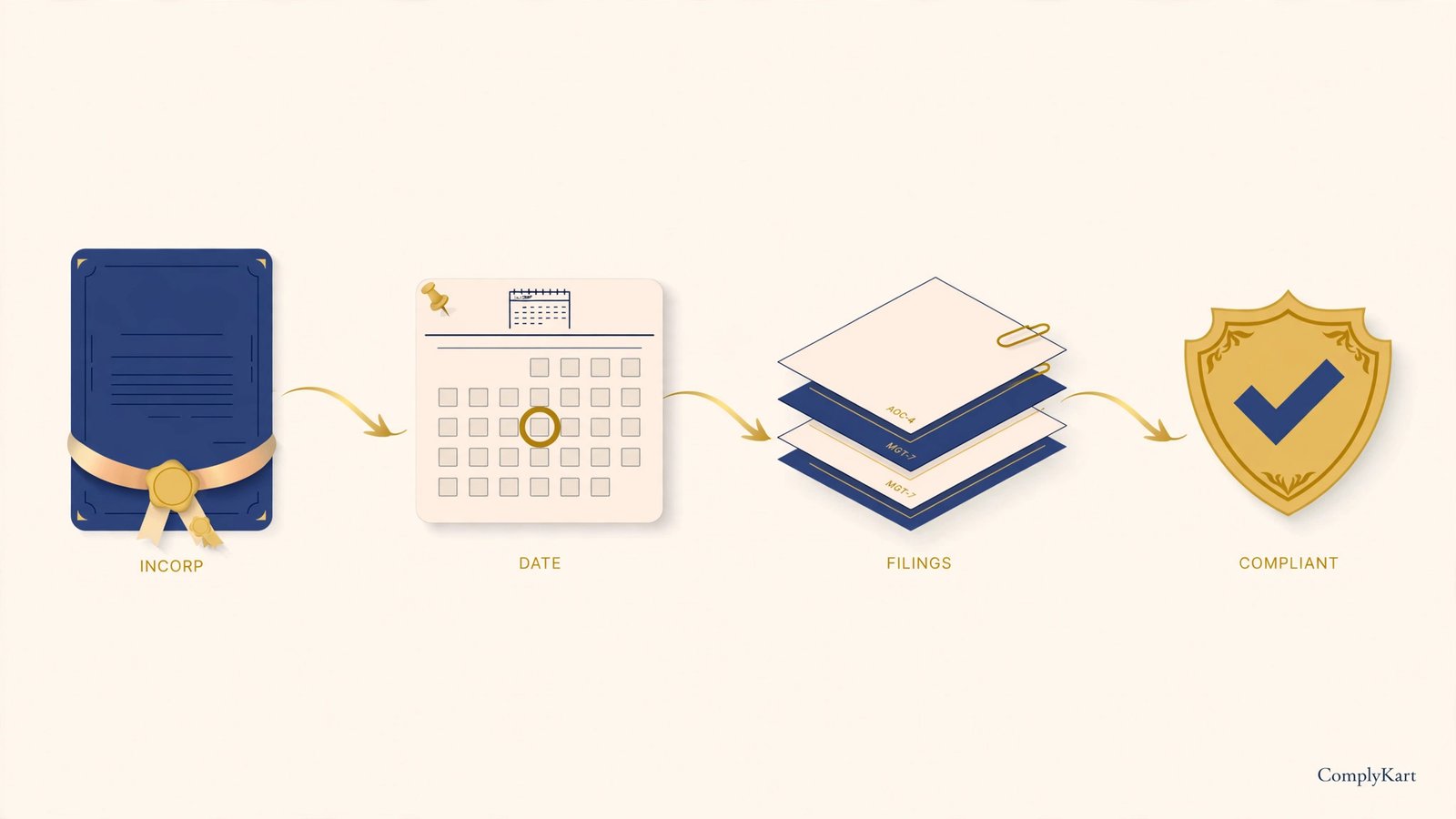
Short answer: yes, your new private limited company must file ROC annual returns in its first year — even with zero revenue. Hold your first AGM within 9 months of the financial year end, then file AOC-4 (financial statements) within 30 days and MGT-7 (annual return) within 60 days. For a 30 September 2026 AGM, that means 29 October and 29 November 2026.
Your company's first annual filing doesn't have to hurt
The incorporation certificate is probably still crisp in your drawer. The current account is open, the first invoices have gone out — or maybe they haven't yet, and that's fine. Either way, a quiet deadline is walking toward you: your company's first annual filing with the Registrar of Companies.
I've watched first-time founders react to this in two ways. Some freeze. Some assume it doesn't apply to them yet — "we barely did any business this year." Both reactions cost money. So let me walk you through it the way I'd explain it over coffee: what you owe, when, and what to keep ready.
Key takeaways
- Every private limited company files ROC annual returns from year one — AOC-4 for financial statements, MGT-7 for the annual return.
- The first AGM gets 9 months from the financial year end; every AGM after that gets 6 months (30 September for a March year-end).
- AOC-4 is due within 30 days of the AGM and MGT-7 within 60 days — 29 October and 29 November 2026 for FY 2025-26.
- Late filing costs ₹100 per day per form, with no reminder and no grace period.
How long is your company's first financial year?
Your company's first financial year runs from the day it was incorporated to the 31st of March that follows. Incorporated on 18 November 2024? Your first year is 18 November 2024 to 31 March 2025 — a short year of about four and a half months. Incorporated on 20 May 2025? Your first year stretches from that day to 31 March 2026.
There's one wrinkle worth knowing. If you incorporated on or after the 1st of January in any year, the law lets your first financial year run all the way to the 31st of March of the next year. So a February 2025 incorporation gets a first year ending 31 March 2026 — roughly thirteen months. Your auditor will confirm which bucket you fall into, but now you know the question to ask.
When is your first AGM due?
Every company has to hold an Annual General Meeting and place its financial statements before the members. For your first AGM, the law gives you nine months from the end of that first financial year. After that, it's six months — which is why most companies hold their AGM on 30 September.
Honest advice? If your first year ended 31 March 2026, just hold the AGM on 30 September 2026 like everyone else. Yes, you technically have till December. But syncing with the standard calendar means one set of dates to remember for the rest of the company's life, and your auditor will thank you for it.
What are AOC-4 and MGT-7?
Here's the part that confuses every first-timer, so here's my analogy. Think back to school.
One-line definitions first, for the record: AOC-4 is the ROC form for filing a company's audited financial statements. MGT-7 is the ROC annual return — shareholders, directors, meetings. Now the analogy.
AOC-4 is the report card. It carries your financial statements — the balance sheet, the profit and loss account, the auditor's report, the board's report. It answers one question: how did the company do?
MGT-7 is the attendance register. It's the annual return — who the shareholders are, who the directors are, how many board meetings happened, the shareholding pattern. It answers a different question: who is this company, and who runs it?
The ROC wants both, every year, because marks and attendance tell different stories. AOC-4 is due within 30 days of the AGM. MGT-7 gets 60 days. So for a 30 September 2026 AGM: AOC-4 by 29 October 2026, MGT-7 by 29 November 2026.
What your auditor will ask you for
Your financial statements need a statutory audit — yes, even in year one, even if revenue was zero. The first auditor is appointed by the board within 30 days of incorporation and holds office till the first AGM, and the appointment gets reported to the ROC in Form ADT-1 within 15 days.
Practically, your auditor will ask for bank statements, sales and purchase invoices, expense bills, the office rent agreement, and details of any loans or director money put into the company. If your books are thin because business was thin, say so upfront. Auditors would much rather hear "we did almost nothing this year" in April than discover it in September.
One more thing the word "board's report" tends to scare people about: for a young private company it's a short document. What the company did, where it stands, the directors' responsibility statement. Your CA drafts it in an afternoon. Don't let the name intimidate you.
What happens if you miss the filing deadline?
Miss a deadline and the additional fee is ₹100 per day, per form — and it doesn't need anyone to send you a reminder first. It just accrues. AOC-4 filed 40 days late means ₹4,000 extra on that form alone. This is the single most expensive lesson first-time founders learn, and it's entirely avoidable.
Two small things to strike off this year's worry list. DPT-3 (the return on deposits and borrowings) was due 30 June — calendar it for next year. And DIR-3 KYC for directors is now once every three years; the next one falls due 30 June 2028, so it isn't your problem this season.
You only do the first one once
Here's the reassuring part nobody tells you: the first filing is the hardest because everything is unfamiliar. The second year, you'll already have the auditor relationship, the document rhythm, the dates in your calendar. Companies that survive year one of compliance tend to stay compliant — because the machinery is finally built.
If you'd rather not spend your first filing season learning ROC forms the hard way, our team at ComplyKart handles first-year filings end to end — auditor coordination, board paperwork, both forms, all of it. Either way, don't let 29 October catch you by surprise.
Frequently asked questions
Do I need to file if my company earned nothing this year?
Yes. Filings report your company's existence, not its success — who owns it, who directs it, what the books say even when the books say "not much." A nil year still gets audited, and still gets an AOC-4 and an MGT-7. The ROC doesn't grade performance; it checks accountability.
We incorporated in January 2026. Is our first filing due this season?
Probably not. Companies incorporated on or after 1 January can stretch their first financial year to 31 March of the next year — so a January 2026 incorporation likely files first for the year ending 31 March 2027. Confirm with your auditor; the extended window is the detail founders most often misread.
Can I file AOC-4 and MGT-7 myself?
The forms are online and the portal accepts your DSC, but the financial statements behind AOC-4 need a statutory audit — which only a CA can sign. Most founders handle the coordination and let their CA or a filing service do the forms. Filing wrong is slower than filing through someone who does it weekly.
What documents should I keep ready for my auditor?
Bank statements for the full year, sales and purchase invoices, expense bills, the office rent agreement, and records of any loans or money directors put in. Thin books are fine — thin books discovered in September are not. Hand everything over in April, not the week before the AGM.
Is DIR-3 KYC due this year?
No. Director KYC moved to a three-year cycle in March 2026 — the next due date is 30 June 2028. Strike it off this season's list entirely and spend that energy on AOC-4 and MGT-7 instead, where the deadlines are real and the meter is running.





Comments
No comments yet — ask the first question below.
Join the discussion
Questions go straight to our expert desk. Comments appear after a quick review — no spam, no noise.