

OPC for Solo Consultants: When It Fits, What It Costs, and When to Convert
Quick answer: A One Person Company gives a solo consultant limited liability with a single owner — one member, one nominee, incorporated via SPICe+. Setup runs roughly ₹10,000–₹20,000; annual compliance about ₹25,000–₹60,000. Since 1 April 2021 there is no mandatory conversion to private limited at ₹50 lakh capital or ₹2 crore turnover — conversion via Form INC-6 is voluntary, anytime.
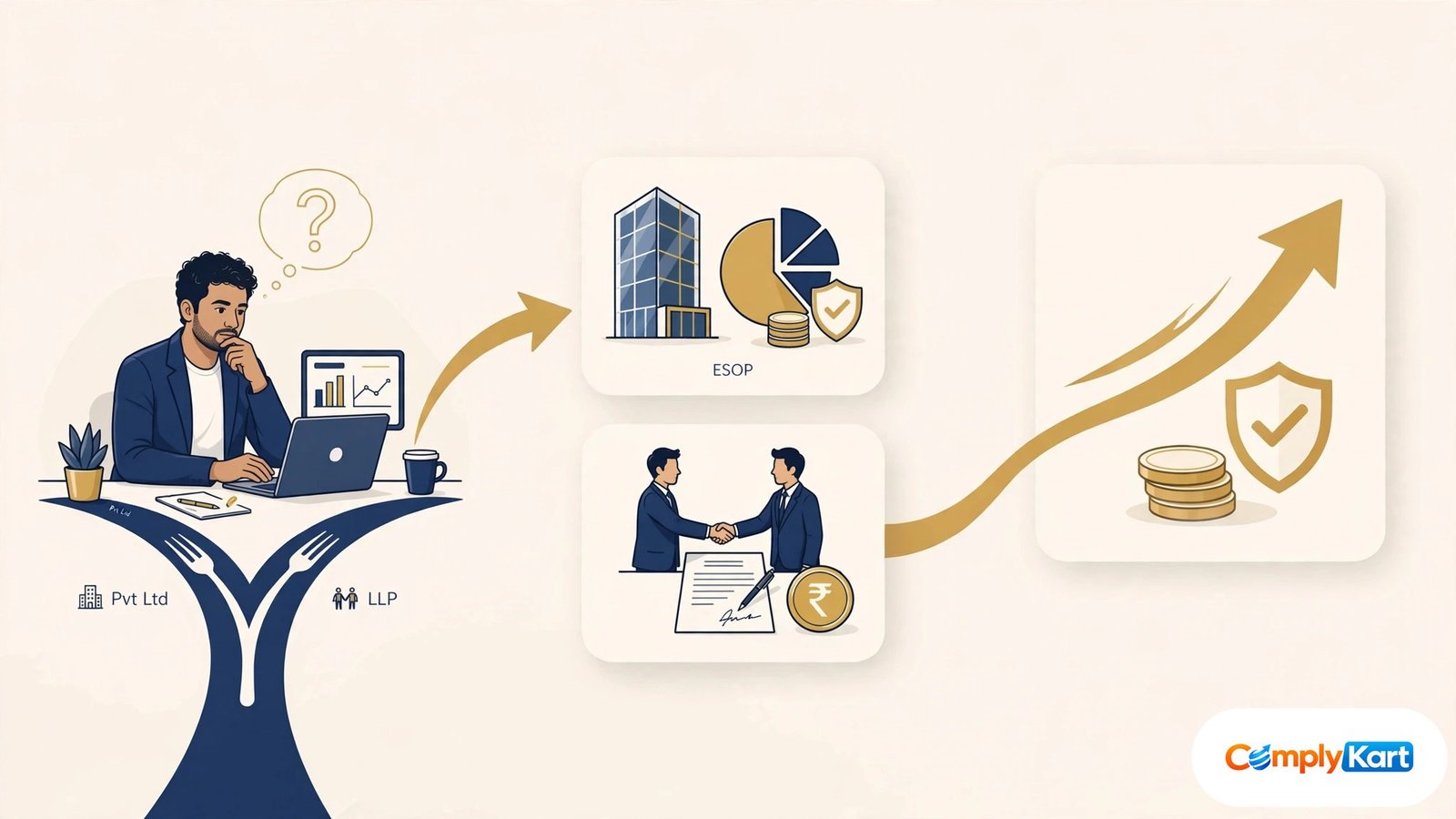
You are a consultant. Your laptop is your office and your name is your brand, and every contract you sign puts your personal savings in the same room as your business risk. A sole proprietorship costs nothing to start — and protects nothing when a client dispute goes sideways. That gap is what the One Person Company was built for.
What an OPC actually is
Section 2(62) of the Companies Act, 2013 defines an OPC as a company with only one person as its member. Separate legal identity, limited liability, perpetual succession — with a single owner. It cannot do NBFC activities, and it cannot convert itself into a Section 8 company.
One person you cannot skip: the nominee. Name one in your memorandum; on your death or incapacity, the nominee becomes the member and the company survives. The nominee must be an Indian citizen with at least 120 days in India in the preceding financial year. Minors are out, and nobody can sit in more than one OPC as member or nominee. Treat the nominee as a spare key to your house — cut it early, hand it to someone you trust.
Two hard limits: an OPC cannot do NBFC activities, and it cannot convert itself into a Section 8 company.
What it costs to set one up
Incorporation runs through SPICe+, which also issues your DIN, PAN and TAN in one pass. The MCA fee is nil for authorised capital up to ₹15 lakh; stamp duty varies by state, usually a few thousand rupees. With a digital signature and professional charges, most consultants land between ₹10,000 and ₹20,000 all-in. Our one person company registration page carries the current document list.
The honest comparison is with doing nothing. A proprietorship costs zero. But the day a client claims your advice cost them money, your savings are on the table. That limited liability is what you are buying.
The yearly upkeep, in plain numbers
An OPC is a company, and companies file things. Every year: statutory audit under Section 139 (no exemption for OPCs — appoint your auditor in year one and file Form ADT-1 within 15 days), AOC-4 financial statements within 180 days of the financial year end, and MGT-7A annual return within 60 days of the date your AGM would have been held. You never have to hold one.
One relief: a single-director OPC holds no board meetings at all — the proviso to Section 173(5) carves you out. (Add a second director and you owe one meeting per half-year.) Budget ₹25,000–₹60,000 a year for the audit, filings and your professional's retainer — the compliance fee calculator prices the full year before you commit.
The conversion rule everyone gets wrong
Almost every article on the internet still states the old law, so read this twice. Before 2021, crossing ₹50 lakh of paid-up capital or ₹2 crore of average annual turnover forced your OPC to convert, and you filed Form INC-5 to announce it. Voluntary conversion was blocked for two years after incorporation.
All of it is gone. The Companies (Incorporation) Second Amendment Rules, 2021 — effective 1 April 2021 — abolished the mandatory triggers, removed the two-year wait, and dropped Form INC-5 while reworking Form INC-6. The same amendment let Indian citizens living abroad form OPCs and cut the residency test from 182 days to 120.
The analogy I give clients: the old rule was a landlord clause forcing you to vacate your studio the day your salary crossed a line. The 2021 amendment tore up that clause. Nobody evicts you for growing anymore — you move only when you decide you need a bigger place.
When you should convert anyway
Voluntary does not mean pointless. Convert when the business demands it:
- A co-founder joins. The moment a second person owns equity, the OPC has done its job.
- You want ESOPs or investors. OPCs cannot run employee stock option plans — Section 62(1)(b) keeps ESOPs a private-company instrument, and investors will ask you to convert first.
- Enterprise clients demand it. Some large companies' vendor policies do not empanel OPCs.
- Succession gets complicated. The nominee handles death cleanly; a private limited company's shareholding is more flexible for structured family ownership.
File a special resolution, alter your memorandum and articles, bring in the second member and director, file MGT-14 within 30 days, then file Form INC-6 with the altered documents, member/director/creditor lists and the creditors' no-objection. The Registrar issues a fresh certificate — same company, new form. Read the private limited company registration details alongside: four board meetings a year and the full AOC-4/MGT-7/ADT-1 cycle await.
Tax: the part consultants misjudge
An OPC pays tax like a company — 22% under Section 115BAA or 25% if turnover stays under ₹400 crore, plus surcharge and 4% cess. A proprietor pays individual slab rates, often cheaper in the early years. Incorporation is a liability decision first and a tax decision second.
Past ₹20 lakh of services turnover a year (₹10 lakh in special-category states), GST registration becomes mandatory — a separate door from the company question, applying to proprietors too. Our GST registration guide covers the threshold math. Bill foreign clients? A LUT lets export invoices go out without IGST.
Five mistakes I watch consultants make
- A nominee who does not know. Tell the person, get written consent, keep details current.
- Assuming no audit. Small revenue changes nothing — the audit is mandatory.
- Mixing personal and company money. Limited liability protects the boundary only if you respect it. Separate bank account, from day one.
- Incorporating for tax savings that do not exist. At ₹12 lakh of profit, slabs usually beat 22%.
- Forgetting GST is a separate trigger. The company and the tax registration are two different doors.
The decision, stripped down
Choose an OPC when you are a solo consultant earning enough that limited liability matters and you have no co-founder on the horizon. Stay a proprietor when revenue is modest and every rupee counts. Convert to private limited when a partner, an investor, or a client makes single ownership a constraint. The 2021 rules gave you the one thing founders always ask for — the choice stays yours.
Weighing the OPC against a private limited company from day one? Our OPC vs private limited comparison and the LLP vs private limited breakdown lay the structures side by side.
FAQs
Can an NRI form a One Person Company in India?
Yes, since 1 April 2021 — any Indian citizen, resident or otherwise, can incorporate an OPC, provided they stayed in India 120 days in the preceding financial year. Foreign citizens cannot.
Is OPC-to-private-limited conversion mandatory at ₹2 crore turnover?
No. The mandatory triggers — ₹50 lakh paid-up capital or ₹2 crore average annual turnover — were abolished from 1 April 2021. Conversion is voluntary, anytime, through Form INC-6.
What is Form INC-6 used for?
The conversion application — OPC to private or public company, and private company to OPC. It carries the altered memorandum and articles, the special resolution, member/director/creditor lists, and the creditors' no-objection.
Does an OPC need board meetings or an AGM?
A single-director OPC needs no board meetings. With more than one director, hold one per half-year. No OPC must hold an AGM.
Can an OPC issue ESOPs?
No. ESOPs under Section 62(1)(b) belong to private companies. Convert first if employee stock options are in your hiring plan.



Comments
No comments yet — ask the first question below.
Join the discussion
Questions go straight to our expert desk. Comments appear after a quick review — no spam, no noise.