
Pvt Ltd vs LLP for Digital Marketing Agencies: Costs, ESOPs and the Funding Question
The short answer: If your agency might ever raise funding, offer ESOPs to retain senior media buyers or designers, or pitch enterprise clients, register a Private Limited Company — the higher compliance cost keeps every door open. A bootstrapped two-to-three partner agency with no outside-investment plans can save real money every year with an LLP. The numbers behind that call are below.
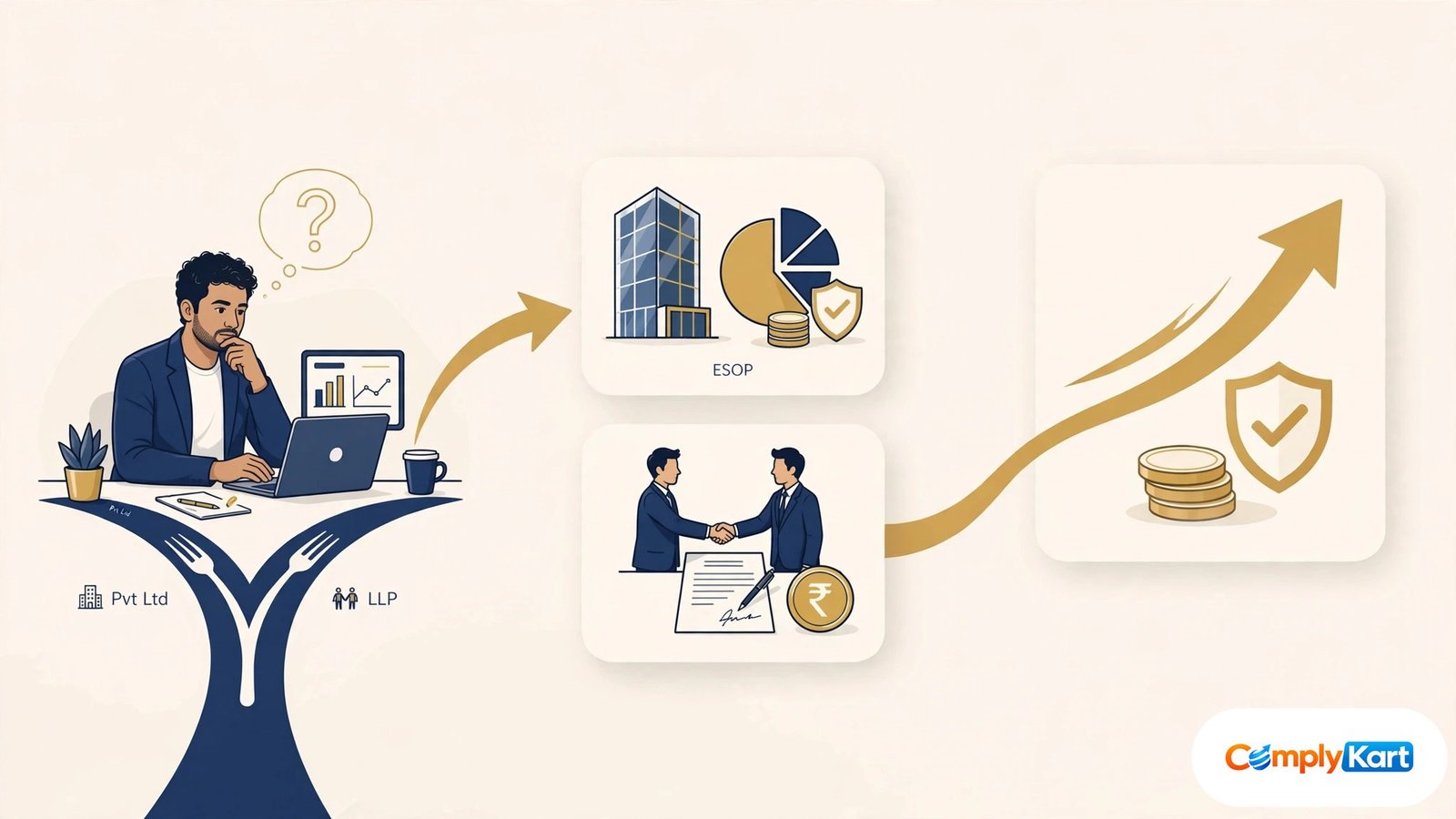
You started with a laptop, a few retainers, maybe a partner. Now the money is real, the team is growing, and someone has told you to "get a proper structure." The two serious options are a Private Limited Company and a Limited Liability Partnership. Both give you limited liability. After that, they behave very differently.
What does each option cost to set up?
An LLP is incorporated through the FiLLiP form. The government fee is slabbed on capital contribution: ₹500 up to ₹1 lakh, ₹2,000 for ₹1–5 lakh, ₹4,000 for ₹5–10 lakh, ₹5,000 above ₹10 lakh. Add state stamp duty on the agreement. All-in through a professional: roughly ₹7,000–₹12,000.
A Private Limited Company comes through SPICe+. For authorised capital up to ₹15 lakh the MCA fee component is nil — you mainly pay state stamp duty on the MoA and AoA, with DINs, PAN and TAN bundled. Through a professional, expect roughly ₹10,000–₹20,000 all-in.
How much annual compliance does each need?
This is the LLP's strongest argument. An LLP files exactly two things a year: Form 11 (annual return) by 30 May, and Form 8 (statement of account and solvency) by 30 October. Audit kicks in only if turnover crosses ₹40 lakh or partner contribution crosses ₹25 lakh (Section 34, LLP Act 2008). No board meetings, no audit below those thresholds. The sting: delay either form and the additional fee is ₹100 per day, per form.
A Private Limited Company carries a heavier calendar: statutory audit every year regardless of turnover, at least four board meetings a year (Section 173, Companies Act 2013), AOC-4 within 30 days of the AGM, MGT-7 within 60 days, ADT-1 within 15 days, and DPT-3 by 30 June. Late fees on AOC-4 and MGT-7 run ₹100 per day. For a small agency with clean books, that calendar typically costs ₹25,000–₹60,000 a year in professional fees — check our compliance fee calculator.
Can an LLP give ESOPs to its team?
No — and this is the most misunderstood point in the whole debate. Only a company can issue ESOPs or sweat equity (Section 62(1)(b), Companies Act 2013). An LLP has no share capital. There is nothing to grant, vest, or exercise.
Think of it this way. An LLP is like a band: partners split the gig money, and you can promise a newcomer a bigger cut of future gigs. A Private Limited Company is like a record label: you can hand someone an actual slice of the company. Lose the media buyer running ₹2 crore a month in ad spend and you feel it next quarter. An LLP can offer profit-sharing through the agreement instead, but that is a bonus by another name — read how ESOPs actually work before promising equity to anyone.
Can an LLP raise funding?
Angels and VCs invest through equity shares or compulsorily convertible preference shares — instruments that only exist inside a company. An LLP takes money as partner capital contributions, which gives an investor no clean buy-in-and-exit mechanism. FDI into LLPs is further restricted: only in sectors with 100% FDI under the automatic route, with no FDI-linked performance conditions.
If funding is even a "maybe in two years" thought, start as a private limited company. An LLP can be converted into a company later, but conversion costs months and fees — choosing right on day one is cheaper. Our LLP vs Private Limited comparison has the full side-by-side.
How are profits taxed in each?
A domestic company pays 22% under Section 115BAA (forgoing specified exemptions) or the 25% slab at turnover up to ₹400 crore; dividends are taxed in shareholders' hands since DDT went away in 2020. An LLP pays a flat 30% plus surcharge and 4% health and education cess, with partner remuneration deductible within Section 40(b) limits.
Do not pick on tax alone — funding access and talent retention matter more.
Which one do enterprise clients prefer?
Big-brand procurement teams ask for incorporation documents, and "Private Limited" is the format every vendor checklist was written for — a familiarity advantage, not a legal requirement.
GST does not change: agency services attract 18% under either structure, registration kicks in above ₹20 lakh turnover (₹10 lakh in special-category states), and foreign clients count as export of services — zero-rated with a LUT. If you are near the threshold, sort your GST registration early; clients ask for the number before they ask for your portfolio.
Five mistakes agency founders keep making
- Choosing an LLP, then chasing a seed round. Investors walk away or make you convert first — at your expense, on their timeline.
- Promising "ESOPs" in an LLP offer letter. Legally impossible. Promise profit-sharing and word it honestly.
- Treating Pvt Ltd compliance as optional. ₹100-a-day late fees on AOC-4 and MGT-7 compound quietly. Two missed years genuinely hurt.
- Running on a copy-paste LLP agreement. Profit splits, exit terms, and decision rights between partners deserve real drafting.
- Deciding on the tax rate alone. The 22%-versus-30% gap rarely decides an agency's fate. Funding access and talent do.
So, which should you pick?
One question decides it: in the next three years, could this agency raise outside money or grant real ownership to the team? If yes — or even maybe — take the Private Limited Company and budget for the compliance. If the answer is a clear no, the LLP's lighter calendar saves money and Sundays. Solo with no partners? Our solo founder guide covers when an OPC fits better.
FAQs
Can I convert my LLP into a Private Limited Company later?
Yes, but it is a formal process with filings, fees, and waiting time — not a one-click upgrade. If you already suspect you will need the company structure, starting there is cheaper.
Does an LLP need an audit every year?
No. Audit is required only if turnover exceeds ₹40 lakh or partner contribution exceeds ₹25 lakh in the financial year. Below that, Form 11 and Form 8 are the whole calendar.
Can a solo agency register as an OPC?
Yes. A One Person Company suits a solo founder with lighter compliance than a private limited company. Convert to private limited when paid-up capital crosses ₹50 lakh or average turnover crosses ₹2 crore.
Do I need GST registration from day one?
Not legally — it becomes mandatory above the threshold (₹20 lakh generally, ₹10 lakh in special-category states). But many clients only work with GST-registered vendors, so voluntary registration early is common for agencies.
Which is cheaper to shut down?
An LLP strike-off is generally simpler and cheaper than striking off a company (Form STK-2), provided all filings are current. Keep filings up to date either way — a defunct entity with pending filings is the expensive kind of closed.



Comments
No comments yet — ask the first question below.
Join the discussion
Questions go straight to our expert desk. Comments appear after a quick review — no spam, no noise.