
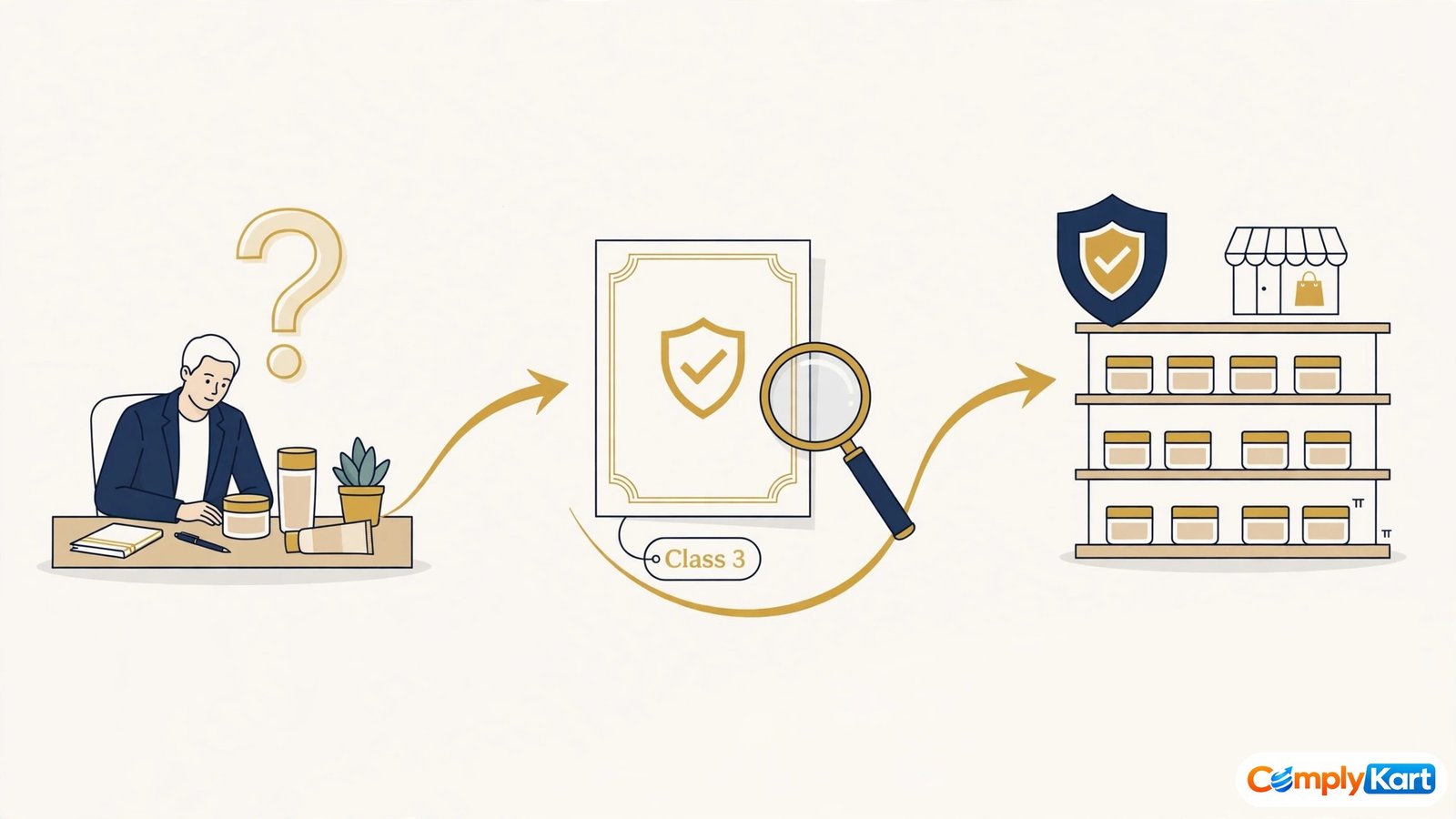
Trademark for Cosmetics Brands: Class 3, Costs and the AYUSH Licence Trap
Launch a skincare brand in India and you meet a split personality in the law: the trade marks office guards your brand name, the drug regulator polices what's inside the jar. The two never talk to each other — and founders stumble exactly in the gap. The licence question comes first, then the trademark.
Your trademark and your licence are two different fights
The trademark protects the name and logo. The cosmetic or AYUSH licence permits the product itself to be made and sold — one never substitutes for the other. I have seen registered trademarks on face creams sold with no manufacturing licence behind them: brand safe, business not. Settle the licence question first (cosmetic or AYUSH — below), then file the trademark, because in India trademark rights go to whoever files first, not whoever sells first.
Which class does your mark belong in?
Class 3 is the home plot: non-medicated cosmetics and toiletries — creams, lipsticks, perfumes, essential oils, soaps, shampoos, dentifrices. Three traps hide around it:
- The medicated trap (Class 5). Claim a therapeutic effect — an acne-curing cream, anti-dandruff shampoo with ketoconazole — and the product slides towards Class 5. Your Class 3 registration then doesn't cover the medicated version of your own product.
- The retail trap (Class 35). Class 3 protects the goods; your own website or store is a retail service — a separate class. File both if you sell D2C.
- The service trap (Class 44). Running treatments under the brand name? Beauty care services live in Class 44.
File wrong and a rival can register your identical name in the class you left empty.
What does filing cost, and how long does it take?
Form TM-A costs ₹4,500 per class for individuals, startups and small enterprises filing online, and ₹9,000 per class for other companies. Non-refundable.
You get a TM application number the same day — you can sell from day one and use ™ immediately. Examination takes 6–12 months (30 days to reply to objections), then a 4-month opposition window; uncontested applications typically register in 12–18 months. Registration lasts 10 years, renewable on Form TM-R at ₹9,000 per class.
File the word mark before the logo — it protects the name in any font; the logo protects one design. And remember: ® before registration is an offence under Section 107 of the Trade Marks Act, 1999 (up to 3 years' imprisonment); ™ is safe until the certificate arrives.
Manufacturing in India: Form COS-1 to Form COS-8
Cosmetics made in India need a licence under the Cosmetics Rules, 2020. Apply to the State Licensing Authority in Form COS-1 with a self-certified GMP declaration (Form COS-7); the licence (Form COS-8) must be decided within 45 days, with inspection within 30 days of the grant. Fee: ₹10,000 for up to ten items of each category, plus ₹500 per additional item — perpetual with a retention fee every five years. Check what the licence and related filings will cost with our compliance fee calculator.
Most new brands skip the factory: a third-party manufacturer with an existing licence makes your product, or you take a loan licence (Form COS-9) on someone else's licensed premises. Ask for the licence copy before the first run and confirm it covers your product category. GST registration sits with your own entity regardless.
Importing instead? Form COS-2
Importers take the CDSCO route: a registration certificate in Form COS-2, applied for in Form COS-1 via the Sugam portal. Fees: USD 1,000 per category, USD 500 per manufacturing site, USD 50 per variant; processing can take up to six months, and "new cosmetics" need prior permission in Form COS-3. Perpetual with a retention fee every five years. You'll also need an Importer Exporter Code before customs clears a consignment.
The AYUSH trap: your claims decide your licence
A cosmetic and an AYUSH drug sit under different chapters of the same Act (the Drugs and Cosmetics Act, 1940), and the dividing line is what you claim the product does.
Think visa categories: a tourist visa and a work visa come from the same embassy, but the stamp you need depends entirely on what you intend to do — and the wrong one gets you deported. A face cream that "moisturises and refreshes" is a cosmetic: cosmetic licence, Class 3 trademark, done. The same cream relabelled to "treats eczema and cures acne" becomes a drug: AYUSH licence, and your Class 3 filing sits on the wrong shelf.
In practice: a cosmetic licence (Form COS-8) allows only beautifying, cleansing and perfuming claims. An AYUSH licence (application in Form 24D, licence in Form 25D) kicks in the moment the product claims to treat, cure or prevent disease — the authority then vets your formula and demands qualified technical staff. "Ayurvedic" on a cosmetic pack is the grey zone: herbal ingredients are fine under a cosmetic licence, but marketing that says "heals" or "cures" can get the product reclassified as a drug made without a licence.
What must be printed on the pack
Labelling is mandatory under the Cosmetics Rules, 2020: product name, manufacturer name and address, net contents, MRP, batch number, manufacturing date and use-before date, plus directions and warnings. Miss these and the product can be treated as misbranded — an offence under Section 27 of the Drugs and Cosmetics Act, punishable with up to two years' imprisonment.
Five mistakes cosmetics founders make
- Filing Class 3 only — a rival can take your name in Class 35 for retail. File 3 + 35 together if you sell D2C.
- Using ® before registration — a criminal offence under Section 107, not a style choice.
- Printing therapeutic claims on a cosmetic licence — "cures pigmentation" invites reclassification as an unlicensed drug.
- Trusting the contract manufacturer's licence blindly — verify category coverage and the 5-year retention before the first run.
- Ignoring the use-before date — products with under six months of shelf life left can't even be imported; retailers won't stock them either.
FAQs
Do I need a licence if I use a third-party manufacturer and sell only on my website?
No — the factory's licence covers production. But you need your own trademark, GST registration, and a written agreement confirming the manufacturer's licence covers your product categories and is current.
Can one trademark application cover the products and the retail store?
No — one application, one class. File Class 3 for the goods and Class 35 for retail services. Two filings, two fees.
How is a cosmetic different from an AYUSH product legally?
By intended use: what cleanses, beautifies or alters appearance is a cosmetic; what claims to treat, cure or prevent disease is a drug. The same formulation can fall on either side — each with its own licence, forms and regulator.
How long does the cosmetic manufacturing licence take?
The authority must decide within 45 days of the Form COS-1 application, and inspects the premises within 30 days of granting it. A complete application typically moves within 2–3 months.
Two filings and one careful decision about your product claims — that is the whole game. File the trademark early so the name is yours, settle the cosmetic-vs-AYUSH question before printing labels, and verify your manufacturer's licence before the first run. See also our guides on trademark for clothing brands and trademark for restaurants and cafes.





Comments
No comments yet — ask the first question below.
Join the discussion
Questions go straight to our expert desk. Comments appear after a quick review — no spam, no noise.