
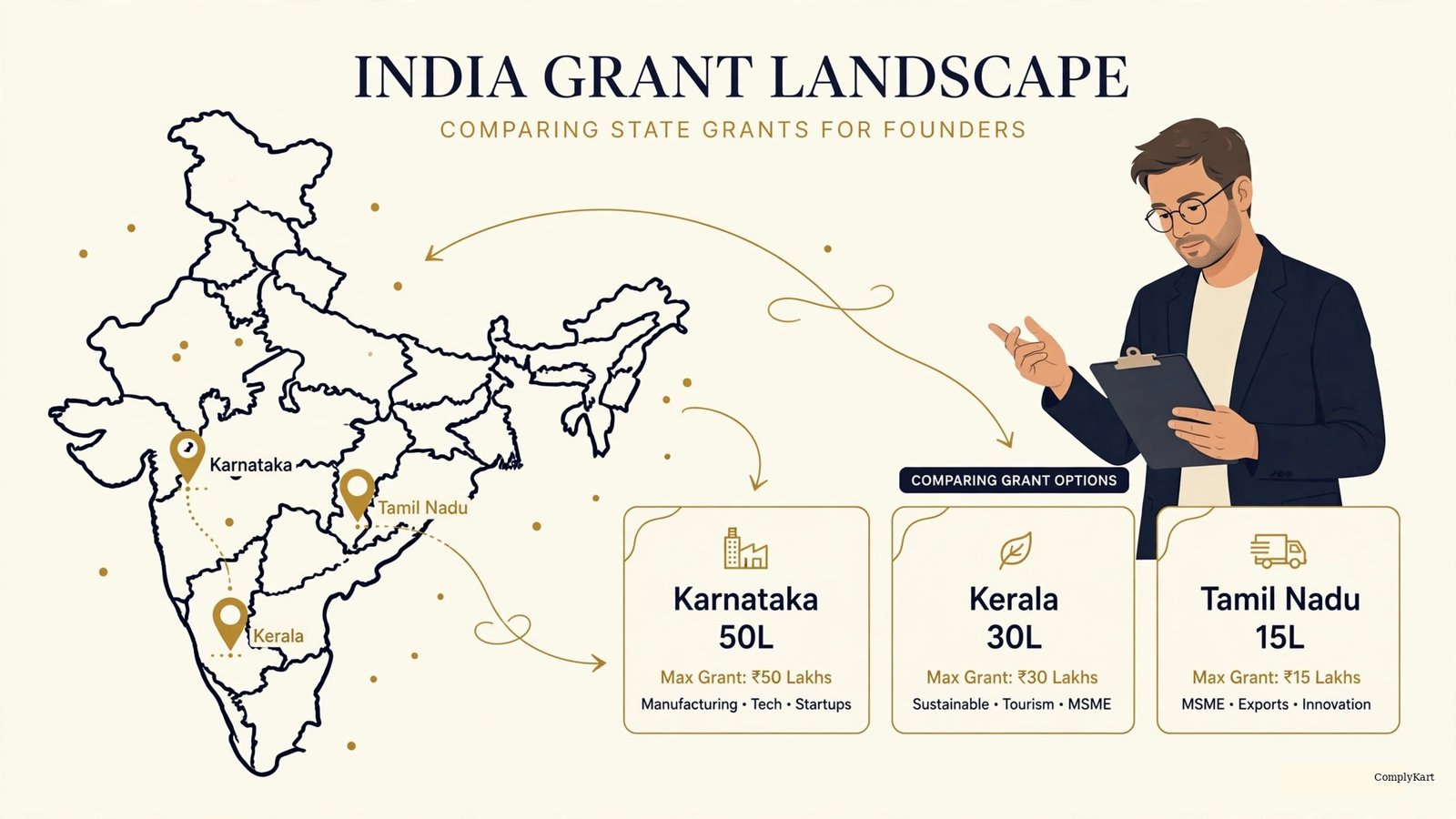
Short answer: most Indian states run their own startup grant programmes alongside the central schemes — Karnataka's ELEVATE (up to ₹50L), Kerala's layered KSUM grants (₹3L–₹30L), Tamil Nadu's TANSEED (₹10L–₹15L), and generous new policies in UP and Maharashtra among them. The catch: most need you registered or genuinely operating in that state. Apply where you actually are.
Central schemes get the headlines. States write cheques too — often with simpler paperwork and faster committees. But state grants come with one rule you must respect: most of them need you registered or genuinely operating in that state. A Karnataka grant does not travel to a Delhi-registered company with no Karnataka presence.
Comparing state grants is like comparing thalis. Every state serves the same rice — seed money for young companies — with different curries: different amounts, different conditions, different paperwork. Compare the thalis, then sit where you belong. Do not relocate your company for a grant alone; the compliance cost of a fake address will eat the grant.
Here is what each major state offers, as of 13 October 2026.
Key takeaways
- Karnataka's ELEVATE (up to ₹50L, deep-tech NxT up to ₹1 cr) is the most founder-friendly state grant in India.
- Kerala offers the most layered menu — idea, productization, market acceleration, scale-up, and R&D grants up to ₹30L.
- UP's revised July 2026 policy is among the most generous: sustenance, prototype, seed, deep-tech tracks, and matching grants up to ₹5 cr.
- Most state grants need genuine registration or operations in that state — a borrowed address is a compliance trap.
- West Bengal has no verified dedicated startup grant right now — founders there should work the central schemes.
Karnataka: ELEVATE
Karnataka runs the most founder-friendly state grant in India. The ELEVATE Idea2PoC programme, run by KITS through the Startup Karnataka portal, offers up to ₹50L as a one-time grant-in-aid, released in milestone tranches under a tripartite agreement between you, KITS, and a K-Tech hub.
In January 2026 the state launched ELEVATE NxT for deep-tech startups, with grants up to ₹1 cr. The 2025 round picked 146 startups worth ₹38.85 cr in grants. Note one distinction: the state's separate Beyond Bengaluru Seed Fund (₹75 cr) is equity, not a grant. Do not mix the two when you plan.
Kerala: Kerala Startup Mission
KSUM runs the most layered grant menu of any state, through grants.startupmission.in: Idea Grant up to ₹3L; Productization Grant up to ₹7L — rising to ₹12L where women or trans founders hold at least 51%; Market Acceleration up to ₹10L; Scale-up Grant up to ₹15L; Research and R&D Grant up to ₹30L.
There is also a seed loan for later stages. And one quiet superpower: Kerala offers direct government procurement up to ₹20L without tender for startups. If you sell to government, that line alone is worth the application.
Tamil Nadu: TANSEED
Run by StartupTN through startuptn.in. TANSEED offers up to ₹15L for green-tech, rural-impact, or women-led startups, and ₹10L for others. Two things to know: the state takes a 3% support stake, and the programme includes a 1-year accelerator. Since 2021, 169 startups have gone through it. Calls open periodically — the 8.0 window ran in December 2025 — so watch the portal rather than waiting for news.
Gujarat: Industrial Policy 2026, SSIP 2.0, iCreate
Gujarat spreads its support across several programmes: seed support up to ₹30L under the Viksit Gujarat Industrial Policy 2026 — ₹40L for high-impact ventures — plus an extra ₹10L for high-tech, fintech, or green startups; a sustenance allowance of ₹25k–₹30k per month for a year; SSIP 2.0 for students (₹2.5L for proof of concept, up to ₹25L for scaling); i-Hub S4 (₹2.5–₹10L); and iCreate Pro-Fund (up to ₹30L).
If you are a student founder, Gujarat's SSIP 2.0 deserves a close look — few states fund student ideas this directly.
Maharashtra: Startup Policy 2025
Maharashtra's 2025 policy centres on the CM Maha-Fund — ₹500 cr aimed at 25,000 early-stage entrepreneurs — delivered in stages with mentoring, incubation, and financial assistance. There is also a separate startup seed funding grant with rolling applications, and the state's Startup Week gives winners pilot work orders up to ₹25L from government departments. A paid government pilot is worth more than a grant of the same size — it is revenue and a reference customer in one.
Uttar Pradesh: revised policy, July 2026
UP revised its startup policy in July 2026, and the numbers are generous. Apply through startinup.up.gov.in: sustenance of ₹20k per month for 2 years; prototype grant of ₹10L; seed funding of ₹15L — up to ₹50L for exceptional cases; a deep-tech track with prototype ₹20L, seed ₹30L, patient capital up to ₹100 cr, and 40% R&D support; patent and quality-certification reimbursement up to ₹2 cr; and matching grants up to ₹5 cr.
Delhi: Startup and Incubation Policy, July 2026
Delhi's July 2026 policy commits ₹400 cr over 5 years, with seed funding up to ₹10L for students and alumni of government schools, colleges, universities, and ITIs. This is a student-first policy by design — if you are building from a Delhi campus, it is written for you.
Rajasthan: iStart
Rajasthan's iStart programme (istart.rajasthan.gov.in) offers seed funding up to ₹25L plus mentoring and incubation, alongside its Challenge for Change programme, which funds startups against specific problem statements. Problem-statement grants suit founders who like building to a brief.
Telangana: TSIC
The Telangana State Innovation Cell (startup.telangana.gov.in) keeps its grants small and its doors open: prototype grant up to ₹1L, pilot grant up to ₹2L, and seed grants of ₹0.2–₹2L from a modest annual corpus. Applications stay open through the year, and TSIC bears incubation costs. Small cheques, low friction — good for very early experiments.
West Bengal: an honest note
West Bengal's old 2013–18 startup policy has lapsed, and a new dedicated startup policy had not been confirmed as of 13 October 2026. I will not invent a grant that is not verified. If you are building in Bengal, work the central schemes for now — NIDHI-PRAYAS, the MSME Innovative Scheme, MeitY's GENESIS — and check the state's official portal before believing any consultant who claims otherwise.
How to play the state game well
Three practical rules. First, apply where you genuinely are — domicile or real operations, not a borrowed address. Second, pair state and central grants for different stages: a state prototype grant, then a central seed grant. You must declare all government support received, and the same project cannot be funded twice. Third, track call windows. States open and close calls; they do not keep counters open forever. The founder who watches the portal beats the founder who waits for someone to tell them.
If you're deciding which state's grant to chase — or whether your current registration qualifies — our team at ComplyKart can map the options to where you actually operate.
Frequently asked questions
Can I take a state grant from a state where my company isn't registered?
Usually not. Most state schemes require the startup to be registered in the state, or to have genuine operations there — an office, a team, real activity. A borrowed address or a shell registration is a compliance trap: it can void the grant and create problems with the ROC. Apply where you actually are.
Which state gives the biggest startup grant?
By headline number, Karnataka's ELEVATE NxT offers up to ₹1 cr for deep-tech startups, and the standard ELEVATE grant goes up to ₹50L. UP's revised 2026 policy is also among the most generous overall, with seed funding, deep-tech tracks, and matching grants up to ₹5 cr. But the "best" grant is the one you can actually win — match the scheme to your stage and sector, not just the cheque size.
Do state grants need DPIIT recognition?
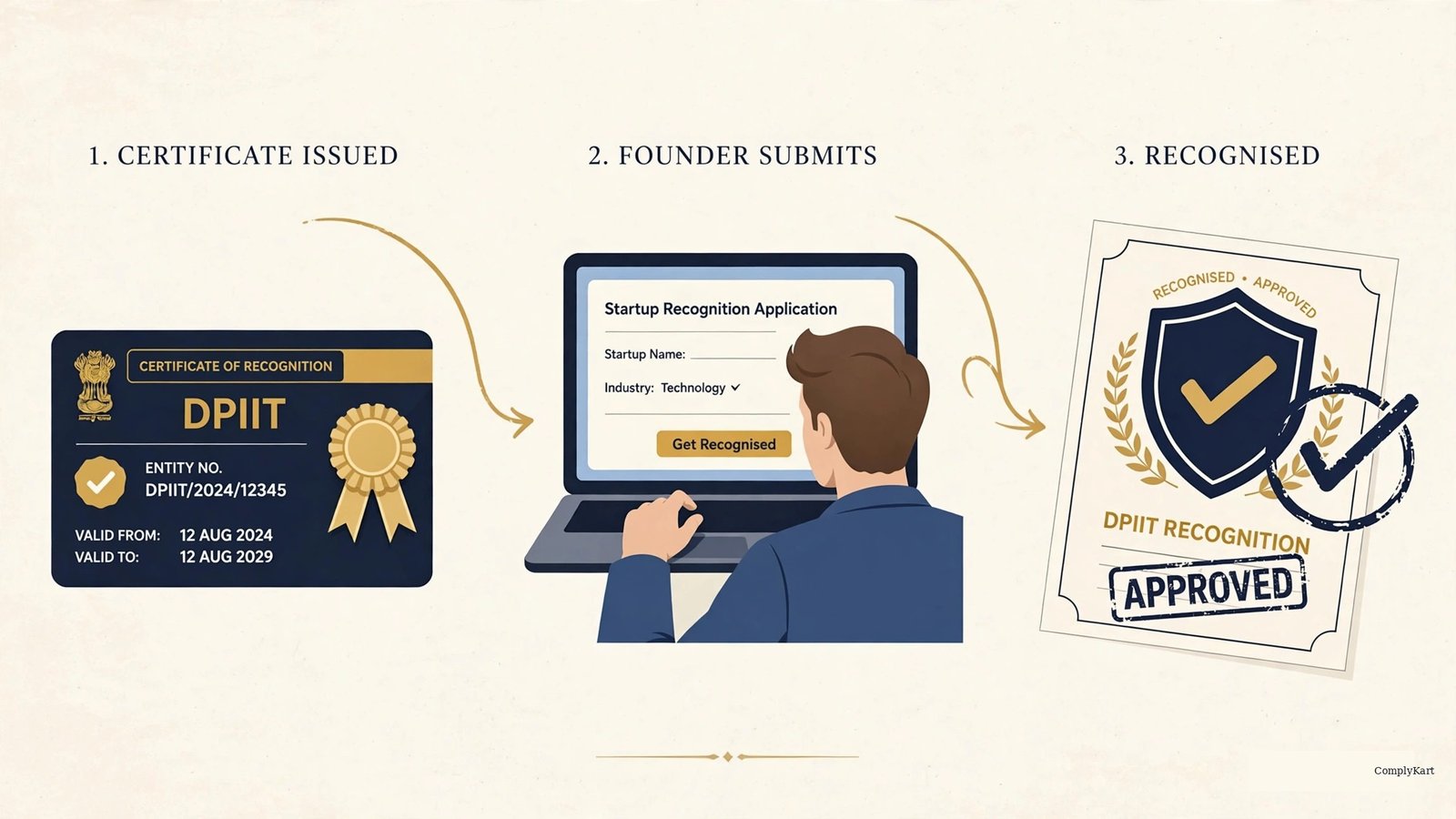
Most do — it is the standard eligibility filter across central and state schemes. A few student-focused programmes (like parts of Gujarat's SSIP 2.0 or Delhi's student policy) are built for pre-incorporation or campus founders. But if you are incorporated, get DPIIT recognition anyway: it costs nothing and unlocks nearly everything.
Can I combine a state grant with a central grant?
Yes — this is normal and common: a state prototype grant, then a central seed grant, for example. The rules: declare all government support received on every application, never take two grants for the same project, and mind prior-support caps (SISFS bars you above ₹10L of prior government monetary support). Sequence deliberately.
Is there any startup grant in West Bengal?
Not that I can verify. The state's 2013–18 startup policy has lapsed and no new dedicated policy had been confirmed as of 13 October 2026. Founders building in Bengal should work the central schemes — NIDHI-PRAYAS, the MSME Innovative Scheme, MeitY's GENESIS — and verify any claim about a state grant on the state's official portal before acting on it.


Comments
No comments yet — ask the first question below.
Join the discussion
Questions go straight to our expert desk. Comments appear after a quick review — no spam, no noise.