Five steps, no guesswork — you always know exactly what comes next. Tap a step to see what it involves.
12345
You pay securely. Payment is confirmed instantly, and your receipt with the written fee breakup lands in your inbox.
Government Grants & Subsidies Advisory: Free Money Is Never Free
Every month, founders ask some version of the same question: "Is there government money I can get for my startup?" The answer is yes — more than most founders realise. The follow-up they do not ask, but should: "What will it cost me in time, conditions, and compliance?"
India runs one of the world's most layered startup-support systems: central schemes for seed capital, equity, and debt guarantees; state policies with their own grants and reimbursements; and sectoral programmes for manufacturing, electronics, and deep tech. As of early 2026, the three flagship central schemes alone had moved thousands of crores. But grants are competitive, slow, and conditional. This guide maps what exists, who qualifies, how to apply — and the honest trade-offs nobody puts in the brochure.
The central trio: Seed Fund, Fund of Funds, Credit Guarantee
These three DPIIT-anchored schemes cover the three capital needs of an early startup: grant money, equity money, and debt money.
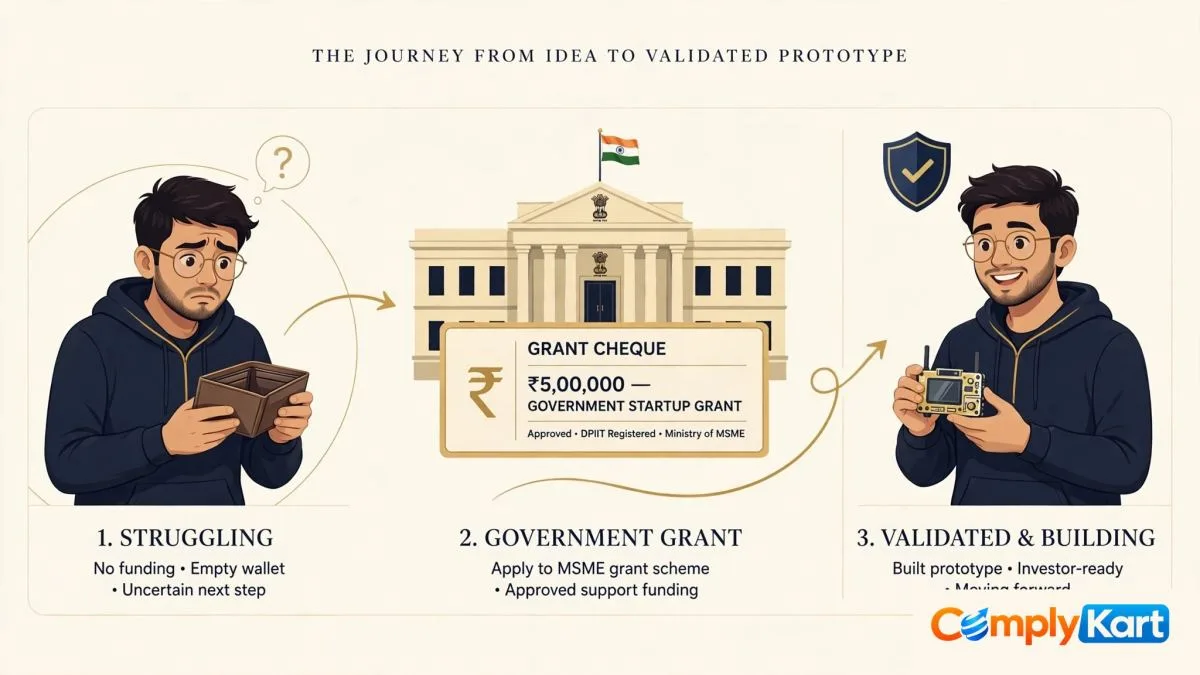
Startup India Seed Fund Scheme (SISFS) is the grant route. Operational since April 2021 with a ₹945 crore corpus, it funds DPIIT-recognised startups through empanelled incubators: up to ₹20 lakh as outright grant for proof of concept, prototype, and trials, and up to ₹50 lakh through convertible debentures or debt-linked instruments for commercialisation and market entry. Eligibility is tight — recognised startup, incorporated less than 2 years at application, not already funded beyond ₹10 lakh by other government schemes. By January 2026, incubators had approved ₹592.12 crore for 3,311 startups. The incubator is not a postbox: it evaluates, mentors, disburses in tranches against milestones, and reports utilisation.
Fund of Funds for Startups (FFS) is the equity route. Instead of the government picking startups, SIDBI commits capital to SEBI-registered Alternative Investment Funds, which invest in startups on commercial terms. As of January 2026: ₹12,362.70 crore committed to AIFs, ₹6,829.47 crore drawn down, and those AIFs had invested ₹25,859.38 crore across 1,382 startups. A 2026 top-up (FFS 2.0, ₹10,000 crore corpus) sharpens the focus on AI and deep tech. For founders, the practical path is pitching FFS-backed AIFs — the "government" part is invisible by the time the term sheet arrives, but it expands the pool of domestic risk capital.
Credit Guarantee Scheme for Startups (CGSS) is the debt route. Operational since April 2023 through NCGTC, it guarantees loans to DPIIT-recognised startups through member banks and NBFCs — up to ₹20 crore per loan, with the government covering a large share of default risk so lenders do not demand collateral founders do not have. By January 2026, 348 loans totalling ~₹925.90 crore had been guaranteed. Debt suits startups with revenue and repayment capacity; it is not a substitute for equity when the business model is still unproven.
Debt without drama: MUDRA, CGTMSE, Stand Up India
Not every business is a DPIIT-style startup, and the MSME credit architecture is older and larger than the startup schemes.
Pradhan Mantri MUDRA Yojana (PMMY) gives collateral-free loans up to ₹20 lakh to non-farm micro and small businesses through banks, NBFCs, and MFIs — Shishu (up to ₹50,000), Kishore (₹50,001–₹5 lakh), Tarun (₹5–10 lakh), and TarunPlus (₹10–20 lakh). No DPIIT recognition needed; any Indian citizen aged 18–65 with a viable business plan qualifies. Apply at any bank or through the JanSamarth portal. It is the highest-volume scheme in the system precisely because the entry bar is low.
CGTMSE (Credit Guarantee Fund Trust for Micro and Small Enterprises) does not lend — it guarantees. Lenders get cover up to ₹5 crore per MSE borrower (up to ₹10 crore under specific startup frameworks), which is what makes banks willing to lend without collateral. If you are borrowing as an MSE and the bank mentions CGTMSE coverage, that is the machinery working.
Stand Up India targets first-time entrepreneurs among women and SC/ST communities: composite loans of ₹10 lakh to ₹1 crore through scheduled commercial banks for greenfield enterprises. It pairs credit with the RuPay debit card and support services — a deliberate attempt to fix the access gap, not just the capital gap.
Sectoral and accelerator-linked programmes
SAMRIDH (MeitY, 2021) backs product startups through accelerators: up to ₹40 lakh per startup plus mentorship, market access, and investor connect. The accelerator model matters — the money comes with a programme, and selection is competitive.
Atal Innovation Mission (AIM) operates upstream: tinkering labs in schools, Atal Incubation Centres, and innovation challenges. Over 3,500 startups have come through AIM-supported channels. If you are at idea stage, an AIC is often a better first door than a funding scheme.
ANRF and the Special Purpose Fund represent the 2026 deep-tech push: long-term low-or-nil-interest loans and equity for R&D-heavy sectors — electronics and semiconductors, EVs and clean energy, AI and deep tech, strategic defence technologies — governed through the Anusandhan National Research Foundation. Early-stage, but the direction is clear: patient capital for hard technology.
MSME Innovative Scheme (design, incubation, and IPR components) offers grants up to ₹4 crore for design-led MSME projects, and state innovation-voucher programmes (Tamil Nadu's EDII vouchers of ₹3–7 lakh, for instance) fund prototype-to-commercialisation steps for manufacturing MSMEs.
State startup policies: the second layer most founders miss
Central schemes get the headlines; state policies often write the more founder-friendly cheques. Most major states run startup policies with some mix of:
Seed grants and sustenance allowances for recognised startups
Patent and trademark reimbursement (Karnataka's policy reimburses up to ₹10 lakh for patents)
SGST reimbursement for a defined period
Stamp duty and registration fee exemptions on property and documents
Subsidised incubation space and marketing assistance
Electricity duty and power tariff concessions for manufacturing startups
These frequently stack with central schemes — a startup can hold SISFS funding and still claim state patent reimbursement, provided each scheme's conditions are met independently. The catch is discovery: every state has its own portal, its own nodal agency, and its own definition of "startup" (usually aligned to DPIIT, but not always). Part of advisory work is simply mapping which state benefits apply to your registered office and operations.
The application playbook: how to actually get selected
Step 1 — Get the entry tickets first
Secure DPIIT recognition (for startup schemes) and Udyam registration (for MSME schemes) before applying for anything. Applications without the right registration are rejected at screening — the most common avoidable failure.
Step 2 — Match scheme to stage honestly
Grants (SISFS) suit validation and prototype; equity (FFS-backed AIFs) suits scaling; guarantees (CGSS) suit revenue-stage debt; MUDRA suits micro-business working capital. Applying to the wrong scheme wastes months — evaluators can tell.
Step 3 — Build the application dossier
Business plan with problem, solution, market, and financials; incorporation and recognition certificates; founder profiles; 12–24 month projections with stated assumptions; utilisation plan showing exactly what the money buys; and for debt, repayment capacity evidence.
Step 4 — Apply through the right channel
SISFS goes through empanelled incubators (listed on the Seed Fund portal) — choose one aligned to your sector. FFS means pitching backed AIFs. MUDRA/CGSS/Stand Up India go through banks. State incentives go through the state nodal agency. Never pay an "agent" who promises sanction — every legitimate scheme has a free official channel.
Step 5 — Clear evaluation and due diligence
Expect a presentation, document verification, and sometimes site visits. Incubators and banks check the same things investors do — team credibility, business viability, and whether the numbers add up. Prepare like it is a funding pitch, because it is.
Step 6 — Sign, accept conditions, and plan utilisation
Sanction letters carry conditions: end-use restrictions, milestone-linked tranches, reporting formats, and audit rights. Read them before celebrating. Set up separate bookkeeping for scheme funds from day one.
Step 7 — Execute, report, and stay compliant
Submit utilisation certificates and progress reports on schedule. Grants are disbursed in tranches against milestones — missed reports mean frozen tranches. Keep every invoice; audits are routine, not adversarial, if your records are clean.
Step 8 — Stack one scheme on the next
A SISFS grant de-risks you for angel investors; a CGSS-backed loan builds credit history; state patent reimbursement strengthens the IP story for equity rounds. Sequence the schemes deliberately instead of treating each as a one-off.
The honest trade-offs
Time: government processes run in months, not weeks. If you need money in 60 days, schemes are the wrong tool — raise privately and apply for schemes in parallel.
Conditions: grants restrict end-use, require milestone reporting, and sometimes cap founder salaries or related-party transactions during the grant period. Read the fine print as carefully as a term sheet.
Success rates: popular schemes are oversubscribed. SISFS has funded 3,311 startups out of far more applicants; incubator selection is competitive. Treat applications as a pipeline, not a lottery ticket.
Compliance load: utilisation certificates, audits, and progress reports are real work. For a two-person team, the reporting burden of a small grant can exceed its value — size the application to your capacity.
No equity dilution is the genuine advantage of grants and guarantees. For the right startup at the right stage, non-dilutive capital is the cheapest capital available — provided you can afford the patience it demands.
How ComplyKart helps — and what we do not do
We map the schemes you actually qualify for (central + your state's policy), secure DPIIT recognition and Udyam registration, prepare application dossiers and financial projections, guide incubator and bank selection, and handle post-sanction compliance — utilisation certificates, reporting, and audit readiness. We track scheme windows so you do not miss cycles.
What we do not do: we do not charge "success fees" for introductions to officials, we do not file applications with inflated projections to game selection, and we do not promise any sanction will come through. Anyone guaranteeing government money is either misinformed or selling access — both are dangerous.
FAQ
Frequently asked questions
25 answers from our consultants.
You pay for our expert's time — document checking, filing, follow-ups — not the government. The government fee goes to the government; our fee is for the work we do so you don't have to figure it out yourself.
Tell us your situation in plain words — what you're trying to do, not which form you think you need. Half our job is stopping clients from buying the wrong service. The first consultation is free and honest.
Yes. We quote professional fee + government charges + taxes separately, in writing, before you pay. The number doesn't change midway. If the government fee changes, we show you the notification.
Every engagement gets a tracker — you see what's filed, what's pending and what's next. No chasing on WhatsApp for status updates.
Both. Startups get incorporation + early compliance bundles; established companies get annual retainers. About half our clients started with us at incorporation.
The Startup India Seed Fund Scheme (SISFS) — up to ₹20 lakh as outright grant for proof of concept, prototype development, and trials, plus up to ₹50 lakh through convertible debentures or debt for commercialisation. It runs through empanelled incubators and requires DPIIT recognition. SAMRIDH offers up to ₹40 lakh per startup through accelerators. Both are competitive and milestone-linked.
A grant (like SISFS's ₹20 lakh component) does not need repayment — but it comes with end-use conditions, milestone-linked tranches, and utilisation audits. A government-backed loan (MUDRA, CGSS-guaranteed) must be repaid with interest, though collateral requirements are removed or reduced. Choose grants for validation-stage work and loans when you have revenue to service debt.
The Fund of Funds for Startups is a SIDBI-operated corpus (over ₹12,300 crore committed, plus a 2026 ₹10,000-crore top-up) that invests in SEBI-registered Alternative Investment Funds, which then invest equity in startups. You do not apply to SIDBI — you pitch the AIFs backed by the fund, like any VC round, except the capital pool is deeper because of government anchoring.
Yes, through two routes: MUDRA loans up to ₹20 lakh are collateral-free by design, and the Credit Guarantee Scheme for Startups (CGSS) lets DPIIT-recognised startups borrow up to ₹20 crore with NCGTC guaranteeing the lender against default. For MSMEs, CGTMSE provides guarantee cover up to ₹5 crore. The guarantee replaces the collateral — the loan itself is still repaid normally.
No. MUDRA is open to any Indian citizen aged 18–65 running (or starting) a non-farm micro or small business — no startup recognition required. DPIIT recognition matters for the startup-specific schemes (SISFS, CGSS, FFS ecosystem) and for tax benefits, but the MSME credit schemes run on Udyam registration or plain business credentials.
Realistically 3–6 months from incubator application to first tranche: screening, evaluation committee, selection, agreement signing, and then milestone-linked disbursement. Incubators run selection cycles, not rolling admissions in most cases. Apply early, and do not make the grant your only runway plan.
Often yes, but check each scheme's exclusions. SISFS bars startups that received over ₹10 lakh from other government schemes. State incentives frequently stack with central ones. The rule of thumb: read the "not eligible if" clause of every scheme before applying, and disclose other support received — non-disclosure discovered later can mean recovery and blacklisting.
Most state startup policies offer patent/trademark reimbursement (Karnataka reimburses up to ₹10 lakh for patents), SGST reimbursement for a defined period, stamp-duty exemptions, seed grants, subsidised incubation, and marketing assistance. Check your state's startup portal and nodal agency — benefits apply based on where you are registered and operating.
SAMRIDH is MeitY's accelerator-linked programme for product startups: up to ₹40 lakh per startup plus mentorship, market access, and investor connections through selected accelerators. It suits startups past idea stage with a product to refine and scale. Selection runs through the accelerators, so research which accelerator fits your sector before applying.
Grants are non-repayable but conditional: funds must be used for the approved purposes, disbursed in tranches against milestones, reported through utilisation certificates, and open to audit. Diversion of funds can trigger recovery with interest and debarment. The "cost" is compliance effort and time — budget for both.
DPIIT recognition certificate and/or Udyam registration, incorporation documents, founder KYC and profiles, business plan with financials, 12–24 month projections with assumptions, fund-utilisation plan, and for debt schemes, repayment capacity proof and bank statements. Keep everything current — expired recognitions or pending ROC filings cause rejections.
Every legitimate scheme has a free official application channel — portals, incubators, or banks. No official asks for payment to "ensure" sanction. Verify any scheme on the official ministry or Startup India website before engaging, and never share DSCs, OTPs, or bank credentials with intermediaries. Genuine advisors charge for preparation work, not for access.
The Credit Guarantee Scheme for Startups (operational since April 2023 via NCGTC) guarantees loans taken by DPIIT-recognised startups from member banks and NBFCs — up to ₹20 crore per loan. If the startup defaults, the guarantee trust compensates the lender for the covered portion. You still repay your loan; the guarantee simply removes the collateral barrier that kept banks from lending to asset-light startups.
Yes — the MSME Innovative Scheme has design, incubation, and IPR components with grants up to ₹4 crore for design-led projects. State innovation-voucher programmes (like Tamil Nadu's EDII vouchers of ₹3–7 lakh) fund prototype development and commercialisation for manufacturing MSMEs. Udyam registration is the usual entry ticket.
Utilisation audits compare spending against the approved plan. Diversion typically triggers recovery of the misused amount with interest, suspension of further tranches, and blacklisting from the scheme and often from related schemes. In serious cases it can invite proceedings for misrepresentation. The prevention is simple: separate books for scheme funds and spend only on approved heads.
No — it is specifically for greenfield (first-time) enterprises set up by women or SC/ST entrepreneurs, with composite loans of ₹10 lakh to ₹1 crore through scheduled commercial banks. Existing businesses should look at MUDRA (for micro/small scale) or CGTMSE-backed bank credit instead.
They usually complement each other. A startup can receive SISFS central funding and separately claim state patent reimbursement or SGST refund, as long as neither scheme prohibits it and there is no double-claiming for the same expense. Always map both layers before applying — many founders leave state money unclaimed out of ignorance.
The Anusandhan National Research Foundation's Special Purpose Fund channels long-term low-or-nil-interest loans and equity into R&D-heavy sectors — semiconductors, EVs, clean energy, AI, defence tech. It is the 2026-era vehicle for patient capital in hard technology, still ramping up. Deep-tech founders should track its calls alongside the established schemes.
When the opportunity cost of figuring it out yourself exceeds the advisory fee — typically when you are targeting multiple schemes, the amounts are significant (₹20 lakh+), or your team has no bandwidth for application and compliance work. A good advisor maps eligibility, prepares dossiers, and manages post-sanction reporting. What no advisor can do is guarantee selection — scheme decisions rest with evaluation committees.
You need DPIIT recognition, incorporation less than 2 years before application, and a scalable business idea. You must not have received more than ₹10 lakh from other central or state government schemes. The startup should be a private limited company or LLP. Applications go through incubators empanelled under SISFS — you apply to the incubator, not directly to DPIIT.
What clients say about working with us
Real stories from businesses we've worked with.
Trademark Registration“
Our Trademark was applied in all the classes with a short span of time by Complykart Trademark Experts and I can say the level of expertise and commitment they carry is remarkable. It's an A+ from my side. We are now sticking to ComplyKart only.
Company Registration“
I found the professionalism of the staff at complykart.com, a pleasure to work with. As a foreigner to India, they took the time to explain the documentation and assisted in every question I raised. I was pleased that complykart.com made it easy for my Business.
Merger & Acquisition“
Trust, Commitment, Dedication and responsiveness are the best things with ComplyKart. Thanks for handling our Merger assignment with so much care. After my business disputes, complykart handles all things with own sense of understanding.
Company Law Specialist · Company Law & ROC Compliance · 10+ years experience
Naman Agarwal specialises in company law and ROC compliance. He manages incorporations, annual filings (AOC-4, MGT-7, ADT-1), board processes and statutory registers for private limited companies, LLPs and Section 8 companies.
Last reviewed: 16 November 2026
Get a free consultation
Talk to a ComplyKart professional about Government Grants Advisory. The first consultation is free.