
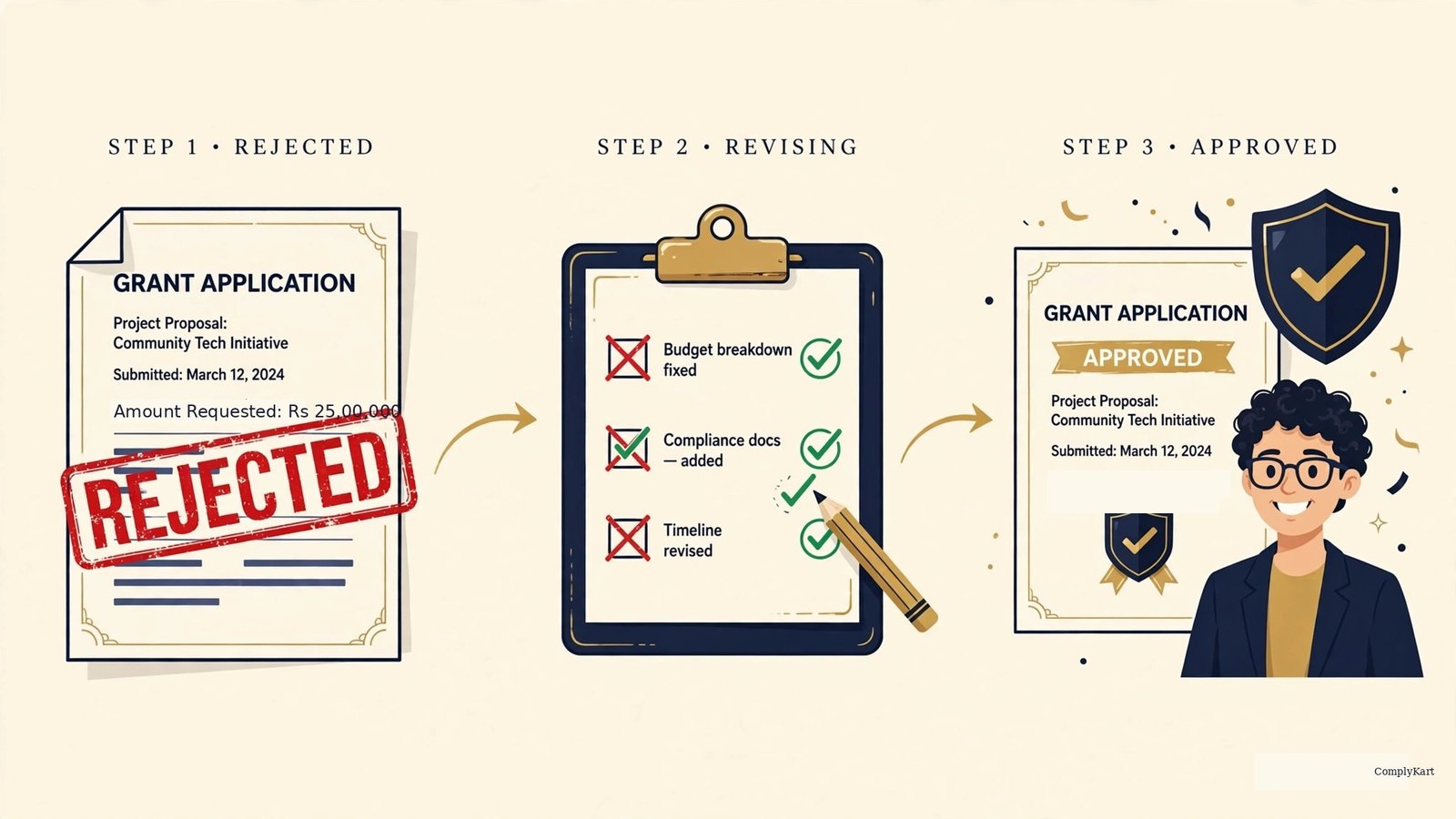
Short answer: most grant applications are not rejected on merit — they fail the innovation test, show up with no prototype, apply in the wrong order, hide prior funding, or let their paperwork argue with itself. Every one of these is fixable, and most schemes (SISFS included) let you re-apply after fixing what was weak.
Most grant applications do not fail on merit. They fail on avoidable mistakes. I have seen the patterns often enough to list them. If your application was rejected — or you want to make sure it is not — read this before you apply again.
Key takeaways
- The most common rejection reason is failing the innovation test — committees fund technology and scalable models, not plain trading or services.
- Grants fund work, not ideas: show a prototype, proof of concept, or early traction before you apply.
- Sequencing matters — a large state grant first can lock you out of SISFS via its ₹10L prior-support cap.
- Selection is the midpoint, not the finish line: money arrives in milestone-linked tranches against utilisation certificates.
- Grants are generally taxable as income — confirm the treatment with your CA before year-end, not after.
1. You failed the innovation test
This is the most common reason, and the least understood. Grant committees are not looking for a good business. They are looking for innovation or a genuinely scalable model — technology at the core, or a new or improved product, process, or service.
A plain trading or services business with no technology angle and no scalability story will not clear it, however profitable it looks. And dressing it up does not help. "AI-powered blockchain platform" with nothing behind it gets spotted fast — committees read hundreds of these.
The innovation test works like a scholarship that reads your marksheet, not your essay. What you have built counts. What you say you will build does not. Show the product, the prototype, the technology, or the scale logic. Claims are cheap. Evidence is not.
2. You showed up empty-handed
Grants fund work, not ideas. No prototype, no proof of concept, no early traction — just an idea and a deck — is the fastest route to a rejection letter.
There is one honest exception: NIDHI-PRAYAS exists precisely to fund the prototype stage, offering up to ₹10L to individual innovators and very early startups with a science-and-technology idea. If you have nothing built yet, PRAYAS is your door. For nearly every other scheme, the rule holds: build first, apply second.
3. You applied in the wrong order
Grant sequencing is a strategy, not an afterthought. Two traps catch founders here.
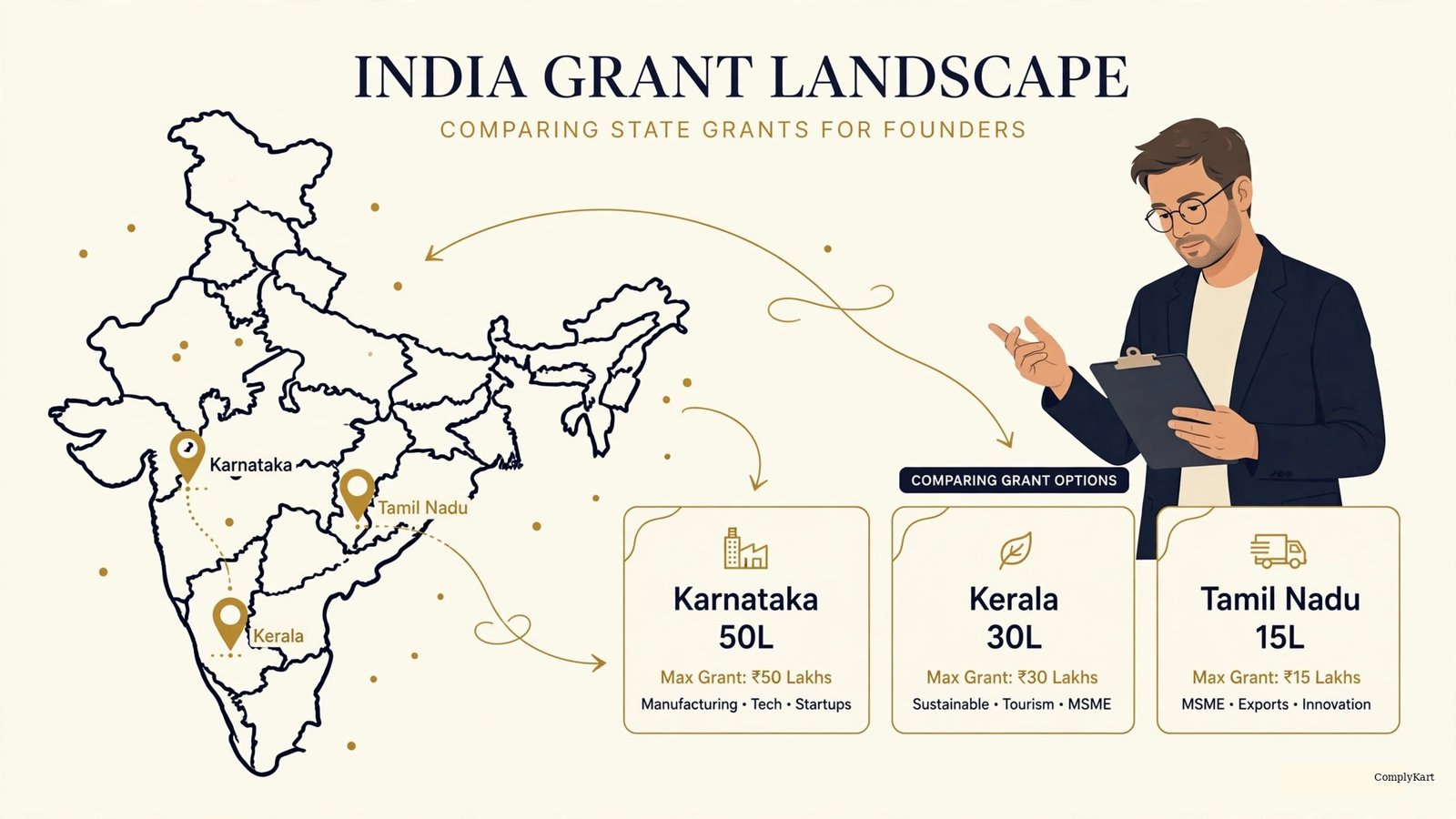
First, the prior-support cap. The Startup India Seed Fund Scheme bars you if you have already received more than ₹10L in monetary support from any central or state government scheme. Take a ₹15L state grant first, and you may have locked yourself out of SISFS. Plan the order: small prototype grants first, bigger seed grants next, and stay under the caps that matter to you.
Second, fellowships end when funding begins. NIDHI-EIR pays ₹30k a month to full-time aspiring founders — but the support stops the month you raise other funding or investment, and you cannot hold another fellowship or salary alongside it. Know the exit conditions before you enter.
4. You took money for the same project twice
Two scholarships cannot cover the same semester's fee. The same project cannot be funded twice by two ministries.
SISFS, RKVY-RAFTAAR, and the space fund's Technology Adoption Fund all require a self-declaration of government support already received. This is not a formality. Hide prior funding and you risk revocation and refund — the scheme can ask for the money back.
You can stack grants — PRAYAS for the prototype, a state grant for market entry, a sector grant for scale-up. Different stages, different purposes, all declared. That is legitimate and common. What is not allowed is the same work billed twice.
5. Your paperwork argued with itself
Committees notice what founders do not. Names, dates, and figures that disagree across your incorporation certificate, PAN, bank account, and pitch deck. A generic deck that could belong to any of fifty startups. Applying as an individual where only companies, LLPs, or partnership firms qualify — SISFS rejects individuals outright. Missing utilisation certificates from an earlier grant.
And the quiet killer: a Memorandum of Association that never mentions innovation. If your MoA reads like a trading company's and says nothing about research, technology, or product development, your innovation argument starts on the back foot. Write your MoA like someone will read it. Someone will.
6. You thought selection was the finish line
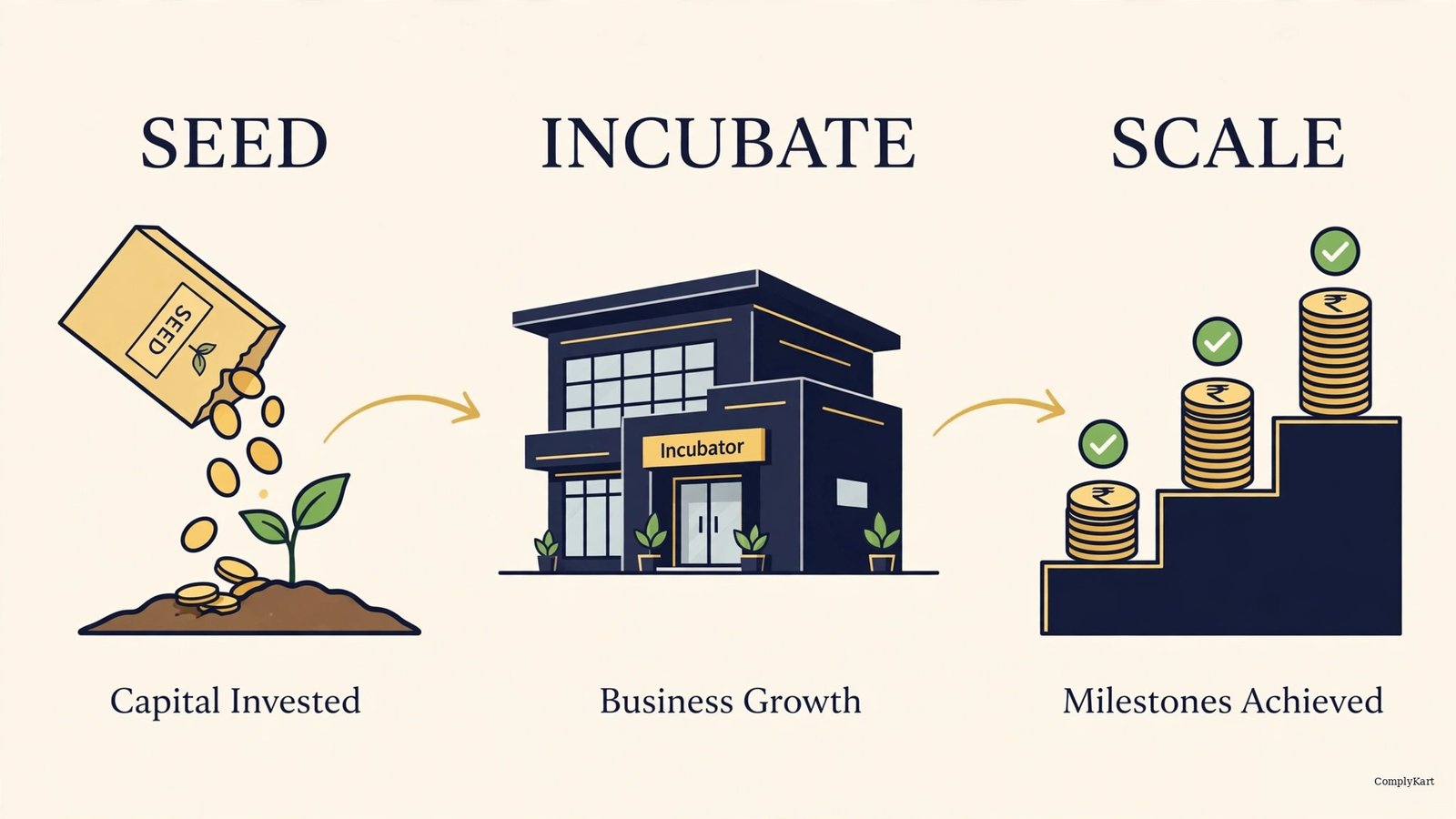
Getting selected is the midpoint, not the end. Grant money arrives in milestone-linked tranches against a signed agreement. You hit the prototype milestone, the next instalment releases. You file utilisation certificates for every tranche. Miss a milestone and the next tranche waits — however good your pitch was.
Founders who treat the sanction letter as victory and relax on documentation are the ones who stall mid-scheme. The discipline that won you the grant is the discipline that releases it.
7. You ignored the tax on the grant
Here is the part nobody puts on the poster: government grants are generally taxable as income. They are revenue receipts unless they are applied toward capital expenditure or are capital-purpose grants tied to a specified project. Book them under Ind AS 20 or AS 12, and confirm the treatment with your CA before year-end — not after.
Two reliefs soften this. The 80-IAC deduction exempts 100% of profits for any 3 consecutive years within your first 10, and the 2025-26 Budget announcements extended it to startups incorporated before 1 April 2030 — but verify that date against the Finance Act text with your CA; do not take any blog's word for a tax deadline, including mine. Separately, with DPIIT recognition and a Form-2 declaration, share premium above fair market value is exempt from angel tax under Section 56(2)(viib).
8. You trusted a grant consultant
No legitimate scheme charges an application fee. DPIIT recognition is free. SISFS applications were free. And no legitimate scheme guarantees a grant — selection is competitive and committee-driven, every time.
Run from anyone who promises a guaranteed grant, demands an upfront "facilitation" or "processing" fee, pressures you with a fake deadline, operates on a Gmail address only, flashes institutional logos with no matching announcement on that institution's own website, or asks for bank passwords or OTPs. Verify every scheme on its official portal before you apply or pay anything.
The closing truth
Rejection is usually a draft, not a verdict. Build the prototype. Fix the MoA. Clean the paperwork. Sequence the applications. Declare everything. SISFS itself lets rejected founders re-apply after about 3 months when calls reopen.
Most founders who eventually win grants were rejected first. The difference is they treated the rejection as feedback and came back sharper.
If your application was rejected and you want a second pair of eyes before reapplying, our team at ComplyKart reviews grant applications against what committees actually look for.
Frequently asked questions
My grant application was rejected. Can I apply again?
Usually, yes — rejection is feedback, not a lifetime ban. SISFS explicitly allows re-application after about 3 months when calls reopen. Before you do, fix what was actually weak: the prototype, the innovation story, the utilisation plan, the paperwork mismatches. Reapplying with the same application and hoping for a different committee is not a strategy.
Is a government grant taxable?
Generally, yes — grants are treated as income (revenue receipts) unless they are applied toward capital expenditure or are capital-purpose grants tied to a specified project. Book them under Ind AS 20 or AS 12 and confirm the treatment with your CA before the financial year ends. The 80-IAC deduction can offset the impact in eligible years, but get advice specific to your case.
A consultant guarantees my grant approval for a fee. Is that legitimate?
No. No legitimate scheme charges an application fee, and no one can guarantee selection — it is competitive and committee-driven, every time. Guaranteed-grant consultants are a known scam pattern: upfront "facilitation fees," fake deadlines, Gmail-only contact, institutional logos with no matching announcement. Verify every scheme on its official portal.
Does a great pitch deck matter more than a prototype?
No — and this is where many founders misjudge the game. Grant committees fund work, not ideas. A working prototype or proof of concept with a plain deck beats a beautiful deck with nothing built, nearly every time. The one exception is NIDHI-PRAYAS, which exists specifically to fund the prototype stage itself.
What is the single most common reason grant applications get rejected?
Failing the innovation test. Committees are not judging whether your business is good — they are judging whether it is innovative or genuinely scalable, with technology at the core or a new or improved product, process, or service. A profitable plain-trading business will lose to a rough prototype with a real technology angle. Show the work, not the adjectives.


Comments
No comments yet — ask the first question below.
Join the discussion
Questions go straight to our expert desk. Comments appear after a quick review — no spam, no noise.