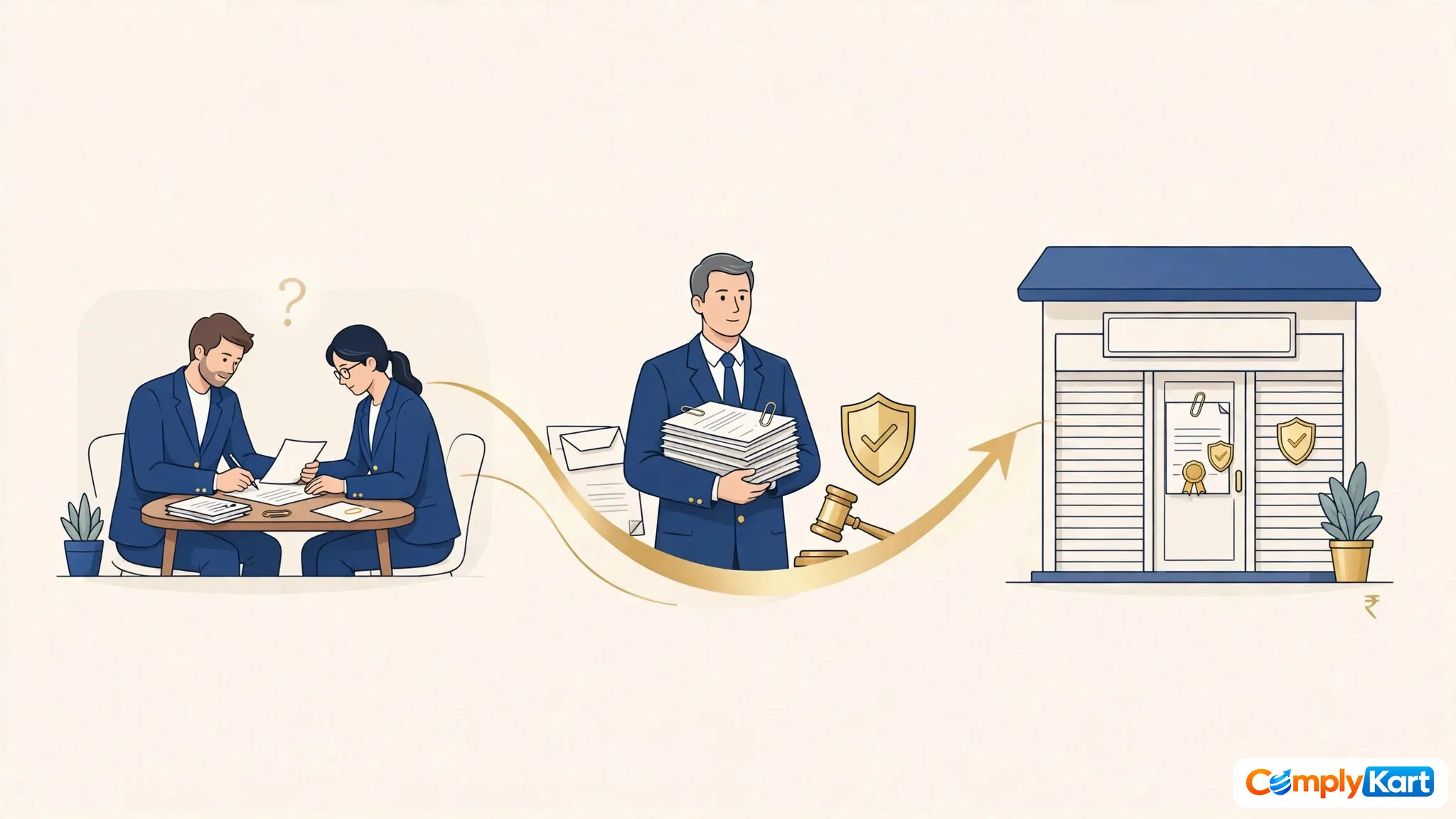
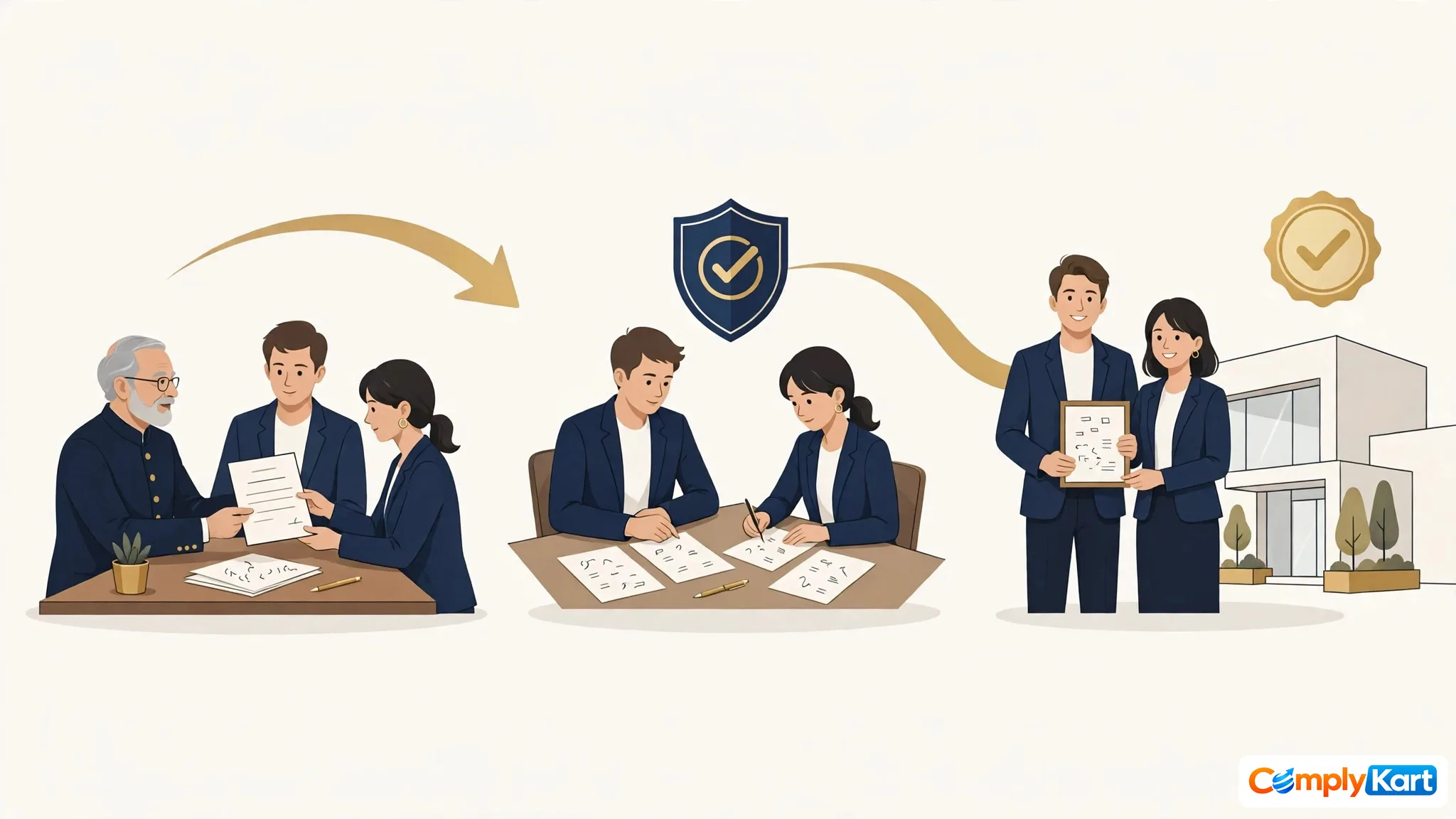
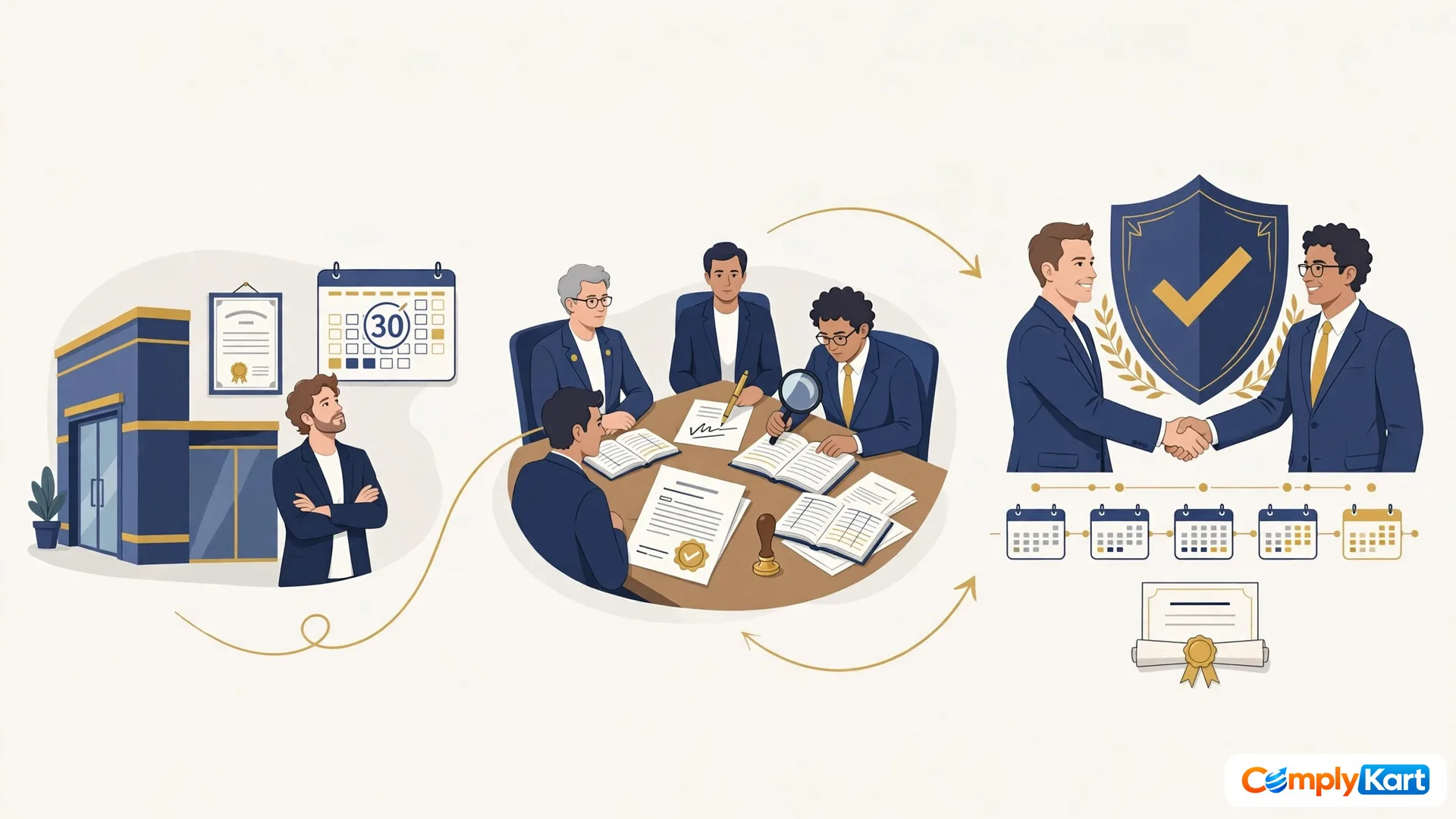
Five steps, no guesswork — you always know exactly what comes next. Tap a step to see what it involves.
12345
You pay securely. Payment is confirmed instantly, and your receipt with the written fee breakup lands in your inbox.
Is a formal closure the right move — and which route?
Strike-off fits if all of these are true: the company has not carried on business for some time (or you are ready to stop now), it has no assets left to distribute, no liabilities outstanding, no pending litigation, no unsatisfied charges on its assets, and no pending prosecution or compounding applications. Most dormant startups, never-launched ventures, and shelf companies land here.
Voluntary liquidation fits if: the company is solvent but holds assets — a bank balance, receivables, property, investments — that must be sold and the proceeds distributed to shareholders; or it owes money to creditors who need a formal claims process; or the shareholders simply want the finality of a Tribunal dissolution order rather than an administrative strike-off.
Do not start either route if: there is an ongoing dispute about who owns what, a tax demand under appeal that could change the liability picture, or a creditor threatening action. Settle or ring-fence those first — a closure filed over an unresolved dispute tends to stall, and in the IBC route the liquidator is duty-bound to surface it anyway.
And if the company is insolvent — it cannot pay its debts — neither of these routes applies. That is the Corporate Insolvency Resolution Process (CIRP) under the IBC, a creditor-driven process with entirely different rules. If you are unsure whether the company is solvent, that is the first question to answer, because the directors' declaration of solvency in the IBC route is given on affidavit, and a false declaration carries prosecution risk.
The cost of just walking away
This section exists because "let's just stop filing" is the most common — and most expensive — advice founders give each other.
Penalties never sleep. Every missed AOC-4 and MGT-7 attracts an additional fee of ₹100 per day, per form, with no cap. A company abandoned for three years can easily accumulate late fees in the lakhs before anyone acts.
Directors get disqualified. Under Section 164(2), directors of a company that fails to file financial statements or annual returns for three consecutive financial years are disqualified from being appointed or reappointed as directors of any company for five years. Their DINs are liable to be deactivated. That follows the person, not the company — it affects the next venture too.
The ROC can strike you off anyway — on worse terms. The Registrar can initiate strike-off on its own under Section 248(1) for non-filing companies. A suo moto strike-off leaves the same dissolution outcome but without the orderly paper trail, and the directors' indemnity position is weaker.
Tax and regulatory loose ends stay live. An unclosed company still holds a PAN, and GST registration (if any) continues to demand returns until formally cancelled. Bank accounts in the company's name remain open to misuse.
Revival is harder than closure. If business circumstances change, reviving a properly closed company through a Section 252 appeal is a defined legal process. Untangling an abandoned company with years of penalties is slower and costlier than either closing or reviving it would have been.
What must be settled before you file
Closure applications fail far more often on preparation than on law. Work through this list before touching a form.
Liabilities — all of them. For strike-off, the statute requires the company to have extinguished all its liabilities. That means vendor dues, loan repayments, statutory dues (TDS, PF, ESI, professional tax), and any contingent liabilities you know about. Get written confirmations where the amounts are material. For voluntary liquidation, liabilities are settled through the liquidator's claims process — but undisclosed liabilities surfacing mid-process will delay everything.
The bank account. Close the company's bank accounts and keep the closure confirmation. Both routes ask for it — for strike-off it evidences that nothing is left to distribute; for liquidation the liquidator takes control of the funds.
Pending ROC filings. No STK-2 application can be filed unless overdue returns in Form AOC-4 and Form MGT-7 have been filed up to the end of the financial year in which the company ceased to carry on business operations. This is the single biggest source of delay: founders discover three years of unfiled returns, each carrying ₹100-a-day late fees, and the "cheap" strike-off suddenly needs a compliance clean-up first. Budget for it honestly.
Tax registrations. File the final income tax return. If the company holds GST registration, apply for cancellation and file the final return in GSTR-10 within three months of cancellation. Surrender any other registrations — shops and establishments, professional tax enrolment, FSSAI or other sectoral licences.
Charges on assets. If any charge is registered against the company's assets and its satisfaction is still pending, strike-off is not available until the charge is satisfied and the satisfaction filed.
Pending litigation, prosecution, or compounding. Strike-off is barred while prosecution for an offence is pending in any court against the company, while a compounding application is pending, or while public deposits remain outstanding or in default. Disclose these upfront — the affidavit each director signs states there are none, and it is given on oath.
Books and records. Preserve the books of account and statutory registers. Even after dissolution, directors can be called upon regarding the company's affairs, and the indemnity bond (STK-3) keeps directors personally answerable for claims that surface later.
Director availability and DSCs. Every director signs an affidavit (STK-4) and the indemnity bond (STK-3), both notarised. The STK-2 itself is signed by a director authorised by the board and certified by a practising professional. Make sure DSCs are valid and the directors are reachable — unresponsive directors are the most common practical bottleneck.
The two closure routes, compared honestly
Route 1 — Strike-off under Section 248(2). An administrative process. The company applies to the Registrar (now C-PACE, the centralised exit cell operational since May 2023) to remove its name from the register. No liquidator, no creditor meetings, no Tribunal. It is designed for companies with nothing left to fight over: no assets, no liabilities. The Registrar publishes a public notice (STK-5/STK-6) inviting objections within 30 days; if none is sustained, the name is struck off and the dissolution is notified in the Official Gazette (STK-7). Average processing is now under two months.
Route 2 — Voluntary liquidation under IBC Section 59. A formal liquidation for solvent companies. A licensed insolvency professional acts as liquidator: takes custody of assets, invites and verifies creditor claims, sells assets, pays creditors in the statutory order, distributes the surplus to shareholders, and finally applies to the NCLT for a dissolution order. Heavier, slower (typically 6–12 months), and costlier — but it is the only route that formally settles a company with real assets and creditors.
Route 3 — Compulsory winding up (Sections 271–272). Mentioned for completeness: the Tribunal orders winding up on a petition — for inability to pay debts, fraud, unlawful objects, or where it is just and equitable. This is not a route you choose; it is one imposed on you. If someone is threatening a winding-up petition, take legal advice before doing anything else.
Strike-off (Sec 248)
Voluntary liquidation (IBC Sec 59)
Company must be
Dormant; no assets or liabilities
Solvent; no default in debt repayment
Who drives it
Board + shareholders
Board + shareholders + liquidator
Liquidator
None
Insolvency Professional (IBBI-registered)
Creditor process
None (liabilities must be nil first)
Public announcement; 30-day claim window
Government fee
₹10,000 (STK-2)
No fixed fee
Typical timeline
Under 2 months (C-PACE)
6–12 months
Final order
STK-7 Gazette notification
NCLT dissolution order
Section 8 companies
Not eligible
Eligible
Documents required for strike-off (STK-2)
Board and shareholder approvals:
Board resolution approving the strike-off and authorising a director to file
Special resolution passed at a general meeting, filed in Form MGT-14 under Section 117 — or, alternatively, consent of members holding 75% of paid-up share capital
Director declarations (each director):
Indemnity bond in Form STK-3, duly notarised — directors undertake personal liability for claims arising after strike-off
Affidavit in Form STK-4, duly notarised — declaring the company has no assets, liabilities, or pending legal proceedings
Financials:
Statement of accounts in Form STK-8, showing nil assets and nil liabilities, prepared for a date not more than 30 days before the application and certified by a Chartered Accountant
Compliance proof:
Evidence that overdue AOC-4 and MGT-7 filings are complete up to the financial year of cessation
Bank account closure confirmation
No-objection certificates from sectoral regulators, if the company was regulated under a special Act
Statement regarding pending litigation, if any
Filing mechanics: STK-2 is signed by the authorised director, certified by a Company Secretary, Chartered Accountant, or Cost Accountant in whole-time practice, and filed on the MCA V3 portal addressed to C-PACE.
Documents required for voluntary liquidation (IBC Section 59)
Declaration of solvency (Section 59(3)(a)) — by a majority of the directors, verified by affidavit, stating that the company has no debts or will be able to pay its debts in full from the proceeds of assets sold in the liquidation, and that the company is not being liquidated to defraud any person. Filed with the ROC in e-form GNL-2.
Accompanying the declaration (Section 59(3)(b)):
Audited financial statements and records of business operations for the previous two years (or since incorporation, if later)
Report of valuation of the company's assets by a registered valuer
Resolutions:
Special resolution of shareholders approving voluntary liquidation and appointing the liquidator (an IBBI-registered insolvency professional), passed within four weeks of the declaration
Where the company owes debts: approval of creditors representing two-thirds in value, within seven days of the resolution
Thereafter (liquidator's filings): public announcement, preliminary report, annual status reports, and the final report with the dissolution application to the NCLT — all handled by the liquidator, but the directors must cooperate with information and records throughout.
Strike-off process — step by step
Step 1 — Board meeting. The board resolves to close the company: approves closure of the bank account, settlement of all pending liabilities, preparation of final financial statements, and convening of an extraordinary general meeting.
Step 2 — Clear the decks. Pay off every liability. Close the bank account. File all overdue AOC-4 and MGT-7 returns up to the financial year the company stopped operating. Cancel GST registration. File the final income tax return.
Step 3 — Shareholder approval. Hold the EGM with at least 21 clear days' notice (or shorter notice with 90% shareholder consent) and pass the special resolution for strike-off — or collect written consent from members holding 75% of paid-up share capital. File MGT-14 for the special resolution.
Step 4 — Prepare the affidavit set. Each director executes the STK-3 indemnity bond and STK-4 affidavit before a notary. The CA certifies the STK-8 statement of accounts dated within the last 30 days.
Step 5 — File STK-2. Upload the application with all attachments on the MCA portal, addressed to C-PACE, with the ₹10,000 fee. The form is certified by a practising professional.
Step 6 — Public notice and objections. C-PACE publishes the intended removal in STK-5/STK-6 — on the MCA website, in the Official Gazette, and in newspapers. Anyone may object within 30 days.
Step 7 — Strike-off and dissolution. If no objection is sustained, the Registrar strikes the name off and publishes STK-7 in the Official Gazette. On publication, the company stands dissolved.
Voluntary liquidation process — step by step
Step 1 — Board meeting and solvency declaration. The board proposes voluntary liquidation. A majority of directors make the declaration of solvency on affidavit, with two years of audited financials and the registered valuer's report attached. The declaration is filed with the ROC in GNL-2.
Step 2 — Shareholder resolution (within 4 weeks). Members pass a special resolution approving the liquidation and appointing the insolvency professional as liquidator. If the company owes debts, creditors holding two-thirds in value approve the resolution within seven days.
Step 3 — Liquidation commences; notices go out. The liquidator notifies the ROC and the IBBI, and within five days makes a public announcement — in newspapers, on the company's website, and on the IBBI website — calling on creditors and stakeholders to submit claims within 30 days.
Step 4 — Claims, verification, and the preliminary report. The liquidator verifies claims, takes custody of assets and records, and within 45 days of commencement prepares a preliminary report: estimates of assets and liabilities, capital structure, and the proposed plan of action.
Step 5 — Realisation and distribution. Assets are sold, creditors paid in the statutory order of priority, and any surplus distributed to shareholders. The liquidator files annual status reports if the process crosses a year, and keeps minutes of stakeholder consultations.
Step 6 — Final report and NCLT dissolution. When the affairs are fully wound up, the liquidator prepares the final report and applies to the NCLT for dissolution. The Tribunal's order dissolves the company from the date of the order, and a copy is forwarded to the ROC within fourteen days. The liquidator aims to complete the process within twelve months of commencement.
How long does it take?
Strike-off: document preparation takes a few working days once the house is in order. The variable part is the clean-up before filing — clearing pending ROC filings and liabilities depends entirely on the company's backlog and can take weeks. After STK-2 is filed, C-PACE averages under two months to strike-off, including the 30-day public notice window. A company with clean records can go from decision to dissolution in roughly three months; one with three years of pending filings should expect four to six.
Voluntary liquidation: the front-loaded steps (declaration, resolution, announcement) take six to eight weeks. The claims window is 30 days, and asset sale timelines depend on what is being sold. Straightforward cases close in six to nine months; the Regulations expect the liquidator to attempt completion within twelve months of commencement.
What slows both routes down: unresponsive directors (affidavits need every signature), disputed liabilities, missing books, pending tax assessments, and charges whose satisfaction was never filed. Almost every delay we see traces to one of these five.
Government fees
Item
Fee
STK-2 strike-off application
₹10,000
MGT-14 (special resolution filing)
Normal filing fee per share capital slab
GNL-2 (solvency declaration filing)
Normal filing fee per share capital slab
IBC voluntary liquidation
No fixed government fee; liquidator's professional fee, valuer's fee, and publication costs apply
Late fees on overdue AOC-4 / MGT-7
₹100 per day per form, no cap — clear before filing STK-2
Professional fees for the closure engagement are quoted per case after reviewing the company's filing status and liability position — the clean-up cost, not the form fee, is what varies.
How ComplyKart helps in this entire process
Closure-route diagnosis. We review the company's balance sheet, filing status, liabilities, and shareholder intent, and tell you plainly whether strike-off or voluntary liquidation fits — including telling you when neither fits yet and what to fix first.
Compliance clean-up. We file the overdue AOC-4s and MGT-7s, compute the late fees, close out GST and tax registrations, and prepare the final financial statements, so the closure application goes in on clean records.
Documentation. Board and shareholder resolutions, STK-3 indemnity bonds, STK-4 affidavits, STK-8 statements with CA certification, the IBC declaration of solvency with valuer coordination, and the liquidator appointment paperwork — drafted, executed, and filed.
Filing and follow-up. STK-2 to C-PACE or the full Section 59 sequence with the insolvency professional, public announcements, and Registrar correspondence — tracked until the STK-7 Gazette notice or the NCLT dissolution order arrives.
What we will not do: we will not file a strike-off over known liabilities, sign affidavits on your behalf, or promise a timeline C-PACE or the NCLT controls. If the company is insolvent, we will tell you so and point you to insolvency counsel rather than sell you a liquidation.
What happens after the certificate — I mean, the Gazette
On publication of STK-7 (or the NCLT dissolution order), the company ceases to exist as a legal person. Its PAN becomes inoperative for business, its name is removed from the ROC register, and it can no longer sue or be sued, hold property, or incur liability.
Keep these: the STK-7 notice or dissolution order, the final financial statements, the bank closure confirmation, and the filed affidavits. Directors should retain them for at least eight years — claims and queries have a long tail.
Directors' continuing exposure: the STK-3 indemnity bond means directors remain personally answerable for liabilities that surface after strike-off. Strike-off does not wash away fraud, and directors can still be proceeded against for offences committed while the company existed.
Revival: if the strike-off turns out to have been wrong — the company had business after all, or a creditor was overlooked — an appeal lies to the NCLT within three years under Section 252, and the Tribunal can restore the company's name to the register.
Common mistakes that derail closures
Filing STK-2 with pending ROC returns. The application will not survive scrutiny. Check the filing history first, not after.
"Nil liabilities" that are not nil. An unpaid TDS demand, a pending vendor invoice, or an unfiled charge satisfaction — each of these contradicts the directors' affidavit. The affidavit is sworn; treat it that way.
Forgetting the 30-day freshness of STK-8. The statement of accounts must be for a date not more than thirty days before the application. A two-month-old balance sheet means a rejection and a fresh CA certification.
Missing the GSTR-10 deadline. GST cancellation needs its final return within three months. Miss it and the GST file stays open while the company file closes.
One director goes missing. Every director signs the affidavit and indemnity bond. Start collecting signatures early; a director abroad or uncooperative can stall the whole filing.
Choosing strike-off for a company with assets. If there is money or property to distribute, strike-off is the wrong route — the "nil assets" affidavit would be false. Use voluntary liquidation.
Ignoring the two-thirds creditor approval in IBC liquidation. Where debts are owed, the shareholders' resolution alone does not suffice; creditors holding two-thirds in value must approve within seven days.
Sources
Companies Act, 2013 — Sections 117, 164(2), 248, 252, 271–272, 302. Insolvency and Bankruptcy Code, 2016 — Section 59. IBBI (Voluntary Liquidation Process) Regulations, 2017. Companies (Removal of Names of Companies from the Register of Companies) Rules, 2016, as amended by the 2023 Amendment Rules. MCA Notification S.O. 1269(E) dated 17.03.2023 (C-PACE establishment); MCA press note reported August 2025 (38,658 companies struck off via C-PACE between 01.05.2023 and 31.07.2025). MCA portal — mca.gov.in; IBBI — ibbi.gov.in. Checked 2026-10-12.
FAQ
Frequently asked questions
11 answers from our consultants.
You pay for our expert's time — document checking, filing, follow-ups — not the government. The government fee goes to the government; our fee is for the work we do so you don't have to figure it out yourself.
Typically 9–18 months for a private limited company, depending on creditors and asset sales. Clean balance sheets move faster.
Strike-off suits companies with no assets or liabilities — simpler and cheaper. Liquidation suits companies with assets to distribute or creditors to settle formally.
The liquidator adjudicates claims under the IBBI regulations. Genuine disputes are resolved within the process.
In a solvent voluntary liquidation, generally no — that is the point of the limited liability structure. Fraud or wrongful trading is a different matter.
Only to complete the winding up — no new business. The liquidator controls the company's affairs.
Employee dues are settled as part of creditor claims, with priority as per the IBC waterfall. We include this in the plan from the start.
₹100 per day, per form, with no maximum cap. A one-year delay on AOC-4 and MGT-7 together can cross ₹70,000 in late fees alone. File on time — it's the cheapest compliance you'll ever do.
Yes. Dormant or not, a private limited company must file AOC-4, MGT-7, hold board meetings and conduct a statutory audit every year. Zero turnover doesn't mean zero compliance.
AOC-4 is your financial statements (balance sheet, profit & loss) filed with the ROC. MGT-7 is your annual return (shareholding, directors, meetings). Both are due after your AGM — AOC-4 within 30 days, MGT-7 within 60 days.
Yes, with late fees. There's no amnesty scheme running right now, so every day of delay adds ₹100 per form. We regularly clear 3-4 years of backlog for companies — it's routine work for us.
What clients say about working with us
Real stories from businesses we've worked with.
Trademark Registration“
Our Trademark was applied in all the classes with a short span of time by Complykart Trademark Experts and I can say the level of expertise and commitment they carry is remarkable. It's an A+ from my side. We are now sticking to ComplyKart only.
Company Registration“
I found the professionalism of the staff at complykart.com, a pleasure to work with. As a foreigner to India, they took the time to explain the documentation and assisted in every question I raised. I was pleased that complykart.com made it easy for my Business.
Merger & Acquisition“
Trust, Commitment, Dedication and responsiveness are the best things with ComplyKart. Thanks for handling our Merger assignment with so much care. After my business disputes, complykart handles all things with own sense of understanding.
Reyansh Singh leads ComplyKart’s NCLT and dispute resolution practice. He represents companies in oppression and mismanagement petitions, insolvency matters, shareholder disputes and regulatory proceedings. He knows how tribunals think — and drafts petitions that win.
Last reviewed: 16 November 2026
Get a free consultation
Talk to a ComplyKart professional about Winding up Private Limited Company. The first consultation is free.