
Presumptive Taxation 44AD/44ADA for Small Businesses: Who Should Opt In
Every small business owner faces the same fork at tax time: maintain full books, track every expense, and pay for a tax audit past the turnover limit — or tell the tax department "assume my profit is X percent of turnover" and skip the books entirely. That second path is presumptive taxation.
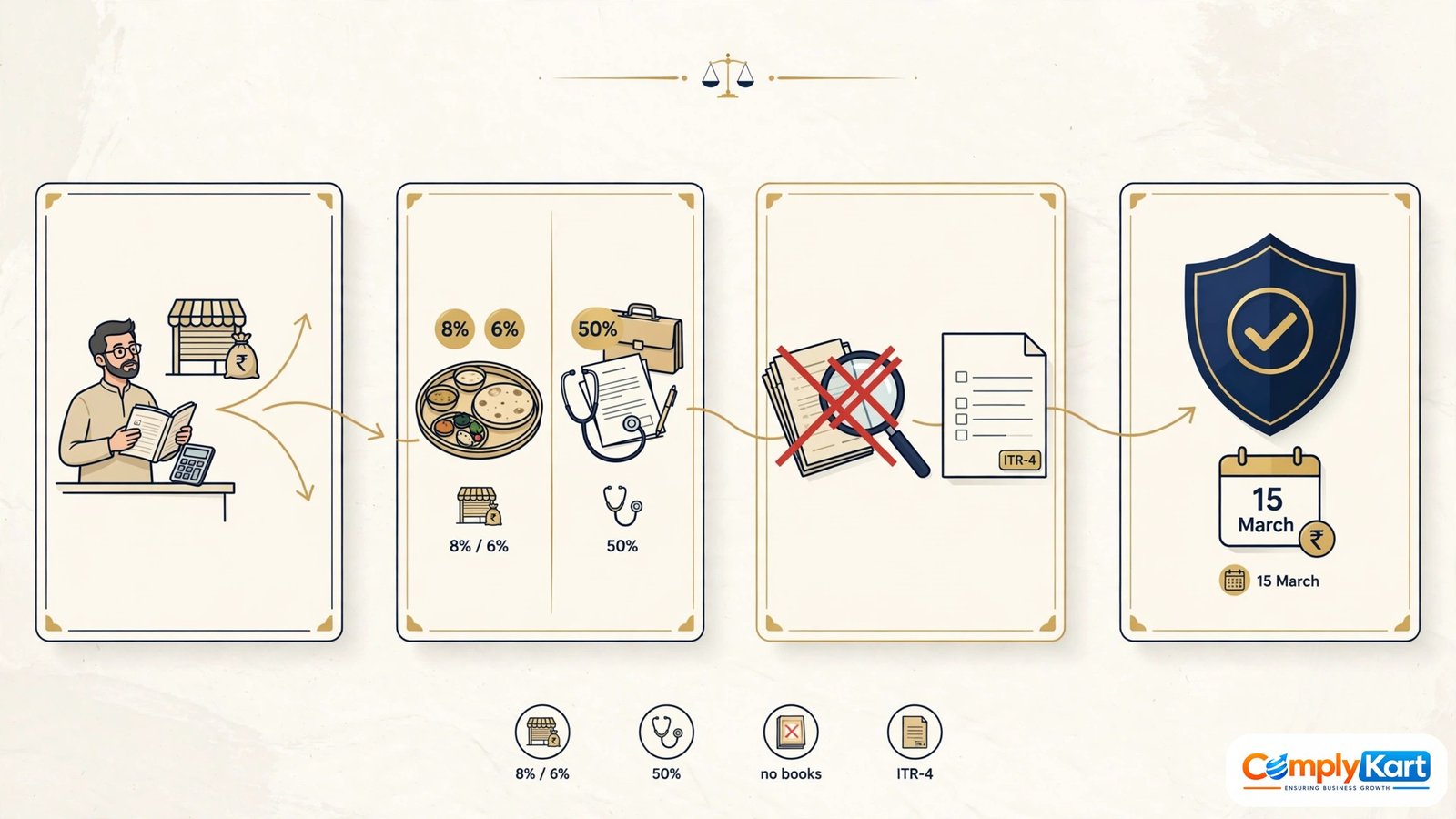
The short answer: 44AD and 44ADA let eligible small businesses and professionals pay tax on deemed profit — 8% of turnover (6% for digital receipts) under 44AD, 50% of gross receipts under 44ADA — with no books and no tax audit. Limits: ₹2 crore turnover (₹3 crore if cash receipts stay under 5%); ₹50 lakh receipts (₹75 lakh, same cash condition) for professionals.
How does presumptive taxation actually work?
Under normal taxation, taxable income is receipts minus allowable expenses — every expense needs a bill, every bill a ledger. Under 44AD, the law simply deems your profit: 8% of cash turnover, 6% for receipts by account-payee cheque, draft, or electronic mode (UPI, NEFT, bank transfer — all count). You pay tax on that figure.
For professionals — doctors, lawyers, architects, CAs, engineers, technical consultants, interior decorators — 44ADA deems 50% of gross receipts as income: no books under section 44AA, no audit under section 44AB, and the simpler ITR-4 (Sugam) instead of ITR-3.
Think of it like a restaurant thali versus ordering à la carte. À la carte, every dish is billed separately — that's normal taxation: every expense tracked, profit computed from actuals. The thali is a fixed price however much you eat — that's presumptive: the taxman fixes your profit at 8% (or 50% for professionals) whatever you actually spent. Margins above 8%? The thali saves money and counting. Thinner than that? À la carte is cheaper. The whole decision is knowing your own appetite.
Who can opt in — and who is shut out?
44AD is open to resident individuals, HUFs, and partnership firms — not LLPs, not companies: trading, manufacturing, services, non-professional freelancing. Excluded: commission and brokerage, 44ADA professionals, 44AE transport operators, and anyone who has claimed deductions under sections 10A/10AA/10B/10BA or 80HH to 80RRB.
44ADA is narrower: only specified professions in section 44AA(1) — legal, medical, engineering, architecture, accountancy, technical consultancy, interior decoration, plus notified others. A freelance designer or digital marketer is not a "specified professional"; they belong under 44AD. The most common misclassification I see — and it puts your entire return under the wrong section.
What are the turnover limits right now?
44AD: turnover up to ₹2 crore — ₹3 crore if cash receipts and payments stay within 5% of the total. Cross that line and the limit snaps back to ₹2 crore. 44ADA: gross receipts up to ₹50 lakh — ₹75 lakh on the same 5% cash condition.
The detail most people miss: the 6% rate applies to receipts by account-payee cheque, draft, or electronic mode. In a business taking zero physical cash, your entire turnover is taxed at 6%, not 8%. On ₹1.5 crore turnover, that's ₹9 lakh of deemed income instead of ₹12 lakh.
Filing note: from 1 April 2026, the new Income-tax Act, 2025 renumbers these provisions (Section 58) — thresholds, percentages, conditions unchanged. The maths holds for FY 2026-27 too.
When does opting in actually save you money?
A trading business with ₹80 lakh turnover at 12% margin earns ₹9.6 lakh really; under 44AD (all digital), deemed profit is 6%: ₹4.8 lakh. Tax on half your actual profit, no bookkeeping or audit costs.
Flip it: a distributor at ₹1.5 crore turnover and 4% margin earns ₹6 lakh really; deemed profit at 6% is ₹9 lakh — tax on ₹3 lakh of profit never earned. The thali just got expensive. Run both scenarios through our income-tax calculator before you commit — five minutes, usually an obvious answer.
For professionals the maths is starker at 50%. A consultant billing ₹40 lakh with modest expenses is almost certainly better off under 44ADA. A doctor with equipment EMIs, staff salaries, and rented premises may find actual expenses far exceed 50% of receipts — normal provisions win there. No universal answer, only your P&L.
What is the catch? The five-year lock-in
Here is the clause that bites. Opt into 44AD, declare lower than the deemed 8%/6% in a later year, and you cannot use 44AD again for the next five assessment years. During those five you must maintain full books, and a tax audit becomes mandatory past the basic exemption limit. Skipping a required audit draws section 271B penalty: 0.5% of turnover or ₹1,50,000, whichever is lower.
So the question isn't "is 44AD good this year?" but "will my margins stay above the deemed rate for years?" Volatile margins should give you pause — and once you're in, don't declare a loss year under normal provisions to save a few thousand; the five-year exile costs far more. Our compliance fee calculator shows the full cost of the books-and-audit route you'd be forced onto.
How do advance tax and filing work under presumptive?
One genuine simplification: instead of four advance-tax instalments, presumptive taxpayers pay the entire advance tax in one instalment by 15 March. Miss it and interest under sections 234B/234C applies like anyone else — the simplification is in the schedule, not the liability.
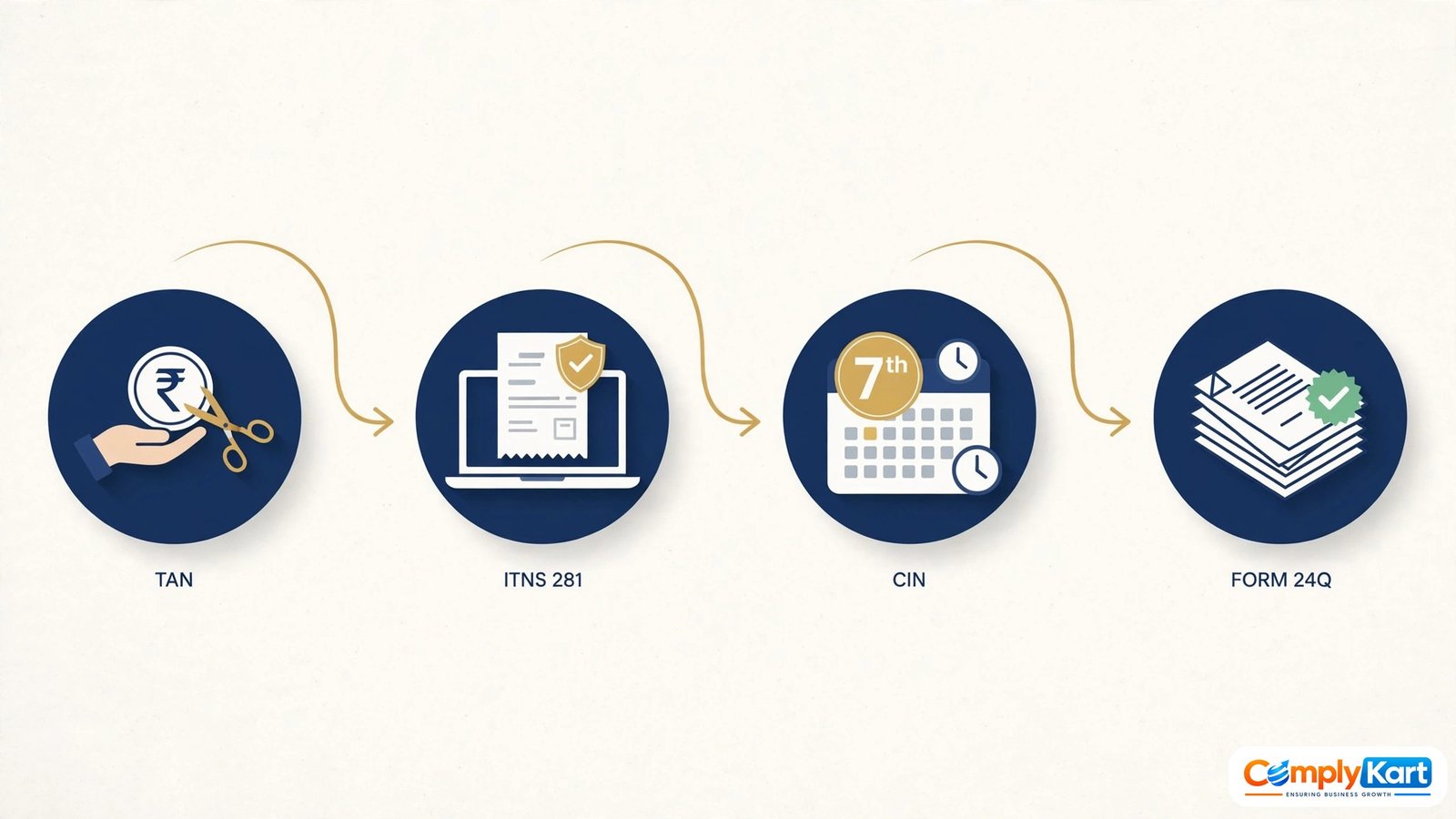
Two practical notes. TDS your clients deduct is fully adjustable against your final liability; claim every rupee in ITR-4 (our TDS e-payment guide covers challan 281). And file ITR-4 (Sugam), not ITR-3 — or let our income-tax return filing service handle it.
Presumptive taxation: quick answers
Can a freelancer with ₹40 lakh in receipts use 44ADA?
Only for specified professions under section 44AA(1) — doctors, lawyers, CAs, architects, engineers, technical consultants, interior decorators. Freelance writers, designers, and marketers use 44AD instead. Check your classification first.
Can I claim office rent and salaries separately under 44AD?
No — that's the whole bargain. No separate deduction for any expense, including depreciation (deemed claimed, reducing written-down value). If real expenses exceed the deemed percentage, presumptive is wrong for you.
What if my turnover crosses ₹2 crore during the year?
44AD stops applying that year (unless you're within ₹3 crore with cash receipts under 5%). Back to normal provisions: books, actual profit, tax audit past ₹1 crore turnover (₹10 crore with the 5% cash condition). Watch running turnover quarterly, not in March.
I opted out of 44AD last year by declaring lower profit. Can I opt back in now?
Not for five assessment years. Maintain books, and tax audit applies past the basic exemption limit. The opt-in decision deserves a multi-year view.
Does opting for 44AD affect my GST registration?
No — separate universes. GST registration depends on aggregate turnover crossing the GST threshold (₹20 lakh for services, ₹40 lakh for goods in most states), counted differently from 44AD limits. Our GST registration cost guide explains what registration involves.
Presumptive taxation is the tax code's rare admission that compliance has a cost — for small businesses with healthy margins, it trades paperwork for a flat, predictable number. Just make sure the flat number is lower than your real one before you sign up for years of it.


Comments
No comments yet — ask the first question below.
Join the discussion
Questions go straight to our expert desk. Comments appear after a quick review — no spam, no noise.