
IN BRIEF
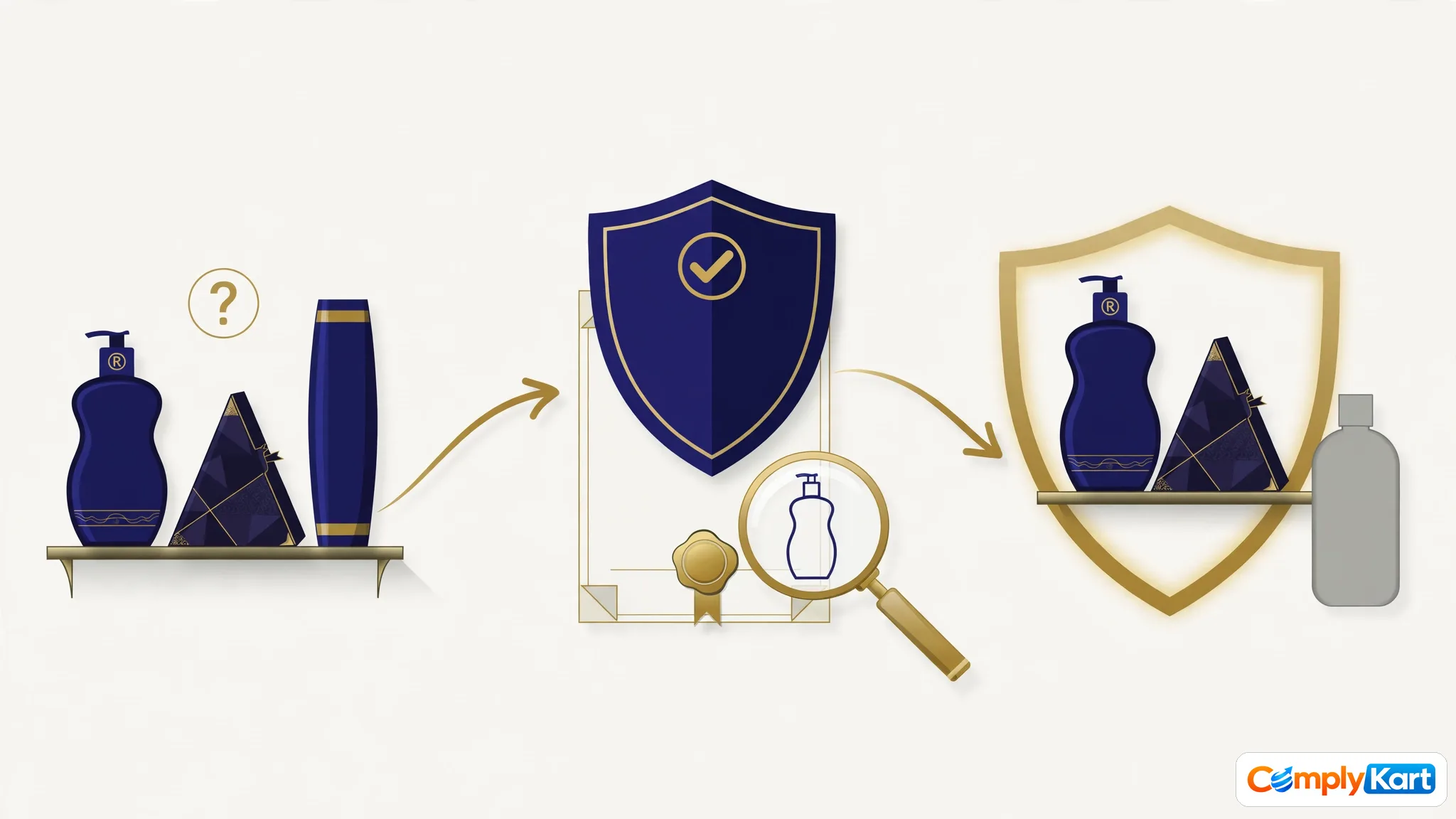
A shape or packaging trademark protects the form of a product or its pack — the bottle or box — rather than the brand name printed on it, under section 2(1)(zb) of the Trade Marks Act, 1999. It can be registered separately from the brand name, but only if the shape is distinctive, clears the three absolute bars in section 9(3), and buyers recognise the product from its shape alone.
Walk down any supermarket aisle and watch how people actually shop. They reach for a bottle by its silhouette before they read the label. They spot the triangular chocolate bar, the squat sauce jar, the tall slim can — and their hand moves before their eyes finish reading. The name matters. But for a lot of products, the shape is the brand. So the question every product business eventually asks is the obvious one: can I trademark the shape itself, separately from the name?
The short answer: Yes. Under section 2(1)(zb) of the Trade Marks Act, 1999, the shape of goods and their packaging can be registered as a trademark in a separate application from the brand name. The shape must be distinctive, must clear the three absolute bars in section 9(3), and must have acquired distinctiveness — buyers must recognise the product from its shape alone.
What the law actually allows
The Act's definition of a trademark is wider than most founders realise. Section 2(1)(zb) says a trademark is a mark capable of being represented graphically and capable of distinguishing one person's goods from another's — and it expressly includes "the shape of goods, their packaging and combination of colours". A three-dimensional form can sit on the register next to words and logos. The statute is explicit about it.
Here is the part people miss: each mark needs its own application. Registering your brand name does not protect your bottle. Registering your logo does not protect your box. The wordmark, the label and the shape are three separate filings, three separate fees, three separate examinations. That sounds like a nuisance. It is actually the point. A copycat who copies your pack but not your name is not infringing your wordmark. If the shape is the thing shoppers recognise, the shape is the thing that needs its own certificate.
Think of it the way you recognise people. You know a friend's face across a crowded room before you read their name tag. The name tag is the wordmark. The face is the shape mark. The law lets you protect both — but it makes you prove the face part separately, because faces are harder to prove than name tags.
The three shapes Section 9(3) will never register
Section 9(3) is the wall every shape application runs into. It lists three absolute exclusions, and if your shape falls into any of them, the application fails. No volume of sales evidence, advertising or consumer surveys can rescue it — the proviso that lets a descriptive word survive through acquired distinctiveness does not extend to section 9(3). Functionality is fatal, full stop.
| What Section 9(3) bars | What it means | Example |
|---|---|---|
| Shape resulting from the nature of the goods | The default form of the product category — every competitor needs it | A round football, a rectangular brick, a plain cylindrical water bottle |
| Shape necessary to obtain a technical result | The shape does a job — grip, stacking, pouring, fitting | Ribs that improve grip, a base that lets bottles stack, a spout that stops drips |
| Shape that gives substantial value to the goods | Buyers choose the product because the shape itself is the attraction | Sculptural jewellery, a designer lamp whose form is the reason it sells |
The logic is simple and fair. Trademark protection lasts forever if you keep renewing it. Patent protection lasts 20 years. If a shape that does a technical job could be trademarked, its owner would hold a permanent monopoly over a function — and competitors would be locked out of making a product that works. So the law sends functional shapes to patent law, beautiful shapes to design law, and keeps trademark law for shapes that only do one job: telling buyers who made the product.
Before you spend a rupee on filing, run your shape through that table. Strip out everything functional and everything generic to the category. What remains is what you can claim. If nothing remains, you do not have a shape mark. You have a product design — which is a different protection, covered below.
Why most shape filings fail at examination
Even a shape that clears section 9(3) faces a second, harder problem. Examiners start from the assumption that consumers see a shape as the product, not as a brand. A bottle is a bottle. A box is a box. To get past that assumption you need acquired distinctiveness — proof that the market has learned to link this shape to you.
The Delhi High Court set the bar in Knitpro International v Examiner of Trade Marks. The court held that a shape mark can only be granted if it has acquired a secondary meaning, and that the standard of distinctiveness required is "quite high". The shape by itself should be immediately identifiable with the source of the product — identifiable without anything further, like a name or logo, appended to it. That last phrase is the test that matters. Cover your brand name and logo with your thumb. Can a buyer still name the maker from the shape alone? If the answer is no, the application is not ready.
That is why the evidence file matters more for a shape mark than for any other filing. The Registry expects years of substantially exclusive use, sales figures, advertising that promotes the shape itself — not just the product — and ideally survey evidence showing buyers link the shape to you. "Look for the bottle" campaigns are evidence factories. A file of dated photographs, sales broken down by SKU, and ads that feature the silhouette is worth more than any argument in the reply. Build it from launch day, not when the examination report arrives — the reply to an examination report is due within 30 days, and that is not enough time to manufacture years of evidence.
Trade dress: the bigger canvas
Shape is one piece. Trade dress is the whole look — shape plus colour scheme plus label layout plus typography, the full "look and feel" that a shopper recognises from three feet away. The phrase "trade dress" appears nowhere in the Trade Marks Act. Indian courts built the protection anyway.
The landmark is Colgate-Palmolive v Anchor Health, decided by the Delhi High Court in 2003. Colgate sued over the red-and-white colour scheme of a tooth powder container. The court held that a colour combination and the overall get-up of a product can be protected — effectively importing trade dress into Indian law through passing off. The practical route to registered protection is the label mark: register your full pack design as a device mark and you bundle the trade dress elements — colours, layout, artwork — into one enforceable certificate. Most Indian FMCG brands protect their trade dress exactly this way, because a label application is faster, cheaper and far less likely to be objected to than a shape application.
Colour deserves one careful note. The Act covers a "combination of colours", and combinations with a track record can be protected. A single colour on its own is the hardest claim in this field — it needs the same acquired-distinctiveness evidence as a shape, only more of it. If colour is your identifier, file the combination as it actually appears on the pack, not a single shade in isolation.
Shape mark or design registration? Sequence them
This is where founders make the expensive mistake: picking one protection and thinking the choice is permanent. It is not. The two protections do different jobs, and the smart move is to sequence them.
| Design registration | Shape trademark | |
|---|---|---|
| Governing law | Designs Act, 2000, section 2(d) | Trade Marks Act, 1999, section 2(1)(zb) |
| What it protects | How the product looks — shape, pattern, ornament, judged by the eye | The shape as a badge of origin — what tells buyers who made it |
| Duration | 10 years, extendable once by 5 — 15 years maximum, then public domain | 10 years, renewable indefinitely |
| The catch | Novelty: file before the shape is disclosed to the public, or the right is gone | Distinctiveness: file only once the market recognises the shape as yours |
| Government fee | ₹1,000 per class for individuals, startups and small entities; ₹4,000 for others | ₹4,500 per class for individuals, startups and small enterprises; ₹9,000 for others |
| When to file | Before launch | After years of consistent, substantially exclusive use |
The sequence writes itself. A brand-new shape has no recognition, so it cannot pass the Knitpro test — but it is new, so it can be protected as a design. File the design before launch to lock in the early years. Spend those years building recognition and archiving the evidence. Then file the shape mark once the market can identify you by silhouette. Coca-Cola, Zippo and Toblerone all walked this road in one form or another: the design right bridged the gap while distinctiveness grew. Design law protects a shape that is new. Trademark law protects a shape that is known.
One warning on the design side, because it is irreversible: launch first and the design right is gone forever. Public disclosure kills novelty, and there is no way to get it back. If your shape is the asset, the design application goes in before the first Instagram post, not after.
What it costs: a worked example
Take a small FMCG brand — say a spice or snacks maker selling through retail — that wants the full stack: wordmark, label, shape, plus a design filing before launch. As an individual, startup or small enterprise applicant, the government fees look like this:
Wordmark on Form TM-A, one class: ₹4,500. Label or device mark on Form TM-A, one class: ₹4,500. Shape mark on Form TM-A, one class: ₹4,500. Design application, one class: ₹1,000. Total government fees at filing: ₹14,500. The same stack filed by a company that is not a small enterprise: three trademark applications at ₹9,000 each plus a ₹4,000 design filing — ₹31,000.
Two things to notice. First, the shape mark is the cheapest part of the stack — the expensive part is the evidence and the waiting, not the fee. Second, renewal is per mark, per class: ₹9,000 on Form TM-R for each registered trademark every ten years, so a three-mark stack costs ₹27,000 a decade to keep alive in one class. Budget for that now, not in year nine. Professional fees for drafting, searches and replies sit on top of these government figures and vary by firm — get them in writing before you file.
How to file a shape or packaging mark, step by step
1. Search first. Run the shape through the IP India public search. A shape that is already registered or applied for in your class will draw an objection under section 11, and you want to know that before you pay the fee.
2. Audit the shape against section 9(3). Strip out anything functional or generic to the category, as above. What remains is the claim.
3. File the design before launch, if the shape is new. Novelty dies on disclosure day. This filing cannot wait for the marketing calendar.
4. Register the word and label marks now. They protect the brand while the shape earns its distinctiveness, and they are the filings that actually stop most copycats in the meantime.
5. Build the evidence archive from day one. Dated photographs, sales by SKU, advertising that features the shape itself, media coverage, and — when you can afford it — a consumer survey. Date everything. The examination report will ask for it.
6. File the shape mark on Form TM-A once recognition is provable. File clear views of the shape from multiple angles, with a description stating that the mark is three-dimensional and identifying exactly what is claimed. A vague drawing invites a vague registration, and vague registrations lose enforcement fights.
7. Answer the examination report within 30 days. An objection is almost guaranteed for a shape mark — expect it, and have the evidence file ready before you file, not after.
8. Survive the opposition window. Once advertised in the Trade Marks Journal, third parties have four months to oppose. If nobody does, the mark proceeds to registration: ten years, renewable indefinitely. Only then does the ® symbol belong on the pack — until registration, ™ is the marker to use.
Realistic timeline, when nothing is objected to or opposed: roughly 12 to 18 months from filing to certificate for an ordinary trademark. A shape mark usually takes longer, because the examination objection and the evidence exchange add rounds. Treat 18 months as the planning figure, not the promise.
No registration? Passing off still protects a known shape
Registration is the shortcut. Passing off is the safety net, and Indian courts have used it to protect shapes with no certificate at all. In Gorbatschow Wodka v John Distilleries, decided by the Bombay High Court in 2011, the German vodka maker held no Indian registration for its distinctive bulbous bottle. The court granted an injunction against a lookalike bottle anyway, holding that the shape had built goodwill that deserved protection. In Zippo v Anil Moolchandani, decided by the Delhi High Court the same year, the court restrained the sale of lookalike windproof lighters that copied Zippo's shape.
Passing off needs three things, and each must be proved with evidence: goodwill in the shape, misrepresentation by the copycat, and damage to you. That makes it slower and costlier than enforcing a registration — you are proving your rights from scratch in every case, instead of pointing at a certificate. But it is the reason a well-known unregistered shape is not defenceless. If your pack is copied and you have the sales history and the photographs to prove buyers know it as yours, a court can stop the copycat while your registration is still pending.
6 mistakes that kill shape and packaging filings
1. Filing the shape before anyone recognises it. A shape with no history behind it fails the Knitpro test and leaves a refusal on the record. File the design first; file the shape mark when the evidence exists.
2. Claiming a functional shape. Grip ribs, a pouring spout, a base that stacks — if the shape does a job, section 9(3)(b) kills it, and no amount of advertising spend revives it.
3. Disclosing the shape before filing the design. One launch post, one exhibition stall, one listing on a marketplace — and the novelty the Designs Act demands is gone. The design application goes in before the first public showing.
4. Filing the shape with the name and logo attached. If the examiner can only recognise the product because the name is printed on it, you have filed a label mark, not a shape mark. The shape must stand alone.
5. Protecting the name and forgetting the pack. Copycats rarely copy the exact name — that is too easy to catch. They copy the colours, the layout and the shape of the pack so shoppers grab the wrong product. In FMCG, the pack is the battlefield.
6. Keeping no evidence archive. No dated photographs, no sales by SKU, no ads featuring the shape. When the examination report arrives, there is nothing to answer it with — and the application dies on a point that was entirely preventable.
Frequently asked questions
Can I trademark my product's shape without trademarking the brand name?
Yes. Each mark needs its own application, so the shape filing stands entirely on its own. In fact, the Knitpro test demands it: the shape must identify the source by itself, without the name or logo attached. Many brands file the wordmark first because it is faster, then add the shape mark once the evidence exists.
What shapes can never be registered as trademarks in India?
Three kinds, under section 9(3) of the Trade Marks Act, 1999: shapes that result from the nature of the goods themselves, shapes necessary to obtain a technical result, and shapes that give substantial value to the goods. These are absolute grounds — acquired distinctiveness cannot cure them.
Is trade dress the same as a shape trademark?
No. Trade dress is the overall look — shape plus colours, layout and typography together. The term does not appear in the Act; Indian courts protect it through passing off, starting with Colgate v Anchor in 2003, and in practice most brands register it as a label or device mark covering the full pack design.
Should I file a design or a trademark first?
The design, before launch — it needs novelty, which public disclosure destroys. The shape trademark comes later, once buyers recognise the shape as yours. The design protects the early years; the trademark, once granted, can last forever.
How much does it cost to trademark a shape in India?
The government fee on Form TM-A is ₹4,500 per class for individuals, startups and small enterprises, or ₹9,000 per class for other applicants. A full stack for a small brand — wordmark, label and shape in one class, plus a design filing — costs ₹14,500 in government fees. Renewal is ₹9,000 per class per mark every ten years.
Can I stop a copycat if my shape is not registered?
Possibly, through a passing-off action — Indian courts protected the unregistered Gorbatschow vodka bottle shape this way in 2011. You must prove goodwill in the shape, misrepresentation by the copycat, and damage. It works, but it is slower and more expensive than enforcing a registration, which is why filing early matters.
The shelf test is the only test that matters. Cover the name on your pack with your thumb. If a buyer can still tell it is yours, you have something worth protecting — and the sequence is design first, evidence always, shape mark when the market can name you from the silhouette alone. If the buyer cannot tell, no filing will fix that. Build the recognition first, then file for it.




Comments
No comments yet — ask the first question below.
Join the discussion
Questions go straight to our expert desk. Comments appear after a quick review — no spam, no noise.