

IN BRIEF
Flipkart Brand Registry is Flipkart's programme that links a seller's trademark to their seller account, letting the brand owner control who sells under the brand name, lock listing content and report counterfeit or unauthorised listings. Enrolment is free and a valid pending trademark application number is usually enough, though Brand Assure, the IP-protection tier, needs a registered trademark under the Trade Marks Act, 1999.
You have spent months building a brand on Flipkart — the name, the packaging, the reviews. Then one morning a listing appears under your brand name, priced ₹200 lower, with photos lifted from your own catalogue. That is the moment most sellers discover Flipkart Brand Registry. It is free, it takes about two weeks to get into, and it is the difference between owning your brand on the marketplace and merely renting space on it.
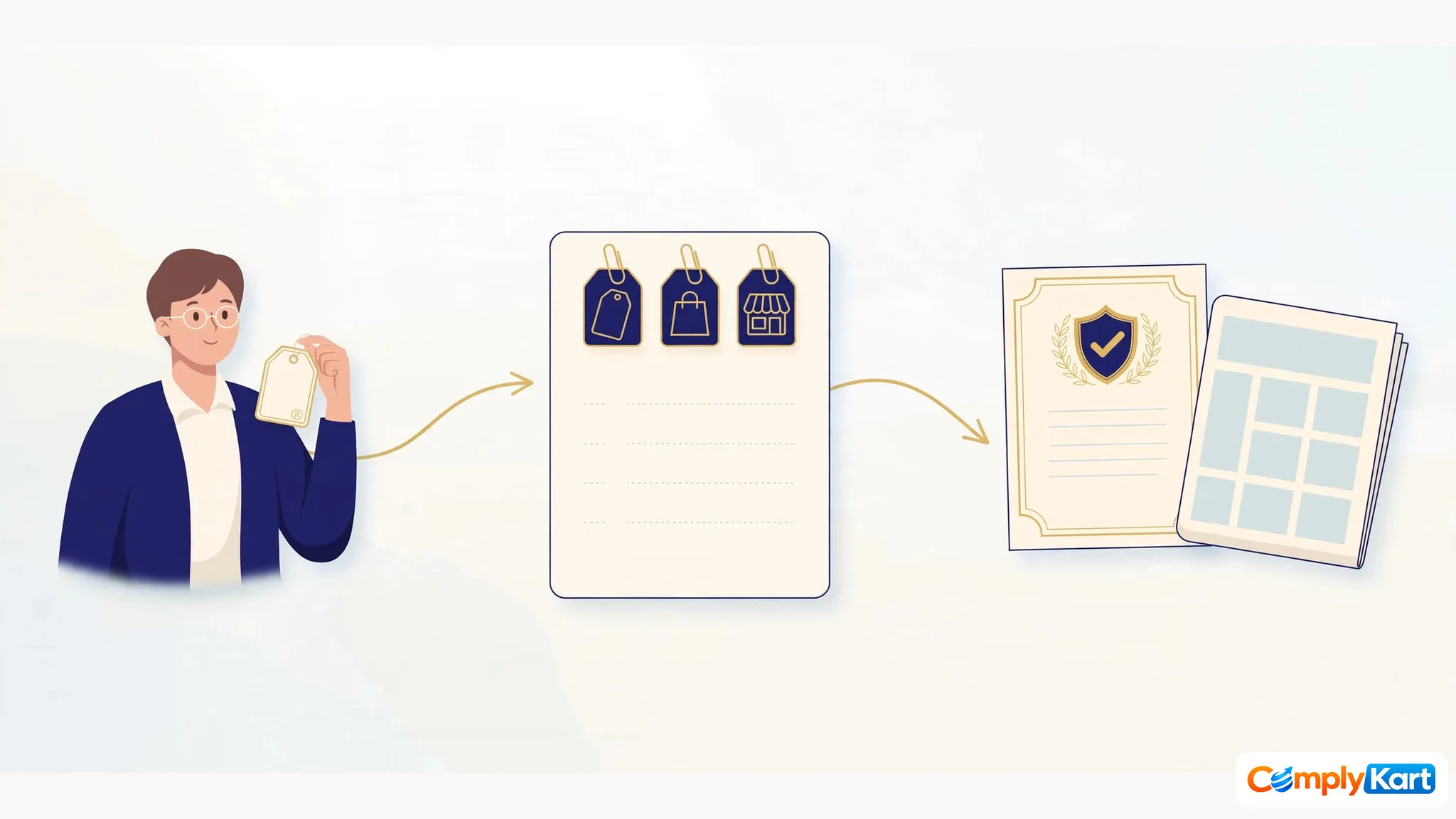
Flipkart Brand Registry is Flipkart's programme that ties your registered trademark to your seller account, giving you control over who sells under your name, locked listing content, and a way to report copycats. Enrolment is free — the only cost is the trademark itself. A pending application number is usually enough to enrol; Brand Assure needs the registered certificate.
The three programmes sound alike and sellers mix them up constantly, so let me separate them first, because getting this wrong is how applications get rejected.
First, three different programmes sellers keep mixing up
Flipkart runs three things with similar names, and each one does a different job.
| Programme | What it does | Trademark needed |
|---|---|---|
| Brand Registry (enrolment) | Claims your brand on Flipkart and gives you brand-protection tools — counterfeit reporting, listing control, seller authorisation | Registered trademark, or a valid pending application number |
| Brand Approval | Permission to list products under a specific brand name — a per-listing step, not a one-time enrolment | Your application number, or an authorisation letter if you resell someone else's brand |
| Brand Assure | Flipkart's IP-protection programme: a direct channel to report infringing listings and sellers, with a seller-management dashboard | Registered trademark only — a pending application is not accepted |
Most sellers need the first two. Brand Assure is the upgrade you reach for once the certificate is in hand. If a guide tells you "you need a registered trademark for Brand Registry" without qualification, it is collapsing all three into one — and that is exactly the confusion that sends sellers away to wait 12 to 18 months for a certificate they did not need to wait for.
Do you need a registered trademark, or is a pending application enough?
The honest answer is: it depends on which programme you are entering. For Brand Registry enrolment and for Brand Approval, a valid trademark application number from the IP India portal is generally enough to get started. Flipkart accepts it, and you do not have to wait for the full registration, which takes 12 to 18 months in an uncontested case. Some sellers are even enrolled conditionally on the Form TM-A acknowledgement receipt, with full confirmation following once registration comes through.
Brand Assure is stricter. Flipkart's own Brand Hub FAQ answers the question directly: can you register for Brand Assure with a pending trademark? No — you need a registered trademark. That is the line. So the practical sequence is this: file your trademark, enrol in Brand Registry on the application number, sell and build, and move into Brand Assure the day your certificate arrives. Waiting for the certificate before doing anything is the most expensive mistake in this whole process, because every month you sell unprotected is a month a copycat can build reviews on your name.
One thing to get straight before you file: your trademark must cover the class of goods you actually sell. A trademark is registered class by class — 45 classes in all, 1 to 34 for goods and 35 to 45 for services — and a Class 25 registration for clothing protects you for clothing, not for the electronics you added last Diwali. File the class that matches your product, and if you also sell through your own website or store, add Class 35 for retail services. It costs one fee per class, and a wrong class means a fresh application and a fresh fee, because you cannot change the class after filing.
What it actually costs
Flipkart charges nothing for Brand Registry enrolment and nothing for Brand Approval. The only cost is the trademark, and that is a government fee, not a Flipkart fee. Filing Form TM-A on the IP India portal costs ₹4,500 per class if you are an individual, a startup, or a small enterprise, and ₹9,000 per class for companies and other entities. The fee is non-refundable, so a wrong class or a name that cannot be registered is money gone.
Work it out for your own case. A sole proprietor selling handmade soaps under one brand files one class — Class 3 — and pays ₹4,500. A private limited company selling kurtas on Flipkart and through its own website files Class 25 for the garments and Class 35 for the retail service: two classes at ₹9,000 each, ₹18,000 in government fees. The trademark, once granted, lasts ten years and is renewed with Form TM-R at ₹9,000 per class. So the whole protection — the certificate that powers Brand Registry, Brand Assure, Amazon Brand Registry and every other marketplace — costs less than a single week of ads for most sellers. That is the maths that makes delay hard to defend.
Documents to keep ready
Have these in clear PDF scans before you start, because a blurry upload is the commonest reason verification drags.
- Trademark certificate or your trademark application number (the PDF acknowledgement from the IP India portal)
- PAN card — of the individual or the business
- GST registration certificate and GSTIN
- Business registration proof — incorporation certificate, partnership deed, or Udyam/MSME registration, whichever fits
- Cancelled cheque or bank statement for the account that receives seller payments
- Product and packaging images showing your brand name or logo on the product itself
- Category licences where they apply — FSSAI for food products, for instance. If you run a restaurant or café selling its own packaged goods on Flipkart, the same brand rules apply — the name on the packet is the brand you protect.
One detail that trips people up: the brand name must match across your trademark, your GST records, and your seller account. A mismatch — "Shree Enterprises" on GST and "Shree" on the trademark — is the kind of small inconsistency that turns a 14-day verification into a month of back-and-forth.
How to enrol, step by step
Step 1 — Get your trademark filed. Run a search on the IP India portal first, pick the right class, and file Form TM-A. You get your application number the same day. That number is your entry ticket. If you have not decided yet whether to file the word or the logo first, settle that before you file — it decides what your registration actually protects.
Step 2 — Set up your Flipkart seller account. Register on Flipkart Seller Hub with your PAN, GSTIN, bank details, and KYC documents. Account setup and verification typically take one to two days. If you already sell on Flipkart, skip this — your account is the starting point, not a separate chore.
Step 3 — Apply for Brand Registry. Inside Seller Hub, go to the Brand Registry section — usually under Account Settings or the Catalogue/My Listings area — and submit your trademark details, the certificate or application number, and your brand and product information. Add clear details; vague brand descriptions get bounced.
Step 4 — Wait for verification. Flipkart reviews your documents and verifies brand ownership. This usually takes up to 14 days. If something is unclear, they ask for more — answer fast, because the clock restarts on your reply, not on their question.
Step 5 — Apply for Brand Approval on your listings. This is the per-listing step, separate from enrolment. In Seller Hub, go to Listings, then My Listings, add a new listing, pick your category, enter your brand name, click Check Brand, and choose Apply for Brand Approval. Upload your trademark number or authorisation documents and submit. Approval generally takes 24 to 72 hours, longer for regulated categories.
| Stage | Typical time |
|---|---|
| Trademark application number (Form TM-A) | Same day as filing |
| Flipkart seller account setup | 1–2 days |
| Brand Registry verification | Up to 14 days |
| Brand Approval (per listing) | 24–72 hours |
| Brand Assure onboarding after registration | Team reaches out within 72 hours |
| Full trademark registration (uncontested) | 12–18 months |
What you actually get once you are in
Enrolment is not a badge; it is a set of controls. The counterfeit reporting tool lets you file IP infringement complaints against unauthorised sellers — Flipkart says these are typically resolved within 7 to 14 days. Listing control locks your titles, descriptions, images, and key attributes so other sellers cannot quietly rewrite them. Brand Approval authority lets you decide which third-party sellers may list under your brand at all. And a Brand Story page gives you a customisable storefront inside Flipkart — hero banners, brand video, curated collections — which is the closest thing to your own website inside someone else's marketplace.
Think of it this way. A trademark is the title deed to your shop. Brand Registry is the lock on the shutter and the guard at the door. The deed alone does not stop anyone walking in; the lock does. Sellers who file the trademark but never enrol have the deed framed on the wall while the shop stays open to anyone.
When someone copies your listing
This is where the programme earns its keep. If you are in Brand Assure, you report through your Brand Assure account — the Manage Sellers section also lets you verify sellers you authorise and mark others as unauthorised. If you are not in Brand Assure yet, you can still report infringement by emailing Flipkart's infringement team at infringement@flipkart.com with the exact product URL or FSN, the seller's details, screenshots, and evidence of your trademark. The report has to explain what is actually wrong — a counterfeit product, copied photos, or a false claim of affiliation. An unauthorised seller is not automatically an infringer, and a vague complaint goes nowhere.
Flipkart does act. The company says it actioned more than 10 million listings for counterfeit or compliance violations between October 2024 and October 2025 and removed 13,000 sellers in that period, and that more than 11,000 brands had joined Brand Assure by December 2025. The courts back it too: in July 2026, the Delhi High Court ordered Flipkart to pull counterfeit BATA footwear listings in Bata India Ltd v. Lalli Devi & Ors. None of this helps a seller who never enrolled, because without a registered mark and a programme membership, your complaint is one email among thousands. With them, it is a rights-holder report with a paper trail.
One warning: a takedown is not the end of it. Removed products return under new listings or new seller accounts, so keep a file — product IDs, seller details, screenshots, your earlier case references — and check your brand name on the platform every week. Protection is a routine, not a one-time form.
If you resell someone else's brand
Resellers do not enrol in Brand Registry themselves — that is the brand owner's job. What you need is a Brand Authorisation Letter from the brand owner: a written document confirming that your specific Flipkart seller ID is authorised to sell products under that brand, plus supplier invoices from an authorised source. Upload both when you apply for Brand Approval on the listing. If you manufacture under a licensed brand, you need the brand owner's trademark registration and an authorisation letter addressed to Flipkart specifically. A generic distributor letter that never mentions Flipkart is the commonest reason reseller approvals fail.
Pick the right class before you file — and watch the 2026 change
From 1 January 2026, trademark applications in India are classified under the 13th edition of the Nice Classification, NCL 13-2026. It is not retrospective — filings made before that date stay under the 12th edition — but anything you file now uses the new edition, and a few everyday goods moved. Spectacles, sunglasses, and contact lenses moved from Class 9 to Class 10; electrically heated clothing moved to Class 25. If your product sits near one of those boundaries, check the current class before filing, not the class your competitor filed three years ago. And remember the standing advice for marketplace sellers: file the product class first, then add Class 35 if you run your own store or website, because Class 35 is what covers the retail service itself.
Five mistakes that cost sellers real money
1. Waiting for the certificate before enrolling. Your application number gets you into Brand Registry. Twelve months of unprotected selling while you wait is twelve months a copycat can use.
2. Filing one class when you need two. The product class protects the goods; Class 35 protects your retail service. D2C sellers who skip Class 35 find their own website's brand unprotected.
3. Letting names drift across documents. Trademark, GST, seller account, bank account — one name, spelled one way. Mismatches stall verification.
4. Using ® before registration. The ® symbol is for registered marks only; using it on a pending application is an offence under Section 107 of the Trade Marks Act, 1999. Use ™ from the day you file.
5. Filing a descriptive name. A name that merely describes the product — "Cotton Comfort" for bedsheets — runs into Section 9(1)(b) and may never register. Distinctive beats descriptive, every time.
Should you do this yourself?
Filing Form TM-A is genuinely doable yourself — the IP India portal is online end-to-end, and the fee is small. What a professional adds is the search before filing, the class decision, and the examination reply if the Registry objects. The search matters most: filing on a name that already exists in your class burns the fee and months of waiting. If your brand name is distinctive and your class is obvious, file it yourself and enrol on the application number the same day. If the name is close to an existing mark, or you sell across several classes, get a professional to run the search first. Either way, do not let the trademark sit unfiled while you "get around to it" — on Flipkart, first to file beats first to sell.
One trademark, filed once with IP India, works across marketplaces. The same certificate or application number that enrols you on Flipkart also enrols you on Amazon Brand Registry, Myntra, Meesho, and Nykaa. You file once and enrol separately on each platform. That is the cheapest brand protection a small seller in India can buy — and on a marketplace where a copycat can be live before lunch, it is the only kind that works.
FAQs
Can I apply for Flipkart Brand Registry with a pending trademark application?
Yes, for Brand Registry enrolment and Brand Approval, a valid trademark application number is generally accepted — you do not need to wait for the certificate. But Brand Assure, Flipkart's IP-protection programme, requires a registered trademark; a pending application is not accepted there. Enrol on the application number now and upgrade to Brand Assure once registered.
Is Flipkart Brand Registry free?
Yes. Flipkart charges no fee for Brand Registry enrolment or for Brand Approval. The only cost is the trademark itself — ₹4,500 per class for individuals, startups, and small enterprises, or ₹9,000 per class for companies and other entities, paid to the government when you file Form TM-A.
Can I sell on Flipkart without a trademark?
Yes, if you sell generic or unbranded products, or if you resell another brand's products with a Brand Authorisation Letter and supplier invoices. A trademark becomes necessary when you want to sell under your own brand name, control who else sells it, or access Flipkart's brand-protection programmes.
How long does Flipkart Brand Registry verification take?
Usually up to 14 days from a complete application. Seller account setup takes one to two days before that, and per-listing Brand Approval generally takes 24 to 72 hours after enrolment. Incomplete or mismatched documents are the main reason verification runs longer.
Can a reseller enrol in Flipkart Brand Registry?
No. Brand Registry is for the brand owner. As a reseller you apply for Brand Approval on your listings using a Brand Authorisation Letter from the brand owner that names your seller ID, plus invoices from an authorised supplier.
Does my trademark work on Amazon too?
Yes. One Indian trademark — the same certificate or application number — is accepted by Amazon Brand Registry, Flipkart Brand Registry, Myntra, Meesho, Nykaa, and most other Indian marketplaces. You file once with IP India and enrol separately on each platform.




Comments
No comments yet — ask the first question below.
Join the discussion
Questions go straight to our expert desk. Comments appear after a quick review — no spam, no noise.