
IN BRIEF
Choosing an ISO certification is a selection decision, not a legal duty: each ISO standard certifies one management system — quality under ISO 9001, environment under ISO 14001, information security under ISO/IEC 27001, food safety under ISO 22000 — and the right choice follows the standard your buyers and tenders actually ask for.
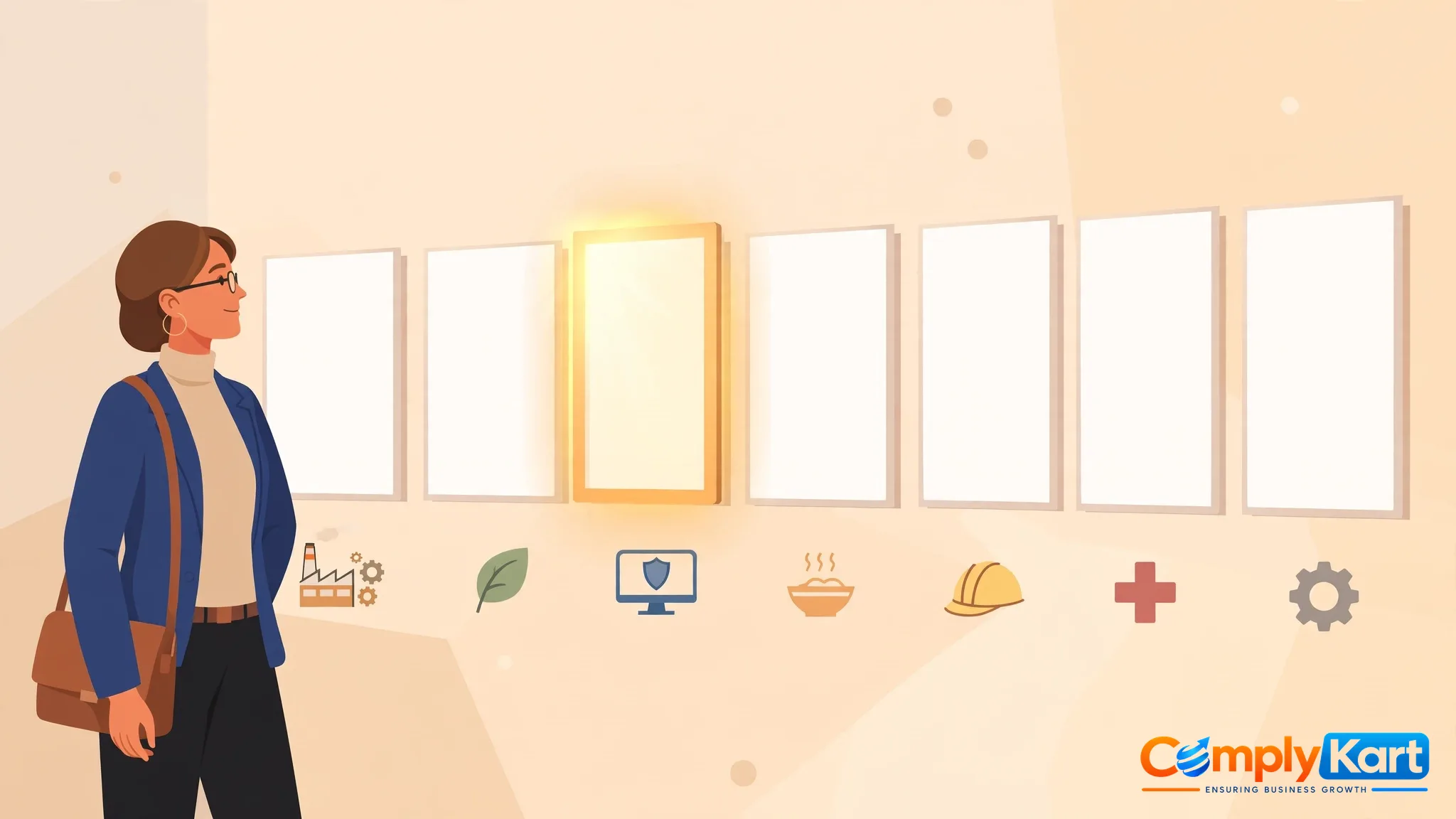
"We need ISO certification." I hear this sentence at least once a week, and my first question is always the same. Which one? The silence that follows is the real problem this article exists to fix. ISO publishes thousands of standards. The seven in this guide are the ones Indian buyers, tenders and portals actually ask small and mid-sized companies for — and they certify completely different things. Picking the wrong one costs you the consultancy fee, the audit fee and three to six months, and it leaves the buyer's actual question unanswered.
So do not start with the catalogue. Start with the demand.
Read the buyer's exact words before you choose anything
Somewhere behind your decision there is a document. A tender eligibility clause. A vendor registration form. A security questionnaire from an enterprise customer. An export buyer's supplier manual. Find it, and read the exact standard it names, down to the number. Buyers ask for a specific standard because that standard answers their specific worry — quality, safety, data security, food safety. A certificate for a different worry, however genuine, does not answer them.
If no document exists and the demand is only a vague feeling that "serious companies have ISO", slow down. Certification you cannot tie to a buyer, a tender or a real internal weakness is a wall decoration with an audit fee. Decide what the certificate must do for you first. Then choose.
The seven standards, in plain words
Each standard below certifies a management system — the way your company runs one part of itself, checked by an outside auditor. None of them certifies a product. None of them is issued by the government.
| Standard | What it certifies | Who usually asks for it |
|---|---|---|
| ISO 9001 | Quality management — you deliver what you promised, the same way, every time, and you fix defects at the root | Tenders, PSUs, OEMs, export buyers, large customers in almost every industry |
| ISO 14001 | Environmental management — you know your unit's impact on air, water and waste, and you control it | Large manufacturers, export customers, buyers with their own environmental commitments |
| ISO 45001 | Occupational health and safety — hazards at your workplace are identified, assessed and controlled before someone is hurt | Construction buyers, factories, warehouses, project owners who carry site risk |
| ISO/IEC 27001 | Information security — customer data and your own systems are protected by assessed, controlled processes | Enterprise clients, banks and NBFCs, foreign customers with vendor security reviews |
| ISO 22000 | Food safety management — hazards are controlled at every step from raw material to dispatch | Retail chains, institutional buyers, export customers across the food chain |
| ISO 13485 | Medical device quality systems — design, production and post-market records built for regulated devices | Regulators' licensing files, hospitals, distributors and export markets for devices |
| ISO 50001 | Energy management — energy use is measured, targeted and cut, year after year | Energy-heavy plants, large buyers tracking supplier efficiency, businesses with heavy power bills |
By industry: where buyers usually land
IT, SaaS and services handling client data
Your buyers' worry is their data in your hands. Enterprise customers send security questionnaires that a sales head cannot answer with confidence and a certificate can. That is why ISO/IEC 27001 is the working standard for software firms, SaaS products, IT services and BPO operations — it is the one their procurement and information security teams recognise. Many such firms add ISO 9001 because tenders and RFPs ask for quality certification in the eligibility section, in plain ink, whatever the buyer's deeper worry. If you take one lesson from this section, take this: a ten-person firm holding no sensitive data may honestly not need 27001 yet. A fifty-person firm losing deals at the questionnaire stage needs it before it needs anything else.
Food manufacturing, processing, catering and food logistics
Your legal permission to operate is your FSSAI licence. That comes first, and ISO 22000 never replaces it. What ISO 22000 adds is proof, in a format organised buyers accept, that food safety at your unit runs as a system — hazard analysis, prerequisite hygiene programmes, traceability that can isolate one bad batch instead of recalling everything you have shipped. Retail chains, hotel and institutional buyers, and export customers are the ones who ask. If a buyer demands a GFSI-recognised scheme by name, that points to FSSC 22000 rather than ISO 22000 alone — ask the buyer, in writing, before you pay anyone.
Manufacturing, engineering and export units
Start with ISO 9001. It is the standard your OEM customers, tender committees and export buyers reach for first, because their worry is repeat quality from a supplier they cannot watch daily. From there, your operations decide. A unit with real emissions, effluents or chemical handling will find bigger buyers asking about ISO 14001. A unit where people work around machines, heights or heavy material will be asked about ISO 45001. Neither is decoration in a factory. Both answer questions your customers are already carrying about their own exposure when they appoint you.
Medical devices
ISO 13485 is the quality system standard written for your industry, and for device makers it sits close to the law without being the law. Licensing under the Medical Devices Rules, 2017 runs through CDSCO and the state authorities, and quality system evidence built on ISO 13485 is what those files expect to see — for a manufacturer's own QMS, and for the foreign manufacturer's certificate behind an import licence. If you make, import or supply components for devices, this is your standard, and a general ISO 9001 certificate is not a substitute for it. If you only distribute finished devices, the licensing track matters more than your own certification — say so to any consultant who tries to sell you 13485 before asking what you actually do.
Construction, contracting and energy-heavy plants
Project owners and principal employers ask contractors for ISO 9001 on delivery and ISO 45001 on the safety of the people doing the delivering. Larger projects often add ISO 14001 for the site's environmental controls. And for plants where power is one of the biggest cost lines — furnaces, cold storage, large process units — ISO 50001 earns its place on commercial grounds alone: it turns energy saving from an annual lecture into a measured system with targets and owners. Choose it when your electricity bill is big enough to argue with, not because a brochure lists it.
Two standards at once? Sometimes. In the right order.
Buyers do stack demands, and factories in particular get asked for the 9001, 14001 and 45001 set together. There is good news buried in the standards' design. These three share the same high-level structure — the same skeleton of leadership, planning, support, operation, review and improvement. Think of them as rooms in one house rather than three separate buildings: one foundation, one roof, different rooms for different risks. Certified together as an integrated system, they run on one manual, one internal audit programme and one management review, and the combined external audit costs less than three separate ones.
The order still matters. Certify first for the demand that is live — the tender closing next quarter, the buyer reviewing you now. Add the next standard when a real buyer or a real risk asks for it. A certificate nobody has asked for, maintained through annual surveillance audits, is rent paid on an empty room.
What the consultancy costs, quoted from the pages themselves
ComplyKart's consultancy pricing is published on each standard's page, in two tiers. For ISO 9001, ISO 14001 and ISO 45001, the Standard tier is ₹9,999 for up to 25 employees and the Growth tier is ₹19,999 for 26 to 100 employees. For ISO 22000 and ISO 50001, the tiers are ₹12,999 and ₹24,999. For ISO/IEC 27001 and ISO 13485, they are ₹14,999 and ₹29,999. Read those numbers with their condition attached: they are consultancy fees only. The certification body's audit fees are charged separately, at actuals, on every one of these pages, and any quote you receive from any consultant should split the two just as plainly. If it does not, ask why.
The honest limits, before you spend a rupee
An ISO certificate is not a government licence. It is issued by a private certification body, and it permits you to do nothing that the law did not already permit. Your FSSAI licence, your CDSCO licence, your factory licence — those come from the state, and no ISO certificate stands in for any of them.
No certificate guarantees an order. It can get your bid past an eligibility gate and your company past a buyer's first screening. The order still goes to the bid that wins on scope, price and trust. Any consultant who promises the certificate will deliver contracts is selling you the brochure, not the standard.
And the body's accreditation is not a detail. A certificate from an accredited certification body — one checked through NABCB or another IAF-member accreditation body — is what serious buyers accept. A cheap, unaccredited certificate can fail the first verification a good customer runs, which is the most expensive kind of cheap there is.
A short way to decide
- Find the document behind the demand — tender clause, buyer manual, questionnaire — and note the exact standard named in it.
- If no document names one, name your own sharpest worry instead: defects and rework point to 9001, a data breach to 27001, a food safety failure to 22000, a workplace injury to 45001, the power bill to 50001.
- Check your industry section above and see whether buyers in your line usually ask for a second standard alongside the first.
- Price the consultancy and the certification body's audit fee as two separate lines, in writing, before you commit.
If the demand in front of you is still ambiguous after that — and tender language often is — bring the document itself to a conversation with our ISO team and we will tell you which standard it is really asking for, including when the honest answer is that you do not need one yet.




Comments
No comments yet — ask the first question below.
Join the discussion
Questions go straight to our expert desk. Comments appear after a quick review — no spam, no noise.