Five steps, no guesswork — you always know exactly what comes next. Tap a step to see what it involves.
12345
You pay securely. Payment is confirmed instantly, and your receipt with the written fee breakup lands in your inbox.
Overview — why a bonus issue is a filing project, not just a board decision
A bonus issue feels like an internal event — the company capitalises its reserves and members wake up with more shares. But in company law, every bonus issue is a chain of filings: a resolution on record, a return of allotment with the ROC, share certificates in shareholders' hands, an updated register of members, and finally the annual return and financial statements that carry the new capital structure into the permanent record. Miss one link and the chain breaks — the most common break being the PAS-3 return of allotment, filed late or not at all, compounding into additional fees and a defective capital history that surfaces years later during due diligence.
Think of it like a property registration. Buying the flat is the commercial event; the registered sale deed is what the world recognises. The board's bonus resolution is the commercial event — PAS-3 is the registered deed. This page walks the full calendar: what to file, when, and how the bonus issue lands in the annual return.
The legal foundation — Section 63 in one page
Before any filing, the issue itself must be valid. Section 63 of the Companies Act, 2013 allows fully paid-up bonus shares to members only from three sources: free reserves, the securities premium account, or the capital redemption reserve. Capitalising revaluation reserves is expressly prohibited. Six conditions must all hold: the articles must authorise the issue (amend them by special resolution under Section 14 if they do not); the general meeting must approve it by ordinary resolution on the board's recommendation; the company must not have defaulted on fixed deposits, debt securities, or employee statutory dues (PF, gratuity, bonus); any partly-paid shares outstanding must first be made fully paid; and the prescribed conditions must be met. Bonus shares cannot be issued in lieu of dividend. And once the board recommends the issue, Rule 14 of the Share Capital and Debentures Rules forbids withdrawing it — the announcement is binding.
The filing sequence — step by step
Step 1 — Board meeting: recommend the issue, fix the ratio
The board approves the bonus ratio, the reserves to be capitalised, the record date, and the notice for the general meeting. Check the articles first — if they lack a capitalisation clause, the same meeting should propose the amendment.
Step 2 — File MGT-14 if a special resolution is involved
Board resolutions under Section 179(3)(c) do not require MGT-14 for private companies. But if the articles are amended, or the articles demand a special resolution for the bonus itself, file Form MGT-14 within 30 days of the resolution with the explanatory statement.
Step 3 — General meeting: members approve
At least 21 clear days' notice under Section 101. Members pass the ordinary resolution (or special, if the articles require it) authorising the capitalisation. Keep the minutes precise on ratio, source of reserves, and record date — the PAS-3 attachments will be tested against them.
Step 4 — Board meeting: allot the bonus shares
After the record date, the board passes the allotment resolution and the list of allottees is finalised — full name, address, PAN, email, class of shares, and number allotted. This resolution starts the 30-day PAS-3 clock.
Step 5 — File PAS-3: the return of allotment (30 days)
Form PAS-3, with the certified board resolution for allotment and the complete list of allottees, goes to the ROC within 30 days of allotment. This is the filing most companies get wrong — late PAS-3 filings attract additional fees on a per-day basis and, more importantly, leave the increased capital unrecorded with the ROC, which poisons every later filing that reads capital from the registry.
Share certificates in Form SH-1, or credit through CDSL/NSDL for dematerialised holdings, within two months of allotment. Fractional entitlements are consolidated and dealt with as the general meeting decided — typically sold and the proceeds distributed proportionately.
Step 7 — Update the register of members
Enter the new holdings the moment certificates issue. The register is the company's own primary record; the ROC filings are its public mirror. They must agree.
Step 8 — Carry the bonus into MGT-7 and AOC-4
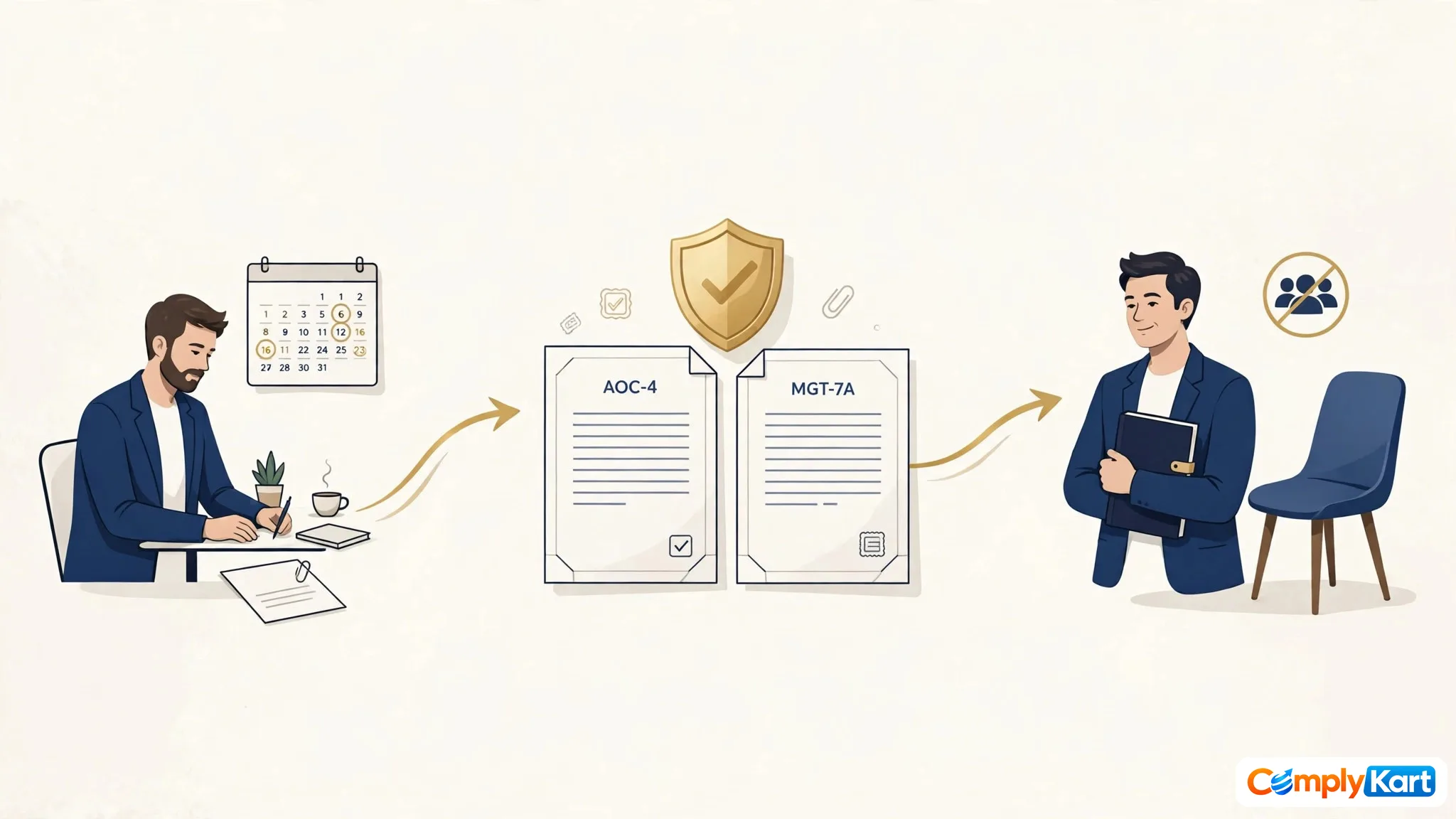
At the next AGM cycle, the annual return (MGT-7, within 60 days of the AGM) discloses the increased paid-up capital and the revised shareholding pattern — percentages unchanged, absolute numbers higher. The financial statements (AOC-4, within 30 days of the AGM) show the reserves movement: the capitalised amount moves from free reserves/securities premium into share capital. An auditor reconciling the two will trace the trail back to the PAS-3 — which is why Step 5 matters so much.
How the bonus issue appears in the annual return
The MGT-7 share-capital section after a bonus issue shows: authorised capital (unchanged, unless increased alongside), issued/subscribed/paid-up capital increased by the bonus amount, and the shareholding pattern with every member's holding grossed up by the ratio. The "break-up of share capital" and indebtedness sections must tie to the audited financials. A frequent error: the MGT-7 shows the new capital but the PAS-3 was never filed, so the ROC's master data still shows the old capital — the mismatch flags in every subsequent certification and in bank or investor due diligence. File PAS-3 first; let MGT-7 reflect what the registry already knows.
A worked example makes the arithmetic concrete. Suppose a private company has ₹1 crore paid-up capital (10 lakh shares of ₹10) and declares a 1:1 bonus from securities premium. Post-allotment: 20 lakh shares outstanding, paid-up capital ₹2 crore, securities premium reduced by ₹1 crore. In MGT-7, the member holding 3 lakh shares now shows 6 lakh — still 30%, but the absolute number doubles. In AOC-4, the reserves schedule shows the ₹1 crore transfer out of securities premium into share capital. If the next year's MGT-7 still shows 10 lakh shares, either the PAS-3 was missed or the return was copied forward — both are visible to anyone who compares two consecutive filings, which is exactly what a diligence team does first.
Tax and accounting notes the filing team should know
Bonus shares are not taxable on receipt — Section 63(3) bars issuing them in lieu of dividend, and receipt itself creates no income. The shareholder's cost of acquisition for the bonus shares is nil, so on sale the entire consideration (less transfer costs) is capital gain, with the holding period counted from the bonus allotment date. For the company, capitalising reserves is not a taxable event; it is a balance-sheet reclassification. Keep the tax working with the filing file — the assessing officer who asks for the bonus trail will want the board resolutions and PAS-3, not just the ledger. One related point founders ask about: bonus shares allotted to non-resident shareholders need no separate RBI approval where the underlying holding was compliant, but the investee company's FEMA reporting of its capital table should reflect the grossed-up holding at the next reporting cycle so the foreign investment record stays consistent.
Bonus vs stock split vs rights issue — picking the right tool
Founders often conflate three capital actions that look similar and file differently. A bonus issue capitalises reserves into new fully-paid shares, pro rata to existing holders — no money changes hands, paid-up capital rises, reserves fall. A stock split (sub-division) cuts the face value and multiplies the share count — a ₹10 share becomes ten ₹1 shares — with no change to paid-up capital or reserves at all; the filing is SH-7 for the capital-clause alteration plus the usual resolutions, but there is no PAS-3 because nothing is "allotted" for consideration or capitalisation. A rights issue offers new shares to existing holders for cash — money comes in, and the full Section 62(1)(a) procedure with PAS-3 applies, plus pricing discipline.
The filing consequences differ accordingly. Bonus and rights both produce a PAS-3 and both change the MGT-7 capital tables; a split changes the share count and face value in MGT-7 with no PAS-3. Companies that run a split and then file a PAS-3 "for safety" create a phantom allotment in the registry that takes a compounding application to remove. Name the action correctly in the board resolution — the form follows the substance, and the ROC reads the form literally.
Common mistakes
PAS-3 filed late or never. The number-one failure. The allotment exists in the minutes but not in the ROC record.
MGT-14 missed on the articles amendment. Companies remember the bonus resolution and forget the amendment that authorised it.
Certificates issued late. The two-month SH-1 deadline slips while the team celebrates the AGM.
Register of members not updated. The ROC filings and the internal register disagree — discovered during the next secretarial audit. Reconcile the register to the PAS-3 allottee list the same week the certificates issue, while the paperwork is still on someone's desk.
MGT-7 copied forward. The previous year's capital figures are carried into the new MGT-7 without reflecting the bonus.
Partly-paid shares ignored. Section 63(2)(e) requires them to be made fully paid before allotment — a condition, not a suggestion.
Revaluation reserves used. Expressly prohibited; the statutory auditor will qualify it.
How ComplyKart helps — and what we do not do
We run the whole calendar: articles check and amendment if needed, board and general-meeting documentation, MGT-14 where triggered, PAS-3 with the allottee list and certified resolutions within the 30-day window, SH-1/demat coordination, register updates, and the MGT-7/AOC-4 cycle with the new capital correctly reflected and reconciled to the PAS-3. If a past bonus issue was filed late or missed, we compute the additional fees, file the belated returns, and clean the registry trail before your next due diligence.
What we do not do: we do not backdate allotment resolutions to fit the PAS-3 deadline, we do not capitalise revaluation reserves to inflate the bonus, and we do not file MGT-7 figures that contradict the ROC's capital record — the registry is the single source of truth, and we reconcile to it.
FAQ
Frequently asked questions
23 answers from our consultants.
You pay for our expert's time — document checking, filing, follow-ups — not the government. The government fee goes to the government; our fee is for the work we do so you don't have to figure it out yourself.
Tell us your situation in plain words — what you're trying to do, not which form you think you need. Half our job is stopping clients from buying the wrong service. The first consultation is free and honest.
Yes. We quote professional fee + government charges + taxes separately, in writing, before you pay. The number doesn't change midway. If the government fee changes, we show you the notification.
Every engagement gets a tracker — you see what's filed, what's pending and what's next. No chasing on WhatsApp for status updates.
Both. Startups get incorporation + early compliance bundles; established companies get annual retainers. About half our clients started with us at incorporation.
The paid-up capital and total share count increase by the bonus quantum, and the shareholding pattern shows every member's grossed-up holding (percentages unchanged). The figures must match the PAS-3 already on record and the audited financials — the three documents form one trail.
No. Rule 14 of the Companies (Share Capital and Debentures) Rules, 2014 provides that a company which has once announced the board's recommendation of a bonus issue shall not subsequently withdraw it. Check reserves, articles, and defaults before the board meeting, not after.
Free reserves, the securities premium account, or the capital redemption reserve account — Section 63(1). Reserves created by revaluation of assets cannot be capitalised for bonus shares. The source must be stated in the resolutions and will appear in the AOC-4 reserves movement.
Amend the articles by special resolution under Section 14 before proceeding, and file MGT-14 within 30 days of that resolution. An issue without articles authority fails Section 63(2)(a) and is vulnerable to challenge.
Within two months of allotment — physical certificates in Form SH-1, or demat credit through the depositories. Fractional shares are consolidated and dealt with as resolved at the general meeting.
Yes. Section 63(2)(e) requires that partly-paid shares outstanding on the allotment date be made fully paid before the bonus allotment. Bonus shares themselves are always issued fully paid-up.
No tax arises on receipt — they are not dividends and no consideration passes. The cost of acquisition is nil, so when the shareholder sells, the full sale consideration (less expenses) is treated as capital gain, with the holding period running from the bonus allotment.
Additional fees accrue, and until filed, the ROC's master data shows the old capital — every later filing, bank DD, and investor check that reads capital from the registry will mismatch the company's books. File belatedly with fees rather than leaving the gap.
No — unlike a preferential allotment under Section 62(1)(c), a bonus issue capitalises existing reserves pro rata and involves no pricing decision, so no valuation report is required. Do not confuse the two procedures.
No. Section 63(3) expressly prohibits it. A company that wants to reward shareholders with shares instead of cash must still declare the dividend route properly or use a genuine bonus capitalisation — the two are legally distinct.
The certified copy of the board resolution allotting the shares and the complete list of allottees (name, address, PAN, email, class and number of shares). Keep the general-meeting resolution and the reserves working papers in the statutory file for audit.
The financial statements show the capitalisation: the amount moves from free reserves/securities premium into equity share capital, disclosed in the notes on share capital and the statement of changes in equity. The auditor verifies the trail back to the board resolutions and PAS-3.
The Companies Act procedure is the same, plus SEBI's framework: record-date intimations to exchanges, listing application for the new shares, and corporate action with the depositories. The ROC filings (PAS-3, MGT-14, MGT-7) apply identically.
The cut-off date for determining which members are entitled to the bonus shares. It is fixed by the board, disclosed in the meeting notices, and the allottee list in PAS-3 is built from the register as on that date.
Only if the existing authorised capital cannot accommodate the post-bonus paid-up capital. If it cannot, increase it first under Section 61 (ordinary resolution, SH-7 filing, stamp duty) — allotting beyond the authorised ceiling is void.
A director and the company secretary (or a director where there is no secretary), with certification by a practising professional as required by the form. The list of allottees must be complete and accurate — it becomes the public record of the issue.
No. Bonus shares go to all existing members in proportion to their holdings as on the record date — that proportionality is the essence of capitalisation of reserves. Selective issuance at a price is a preferential allotment, a different transaction with different law.
File the belated PAS-3 with additional fees, reconcile the register of members and all subsequent MGT-7s to the corrected capital, and document the remediation for the secretarial audit. Do not backdate resolutions — file late and pay the fee; the registry corrects forward, not backward.
What clients say about working with us
Real stories from businesses we've worked with.
Trademark Registration“
Our Trademark was applied in all the classes with a short span of time by Complykart Trademark Experts and I can say the level of expertise and commitment they carry is remarkable. It's an A+ from my side. We are now sticking to ComplyKart only.
Company Registration“
I found the professionalism of the staff at complykart.com, a pleasure to work with. As a foreigner to India, they took the time to explain the documentation and assisted in every question I raised. I was pleased that complykart.com made it easy for my Business.
Merger & Acquisition“
Trust, Commitment, Dedication and responsiveness are the best things with ComplyKart. Thanks for handling our Merger assignment with so much care. After my business disputes, complykart handles all things with own sense of understanding.
Senior Consultant · ESOP, Trademark & General Advisory · 14+ years experience
Pankaj Jain is a senior consultant covering ESOP structuring, trademark and IP protection, accounting advisory and legal documentation. With the broadest practice at the firm, he handles the matters that don’t fit neatly in one box.
Last reviewed: 16 November 2026
Get a free consultation
Talk to a ComplyKart professional about Bonus Annual Return Filing. The first consultation is free.