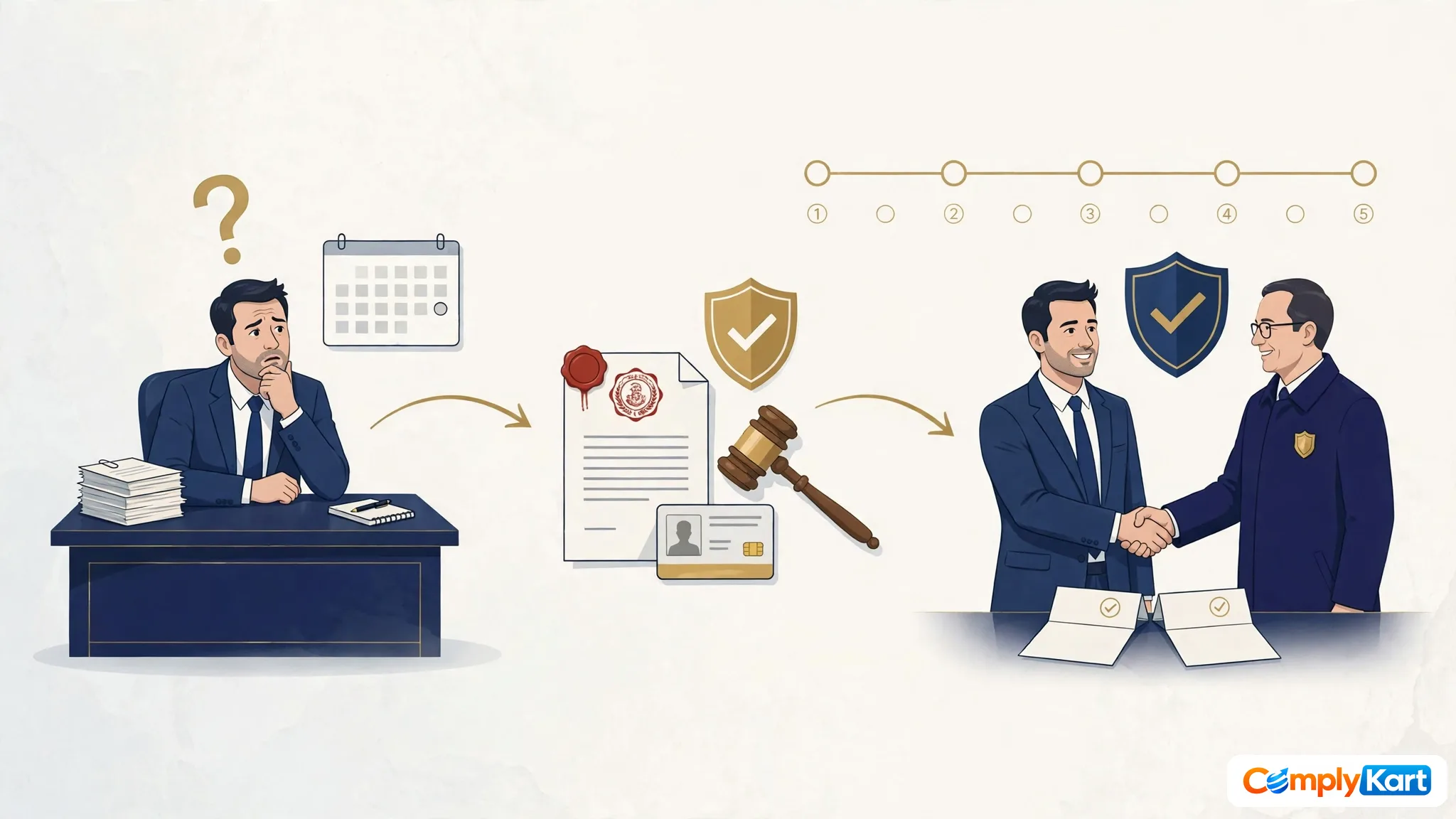
Five steps, no guesswork — you always know exactly what comes next. Tap a step to see what it involves.
12345
You pay securely. Payment is confirmed instantly, and your receipt with the written fee breakup lands in your inbox.
Winding Up a One Person Company: Choosing the Right Closure Route
Closing a One Person Company sounds like it should be the simplest corporate exit in India — one member, one director, one decision-maker. In practice, founders discover that shutting an OPC involves the same statutory machinery as closing any company, just with fewer people in the room. The good news is that the single-member structure actually simplifies several steps: there are no shareholder disputes, no boardroom deadlocks, and the member's resolution is the company's resolution.
There are two genuine routes to close an OPC, and choosing wrong is the most common mistake founders make. The first is strike-off under Section 248 of the Companies Act, 2013, filed on Form STK-2 — an administrative removal of the company's name by the ROC, suitable where the OPC has no meaningful assets or liabilities left. The second is voluntary liquidation under Section 59 of the Insolvency and Bankruptcy Code, 2016 — a formal liquidation with an insolvency professional as liquidator, suitable where there are assets to realise, debts to settle formally, or the founder wants the clean finality of an NCLT dissolution order.
A note on terminology before we go further: practitioners use "winding up," "closure," "liquidation," and "strike-off" loosely, but they are legally distinct. Strike-off removes the name without a liquidator; winding up/liquidation settles affairs through a liquidator and ends in dissolution. This guide covers both, with the practical emphasis on strike-off, which is what the overwhelming majority of OPC closures actually use.
Why OPCs get closed — the real triggers
Most OPC closures fall into a handful of patterns. The business idea didn't take off and the founder wants to stop the annual compliance bleed (AOC-4, MGT-7A, income-tax return, auditor appointment — each with its own fee and penalty clock). The founder is taking employment and the OPC has become a compliance liability. The OPC was incorporated for a contract or a visa/banking requirement that has since lapsed. Or the founder is consolidating into a private limited company or LLP and the OPC is redundant.
Whatever the trigger, the economics are the same: a dormant OPC costs money every year it exists, and the penalties for non-filing compound. Closing it properly is almost always cheaper than letting it rot.
Route 1 — Strike-off under Section 248 (the standard OPC closure)
Section 248(2) allows a company to apply to the ROC for removal of its name after extinguishing all its liabilities, by special resolution — in an OPC, the sole member's resolution. This is the route for OPCs that are dormant, have nil or settled liabilities, and no assets worth formally liquidating.
Eligibility in practice: the OPC should have cleared its debts, closed or zeroed its bank account, settled tax dues (including filing the final income-tax return position), and brought its MCA filings current. The ROC will not process an STK-2 happily if AOC-4 or MGT-7A filings are years overdue — clear the backlog first (with additional fees under Section 403) or expect rejection.
The STK-2 application is accompanied by: a statement of accounts certified by a chartered accountant (not older than 30 days before the application, as a matter of practice), an affidavit and indemnity bond from the director, the member's resolution, and NOCs where relevant (e.g., from regulatory authorities if the OPC held licences). The filing fee is commonly stated as ₹10,000.
After filing, the ROC examines the application, publishes a public notice (on the MCA portal and in the Official Gazette), and invites objections within 30 days. If no objections are received and the ROC is satisfied, it strikes the name off and publishes a dissolution notice. The whole cycle typically runs 3–6 months.
Route 2 — Voluntary liquidation under IBC Section 59
Where the OPC has assets to realise or the founder wants formal liquidation finality, Section 59 of the IBC applies — an OPC is a "corporate person" under the Code. The process: the director makes a declaration of solvency (affidavit-backed, stating the OPC has no debts or can pay them in full from liquidation proceeds, and is not being liquidated to defraud anyone), accompanied by audited financial statements for the previous two years (or since incorporation) and a registered valuer's report if assets exist. Within four weeks, the member passes a special resolution to liquidate voluntarily and appoints an insolvency professional as liquidator. If the OPC owes debts, creditors representing two-thirds in value must approve within seven days. The liquidator makes a public announcement (Form A) within the statutory window, calls for claims, realises assets, distributes proceeds, and files a final report — targeting completion in 90 days (270 where creditor approval was needed) under amended Regulation 37. The NCLT then passes the dissolution order under Section 59(8).
For a typical dormant OPC, this is overkill — but where the OPC holds immovable property, investments, or disputed receivables, the formal route protects the founder better than an administrative strike-off.
Creditor settlement — the step you cannot skip
Both routes require liabilities to be extinguished or provided for. Practically: obtain NOCs or settlement letters from banks (loan closure, OD/CC closure), clear statutory dues (GST, TDS, PF/ESI if applicable, professional tax), settle vendor and employee dues with written acknowledgements, and close the current account only after the last cheque/ECS clears. Unpaid creditors are the single biggest source of objections during the 30-day public-notice window — and a single credible objection can stall the STK-2 indefinitely.
ROC filings to clear before applying
Bring these current before STK-2: AOC-4 (financial statements) and MGT-7A (annual return) for all pending years, DIR-3 KYC for the director if due, and the income-tax return position (file up to the closure year; obtain the final assessment/no-dues position where practical). The statement of accounts filed with STK-2 should reconcile with the last filed financials — mismatches invite ROC queries.
What happens after strike-off
Once struck off, the OPC ceases to exist as a legal entity. The ROC publishes the dissolution. The director should retain the books and records, the strike-off order, and tax filings for at least eight years as a matter of prudence (the IBC route expressly requires eight-year preservation; for strike-off it is best practice). If assets or liabilities surface later, Section 248(6) allows restoration applications — and creditors can still pursue the former member in limited circumstances, which is why the indemnity bond matters.
Common mistakes that derail OPC closure
Filing STK-2 with pending annual filings (rejection). Leaving the bank account open with a balance (the CA-certified statement must reflect reality). Forgetting the nominee — the nominee's consent/position should be documented. Not publishing or responding to the public notice (objections unanswered = delay). And the classic: assuming a zero-balance OPC needs no tax filings — file the final ITR and close the PAN/Aadhaar linkages properly.
How ComplyKart helps — and what we do not do
We run the full closure: backlog compliance clean-up, CA-certified statements, STK-2 drafting and filing, objection handling, and post-closure record checklists — or the IBC Section 59 route with an empanelled insolvency professional where that fits. What we do not do: we don't advise leaving an OPC dormant instead of closing it (the penalty math never favours delay), and we don't file strike-off applications for companies with disputed or unpaid liabilities without a settlement plan — that application will fail.
Step N — the process, end to end
Step 1 — Decide the route: strike-off or liquidation
Assess assets, liabilities, and disputes. Dormant/nil-liability OPC → STK-2 strike-off. Assets to realise or formal finality wanted → IBC Section 59 voluntary liquidation. Document the decision in the member's minutes.
Step 2 — Clear the compliance backlog
File all pending AOC-4, MGT-7A, and other MCA forms with additional fees. Reconcile the books to the last filed financials. Obtain a no-dues position on GST, TDS, and income tax.
Step 3 — Settle every creditor and close banking
Pay or formally settle all dues; collect NOCs and settlement letters. Close the current account after the last transaction clears. Keep written acknowledgements from every counterparty.
Step 4 — Pass the member's resolution
The sole member resolves to apply for strike-off (special resolution for Section 248(2)) or to liquidate voluntarily (special resolution under IBC Section 59, appointing the insolvency professional as liquidator).
Step 5 — Get the CA-certified statement of accounts
A chartered accountant certifies the statement of accounts (assets, liabilities — ideally nil). Prepare the director's affidavit and indemnity bond, plus the nominee's documentation.
Step 6 — File Form STK-2 (or commence IBC liquidation)
File STK-2 on the MCA portal with all attachments and the fee. For the IBC route: declaration of solvency, audited financials, valuer's report, then the liquidator's public announcement and claims process.
Step 7 — Survive the public-notice window
The ROC publishes the notice; monitor for objections for 30 da
FAQ
Frequently asked questions
25 answers from our consultants.
You pay for our expert's time — document checking, filing, follow-ups — not the government. The government fee goes to the government; our fee is for the work we do so you don't have to figure it out yourself.
₹100 per day, per form, with no maximum cap. A one-year delay on AOC-4 and MGT-7 together can cross ₹70,000 in late fees alone. File on time — it's the cheapest compliance you'll ever do.
Yes. Dormant or not, a private limited company must file AOC-4, MGT-7, hold board meetings and conduct a statutory audit every year. Zero turnover doesn't mean zero compliance.
AOC-4 is your financial statements (balance sheet, profit & loss) filed with the ROC. MGT-7 is your annual return (shareholding, directors, meetings). Both are due after your AGM — AOC-4 within 30 days, MGT-7 within 60 days.
Yes, with late fees. There's no amnesty scheme running right now, so every day of delay adds ₹100 per form. We regularly clear 3-4 years of backlog for companies — it's routine work for us.
Yes — this is the cleanest case for strike-off. Ensure INC-20A (commencement of business declaration) was handled, file any due nil returns, get the CA-certified nil statement of accounts, and file STK-2.
Not for strike-off. A liquidator — an insolvency professional — is required only if you choose voluntary liquidation under IBC Section 59, which suits OPCs with assets to realise or where formal liquidation finality is wanted.
Strike-off is an administrative removal of the company's name by the ROC for companies with no liabilities; winding up (liquidation) is a formal process where a liquidator settles debts, realises assets, and distributes the surplus before dissolution. Most OPCs use strike-off.
Yes. The ROC publishes a public notice inviting objections within 30 days. A creditor with an unpaid, credible claim can object and stall or defeat the application — which is why settling every liability beforehand is essential.
The member's special resolution, a CA-certified statement of accounts, the director's affidavit, an indemnity bond, and NOCs from relevant authorities where applicable. Pending MCA annual filings should be cleared first.
File the overdue AOC-4 and MGT-7A first, paying additional fees under Section 403 (which accrue per day of delay). ROCs routinely reject STK-2 applications sitting on top of filing backlogs.
Surrender or close out the tax registrations after filing the final income-tax return. The PAN itself is not "cancelled" on strike-off, but all assessments for the closure year should be completed and dues settled.
Yes, under Section 252 — the company, a member, or a creditor can appeal to the NCLT for restoration within the statutory limitation periods. Revival is a separate NCLT process with its own costs, so it is not a casual fallback.
The nominee (named in the MOA) becomes the member only on the original member's death or incapacity. In a voluntary closure by a living, capable member, the nominee has no operative role — but their documentation should be in order as part of the records.
No — not until the loans are repaid or formally settled with the lender's NOC. Section 248(2) requires all liabilities to be extinguished before the ROC will process the application. An OPC with unresolved debt should use the IBC route or settle first.
In an OPC the member and the director are typically the same person, and Section 122(3) deems the member's resolution to be passed on the date it is recorded. One properly documented resolution covers it — there is no separate board/shareholder split as in multi-member companies.
File the income-tax return for the year of closure, complete any pending assessments, settle TDS/GST positions, and obtain no-dues confirmations. Keep the final computation and challans with the closure file.
Yes. Closure of one company does not disqualify the director (disqualification under Section 164 relates to filing defaults, not to having closed a company). Ensure the closed OPC's filings were actually completed, or the DIN may carry the default history.
It is the formal liquidation route: declaration of solvency by the director, audited financials for two years, a valuer's report, a member's special resolution appointing an insolvency professional as liquidator, public announcement, claims verification, asset realisation, distribution, final report, and an NCLT dissolution order.
The IBC declaration of solvency is an affidavit-backed statement that the company has no debts or can pay them in full from liquidation proceeds and is not being liquidated to defraud anyone — a higher bar with personal liability for false declarations. The STK-2 affidavit/indemnity bond supports the administrative strike-off application.
Strike-off is unsuitable where significant assets exist — realise or transfer them first, or use IBC voluntary liquidation so the liquidator handles realisation and distribution with proper legal finality. Undisclosed assets surfacing after strike-off create restoration and liability risk.
For STK-2 strike-off, the ROC handles the public notice (MCA portal + Official Gazette); the applicant does not separately advertise. For IBC voluntary liquidation, the liquidator publishes the public announcement in newspapers and on the IBBI website.
Keep the strike-off/dissolution order, all financial statements, tax returns and challans, the CA-certified statement, NOCs, and bank closure proof for at least eight years. The IBC route expressly requires eight-year preservation by the liquidator; for strike-off it is strongly advisable.
Strike-off under Section 248 via Form STK-2 is the cheapest route — the ROC fee is commonly stated as ₹10,000, plus professional fees for the CA-certified statement and filing. There is no liquidator and no NCLT process, which keeps costs far below formal liquidation.
Typically 3–6 months from STK-2 filing. The ROC examines the application, publishes a 30-day public notice for objections, and then passes the strike-off order. Backlog filings or objections extend the timeline.
What clients say about working with us
Real stories from businesses we've worked with.
Trademark Registration“
Our Trademark was applied in all the classes with a short span of time by Complykart Trademark Experts and I can say the level of expertise and commitment they carry is remarkable. It's an A+ from my side. We are now sticking to ComplyKart only.
Company Registration“
I found the professionalism of the staff at complykart.com, a pleasure to work with. As a foreigner to India, they took the time to explain the documentation and assisted in every question I raised. I was pleased that complykart.com made it easy for my Business.
Merger & Acquisition“
Trust, Commitment, Dedication and responsiveness are the best things with ComplyKart. Thanks for handling our Merger assignment with so much care. After my business disputes, complykart handles all things with own sense of understanding.
Reyansh Singh leads ComplyKart’s NCLT and dispute resolution practice. He represents companies in oppression and mismanagement petitions, insolvency matters, shareholder disputes and regulatory proceedings. He knows how tribunals think — and drafts petitions that win.
Last reviewed: 16 November 2026
Get a free consultation
Talk to a ComplyKart professional about Winding up One Person Company. The first consultation is free.