
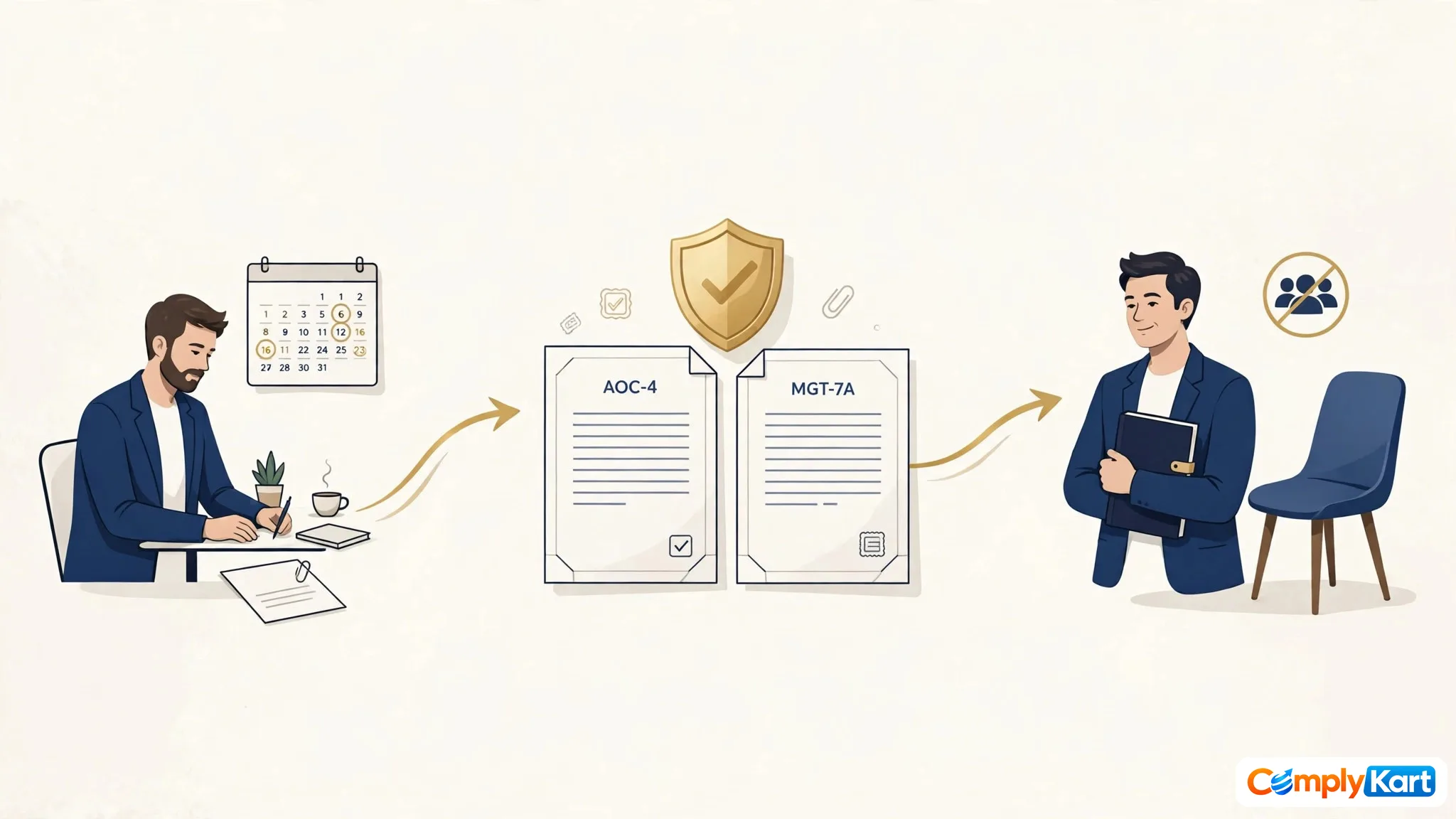
IN BRIEF
OPC annual compliance is the set of filings a One Person Company makes with the Registrar of Companies under the Companies Act, 2013: audited financial statements in Form AOC-4 within 180 days of the financial year-end and the abridged annual return in Form MGT-7A within 60 days of the deemed annual general meeting date. OPCs hold no annual general meeting under section 96(1), so both deadlines run from fixed dates, not a meeting.
An OPC is a one-person band. You play every instrument, so the law stops asking you to hold committee meetings about the music. It still wants the recording filed on time — two forms, two dates, and a penalty meter that runs whether or not you had a meeting to miss.
Short answer: a One Person Company files two ROC forms every year — AOC-4 for its financial statements within 180 days of the financial year-end (27 September 2026 for FY 2025-26) and MGT-7A, the abridged annual return, within 60 days of the deemed AGM date (29 November 2026). This year, the MCA lets you file AOC-4 up to 31 December 2026 and MGT-7A up to 31 January 2027 without additional fees.
Key takeaways
- An OPC files AOC-4 and MGT-7A every year — never MGT-7, the longer form meant for regular companies.
- OPCs hold no AGM at all, and a sole-director OPC holds no board meetings either. The dates still run — from 30 September, not from a meeting.
- General Circular 05/2026 gives fee-free windows to 31 December 2026 (AOC-4) and 31 January 2027 (MGT-7A). After those dates, fees count from the original deadline.
- Late filing costs ₹100 a day per form, with no cap. The penalty exposure on top is halved for OPCs — but it is real.
- The old ₹2 crore / ₹20 crore forced-conversion rule is gone. An OPC can grow past those numbers and stay an OPC.
What are the two OPC annual compliance dates?
Everything else in this guide hangs off two dates. Here they are, with the extension the MCA granted for this year only.
| Form | What it is | Statutory due date (FY 2025-26) | Fee-free window under GC 05/2026 |
|---|---|---|---|
| AOC-4 | Financial statements | 27 September 2026 — 180 days from 31 March | 31 December 2026 |
| MGT-7A | Annual return (abridged) | 29 November 2026 — 60 days from the deemed AGM date | 31 January 2027 |
Both dates run from fixed points in the calendar, not from meetings you held. That is the whole trick of OPC compliance: the meetings are gone, the calendar is not.
The extension that changes this season
On 24 October 2026 the MCA issued General Circular No. 05/2026. It followed a representation from the Institute of Company Secretaries of India, which had asked on 9 October 2026 for the annual filing dates to move to 31 December 2026 without additional fees. The MCA answered with a fee relaxation, not a date change — and the difference matters.
What the circular does: it lets companies file AOC-4 (and its CFS, XBRL and NBFC variants) up to 31 December 2026 and MGT-7 and MGT-7A up to 31 January 2027 without paying additional fees. That covers OPCs too — the circular names MGT-7A expressly.
What it does not do: it does not move the statutory dates, it does not extend the AGM deadline (irrelevant for an OPC, but the circular says so plainly), it does not cover ADT-1 or DIR-12, and it applies only to FY 2025-26. LLPs are outside it entirely.
And here is the part people miss. File after the relaxed window closes and the additional fee is counted from the original statutory date, not from the end of the window. File AOC-4 on 15 January 2027 and you owe 110 days of fees, not 15. The window is breathing room, not a new deadline.
What is AOC-4 for an OPC?
AOC-4 carries your audited financial statements to the Registrar: balance sheet, profit and loss account, notes to accounts, the auditor's report and the board's report. Three things about it are different for an OPC, and all three are in your favour.
First, the deadline. A private limited company files AOC-4 within 30 days of its AGM. An OPC has no AGM, so the third proviso to section 137(1) gives it a fixed period instead: 180 days from the close of the financial year. For a year ending 31 March 2026, that is 27 September 2026. Plenty of guides quote the 30-day rule for OPCs too. It is wrong for an OPC, and it has cost founders a month of planning time they actually had.
Second, the audit is compulsory. No turnover threshold lets an OPC escape statutory audit — section 139 applies whatever the size of the business. What you escape is CARO reporting and the cash flow statement (more on that below).
Third, the paperwork is lighter. The financial statements are signed by one director under section 134(1). The board's report can follow the abridged format under Rule 8A of the Companies (Accounts) Rules, 2014 — shorter, same legal standing. Use it; filing a full-length board's report out of habit is work you do not owe anyone.
What is MGT-7A, and why never MGT-7?
MGT-7A is the abridged annual return written for OPCs and small companies, in use since FY 2020-21. It asks for less: one principal business activity, shareholding (you, plus your nominee's particulars), director information, and board meetings held. MGT-7 is the longer form for regular companies — file the wrong one and you will be redoing it.
The due date needs a careful sentence, because two good sources disagree about where the 60 days start. Section 92(4) gives 60 days from the date the AGM is held, or from the date it should have been held. For an OPC there is no AGM, so the date it should have been held is 30 September — six months from the year-end — which gives 29 November 2026. But section 122(3) says the date you sign the resolution adopting the accounts is deemed to be the date of the meeting. If you sign on 27 September, the 60 days arguably run from then, giving 26 November.
The safe rule: count 60 days from the day you sign the adoption resolution, and treat 29 November as the absolute outer edge. Sign early, file early, and the argument never arises.
One more relief: MGT-7A needs no certification by a practising company secretary for an OPC. Your signature as director is enough. The financial statements behind AOC-4 still need a statutory audit — two different forms, two different rules, and mixing them up is one of the commonest OPC mistakes.
The relaxations, one by one
This is the part that makes the OPC worth having. The Companies Act, 2013 removes seven things for a one-person company that a private limited company still owes.
1. No annual general meeting
Section 96(1) requires an AGM from "every company other than a One Person Company". The business an AGM would handle — adopting the accounts, continuing the auditor, declaring a dividend — still has to be done. Section 122(3) says how: you communicate the resolution to the company, it goes in the minutes book, signed and dated by you. That date counts as the meeting date for every purpose under the Act.
2. Board meetings: two, one, or none
This one depends on how many directors you have. Two or more directors: section 173(5) wants at least one board meeting in each half of the calendar year, with at least 90 days between the two. One director: the proviso to section 173(5) switches off the meeting requirement and the quorum rule in section 174 altogether, and section 122(4) lets you transact board business by a resolution entered in the minutes book, signed and dated. Most guides say "OPCs hold two board meetings a year" and stop there. If you are the only director, the true number is zero.
3. No cash flow statement
The definition of "financial statement" in section 2(40) lets an OPC leave the cash flow statement out. Balance sheet, profit and loss account and notes are still required — but the statement that takes the most fiddling to prepare is simply not owed.
4. One signature on the accounts
Section 134(1) lets one director sign the financial statements for an OPC. No chasing a second signatory who does not exist.
5. An abridged board's report
Rule 8A gives OPCs (and small companies) a shorter board's report format. It covers what the law needs and nothing more.
6. No professional certification on MGT-7A
Covered above — your signature suffices. Larger companies pay a practising professional to certify the annual return. You do not.
7. Halved penalties
Section 446B caps the penalty for an OPC (and a small company, start-up or producer company) at not more than half the usual amount, subject to an overall ceiling of ₹2 lakh for the company and ₹1 lakh for an officer. Half of a penalty is still a penalty — but the law does recognise that a one-person company is not a listed giant.
The rule that no longer exists
Ask around and someone will still tell you an OPC must convert to a private or public company within six months of crossing ₹2 crore paid-up capital or ₹20 crore turnover. That was the rule — until the Companies (Incorporation) Second Amendment Rules, 2021 removed the mandatory conversion thresholds with effect from 1 April 2021. An OPC can now grow past both numbers and stay an OPC. If your planning still has a conversion trigger in it, delete it. Our own earlier OPC filing checklist still carried the old rule; it has been corrected alongside this guide.
What does late filing actually cost?
Two different meters run when you file late, and people confuse them constantly.
The first is the additional fee: ₹100 a day, per form, with no cap, under section 403 read with the Companies (Registration Offices and Fees) Rules, 2014. It starts the day after the statutory deadline and it is charged by the portal when you file. For FY 2025-26, General Circular 05/2026 pauses it until 31 December 2026 for AOC-4 and 31 January 2027 for MGT-7A — and then it resumes from the original date.
Worked example, so you can check the maths. File AOC-4 on 15 January 2027, two weeks after the relaxed window closes: the delay runs from 28 September 2026 — 3 days of September, 31 of October, 30 of November, 31 of December, 15 of January — 110 days at ₹100, which is ₹11,000. File MGT-7A on 15 February 2027: 1 day of November, 31 of December, 31 of January, 15 of February — 78 days, ₹7,800. Both late together: ₹18,800 in additional fees alone.
The second meter is the penalty under the Act itself: section 137(3) for financial statements and section 92(5) for the annual return. Each starts at ₹10,000 plus ₹100 a day, capped at ₹2 lakh for the company and ₹50,000 for an officer — and halved for an OPC under section 446B. Unlike the additional fee, penalties are not automatic. They are imposed by an adjudicating officer under section 454, after a notice and a hearing. Filing late does not trigger a penalty order by itself, but it does not wipe out the exposure either. The additional fee is certain; the penalty is possible. Budget for the certain one and do not test the possible one.
The rest of the OPC year
Two ROC forms are the core, but four smaller items complete the year — add them to your compliance calendar:
| Item | Form | When |
|---|---|---|
| Auditor appointment (only if the auditor changed) | ADT-1 | Within 15 days of the appointment |
| Income tax return (audit applies, so ITR-6) | ITR-6 | 31 October |
| Return of deposits and borrowings | DPT-3 | 30 June |
| Director KYC | DIR-3 KYC | Once in three years now — next due 30 June 2028 |
Director KYC deserves one line of its own, because half the guides on the internet still call it annual. It moved to a three-year cycle in March 2026. Nothing to do this season; keep your attention on the two ROC forms, where the deadlines are real.
Five mistakes OPCs keep making
Filing MGT-7 instead of MGT-7A. The simplified form exists for you. Check the form code before you submit, because the portal will not stop you from picking the wrong one.
Treating "no AGM" as "no deadline." I see this every season. No AGM does not mean no due date; the dates run from 30 September and the penalty meter runs with them.
Using the 30-day AOC-4 rule. That is the private limited company's deadline. Yours is 180 days from the year-end. Getting this backwards in either direction costs you — a month of planning time, or a late fee you did not expect.
Forgetting the nominee. The nominee is not decorative. If they withdrew consent or their details changed and your return still names the old one, that is a defective filing. Five minutes of checking now saves a correction later.
Planning around the dead conversion rule. The ₹2 crore / ₹20 crore forced conversion ended in April 2021. If your growth plan still has a conversion in it, it is planning for a law that no longer exists.
Frequently asked questions
Does an OPC need to hold an AGM?
No. Section 96(1) of the Companies Act, 2013 exempts One Person Companies from AGMs entirely. The member signs the resolutions in the minutes book instead, and that signed date counts as the meeting date. But exemption from the meeting is not exemption from the calendar — AOC-4 and MGT-7A deadlines still run, and the penalty meter runs with them.
MGT-7 or MGT-7A — which one do I file?
MGT-7A. Always. It is the abridged annual return written for OPCs and small companies. MGT-7 is the longer form for regular companies, and filing it as an OPC means redoing the filing. Check the form code before you submit.
What is the last date for OPC annual filing for FY 2025-26?
Statutorily, AOC-4 by 27 September 2026 and MGT-7A by 29 November 2026. Under MCA General Circular 05/2026, you can file AOC-4 up to 31 December 2026 and MGT-7A up to 31 January 2027 without additional fees. After those windows, fees count from the original dates.
How many board meetings does an OPC need?
It depends on the number of directors. Two or more directors: one meeting in each half of the calendar year, at least 90 days apart, under section 173(5). One director: none at all — the proviso to section 173(5) switches the requirement off, and board business is done by resolutions in the minutes book under section 122(4).
Is an audit compulsory for an OPC?
Yes. A statutory audit is mandatory for every OPC under section 139, whatever the turnover. What you escape is CARO reporting and the cash flow statement — the audit itself still happens.
What happens if my OPC crosses ₹20 crore turnover?
Nothing, as far as conversion goes. The mandatory conversion thresholds were removed with effect from 1 April 2021, so an OPC can grow past ₹2 crore paid-up capital or ₹20 crore turnover and remain an OPC. You still file as an OPC, on OPC dates, with OPC forms.
That is the whole OPC year: two forms, two dates, seven relaxations, and one extension window that is open right now. The meetings are gone. The calendar is not. If you would rather not watch the calendar yourself, ComplyKart's annual filing service handles OPC filings round the year — hand us the books and we will close the loop. Still deciding on the structure? Our guide to registering an OPC covers the setup side, including the nominee.





Comments
No comments yet — ask the first question below.
Join the discussion
Questions go straight to our expert desk. Comments appear after a quick review — no spam, no noise.