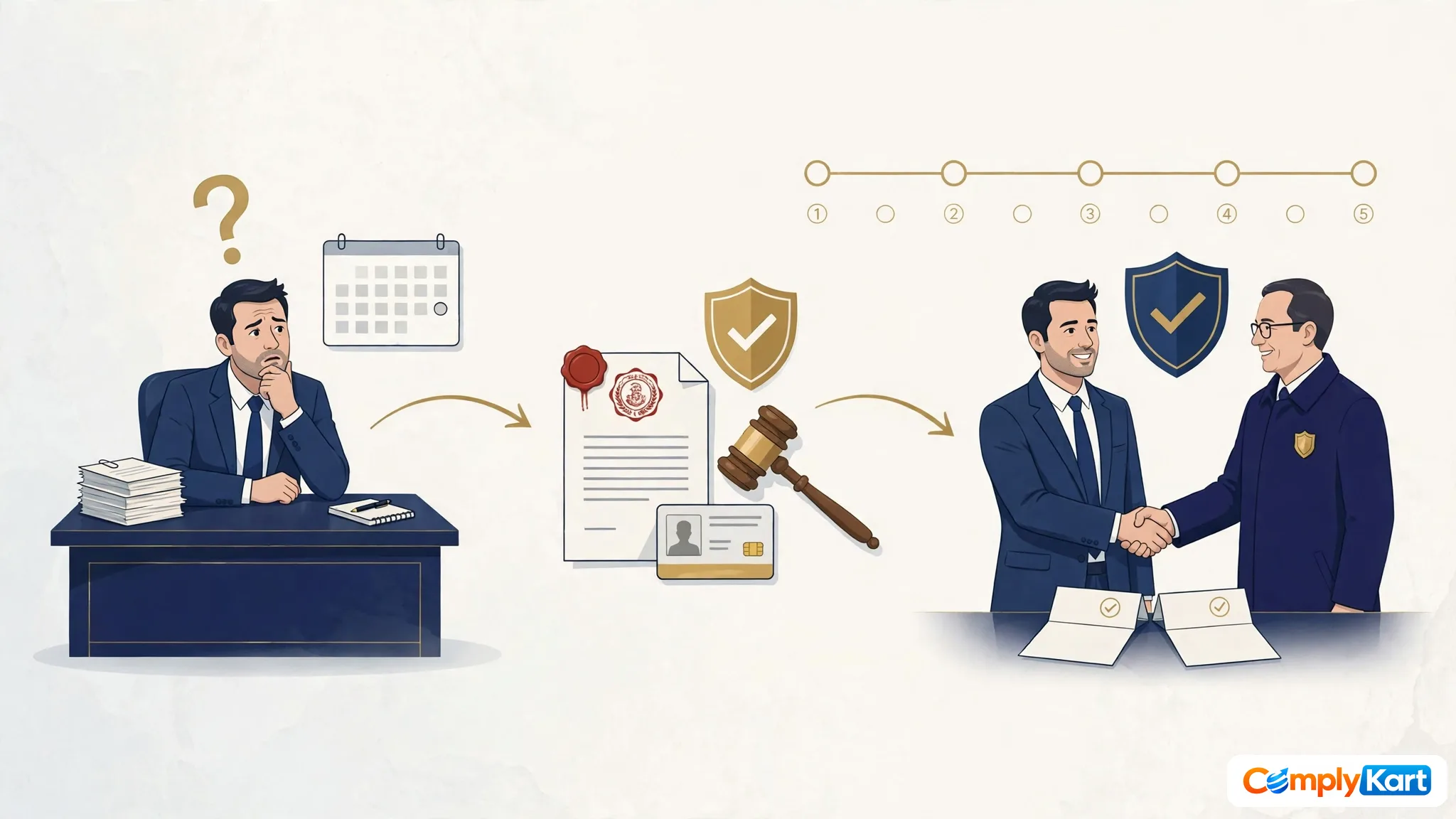
Five steps, no guesswork — you always know exactly what comes next. Tap a step to see what it involves.
12345
You pay securely. Payment is confirmed instantly, and your receipt with the written fee breakup lands in your inbox.
Director Disqualification Removal in India: the Honest, Complete Guide
Losing your directorship without a hearing feels wrong — because it often is
Think of a Director Identification Number the way you think of a driving licence. Now imagine the traffic department suspending thousands of licences in one afternoon because the vehicle owners — not the drivers — hadn't paid their road tax for three years. The driver learns about it when he is stopped at a checkpoint. That is, in substance, what happened to roughly three lakh directors in 2017, and what continues to happen in smaller waves every year: Section 164(2) disqualification, applied by the Registrar of Companies, with the DIN deactivated, usually discovered only when the director tries to sign a filing.
This page tells you the position as it actually stands — not the comforting version. There is no single "apply here and get it removed" button in the Companies Act for a 164(2) disqualification. The NCLT has no express statutory power to erase it. Form DIR-10 only helps at the end of the five-year tenure. The routes that have actually worked are: curing the company's default and approaching the High Court under Article 226, or reviving the struck-off company and then seeking relief. We walk through each one, with the case law, the steps, the costs, and the traps.
What Section 164(2) actually does to you
Read the provision once, slowly, because most of the panic around it comes from misreading it. A person who "is or has been" a director of a company which —
(a) has not filed financial statements or annual returns for any continuous period of three financial years; or
(b) has failed to repay the deposits accepted by it or pay interest thereon, or to redeem any debentures on the due date or pay interest due thereon, or to pay any dividend declared, and such failure continues for one year or more —
is not eligible to be re-appointed as a director of that company, or appointed in any other company, for five years from the date on which the company failed to do so.
Three things follow automatically. First, Section 167(1)(a) vacates the director's office in every company where they hold office — not just the defaulting one. Second, the ROC deactivates the DIN, which freezes the director out of the MCA system entirely: no filings can be signed, no appointments accepted. Third, the five-year clock runs from the date of the company's failure, not from the date the director finds out — a director who discovers the disqualification in year three has only two years left, not five fresh ones.
Note the reach of "is or has been": even a director who resigned before the disqualification was flagged can be caught if they were on the board during the default period. This is why the 2017 drive swept up directors of companies they had mentally written off years earlier.
How to confirm you are actually disqualified (and under which limb)
Before spending a rupee on remedies, verify three things:
DIN status on the MCA portal. A deactivated DIN is the practical signature of a 164(2) action. The MCA's DIN enquiry shows the status.
Which limb triggered it. Pull the defaulting company's filing history. If MGT-7/AOC-4 are missing for three consecutive financial years, it is clause (a). If deposits, debentures, or declared dividends went unpaid for a year, it is clause (b). The remedy strategy differs: clause (a) defaults are curable by filing; clause (b) defaults require actual payment, which may be a far bigger problem.
Whether the company still exists. A struck-off company needs revival first (see our [revival of struck-off company](/service/Revival-of-Strike-Off-Company) page); an active company needs its backlog filed.
A word on timing: the ROC's disqualification lists are published in batches, and directors often learn of their status from their auditor, their bank, or a failed filing — not from any personal notice. The absence of a personal hearing before disqualification is precisely the natural-justice ground on which High Courts have granted relief.
The uncomfortable truth: the statute gives you almost no direct remedy
Say this plainly, because paid "disqualification removal packages" sometimes imply otherwise:
The NCLT has no express power under the Companies Act, 2013 or the NCLT Rules to remove a 164(2) disqualification. Commentaries and practitioner articles have consistently taken this position, and no rule prescribes a form or procedure for it.
Form DIR-10, prescribed by Rule 14(5) of the Companies (Appointment and Qualification of Directors) Rules, 2014 for "removal of disqualification of directors," is in practice usable only at the end of the five-year disqualification tenure — it does not shorten the period.
The Condonation of Delay Scheme, 2018 (1 January to 30 April 2018, later extended) was a genuine one-time lifeline: disqualified directors got temporary DIN reactivation to file overdue documents. It is closed. Do not plan around a repeat.
What *has* worked, in reported cases, is the combination of curing the default + High Court writ petition under Article 226. The writ grounds that courts have entertained are: (i) violation of natural justice — disqualification without notice or hearing, contrary to Article 14; (ii) the director having cured or being ready to cure the default; (iii) the director not being at fault (e.g., a non-executive or nominee director with no role in the default); and (iv) retrospective or mechanical application of the provision. The Madras High Court's interim order of 21 September 2017 staying the ROC Chennai's disqualification order in *Bhagavan Das Dhananjaya Das* opened the floodgates; several High Courts followed with interim stays, and many matters were ultimately resolved by filing the backlog under court protection.
Courts are, however, markedly less sympathetic where the default involves fraud, siphoning, or deliberate non-compliance, and where the company is a shell with no real business. Relief is a remedy for the compliant-but-caught, not a laundering service for the wilful.
The four real routes, compared
Route
Fits when
What it achieves
Honest caveat
1. Cure the default + High Court writ
Company is active; default is curable (filings or payments); director has clean hands
Interim stay, then quashing or time-bound cure directions; DIN reactivation
Litigation cost and time; outcome depends on facts and the bench
2. Revive the struck-off company, then seek relief
Company was struck off under Section 248
Restoration under Section 252 gives the company (and its directors) a live entity to cure defaults through
NCLT restoration takes months; then the writ route still follows
3. Wait out five years + DIR-10
Default is uncurable (company dead, dues unpayable) or litigation is uneconomic
Clean eligibility after tenure; DIR-10 on record
Five years is a long professional exile; DIN stays dead meanwhile
4. Challenge the trigger itself
The three-year default period is factually wrong (filings were actually made; company was dormant with nil filings due; wrong DIN tagged)
Disqualification collapses if the trigger fails
Rare; needs documentary proof the ROC's records are wrong
Route 4 deserves emphasis because it is the cheapest win when it applies. ROC data has errors — wrong DINs tagged, filings made but not reflected, companies that filed nil returns treated as non-filers. A careful reconciliation of the company's MCA filing history against the ROC's disqualification list sometimes shows the trigger never legally occurred. Always do this reconciliation before choosing a route.
The process, step by step
Step 1 — Reconstruct the default timeline
List, financial year by financial year, which filings are missing and which payments defaulted. Fix the exact date the three-year or one-year trigger completed — the five-year clock runs from there. Pull the company's master data, charge history, and filing status from the MCA portal, and match them against the ROC's disqualification list entry for your DIN.
Step 2 — Decide whether the default is curable
For clause (a), curable means the books and records exist to prepare and file the overdue MGT-7s and AOC-4s, with additional fees. For clause (b), curable means the money to repay deposits, redeem debentures, or pay dividends can actually be found. If the company is a hollow shell with no records and no funds, routes 1 and 2 are theatre — route 3 is the honest advice.
Step 3 — Check whether the company is struck off
If the ROC struck the company off under Section 248 (common where filings lapsed), the company must first be revived under Section 252 before it can file anything. File the NCLT restoration application (Form NCLT-9) within the limitation applicable to your route — three years from the strike-off order under Section 252(1), or the longer Section 252(3) window for members/creditors. Our [revival page](/service/Revival-of-Strike-Off-Company) covers this in full.
Step 4 — Get the DIN temporarily reactivated (if the court route is chosen)
Courts granting interim stays on disqualification have directed reactivation of the DIN so the director can sign the curative filings. This is typically sought as interim relief in the writ petition itself. Without a reactivated DIN, the director cannot sign the very filings the court wants cured — the classic catch-22 the interim orders resolve.
Step 5 — File the backlog
With the DIN live (or through a non-disqualified director, where one exists), file all overdue financial statements and annual returns with additional fees, clear the deposit/debenture/dividend defaults with proof of payment, and obtain challans and receipts for everything. This is the evidentiary heart of the case: courts grant relief to directors who have cured, not to
FAQ
Frequently asked questions
24 answers from our consultants.
You pay for our expert's time — document checking, filing, follow-ups — not the government. The government fee goes to the government; our fee is for the work we do so you don't have to figure it out yourself.
Tell us your situation in plain words — what you're trying to do, not which form you think you need. Half our job is stopping clients from buying the wrong service. The first consultation is free and honest.
Yes. We quote professional fee + government charges + taxes separately, in writing, before you pay. The number doesn't change midway. If the government fee changes, we show you the notification.
Every engagement gets a tracker — you see what's filed, what's pending and what's next. No chasing on WhatsApp for status updates.
The Companies Act and the NCLT Rules give the Tribunal no express power or procedure to remove a 164(2) disqualification. In reported practice, High Court writ petitions under Article 226 — not NCLT applications — have been the effective forum for stays and relief.
Cure the company's default (file the backlog or pay the dues), then approach the High Court for an interim stay with DIN reactivation and final quashing. Where the default is genuinely cured and the director's hands are clean, courts have been receptive.
No. Curing the default is necessary but not sufficient by itself — the disqualification is a statutory consequence that has already crystallised. The cure is the foundation of the writ petition, not a substitute for it.
Under Rule 14(5) of the Companies (Appointment and Qualification of Directors) Rules, 2014, an application for removal of disqualification of directors is made in Form DIR-10. It is usable at the end of the five-year disqualification tenure — not as a mid-term shortcut.
Because Section 164(2) catches a person who "is or has been" a director of the defaulting company. If you were on the board during the default period, the resignation does not erase the trigger — though your lack of continuing connection can be a sympathetic fact in a writ.
No. Section 167(1)(a) vacates your office in every company where you hold it, and Section 164(2) bars appointment in any other company for the five-year period. Accepting fresh appointments during disqualification invites penalties.
Acting as a director while disqualified can attract punishment under the Act, and decisions taken may be challenged. The exact exposure depends on the facts — get advice before signing anything in a directorial capacity.
Yes, but the company usually needs revival first under Section 252 — a struck-off company cannot file the backlog that your writ petition needs to show as cured. Run the revival, then the writ.
The ROC's disqualification communication (or DIN status printout), the company's filing history, proof of the cured default (filing challans, payment receipts), board/employment records showing your role and bona fides, and evidence of hardship. Your counsel will settle the final list.
Interim relief often comes within weeks of filing; final disposal typically takes 6–18 months, though many matters end earlier in consent directions once the default is cured and the ROC has no objection.
Almost certainly not. Courts grant this relief on natural justice and bona fides; wilful default, siphoning, or shell-company abuse are the cases where relief is refused. Be candid with your advisers about the facts.
No. The DIN is deactivated, not cancelled. It reactivates on court-directed relief, at the end of the five-year tenure via DIR-10, or under an MCA scheme. The DIN itself is never re-allotted to anyone else.
Often, yes — courts have been sympathetic where the director had no executive role in the default and can show it. Document your actual role: board minutes, attendance, correspondence showing you pressed for compliance.
Then the trigger fails and the disqualification collapses. Reconcile the company's actual filing history against the ROC list before anything else; wrong-DIN tagging and unreflected filings do occur, and this is the cheapest win available.
Verify the DIN shows active, confirm the disqualification flag is cleared in your director master data, ensure the company's filings are fully current, and keep the court order with your permanent records — appointing companies and lenders will ask.
If the default is uncurable or litigation is uneconomic, yes — it is the honest, zero-risk route, ending with DIR-10. But weigh five years of professional exile against the cost of the cure-and-writ route before deciding.
It is a five-year bar on holding directorship — in the defaulting company and every other company — imposed when a director's company fails to file financial statements or annual returns for three consecutive financial years [clause (a)], or fails to repay deposits, redeem debentures, or pay declared dividends for one year or more [clause (b)].
Check your DIN status on the MCA portal — a deactivated DIN is the practical marker. Then match the defaulting company's filing history against the two statutory triggers to confirm which limb applies and when the five-year clock started.
A one-time MCA window (1 January – 30 April 2018, later extended) that let disqualified directors get temporary DIN reactivation to file overdue documents and regularise their position. It is closed, and no general successor scheme is currently announced.
Backlog filing fees plus additional fees (₹10,000 to over ₹1,00,000 depending on the default), plus writ litigation costs (indicatively ₹50,000–₹2,50,000 depending on counsel and city). Get an estimate on your facts before committing.
What clients say about working with us
Real stories from businesses we've worked with.
Trademark Registration“
Our Trademark was applied in all the classes with a short span of time by Complykart Trademark Experts and I can say the level of expertise and commitment they carry is remarkable. It's an A+ from my side. We are now sticking to ComplyKart only.
Company Registration“
I found the professionalism of the staff at complykart.com, a pleasure to work with. As a foreigner to India, they took the time to explain the documentation and assisted in every question I raised. I was pleased that complykart.com made it easy for my Business.
Merger & Acquisition“
Trust, Commitment, Dedication and responsiveness are the best things with ComplyKart. Thanks for handling our Merger assignment with so much care. After my business disputes, complykart handles all things with own sense of understanding.
Company Law Specialist · Company Law & ROC Compliance · 10+ years experience
Naman Agarwal specialises in company law and ROC compliance. He manages incorporations, annual filings (AOC-4, MGT-7, ADT-1), board processes and statutory registers for private limited companies, LLPs and Section 8 companies.
Last reviewed: 16 November 2026
Get a free consultation
Talk to a ComplyKart professional about Director Disqualification Removal. The first consultation is free.