★★★★★4.7Google ratingPan-IndiaClients across IndiaCS-LedCA · CS · Advocate networkJanakpuriNew Delhi officeTransparentPricing, no hidden fees
ComplyKart Services
EPCG Scheme — Zero-Duty Capital Goods Import in India
Import capital goods duty-free. EPCG structured right, obligations tracked.
EPCG and Advance Authorisation can eliminate customs duty on your imports - but they come with export obligations that must be fulfilled and tracked for years. We prepare strong DGFT applications and monitor your obligations till redemption.
CA/CS-guided reviewYour documents and structure are checked before anything is filed.
Written scope firstInclusions and payable charges are explained before work begins.
Support till it’s doneOne team owns your filing, from the first call to the final handover.
Price on request
This work is scoped case by case. You get a fixed written quote before any work starts — no charge for asking.
Five steps, no guesswork — you always know exactly what comes next. Tap a step to see what it involves.
12345
You pay securely. Payment is confirmed instantly, and your receipt with the written fee breakup lands in your inbox.
Overview
Every manufacturer that exports faces the same arithmetic: world-class machinery costs world-class money, and Indian customs duty sits on top of the invoice. The EPCG scheme is the government's answer — import your capital goods at zero customs duty, and pay for the concession not in cash but in exports: six times the duty you saved, over six years.
It is one of the most powerful incentives in the Foreign Trade Policy, and one of the most unforgiving. The export obligation is a legal commitment monitored block-wise by DGFT's Regional Authorities, and a shortfall converts the "saving" into a demand — duty plus 15% annual interest from the date of import. I have watched companies treat EPCG as a discount scheme and others treat it as what it is: a six-year export contract with the government. The second group sleeps better.
This page covers the current FTP 2023 position: what qualifies, how the obligation is computed and monitored, the 2026 extensions and digital EODC changes, and how closure actually works.
How the scheme works — the core bargain
Under Chapter 5 of FTP 2023, an exporter (or an exporter working with a supporting manufacturer) can import capital goods — machinery, equipment, spares, tools, dies, jigs — required for pre-production, production or post-production at zero customs duty. "Zero duty" here means exemption from Basic Customs Duty, Social Welfare Surcharge and IGST.
A practical nuance most summaries skip: for a GST-registered exporter, IGST paid on imports is recoverable as input tax credit anyway, so the true cash saving of EPCG is mainly the BCD plus SWS. Run the numbers on that basis. If the BCD on your machinery is already low, the duty saved amount — and therefore the export obligation — may be smaller than you expect, which cuts both ways: less benefit, but also a lighter obligation.
The export obligation — two obligations, not one
This is the part that needs care, because EPCG actually imposes two obligations:
Specific Export Obligation (SEO): export goods or services worth 6 times the duty saved amount, within 6 years of the authorisation date. This is the headline number.
Average Export Obligation (AEO): maintain your average level of exports — the average of your exports in the preceding three licensing years — in addition to the specific obligation. The SEO is incremental to this baseline. Exports counted toward the SEO in the preceding three years do not count toward the baseline.
The block-wise discipline applies to the SEO: minimum 50% in the first block (years 1–4), the balance in the second block (years 5–6). Within three months of each block's completion, you intimate the Regional Authority of the fulfilment position through secured electronic filing with a digital signature. Excess exports in an earlier block can be set off against a later block's requirement.
Miss the first block's 50%? Two paths: the RA may extend the block's EO on payment of a 2% composition fee on the duty saved amount proportionate to the unfulfilled portion — or, failing that, you pay the proportionate customs duties with DOR-notified interest within three months of the block's expiry. The extension request itself must go in within six months of the block's expiry, with a graded composition fee.
Every year, by 30 April, you file a report on EO fulfilment with the RA. The RA can issue a partial EO fulfilment certificate where performance is proportionately adequate — useful evidence for banks and auditors mid-tenure.
Who is eligible and what qualifies
Any exporter — manufacturer exporters, merchant exporters tied to supporting manufacturers, and service providers in specified sectors — can apply. The capital goods must relate to the export product: pre-production, production or post-production activity. Spares (including refurbished/reconditioned spares, subject to conditions), tools, jigs, fixtures, dies and moulds are covered.
Two carve-outs worth knowing:
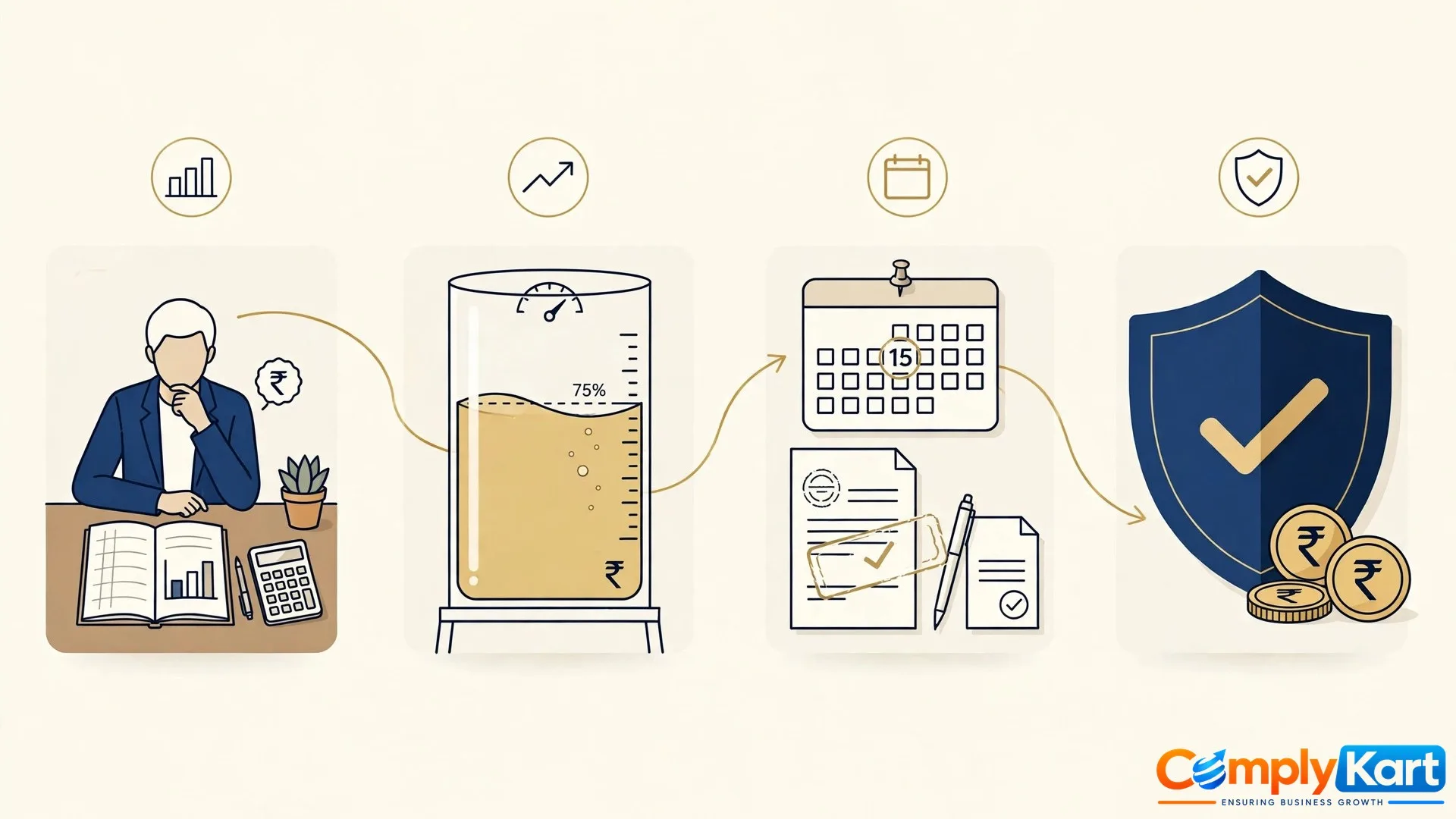
Green technology products get a reduced EO — 75% of the normal obligation, effectively 4.5× the duty saved instead of 6×. Claim the reduction explicitly in your ANF 5B; it is not applied automatically.
Specified traditional sectors — handicrafts, handlooms, cottage and tiny sector, agriculture, aquaculture, animal husbandry, floriculture, horticulture, poultry, sericulture and similar — are exempt from maintaining the average export obligation (though not the specific one). Fishing trawlers, boats, ships and similar items are excluded from this exemption.
2026 updates you must know
Three developments from 2026 change the practical picture:
Automatic EO extension to 31 August 2026. By DGFT Public Notice No. 51/2025-26 (amending HBP 2023 paras 4.40(i), 5.13(f) and 5.16(f)), EO periods and block-wise EO periods expiring between 1 March 2026 and 31 May 2026 stand automatically extended to 31 August 2026 — no application, no amendment, no composition fee, fully system-driven. If you already paid a composition fee for an extension, no refund is permitted. Customs allows exports accordingly; the RA verifies compliance at EODC or regularisation.
Average EO relief for declining sectors. DGFT Policy Circular No. 10/2025-26 dated 26 February 2026 directs RAs to proportionately reduce the Average EO for FY 2024-25 where a sector or product group's exports declined more than 5% versus the previous year, recording the revision in the licence file with an amendment sheet. RAs must consider this relief before initiating any demand at EODC stage.
Digital EODC — no more physical challans. Trade Notice No. 15/2026-27 dated 5 August 2026 removed the requirement to submit physical duty-payment challans with EODC applications under EPCG and Advance Authorisation. Payment particulars now flow through a DGFT–ICEGATE API as authenticated digital records, visible on the DGFT customer portal for the exporter to verify before filing. This particularly helps MSME exporters who handle closure in-house.
The application and import process — step by step
Step 1 — Compute the duty saved amount before anything else
Get the assessable value of the machinery and the applicable BCD rate. Duty saved = BCD + SWS on that value. Multiply by six: that is your specific export obligation in rupee terms. Now sanity-check it against your realistic export forecast — model the EO against 70–80% of your realistic forecast, not the optimistic one. The downside of a shortfall is asymmetric and unforgiving.
Step 2 — File ANF 5B on the DGFT portal
The EPCG application goes on ANF 5B at dgft.gov.in with the IEC, machinery details, duty saved computation, and the EO you undertake. Green-tech applicants claim the 75% EO reduction here, explicitly.
Step 3 — Register the authorisation with Customs on ICEGATE
Before the first import, register the EPCG authorisation on ICEGATE. Customs clearance under EPCG runs through this registration — skipping it means paying duty you did not need to pay.
Step 4 — Import and execute the bond / bank guarantee
Import the capital goods at zero duty against the authorisation, executing the customs bond and lodging the bank guarantee as required. The guarantee stays locked until EODC — factor this working-capital lock-in into your cost-benefit model.
Step 5 — File the installation certificate within six months
Proof that the machinery is installed at the declared premises goes on record within six months of import. This is a frequent tripwire — the machine is running, the certificate is forgotten, and the file shows non-compliance.
Fulfil the EO through physical exports (shipping bills evidencing the exports count), track against the 50%-in-four-years discipline, and file the annual EO fulfilment report with the RA by 30 April each year.
Step 7 — Intimate the RA at each block's end
Within three months of completing a block, intimate the RA of the fulfilment position — SEO and average exports — by secured electronic filing with DSC. Keep the shipping-bill evidence organised; the RA examines it at EODC.
Step 8 — Apply for EODC on ANF 5C and close
After the EO period, apply for the Export Obligation Discharge Certificate on ANF 5C with the evidence of exports. On issuance, the authorisation closes and the bank guarantee is released. If there is a shortfall, regularise first: voluntarily pay the proportionate duty saved with applicable interest (now verifiable as digital records under the August 2026 trade notice), then apply.
What failure costs — the math nobody shows you
If the EO is not fulfilled, the authorisation holder is liable for the customs duty saved with interest — currently 15% per annum from the date of import. On a six-year default, interest alone approaches the original duty saved; the total recovery can run to nearly double the duty, before any penalty proceedings. This is why the "model at 70–80% of realistic forecast" discipline in Step 1 matters more than any other advice on this page.
EPCG vs Advance Authorisation vs Duty Drawback
Feature
EPCG
Advance Authorisation
Duty Drawback
What it covers
Capital goods (machinery)
Inputs physically incorporated in exports
Refund of duties on inputs
Duty benefit
Zero BCD/SWS/IGST on import
Duty-free input import
Post-export cash refund
Obligation
6× duty saved over 6 years
Export with 15%+ value addition, ~18 months
None (claim-based)
Application
ANF 5B
ANF 4A
Shipping bill + claim
Closure
EODC on ANF 5C
EODC / closure on DGFT portal
Direct credit
Choose EPCG when the constraint is machinery cost; Advance Authorisation when it is input cost; drawback when you want no obligation strings attached.
Common mistakes we see
Computing EO on the machine's price instead of the duty saved. The obligation is 6× the duty, not 6× the machine value. Get this wrong and you misjudge the entire commitment.
Ignoring the average EO. Companies track the 6× figure and forget the baseline maintenance — then fail EODC on the average leg.
Missing the installation certificate. Six months passes fast when a plant is being commissioned.
No ICEGATE registration before first import. The authorisation exists; Customs does not know it does.
Treating the 2026 auto-extension as a strategy. It was a one-time relief for a specific window, not a planning input.
Applying EPCG where BCD is already nil. Zero duty saved means a nominal EO and pure compliance burden for no benefit — always compute the DSA first.
How ComplyKart helps
We handle EPCG as an end-to-end mandate: DSA computation and EO modelling against your export forecasts, ANF 5B filing, ICEGATE registration coordination, installation-certificate diary management, annual 30 April EO reporting, block-completion intimations, shortfall regularisation arithmetic, and the ANF 5C EODC application with evidence compilation — through to bank-guarantee release.
What we do not do: we do not arrange the bank guarantee itself (your bank does, we brief them), we do not certify machinery valuations that need a chartered engineer's certificate, and we do not promise EO fulfilment — the exports are yours to make; our job is that the paperwork never becomes the reason you fail.
FAQ
Frequently asked questions
20 answers from our consultants.
You pay for our expert's time — document checking, filing, follow-ups — not the government. The government fee goes to the government; our fee is for the work we do so you don't have to figure it out yourself.
Tell us your situation in plain words — what you're trying to do, not which form you think you need. Half our job is stopping clients from buying the wrong service. The first consultation is free and honest.
Yes. We quote professional fee + government charges + taxes separately, in writing, before you pay. The number doesn't change midway. If the government fee changes, we show you the notification.
The Export Promotion Capital Goods scheme (Chapter 5, FTP 2023) lets exporters import capital goods — machinery, equipment, spares — at zero customs duty, against an export obligation of six times the duty saved, to be fulfilled over six years.
Basic Customs Duty, Social Welfare Surcharge and IGST on the imported capital goods. For GST-registered exporters the effective cash saving is mainly BCD plus SWS, since IGST would otherwise be recoverable as input tax credit.
Manufacturer exporters, merchant exporters tied to supporting manufacturers, and service providers in specified sectors. The capital goods must be used for pre-production, production or post-production of the export product.
File ANF 5B on dgft.gov.in with your IEC, machinery and duty-saved details. Before the first import, register the authorisation with Customs on ICEGATE, execute the bond and bank guarantee, and file the installation certificate within six months of import.
At least 50% of the specific export obligation must be met in the first block (years 1–4 from authorisation), and the balance in the second block (years 5–6). Fulfilment is intimated to the Regional Authority within three months of each block's end.
The RA may extend the block's EO on a 2% composition fee on the duty saved proportionate to the unfulfilled portion — otherwise you must pay proportionate customs duties with applicable interest within three months of the block's expiry.
Separately from the 6× specific obligation, you must maintain your average export level (average of the preceding three years' exports). Sectors whose exports fell over 5% in FY 2024-25 got proportionate AEO reduction under DGFT Policy Circular No. 10/2025-26.
The Export Obligation Discharge Certificate is DGFT's closure document. Apply on ANF 5C after the EO period with export evidence. Since Trade Notice No. 15/2026-27 (5 August 2026), duty-payment proof is verified through digital DGFT–ICEGATE records — no physical challans.
It stays lodged with Customs through the EO period and is released only after the EODC is issued. Build this working-capital lock-in into your EPCG decision.
Regularise by voluntarily paying the proportionate duty saved with applicable interest, then apply for EODC. Unregularised failure exposes you to recovery of the full duty saved plus 15% per annum interest from the date of import.
Yes. Green technology products qualify for EO at 75% of the normal level — effectively 4.5× the duty saved. The reduction must be claimed explicitly in the ANF 5B application.
DGFT Public Notice No. 51/2025-26 automatically extended EO and block-wise EO periods expiring between 1 March and 31 May 2026 up to 31 August 2026 — no application, no fee, no RA amendment. Composition fees already paid are not refunded.
Transfer is restricted — in specified sectors the goods cannot be transferred for five years from import even after EO fulfilment; transfers to group companies after EO fulfilment are permitted with intimation to the RA and the jurisdictional authority.
Yes — an annual EO fulfilment report to the RA by 30 April each year, plus the block-completion intimation within three months of each block's end. The RA may issue partial EO fulfilment certificates on adequate performance.
Yes. Exports made under the EPCG scheme are also entitled to benefits under Chapter 4 of the FTP (such as duty drawback or RoDTEP, as applicable) — the schemes can stack where the provisions allow.
Proof that the imported capital goods are installed at the declared premises must be filed within six months of import. Missing it is one of the most common EPCG compliance failures.
EPCG for machinery (capital goods, 6-year 6× EO); Advance Authorisation for raw materials and inputs (duty-free, ~18-month EO with 15% value addition). Many exporters use both — they address different cost constraints.
What clients say about working with us
Real stories from businesses we've worked with.
Trademark Registration“
Our Trademark was applied in all the classes with a short span of time by Complykart Trademark Experts and I can say the level of expertise and commitment they carry is remarkable. It's an A+ from my side. We are now sticking to ComplyKart only.
Company Registration“
I found the professionalism of the staff at complykart.com, a pleasure to work with. As a foreigner to India, they took the time to explain the documentation and assisted in every question I raised. I was pleased that complykart.com made it easy for my Business.
Merger & Acquisition“
Trust, Commitment, Dedication and responsiveness are the best things with ComplyKart. Thanks for handling our Merger assignment with so much care. After my business disputes, complykart handles all things with own sense of understanding.
Senior Consultant · ESOP, Trademark & General Advisory · 14+ years experience
Pankaj Jain is a senior consultant covering ESOP structuring, trademark and IP protection, accounting advisory and legal documentation. With the broadest practice at the firm, he handles the matters that don’t fit neatly in one box.
Last reviewed: 16 November 2026
Get a free consultation
Talk to a ComplyKart professional about EPCG / Advance Authorization. The first consultation is free.