
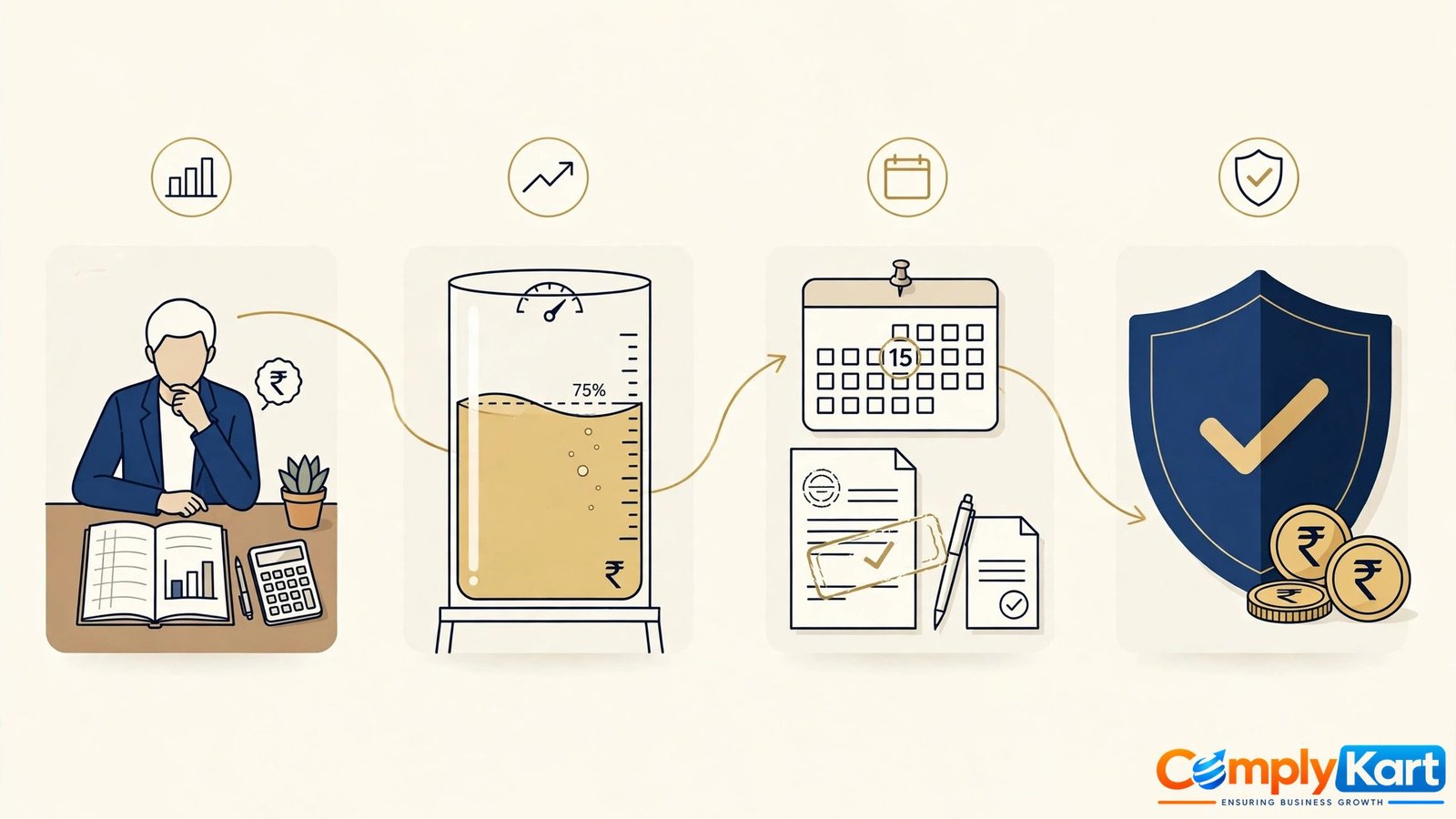
The December instalment is the one that catches people. By mid-December, nine months of the financial year are behind you — enough for an honest estimate of your income, and enough still ahead that most businesses haven't made one. On 15 December 2026, your cumulative advance tax for the year must reach 75% of your total estimated liability. Here's how to get the number right.
The short answer: If your total tax liability for FY 2026-27 exceeds ₹10,000 after TDS/TCS, you must pay advance tax in four instalments — 15% by 15 June, 45% by 15 September, 75% by 15 December 2026, and 100% by 15 March 2027. Shortfalls attract interest at 1% per month under Sections 234B and 234C.
Do you even need to pay advance tax?
The test: estimate your total tax for the year, subtract the TDS and TCS that will be cut on your income, and if the balance exceeds ₹10,000, you're in the advance tax net. Salary earners with full TDS coverage usually aren't — their employer handles it. Business owners, freelancers, landlords with rental income, and anyone with capital gains almost always are. Running a private limited company? Advance tax is one more date on a calendar that already holds AOC-4 and MGT-7 — our compliance fee calculator totals the year's filing costs in one place.
One exemption: senior citizens (60+) with no business or professional income don't pay advance tax at all. Everyone else in the ₹10,000-plus bracket pays.
How do you compute the 75% December target?
Don't estimate the full year by dividing nine months by three — that method underestimates in a growing business and overestimates in a seasonal one, and the interest falls on the shortfall either way. Instead: work out your actual profit to 30 November from the books, then add a separately estimated figure for December to March — including anything you already know about — a year-end bonus, an asset sale, or a large receipt due in Q4.
Compute tax on that total, subtract TDS/TCS expected for the full year, and take 75% of the balance. That's your cumulative target by 15 December. Subtract what you already paid in June and September — the difference is this instalment.
What do Sections 234B and 234C actually charge?
Two separate interests, and people confuse them constantly. Section 234B is the year-end test: if your total advance tax for the year ends up below 90% of your actual assessed tax, you pay 1% per month on the shortfall from 1 April of the assessment year until you pay. It's about the year's total, not any single instalment.
Section 234C is the instalment test: fall short of the 75% cumulative mark on 15 December, and you pay 1% per month for three months on the shortfall — effectively 3% of whatever you underpaid this instalment. Both can apply at once. And both are mandatory; the assessing officer has no discretion to waive them.
An analogy helps: think of your year’s tax as a water tank the department expects to be three-quarters full on 15 December. Section 234C checks the level at that deadline. Section 234B checks the level when the year ends. Same water, two separate measurements — and one shortfall can fail both.
A worked example: your 75% target is ₹3,00,000 but you've paid ₹2,00,000. Shortfall ₹1,00,000 × 1% × 3 months = ₹3,000 under 234C — the price of being three weeks late with money you owed anyway.
Do presumptive taxpayers pay advance tax quarterly?
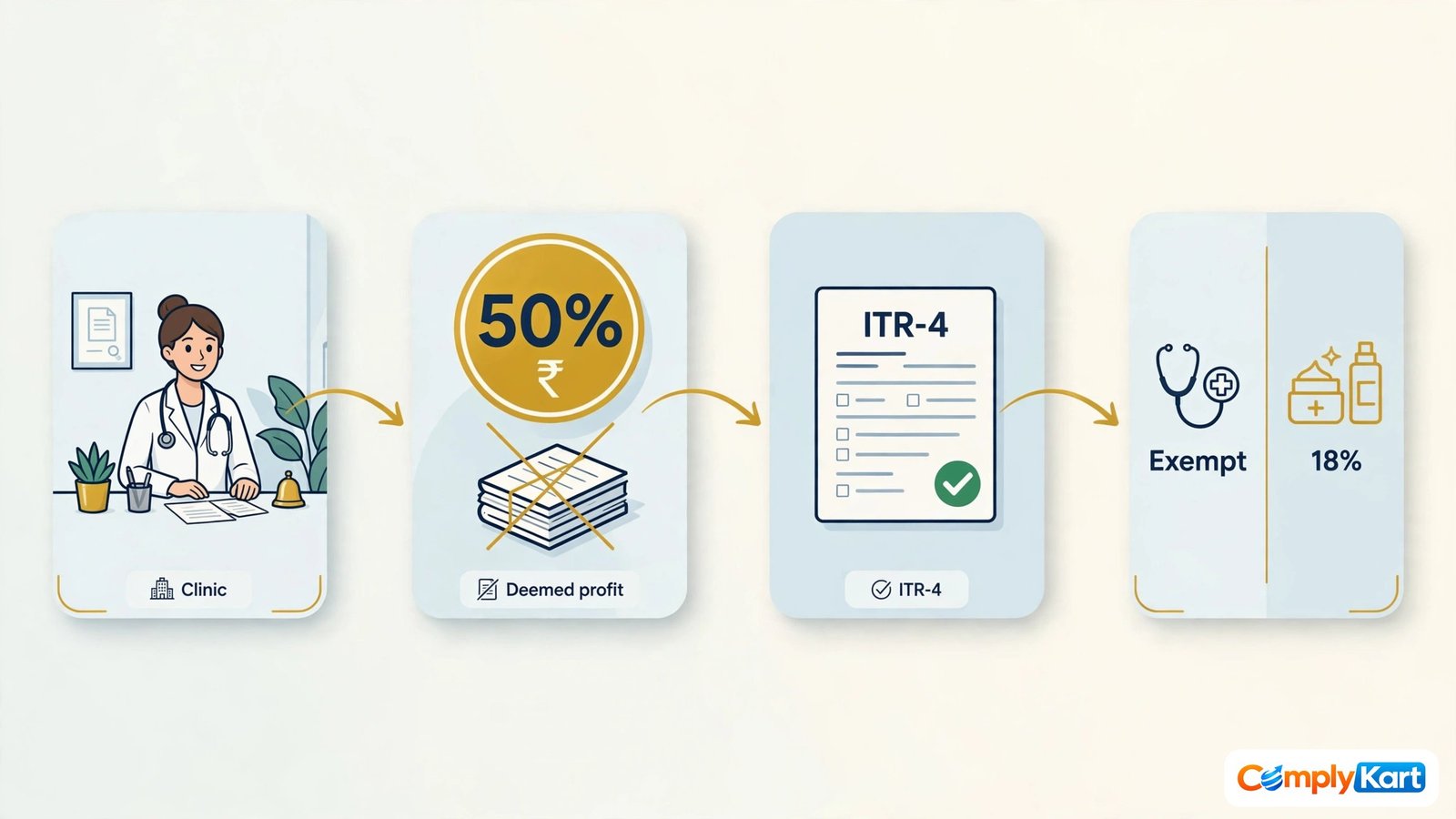
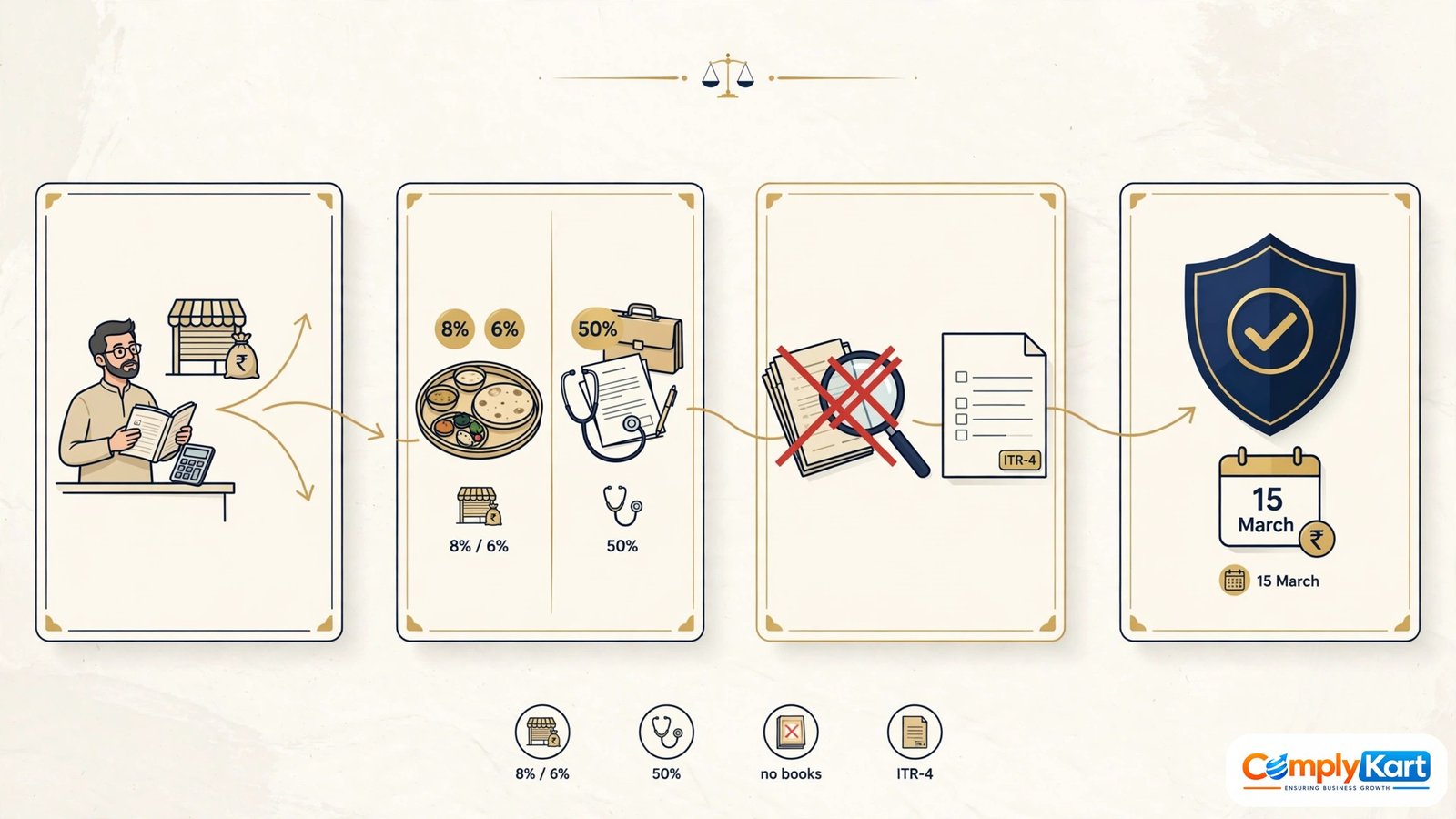
If you're on the presumptive schemes for business or profession (44AD/44ADA), the quarterly drill doesn't apply to you — your entire advance tax for the year is due in a single instalment by 15 March 2027. One date, one payment. Just don't forget it exists.
One relief worth knowing: if the shortfall comes from income you genuinely couldn't have estimated earlier — capital gains from a sale you didn't plan, lottery winnings, first-time business income — the 234C interest is excused, provided you pay the tax on that income in the immediately following instalment. The law doesn't punish you for not predicting the unpredictable. It only punishes you for not paying once you know.
Before you compute, reconcile your TDS. Match every TDS credit in Form 26AS and the AIS/TIS against your books. TDS that's been deducted but doesn't appear in 26AS isn't credit you can rely on — chase the deductor now, because a missing TDS credit inflates the advance tax you think you owe and the shortfall interest that follows.
The five-line December worksheet
Do the computation on one page before you touch the portal. Line one: actual April-to-November profit from the books. Line two: estimated profit December to March, with known one-offs listed separately. Line three: total estimated income, and the tax on it. Line four: TDS and TCS expected for the full year, from 26AS plus estimates for Q4. Line five: 75% of (line three minus line four), minus what you paid in June and September.
That's your instalment. One page, five lines, no spreadsheet gymnastics — and if the assessing officer ever asks how you arrived at the figure, that page is your answer. Estimates made honestly and documented contemporaneously are defensible. Estimates made up on 14 December are not.
How to pay
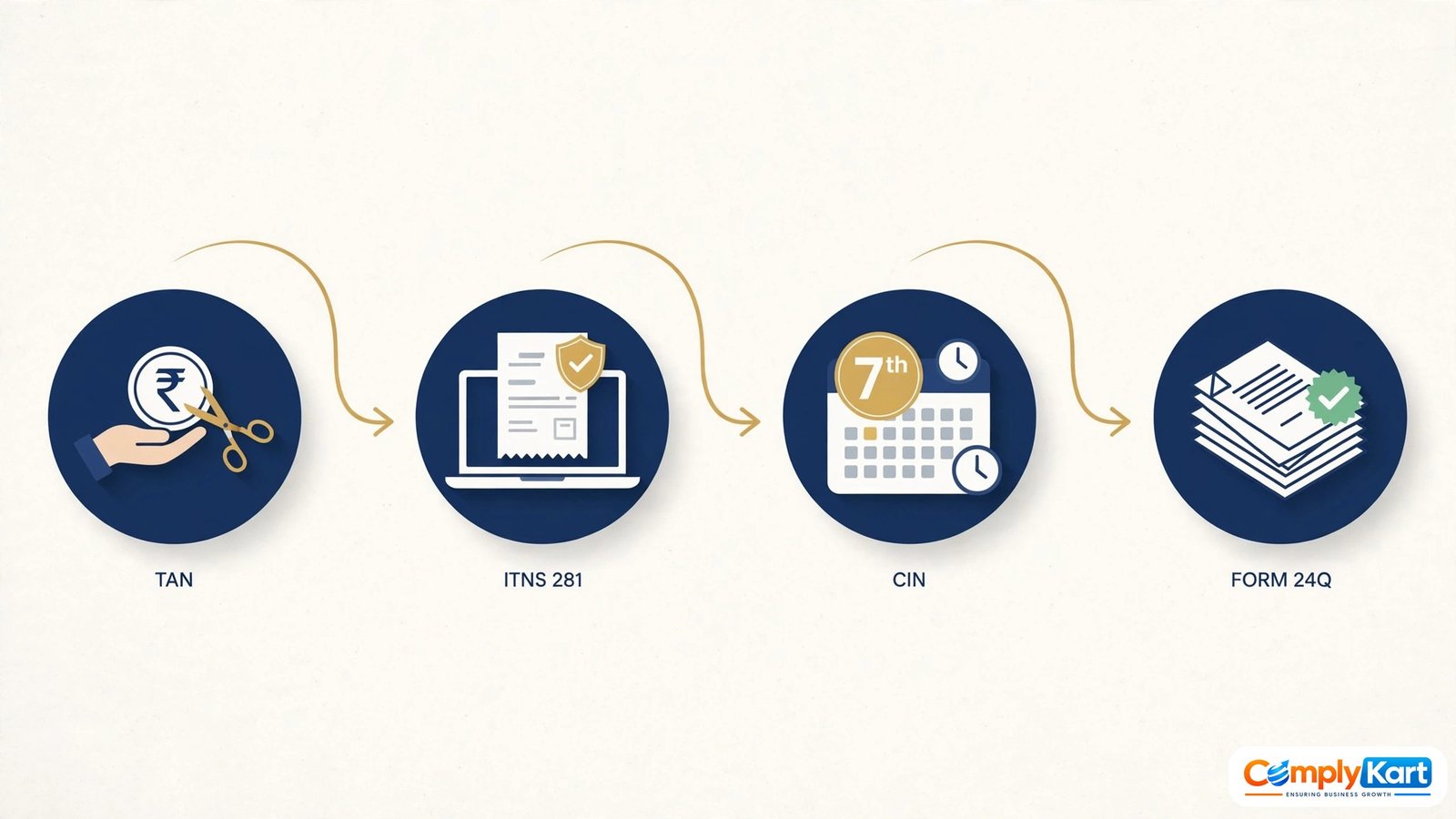
Pay on the income-tax e-filing portal through e-Pay Tax (challan 280), net banking or UPI, before 15 December. Save the challan — the CIN on it is what ties your payment to your PAN in the department's records. A payment without a traceable challan is a dispute waiting to happen.
Advance tax: quick answers
What happens if I miss the 15 December advance tax deadline?
Section 234C charges 1% per month for three months on the shortfall against the 75% cumulative target — effectively 3% of whatever you underpaid this instalment. And if your total advance tax for the year ends below 90% of actual assessed tax, Section 234B adds 1% per month from 1 April. Both can apply at once, and neither is waivable.
What's the difference between 234B and 234C interest?
234C is the instalment test — it punishes falling short of a specific due date's cumulative percentage (75% on 15 December). 234B is the year-end test — it punishes the year's total advance tax ending below 90% of assessed tax. Miss December and you can easily trigger both: 234C on the instalment shortfall, 234B on the annual shortfall.
Do senior citizens pay advance tax?
Senior citizens (60+) with no business or professional income are fully exempt — no advance tax at all. Everyone else with a post-TDS balance above ₹10,000 pays, whatever their age.
I'm on the presumptive scheme — when do I pay?
Once: your entire advance tax for the year is due in a single instalment by 15 March 2027. No quarterly drill. But the shortfall relief for genuinely unpredictable income still applies — and if you missed earlier deadlines entirely, our ITR filing page covers the 234A interest and what late filers lose.
Nine months of actuals, one honest estimate, one payment by 15 December. That's the whole exercise — and if you'd rather not do the computation yourself, our team runs advance tax workings for businesses and professionals every quarter.


Comments
No comments yet — ask the first question below.
Join the discussion
Questions go straight to our expert desk. Comments appear after a quick review — no spam, no noise.