
IN BRIEF
A GST refund is the repayment of excess tax, interest or unutilised input tax credit claimed under section 54 of the CGST Act, 2017 by filing Form RFD-01 on the GST portal within two years of the relevant date. It covers exporters and SEZ suppliers, inverted duty structure credits, excess payments and cash ledger balances, and the department must sanction it within 60 days of acknowledgement.
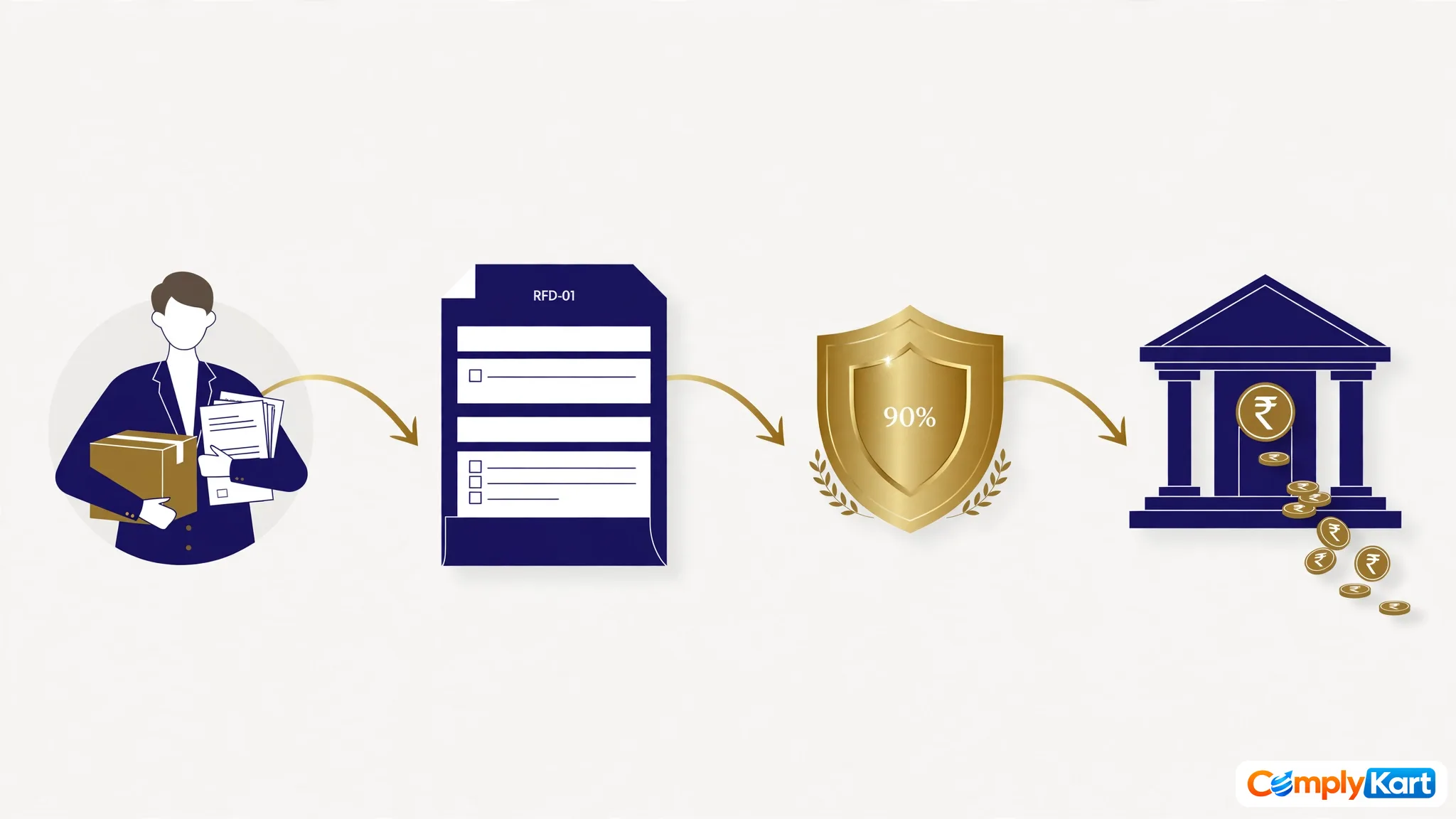
A GST refund is money the department owes you — excess tax paid, unutilised credit on exports, or credit stuck in an inverted duty structure — claimed in Form RFD-01 under section 54 of the CGST Act within two years of the relevant date. From 1 November 2026, low-risk claims get 90% provisionally within three working days, and the final order comes within 60 days.
That is the short version. The long version is where refunds are won or lost: the clock that runs from a different date for every claim type, the two formulas that decide how much you actually get back, and a deficiency memo that does not ask you to fix anything — it kills the application outright. I have seen good claims die on each of these. This guide walks through all three, with the November 2026 rule changes that most guides online have not caught up with yet.
What can you claim back?
Section 54 of the CGST Act, 2017 is the whole law of refunds. The Supreme Court said so in 2026 in Union of India v. Torrent Power Ltd. — section 54 is a complete code, and no refund exists outside it on fairness grounds alone. Rules 89 to 97A of the CGST Rules supply the procedure, and Circular 125/44/2019-GST is still the master circular on the electronic process. Everything starts in Form RFD-01 on the GST portal, with one exception I come to below.
The claims the law recognises are:
| Claim type | Who it fits | Legal basis |
|---|---|---|
| Unutilised ITC on zero-rated supplies | Exporters and SEZ suppliers who export without paying IGST (under LUT) | Section 54(3)(i), Rule 89(4) |
| Unutilised ITC in an inverted duty structure | Businesses whose inputs attract more tax than their outputs | Section 54(3)(ii), Rule 89(5) |
| IGST paid on exports | Exporters who pay IGST and claim it back | Section 16, IGST Act; Rule 96 |
| Excess tax paid by mistake | Anyone who paid more than the liability — wrong head, wrong month, double payment | Section 54(1) |
| Balance in the electronic cash ledger | Anyone with money sitting unused in the cash ledger | Section 49(6) |
| Deemed exports, pre-deposits, UN bodies | Suppliers to EOUs and advance authorisation holders; appellants who won; notified international bodies | Sections 54, 55, 147 |
Two limits matter before you go further. First, unutilised input tax credit is refundable only for zero-rated supplies and inverted duty structure. Credit that piles up because your supplies are exempt or nil-rated stays where it is — the law does not refund it. Second, no refund under section 54(5) or 54(6) is paid if the amount is less than ₹1,000 — except, since 1 November 2026, for goods exported with payment of tax, where that minimum has been removed. Small exporters who paid IGST on a modest shipment can now claim even a small refund.
What changed on 1 November 2026?
This is the part most refund guides get wrong, because they were written before the changes. The 57th GST Council met on 8 October 2026 and recommended system-based refund processing in two phases. Phase 1 arrived through Notification 05/2026-Central Tax, dated 26 October 2026, and through sections 153 to 155 of the Finance Act, 2026, brought into force the same day by Notification 03/2026-Central Tax. Phase 2 — fully automated sanction of the whole refund — is still a recommendation, not law. Do not let anyone tell you refunds are fully automatic yet.
What is law from 1 November 2026:
Acknowledgement in 10 days, not 15. Under the amended Rule 90, the officer has 10 days from filing to issue the acknowledgement in Form RFD-02 or a deficiency memo in Form RFD-03. And if nothing arrives in 10 days, new Rule 90(3A) deems the application acknowledged — the portal issues RFD-02 itself, and the 60-day clock for the final order runs from the filing date. The old game of letting an application sit unacknowledged is over.
90% provisional refund in 3 working days. For claims the system scores as low-risk, the provisional order in Form RFD-04 now issues automatically within three working days of acknowledgement — no officer revalidation. This is the end of a journey that started with the 56th Council on 3 September 2025: Notification 13/2025-Central Tax amended Rule 91(2) from 1 October 2025, and CBIC Instruction 06/2025-GST, dated 3 October 2025, told officers how the risk scoring works. Which claims count as low-risk is the system's call on its risk scoring — there is no fixed list to apply from.
The 90% provisional refund now covers inverted duty structure claims by statute. Until October 2025 it was available only for zero-rated supplies. The Instruction allowed it for inverted duty claims as an interim measure from 1 October 2025; the Finance Act, 2026 amended section 54(6) itself, so from 1 November 2026 the extension has a statutory footing. One condition survives from Rule 91(1): you must not have been prosecuted for any offence under the Act in the five years before the claim period, and certain notified categories of persons are excluded under Notification 14/2025-Central Tax.
Cash ledger refunds are now fully automated. New Rule 92(1B) lets the portal itself issue the final order in Form RFD-06 for a balance in the electronic cash ledger, after adjusting any outstanding demands. No officer, no waiting room. This makes sense — a cash balance is your own money, and it was never subject to the two-year limit in the first place.
A revised RFD-01 arrives on 1 December 2026. The form will capture invoice details in a system-readable format instead of scanned uploads, with new statements for merchant exporters and for input tax credit, and a declaration that you have not been prosecuted for an offence involving tax evaded above ₹2.5 crore in the preceding five years. A capital-goods declaration follows from 1 April 2027. If you file in December, expect the new form.
The two clocks that kill claims
Every refund dies on a clock. There are two of them, and mixing them up is the most expensive mistake in this whole subject.
The first clock is section 54(1): two years from the "relevant date". The relevant date is not one date. It changes with the claim, and it works like a train ticket — the departure time printed on it depends on the destination, and a day late means the ticket is worthless.
| Claim | The relevant date |
|---|---|
| Export of goods | The date the ship or aircraft leaves India; for land, the date the goods cross the frontier |
| Export of services | The date payment is received in convertible foreign exchange — or the invoice date, if payment arrived in advance |
| Inverted duty structure / unutilised ITC | The due date for furnishing the return under section 39 for the period the claim relates to |
| Excess tax paid | The date the tax was paid |
| Refund arising from an appellate order | The date of that order |
Note the inverted duty row carefully. Until 31 January 2019 the relevant date was the end of the financial year. The CGST (Amendment) Act, 2018 changed it to the section 39 return due date with effect from 1 February 2019, and the courts have held the change prospective. Guides that still say "end of the financial year" are quoting law that expired seven years ago. If your claim period ended in March 2026, your clock runs from the April 2026 return due date — not from 31 March 2028.
The second clock is the one people invent. Several guides claim the Finance Act, 2023 imposed a three-year cap on filing refund applications. It did not. What the 2023 Act did, with effect from 1 October 2023, was bar the furnishing of returns and statements — GSTR-1, GSTR-3B, annual returns — after three years from their due dates, under sections 37, 39 and 44. There is no three-year refund cap in section 54. The practical effect is narrower and still worth knowing: a refund built on a return you can no longer file is a refund you can no longer claim. But the two-year section 54 clock is the one that bars you, and it runs first in almost every case.
One more date to keep in mind: the export-duty bar is gone. Until 1 November 2024, no refund of unutilised credit was allowed where the exported goods attracted export duty. The Finance (No. 2) Act, 2024 removed that bar, so those claims are open now.
How much money comes back?
Never the whole credit balance. Rule 89 prescribes a formula for each of the two big unutilised-credit claims, and the formula caps what the department pays.
Zero-rated supplies — Rule 89(4). Refund = (Turnover of zero-rated supply of goods + Turnover of zero-rated supply of services) × Net ITC ÷ Adjusted Total Turnover. Net ITC here means the credit on inputs and input services — capital goods excluded. The formula pays you the share of your credit that belongs to the exports, and nothing more.
Take a software exporter working under LUT. Zero-rated turnover for the quarter is ₹60 lakh. Total adjusted turnover, domestic plus export, is ₹90 lakh. Net ITC for the period is ₹4.5 lakh. Refund = ₹60 lakh × ₹4.5 lakh ÷ ₹90 lakh = ₹3 lakh. The remaining ₹1.5 lakh stays in the credit ledger for use against domestic tax. A claimant who asks for the full ₹4.5 lakh will be disappointed, and the disappointment is the formula working as written.
Inverted duty structure — Rule 89(5). Maximum Refund = (Turnover of inverted rated supply × Net ITC ÷ Adjusted Total Turnover) − (Tax payable on inverted rated supply × Net ITC ÷ ITC availed on inputs and input services). Two things about this formula trip people up. First, Net ITC for inverted duty means credit on input goods only — input services and capital goods are out. Second, since 5 July 2022, when Notification 14/2022-Central Tax amended the rule, the deduction is only a proportionate share of the output tax — not the whole of it. Some guides still work the old formula and deduct the full output tax. Their worked examples come out at nil. The law does not.
Take a footwear maker. Inputs come in at 18%, the finished shoes go out at 12%. Inverted rated turnover is ₹1 crore. Adjusted total turnover is ₹1.2 crore. Net ITC on inputs only is ₹18 lakh. ITC on inputs plus input services is ₹20 lakh. Tax payable on the inverted supplies is 12% of ₹1 crore, which is ₹12 lakh. The first leg is ₹1 crore × ₹18 lakh ÷ ₹1.2 crore = ₹15 lakh. The deduction is ₹12 lakh × ₹18 lakh ÷ ₹20 lakh = ₹10.8 lakh. Maximum refund = ₹15 lakh − ₹10.8 lakh = ₹4.2 lakh. Under the old formula the deduction would have been the full ₹12 lakh, and the answer would have been ₹3 lakh — the correction is worth ₹1.2 lakh on these numbers alone.
For exports made with payment of IGST, there is no formula and no RFD-01 at all. The shipping bill is treated as the refund application under Rule 96, and the refund comes automatically through ICEGATE once GSTR-1 and GSTR-3B are filed and the data matches. The choice every exporter makes is between that route and the LUT route — pay IGST and get it back automatically, or export without paying tax under a Letter of Undertaking and claim the accumulated credit in RFD-01. Our guide to filing an LUT and choosing between the two refund routes works through the trade-off.
How to file RFD-01, step by step
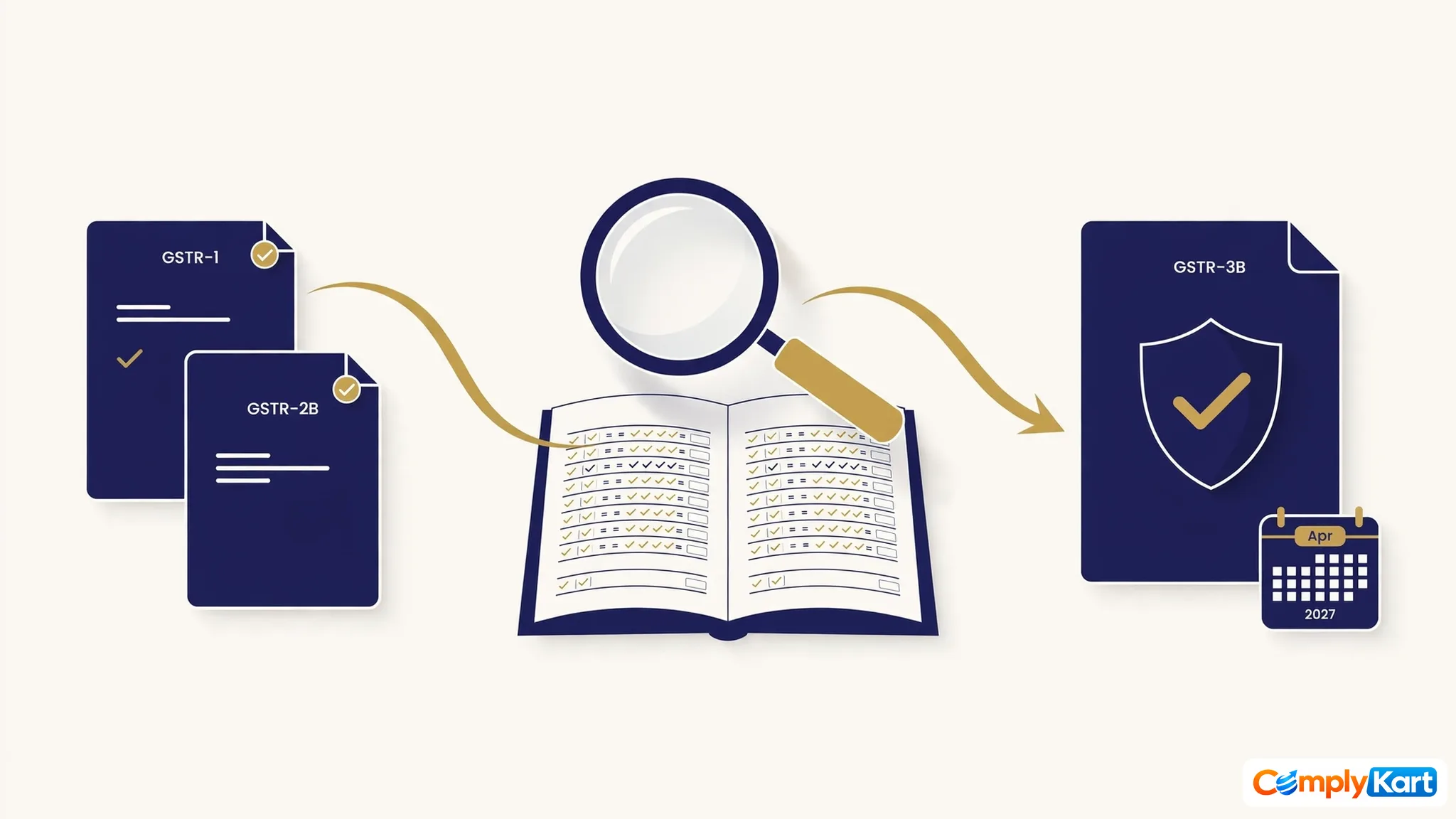
File only after the returns for the period are in. The portal will not entertain a refund built on unfiled GSTR-1 and GSTR-3B, and a mismatch between the two is the single most common reason a claim stalls. Reconcile first — our GSTR-9 reconciliation guide covers the same discipline for the annual return, and the habit is identical here.
1. Log in to the GST portal and go to Services, then Refunds, then Application for Refund. Pick the refund category — exports, inverted duty, excess payment, cash ledger balance, deemed exports — and the tax period the claim relates to.
2. Fill in the claim amount from your own working, not from the ledger balance. The formula decides the amount, and the department will apply it whether you did or not. Attach the statements the category needs: Statement 1 for inverted duty, Statement 3 for exports, Statement 2 for SEZ supplies, the shipping bills for goods exports, and the foreign inward remittance certificate or e-BRC for services exports.
3. Handle the unjust enrichment declaration. If the claim is up to ₹2 lakh, your own declaration that the tax incidence was not passed on to anyone else is enough. Above ₹2 lakh, you need a certificate from a chartered accountant or cost accountant saying the same thing. The declaration is not needed at all for zero-rated supplies, inverted duty refunds, deemed exports, or supplies the recipient rejected — the law exempts those categories outright.
4. Check the bank account the refund will land in. The portal validates it before the application, and a wrong account number or IFSC is a delay nobody needs. If your GST registration details have changed — a new bank account, a new authorised signatory — update them first.
5. Submit, keep the Application Reference Number, and track it under Services, then Track Application Status, then Refunds. From 1 December 2026 the form itself changes, so if you are filing in December, expect the new fields and have invoice-level details ready rather than scanned PDFs.
What happens after you file
The application moves through a fixed set of forms. Knowing which one you are looking at tells you where you stand.
RFD-02 is the acknowledgement. From 1 November 2026 it must arrive within 10 days, and if it does not, the application is deemed acknowledged and the portal issues it. RFD-03 is the deficiency memo, also within 10 days — and this is the form to fear. A deficiency memo does not ask you to fix the application. It voids it. You file a fresh RFD-01, and the two-year clock has not stopped while you do. Every day spent on a deficient application is a day off the limitation period.
RFD-04 is the provisional refund order. For low-risk zero-rated and inverted duty claims it now issues automatically within three working days of acknowledgement, for 90% of the amount claimed. RFD-06 is the final sanction or rejection order, which the officer must issue within 60 days of receiving the application complete in all respects. RFD-05 is the payment order that moves the money to your bank account. RFD-07 is a withholding order. And if the department proposes to reject the claim, it issues a show cause notice in RFD-08, to which you reply in RFD-09. A rejection without an RFD-08 is not a rejection the law recognises.
Cash ledger refunds skip the queue now. Under the new Rule 92(1B) the portal issues the RFD-06 itself, after adjusting any outstanding demands under the Act or any other law. If you have unpaid dues, expect them netted off before the balance reaches you.
Why refunds get rejected
The reasons repeat so reliably that you can check for all of them before filing.
GSTR-1 and GSTR-3B do not match. The invoice is in one return and not the other, or the values differ. Reconcile before filing, not after the deficiency memo arrives.
The LUT is missing or expired. An exporter claiming a refund of unutilised credit without a valid Letter of Undertaking for the period has no zero-rated supply to point to. File the LUT first, export second.
The claim is filed late. Two years from the relevant date sounds generous until the relevant date turns out to be the section 39 due date of a period eighteen months ago. Track the deadline per claim period, not per financial year.
The wrong category is chosen. A cash ledger refund filed as an ITC refund, or an inverted duty claim filed as a zero-rated claim, will be rejected on the category alone. The category decides the formula, the statements and the relevant date.
Documents are incomplete or illegible. Missing shipping bills, no e-BRC for services exports, no Statement 1 for an inverted duty claim. From 1 December 2026 the portal wants the details in structured fields, which makes a missing invoice harder to hide and easier to catch early.
Returns are pending. The portal blocks the refund if GSTR-1 or GSTR-3B for the period is not filed. File the returns first — our GST return filing service covers the monthly cycle if it has slipped.
Export data does not match customs. The shipping bill number, the invoice value and the GSTR-1 entry must agree. For IGST-paid exports the ICEGATE match is automatic, which means a mismatch is also automatic — and silent until the refund does not arrive.
Two more things can hold the money even when the claim is sound. Under section 54(10) the officer may withhold a refund and adjust it against unpaid tax, interest or penalty, for reasons recorded in writing. Under section 54(11) the Commissioner may withhold it where the refund is likely to affect revenue adversely because of malfeasance or fraud, or because an appeal is pending — but only after giving you a hearing. If the refund is eventually paid after withholding, interest runs for the period it was held. And if you are on the receiving end of a scrutiny notice in ASMT-10, answer it properly — an unanswered notice has a way of becoming a withheld refund.
What interest do you get on a delayed refund?
Section 56 pays 6% per annum when the department misses the 60-day window, running from the day after the sixty days expire until the refund is actually paid. Where the refund arises from an appellate or court order, the rate is 9%. The asymmetry is deliberate and worth knowing: if the department later finds it refunded you too much, you repay the excess with 18% interest under section 50. A wrong claim is not free money — it is a loan at 18% with a show cause notice attached. Fraudulent claims face prosecution under section 132 as well.
Mistakes that cost exporters money
File the LUT before the export, not after. Reconcile GSTR-1 with GSTR-3B before every refund, not just at year end. Work the Rule 89 formula yourself before filing, so the sanctioned amount holds no surprises. Diary the relevant date for each claim period separately — one calendar entry per quarter, not one per year. Treat an RFD-03 as a dead application and refile at once, while the clock still allows it. And before filing, check what pending compliances already cost you — the compliance fee calculator puts a number on the late fees sitting behind a blocked refund.
A refund is not a favour the department does you. It is your money, or your credit, coming back under a statute that now moves faster than it did a month ago. The 1 November 2026 changes cut the waiting at both ends — ten days to acknowledgement, three working days to 90% for a clean low-risk claim. The claims that still fail are the ones filed late, filed in the wrong category, or filed on numbers nobody reconciled. Get those three right and the system mostly gets out of your way.
Frequently asked questions
Can I claim a GST refund without a LUT?
Only if you export with payment of IGST. In that case the shipping bill is the application and the refund comes automatically through ICEGATE. If you export without paying IGST, you need a valid LUT for the period, and the refund of unutilised credit goes through RFD-01.
What happens if I miss the two-year deadline?
The claim is time-barred. Section 54 is a complete code, so there is no equity route around the deadline — the department cannot grant a refund the section does not allow. The only practical protection is diary discipline: one deadline per claim period, set from the relevant date, not from the end of the financial year.
Is there a minimum refund amount?
Yes, generally — no refund under section 54(5) or 54(6) is paid below ₹1,000. The exception, from 1 November 2026, is goods exported with payment of tax, where the minimum no longer applies. Cash ledger balances are refundable regardless of the two-year limit, since the money was never tax.
Can the department keep my refund if I owe tax?
It can withhold and adjust it under section 54(10) against unpaid tax, interest or penalty, for reasons recorded in writing — and under section 54(11) the Commissioner can withhold where fraud or a pending appeal is involved, after a hearing. Clearing dues before filing is usually cheaper than fighting a withholding after.
If a refund has been sitting unpaid and the numbers are tangled — mismatched returns, an old deficiency memo, a claim that never got filed — bring the workings to a professional before the clock runs out. A missed deadline cannot be argued back into existence.



Comments
No comments yet — ask the first question below.
Join the discussion
Questions go straight to our expert desk. Comments appear after a quick review — no spam, no noise.