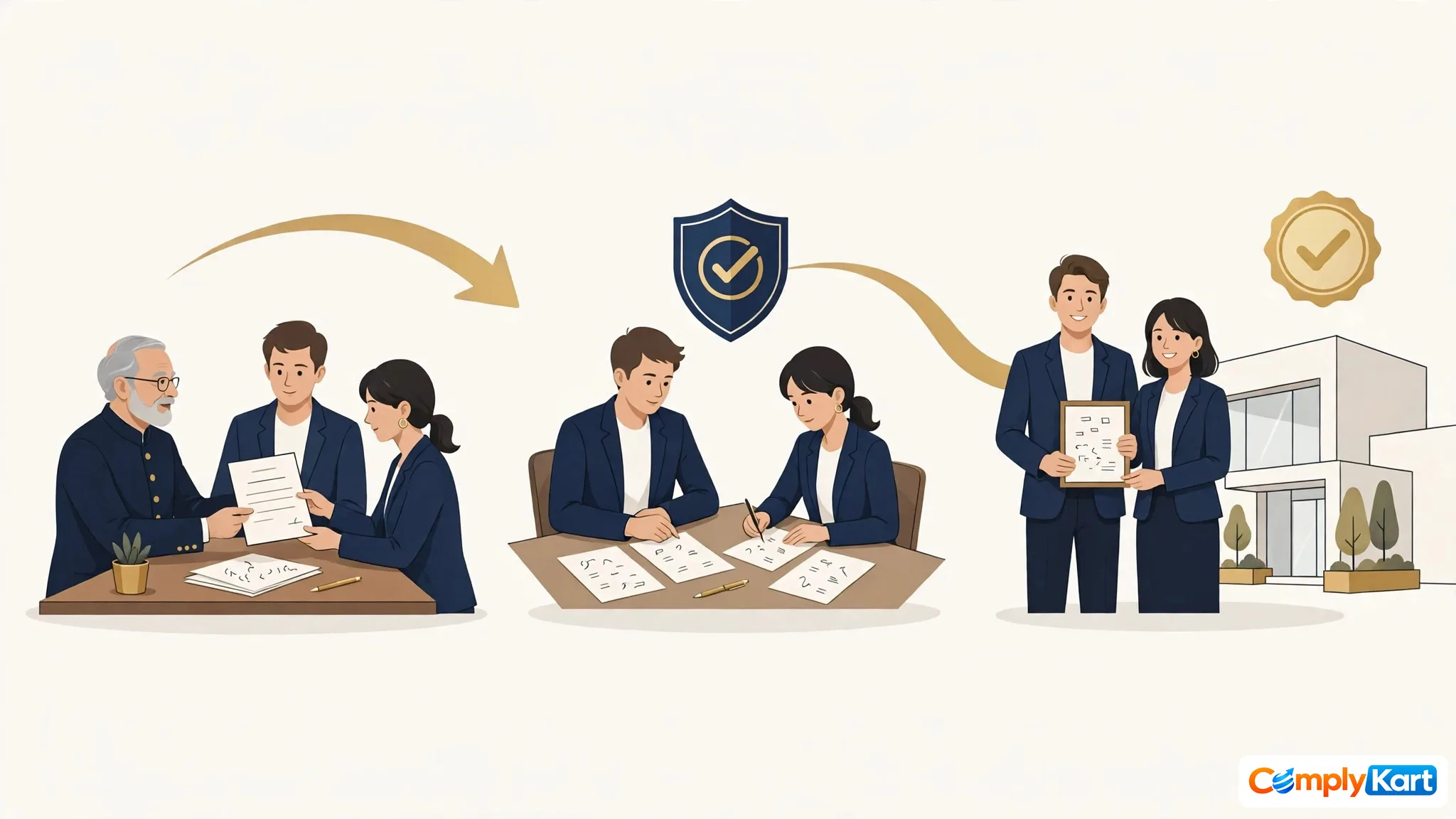
Five steps, no guesswork — you always know exactly what comes next. Tap a step to see what it involves.
12345
You pay securely. Payment is confirmed instantly, and your receipt with the written fee breakup lands in your inbox.
Winding Up a Public Limited Company: The Complete Closure Guide
A public limited company carries the heaviest compliance load in Indian company law — seven members, three directors, four board meetings a year, and a regulatory footprint to match. When the time comes to close one, the exit is correspondingly formal. Since 1 April 2017, the voluntary winding up of a solvent company — public or private — has lived under Section 59 of the Insolvency and Bankruptcy Code, 2016, not the Companies Act. The old Companies Act machinery (Sections 304–323, members' vs creditors' voluntary winding up) was replaced by a single IBC track with one set of regulations: the IBBI (Voluntary Liquidation Process) Regulations, 2017.
This matters because much of what you will read online still describes the pre-2017 Companies Act process. If a guide talks about "members' voluntary winding up" under the Companies Act without mentioning the IBC, it is describing repealed law. The current process runs through an insolvency professional as liquidator, a declaration of solvency, creditor approvals where debts exist, and an NCLT dissolution order at the end.
This guide walks through the full Section 59 process for a public limited company: eligibility, the declaration of solvency, the resolutions, the liquidator's duties, stakeholder claims, distribution, and dissolution — plus the practical questions boards actually ask.
When winding up is the right call
Public companies get wound up voluntarily for familiar reasons: the business has run its course, the listing never happened and the public structure is pure overhead, the promoters are consolidating group entities, or a joint venture has served its purpose. The key threshold question is solvency. Section 59 is available only to a corporate person that has not committed any default — it is the solvent exit. An insolvent public company belongs in the Corporate Insolvency Resolution Process, not voluntary liquidation. If the board cannot honestly declare solvency, stop here and take insolvency advice instead.
The declaration of solvency — the foundation
Everything rests on the declaration under Section 59(3)(a): a majority of the directors, verified by affidavit, state that they have made full enquiry into the company's affairs and formed the opinion that either the company has no debt, or it will be able to pay its debts in full from the proceeds of assets sold in the liquidation — and that the company is not being liquidated to defraud any person. This is a personal, sworn statement; a false declaration exposes directors to prosecution.
The declaration must be accompanied by: audited financial statements and records of business operations for the previous two years (or since incorporation, whichever is later), and a report of the valuation of the company's assets, if any, prepared by a registered valuer. For a public company with significant assets, the valuer's report is not optional in practice — it underpins the solvency opinion.
Resolutions and creditor approval
Within four weeks of the declaration, the members must pass a special resolution in general meeting requiring the company to be liquidated voluntarily and appointing an insolvency professional to act as liquidator. (A parallel track exists for liquidation triggered by expiry of duration or an event specified in the articles.)
Where the company owes any debt, creditors representing two-thirds in value of the debt must approve the resolution within seven days of its passing. For a public company with debenture holders or institutional lenders, this is the first real checkpoint — engage creditors before the EGM, not after. The resolution (and creditor approval, if any) must be notified to the ROC and the IBBI within seven days.
The liquidation commencement date is the date of the members' resolution (or the creditor approval date, where applicable).
The liquidator takes charge
From commencement, the insolvency professional is the liquidator. Their statutory functions: take custody of assets, verify and admit or reject claims (a rejected creditor may appeal to the NCLT), realise assets in a time-bound manner, open a dedicated bank account in the company's name suffixed "in voluntary liquidation," distribute proceeds to stakeholders, and preserve records for eight years after dissolution.
The liquidator must make a public announcement (Form A) within the prescribed window — in practice within five days — in newspapers and on the IBBI website, calling for claims. The stakeholder list is prepared within 45 days of the last date for receipt of claims.
Settling claims and distributing the surplus
The waterfall is strict: liquidation costs first, then creditors in their legal order of priority, and only then the contributories (shareholders). For a public company, expect claims from debenture trustees, lenders, employees (gratuity, leave encashment, bonuses), tax authorities, and vendors. Each claim is verified against proof; disputed claims can go to the NCLT.
Proceeds must be distributed within the statutory period of realisation (the regulations target distribution within 30 days of realisation per the Schedule I norms). Unclaimed dividends and undistributed proceeds go into the Companies Liquidation Account (Public Account of India) before the dissolution application — claimable later from the IBBI, and after fifteen years unclaimed, transferred to the Central Government's general revenue.
Completion, final report, and dissolution
The liquidator must target completion within 90 days of commencement — or 270 days where creditor approval was required (Regulation 37, as amended in 2022 and 2024; previously twelve months). If the process runs longer, the liquidator holds contributories' meetings at the end of each period and files status reports with the Board.
When affairs are fully wound up, the liquidator prepares the final report: audited liquidation accounts showing receipts and payments, statements of assets disposed and the manner of sale, confirmation that all debts are discharged (with provision for pending litigation outcomes), and the compliance/deviation statement. The report goes to the contributories, the ROC, and the IBBI — and with an application under Section 59(7), to the NCLT. The NCLT then passes the dissolution order under Section 59(8); the company stands dissolved from the date of that order. A copy goes to the ROC within 14 days.
Tax and regulatory closure alongside
Winding up doesn't end tax obligations by itself. File the final income-tax return, complete assessments, surrender GST registration, close TDS/TAN positions, settle PF/ESI and professional-tax dues, and close bank accounts after distribution. The liquidator is the principal officer for tax purposes during liquidation — coordinate filings through them.
Strike-off vs voluntary liquidation — choosing for a public company
Section 248 strike-off remains available to public companies in theory, but in practice a public limited company almost always has a shareholder base, a compliance history, and counterparties that make the administrative route fragile — a single objection in the 30-day window stalls it, and seven-plus members make the "extinguished all liabilities" certification harder to stand behind. Where the company is genuinely dormant with nil assets and liabilities, strike-off can work; everywhere else, Section 59 is the honest route.
Common pitfalls
Declaring solvency without the valuer's report (the affidavit then rests on air). Missing the four-week resolution window after the declaration. Forgetting the two-thirds creditor approval where debts exist. Distributing to shareholders before creditors are fully settled (personal exposure for the liquidator and directors). And the perennial one: treating NCLT dissolution as automatic — it requires a proper final report and application; thin paperwork gets adjourned.
How ComplyKart helps — and what we do not do
We manage the full Section 59 process: solvency documentation, valuer coordination, EGM and creditor-approval mechanics, liquidator appointment through an empanelled insolvency professional, claims handling, and the NCLT dissolution application — plus the parallel tax and ROC closure. What we do not do: we don't support declarations of solvency for companies that cannot genuinely pay their debts (that belongs in CIRP, and a false declaration is a prosecutable offence), and we don't promise NCLT timelines — the tribunal's calendar is its own.
Step N — the process, end to end
Step 1 — Confirm solvency and choose the Section 59 route
The board satisfies itself the company has committed no default and can pay all debts in full. If not solvent, take insolvency advice instead — Section 59 is not available.
Step 2 — Commission audited financials and the valuer's report
Prepare audited financial statements and business-operation records for the previous two years, and get a registered valuer's report on the assets. These accompany the declaration of solvency.
Step 3 — Board declaration of solvency
A majority of directors execute the affidavit-backed declaration of solvency: no debt or payable in full from liquidation proceeds, and not being liquidated to defraud anyone.
Step 4 — Members' special resolution within four weeks
Convene the general meeting; pass the special resolution to liquidate voluntarily and appoint the insolvency professional as liquidator. Where debts exist, secure two-thirds-in-value creditor approval within seven days. Notify the ROC and IBBI within seven days.
Step 5 — Liquidator's public announcement and claims
The liquidator announces the liquidation (newspapers + IBBI website), opens the dedicated bank account, calls for and verifies claims, and prepares the stakeholder list within 45 days of the claim deadline.
Step 6 — Realise assets and settle c
FAQ
Frequently asked questions
25 answers from our consultants.
You pay for our expert's time — document checking, filing, follow-ups — not the government. The government fee goes to the government; our fee is for the work we do so you don't have to figure it out yourself.
₹100 per day, per form, with no maximum cap. A one-year delay on AOC-4 and MGT-7 together can cross ₹70,000 in late fees alone. File on time — it's the cheapest compliance you'll ever do.
Yes. Dormant or not, a private limited company must file AOC-4, MGT-7, hold board meetings and conduct a statutory audit every year. Zero turnover doesn't mean zero compliance.
AOC-4 is your financial statements (balance sheet, profit & loss) filed with the ROC. MGT-7 is your annual return (shareholding, directors, meetings). Both are due after your AGM — AOC-4 within 30 days, MGT-7 within 60 days.
Yes, with late fees. There's no amnesty scheme running right now, so every day of delay adds ₹100 per form. We regularly clear 3-4 years of backlog for companies — it's routine work for us.
Section 59 of the Insolvency and Bankruptcy Code, 2016, read with the IBBI (Voluntary Liquidation Process) Regulations, 2017. The old Companies Act provisions (Sections 304–323) were superseded for voluntary winding up from 1 April 2017.
An insolvency professional registered with the IBBI, appointed by the members' special resolution. The liquidator conducts the entire process — asset custody, claim verification, realisation, distribution, reporting, and the dissolution application.
A majority of the directors, verified by affidavit, declaring after full enquiry that the company has no debts or can pay them in full from liquidation proceeds, and is not being liquidated to defraud anyone. It is accompanied by two years' audited financials and a registered valuer's report.
Within four weeks of the declaration of solvency. Missing this window invalidates the sequence — the declaration would need to be made afresh.
Where the company owes any debt, creditors representing two-thirds in value of the debt must approve the members' resolution within seven days of its passing. Engage lenders and debenture trustees before the EGM.
The creditor may appeal to the NCLT (the Adjudicating Authority) against the liquidator's decision on the claim. The liquidator must prepare the stakeholder list within 45 days of the last date for receipt of claims.
Liquidation costs first, then creditors in their statutory order of priority, and only after all debts are discharged in full do the contributories (shareholders) receive the surplus according to their rights.
The regulations target completion in 90 days from commencement — 270 days where creditor approval was required (Regulation 37, as amended 2022/2024). Complex asset sales, disputed claims, or litigation extend it, with contributories' meetings and status reports at each milestone.
The liquidator's Form A announcement calling for claims, published in newspapers and on the IBBI website within the prescribed window after commencement (five days in practice), so all stakeholders know the company is being liquidated.
No. Creditors must be paid in full first; only the surplus goes to contributories. Distributing to members ahead of creditors exposes the liquidator and directors personally.
Audited liquidation accounts (receipts and payments), statements of assets disposed with the manner of sale, confirmation that all debts are discharged with provision for pending litigation, and a statement of deviations/non-compliances, if any.
The NCLT, on the liquidator's application under Section 59(7). The company stands dissolved from the date of the NCLT's order under Section 59(8) — not from the members' resolution or the final report.
Before applying for dissolution, the liquidator transfers unclaimed proceeds into the Companies Liquidation Account (Public Account of India). Claimants can apply to the IBBI; amounts unclaimed for fifteen years go to the Central Government's general revenue.
No — commencement is by the members' resolution (plus creditor approval where needed). The NCLT enters at the end, passing the dissolution order on the liquidator's application with the final report.
In theory yes, but public companies rarely suit it — the shareholder base and compliance history make the "all liabilities extinguished" certification and the 30-day objection window fragile. Genuinely dormant public companies with nil assets/liabilities can consider it; others should use Section 59.
The liquidator acts as principal officer for tax purposes. File returns through the liquidation period, complete assessments, settle TDS/GST/PF positions, surrender registrations after dissolution, and close bank accounts only after final distribution.
At least eight years after dissolution — the liquidator must preserve a physical or electronic copy of reports, registers, and books of account, with themselves or an information utility.
The dissolved company is gone, but the eight-year records, the Companies Liquidation Account mechanism for unclaimed amounts, and potential director liability for false declarations provide the framework. This is why thorough claim verification during the process matters more than speed.
Yes — a copy of the NCLT dissolution order must be forwarded to the ROC (and the IBBI is already in the loop via the final report) within 14 days of the order, closing the loop on the MCA register.
No. Section 59 is available only to a corporate person that has not committed any default. An insolvent company must go through the Corporate Insolvency Resolution Process (CIRP) under the IBC instead.
What clients say about working with us
Real stories from businesses we've worked with.
Trademark Registration“
Our Trademark was applied in all the classes with a short span of time by Complykart Trademark Experts and I can say the level of expertise and commitment they carry is remarkable. It's an A+ from my side. We are now sticking to ComplyKart only.
Company Registration“
I found the professionalism of the staff at complykart.com, a pleasure to work with. As a foreigner to India, they took the time to explain the documentation and assisted in every question I raised. I was pleased that complykart.com made it easy for my Business.
Merger & Acquisition“
Trust, Commitment, Dedication and responsiveness are the best things with ComplyKart. Thanks for handling our Merger assignment with so much care. After my business disputes, complykart handles all things with own sense of understanding.
Reyansh Singh leads ComplyKart’s NCLT and dispute resolution practice. He represents companies in oppression and mismanagement petitions, insolvency matters, shareholder disputes and regulatory proceedings. He knows how tribunals think — and drafts petitions that win.
Last reviewed: 16 November 2026
Get a free consultation
Talk to a ComplyKart professional about Winding up Public Limited Company. The first consultation is free.