

AOC-4 Due Date for FY 2025-26: 30 October Filing Guide
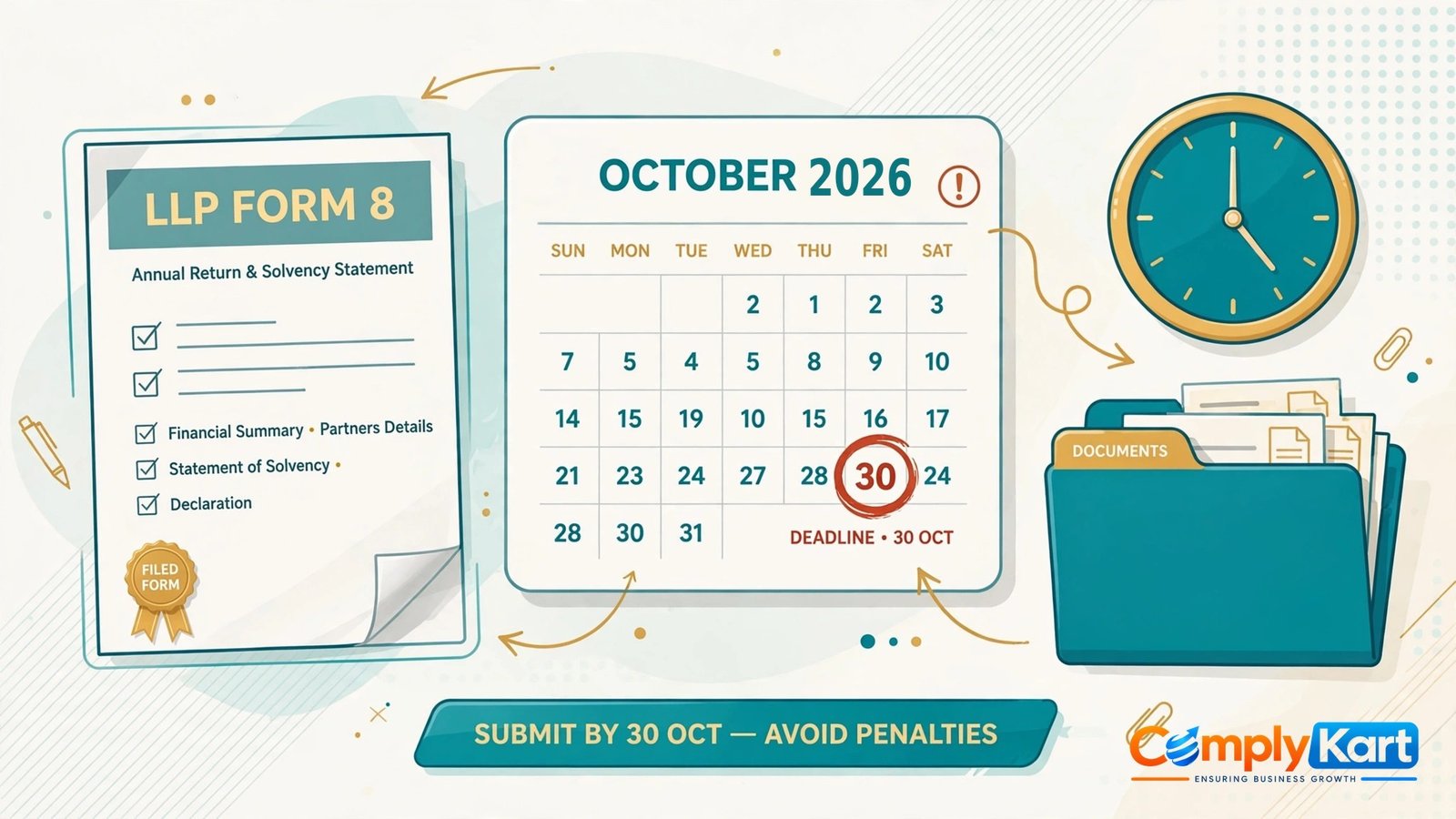
Ten days. That's the gap between today and 30 October 2026 — the day AOC-4 for FY 2025-26 falls due for every company that held its AGM on 30 September. If your audited financials are signed and sitting in a folder somewhere, this is the week they go onto the MCA portal. If they aren't signed yet, this is the week that conversation gets uncomfortable.
The short answer: AOC-4 — the form through which companies file their audited financial statements with the Registrar of Companies — is due within 30 days of the AGM under Section 137 of the Companies Act, 2013. For an AGM held on 30 September 2026, that means 30 October 2026. Late filing attracts ₹100 per day with no upper cap.
What exactly is AOC-4?
AOC-4 is the MCA form that carries your company's financial statements — balance sheet, profit and loss account, cash flow statement where applicable, auditor's report, and the Board's report — to the Registrar of Companies. The AGM approves the accounts; AOC-4 files them with the state. One is a meeting, the other is a filing. Both are compulsory.
There are variants, and picking the wrong one is treated as a non-filing. The default AOC-4 covers most private limited companies. AOC-4 XBRL is for listed companies and unlisted public companies with paid-up capital of ₹5 crore or more or turnover of ₹100 crore or more. AOC-4 CFS carries consolidated financial statements where the company is required to prepare them. Check which bucket you're in before you open the portal.
Is the 30 October deadline confirmed?
Yes — with one caveat worth knowing. On 9 October 2026, the Institute of Company Secretaries of India wrote to the MCA asking for annual filing forms, including AOC-4 and MGT-7, to be extended to 31 December 2026 without additional fees. As of mid-October, the MCA has not issued any extension circular. The statutory deadline stands.
My advice: file on the current date. If an extension comes, you've lost nothing. If you wait for one that never comes, the ₹100-a-day meter is already running. Hope is not a filing strategy.
What about One Person Companies?
OPCs don't hold AGMs, so the 30-days-from-AGM logic doesn't apply to them. An OPC files its financial statements within 180 days of the close of the financial year — which for FY 2025-26 meant 27 September 2026. If you're reading this as an OPC director, your AOC-4 date has already passed. File now and stop the daily fee.
What do you need before filing AOC-4?
The filing itself is the easy part. The preparation is where filings die. You need: audited financial statements signed by the auditor and adopted at the AGM; the Board's report; the AGM minutes recording adoption; and MGT-14 filed for the board resolution approving the accounts, where applicable. The single most common last-week crisis I see is a mismatch between the figures in the board report and the audited accounts — one number transcribed wrong, and the form bounces. Reconcile the three documents against each other before you start.
Also check your DSCs. Expired digital signatures on deadline day are a depressingly regular emergency, and renewing one takes longer than anyone expects when the whole country is renewing at once.
What does late filing actually cost?
The additional fee is ₹100 per day, per form, with no upper limit — it runs from the due date until the form is filed. But that's only the portal fee. Section 137(3) of the Companies Act provides for adjudicated penalties that can run into lakhs, and three consecutive years of default can disqualify the directors under Section 164(2). The ₹100 a day is the visible meter. The rest is the part nobody wants to discover.
File AOC-4 before MGT-7, by the way — the portal expects that sequence, and your annual return (due 29 November, our MGT-7 guide) draws on the filed financials.
What if your AGM was held earlier?
The 30 October date assumes a 30 September AGM — the last permissible day. If your company held its AGM earlier, your AOC-4 deadline moved up with it: 30 days from your AGM date, not 30 October. The MCA portal computes the due date from the AGM date you enter in the form. An AGM on 20 September means AOC-4 was due 20 October. Check your actual meeting date before assuming you have ten days.
Dormant companies file too — with nil financial statements. The obligation attaches to the company's existence, not its activity. And on attachments: the auditor's report travels with the financials, plus the Board's report with its annexures. If CARO applies to your audit, that report is part of the package.
This week's action plan
Three steps. One: confirm the accounts are audited, signed and adopted — if the audit isn't done, call your auditor today, not tomorrow. Two: reconcile the board report, the financials and the AGM minutes against each other, and check DSC validity. Three: file on the MCA V3 portal and download the filed form with the challan for your records.
AOC-4: quick answers
What happens if I miss the 30 October AOC-4 deadline?
An additional fee of ₹100 per day starts running with no upper cap, until the form is filed. Beyond the portal fee, Section 137(3) provides for adjudicated penalties that can run into lakhs, and three consecutive years of default can disqualify directors under Section 164(2). File late, but file — every day you wait is another ₹100.
Do dormant companies need to file AOC-4?
Yes. AOC-4 is filed with nil financial statements for dormant companies — the obligation attaches to the company's existence, not its activity. Dormant status changes what you file, not whether you file.
AOC-4 or AOC-4 XBRL — which one do I file?
Most private limited companies file the standard AOC-4. AOC-4 XBRL is for listed companies and unlisted public companies with paid-up capital of ₹5 crore or more or turnover of ₹100 crore or more. Filing the wrong variant is treated as a non-filing, so confirm your category first.
Has the MCA extended the AOC-4 deadline for FY 2025-26?
As of mid-October 2026, no. The ICSI wrote to the MCA on 9 October asking for annual filing forms to be extended to 31 December 2026 without additional fees, but no extension circular has been issued. Plan for 30 October — an extension, if it comes, is a bonus, not a plan. Wondering what the full year's compliance costs? Our compliance fee calculator estimates it in under a minute.
Ten days is plenty for a filing whose preparation is done, and nowhere near enough for one whose audit isn't. You know which situation you're in. And if getting this filed correctly and on time would help to have handled for you — that's exactly what our team does for companies every filing season.



Comments
No comments yet — ask the first question below.
Join the discussion
Questions go straight to our expert desk. Comments appear after a quick review — no spam, no noise.