
IN BRIEF
Cancellation of a registered trademark in India is the removal of a registered mark from the Register of Trade Marks, on an application by a person aggrieved, under Section 47 for non-use or Section 57 for rectification of the Trade Marks Act, 1999. The petition is filed on Form TM-O before the Registrar or the High Court, and the owner can defend it with proof of genuine use.
Somebody else owns the name you need. Not a similar name — the name. Your application came back cited against it, or a legal notice landed on your desk, and the registration blocking you belongs to a business that, as far as anyone can tell, never sold a thing under it. That is the exact situation trademark cancellation exists for. A registered mark is not a permanent fence. If it is not used, or if it should never have been registered at all, the law lets the right person ask for it to be taken off the register.
Short answer: Cancellation of a registered trademark in India is the removal of a registered mark from the Register of Trade Marks under Section 47 for non-use or Section 57 for rectification of the Trade Marks Act, 1999. Only a person aggrieved can apply, on Form TM-O, before the Registrar or the High Court.
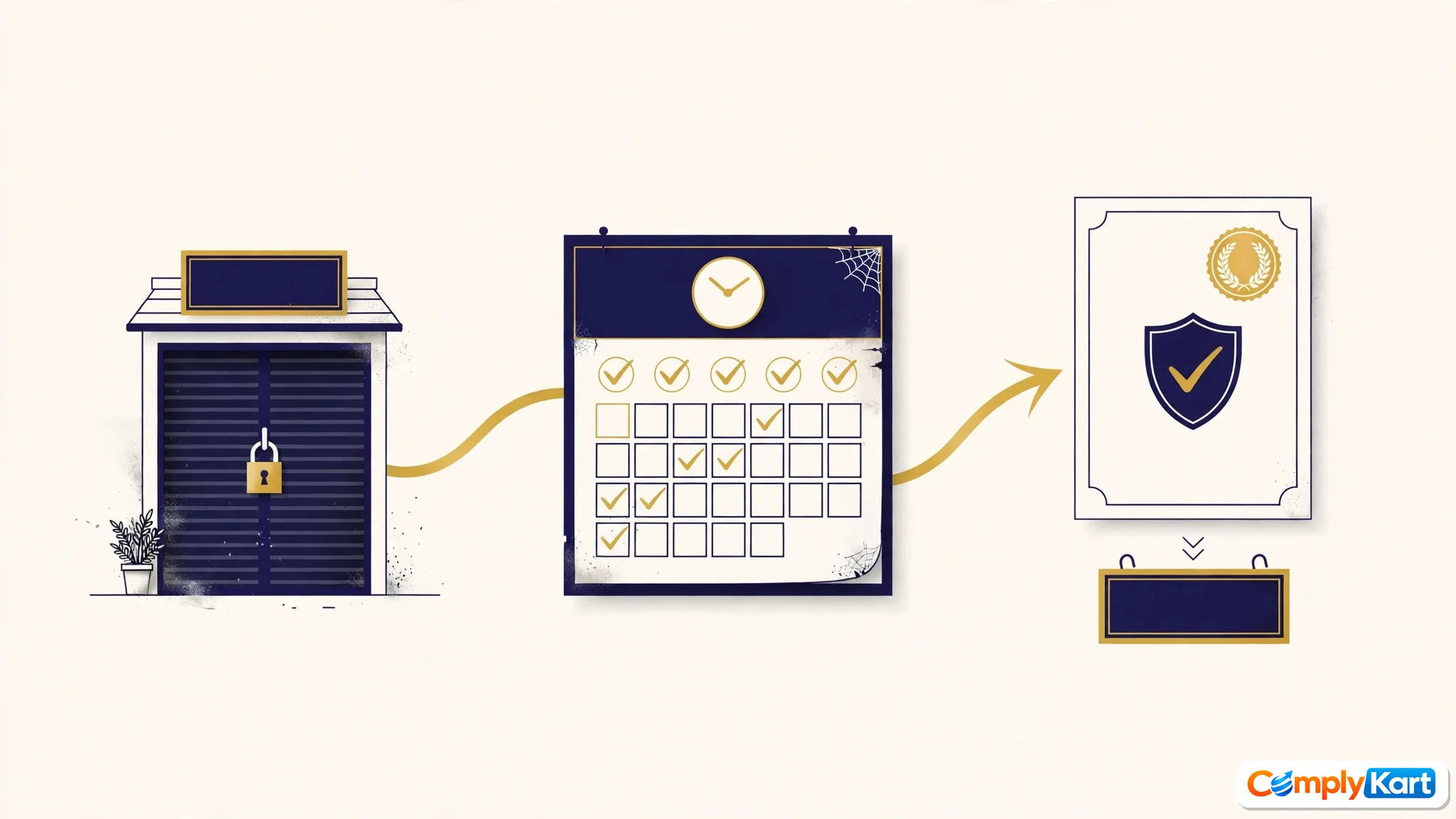
Picture a shuttered shop with a painted signboard. The board has been up for years. Nobody trades behind it, the lights never come on, and a trader who actually wants that spot cannot use the name because the board says it is taken. Cancellation is the municipality taking the board down — but only if the trader asking has a real reason to want the spot, and only after the shop owner gets a fair chance to prove the shop is, in fact, open. Registration is the board. Use is the trading behind it. Everything in this post hangs on that distinction.
"Cancellation" is four different proceedings — do not mix them up
The word cancellation is shorthand, and it causes most of the confusion in this area. Four different routes change the register, and each has its own section, form and test. Filing the wrong one wastes the fee and the year.
| Route | What it does | Who applies | Form and fee |
|---|---|---|---|
| Section 47 — removal for non-use | Takes a mark off the register because it was never genuinely used | Any person aggrieved | Form TM-O, ₹2,700 per class by e-filing |
| Section 57 — rectification | Cancels or varies an entry that should not be there or should not stay | Any person aggrieved | Form TM-O, ₹2,700 per class by e-filing |
| Section 58 — proprietor's own request | The owner asks to cancel the entry or strike out goods or services | The registered proprietor | Form TM-P, ₹900 per mark by e-filing |
| Section 25 — non-renewal | The mark is removed because the renewal fee was not paid | Nobody files — the Registrar removes it | Restoration on Form TM-R, ₹9,000 plus the renewal fee |
Two traps sit in that table. First, Section 50 does not protect prior users. Several guides say it does; it does not. Section 50 governs variation or cancellation of a person's registration as a registered user — a completely different thing. A prior user who never registered argues under Section 47 or 57, not Section 50. Second, non-renewal is not a cancellation petition. A mark that lapsed because nobody paid the renewal fee is a different problem from a live registration you want removed, and it has a different fix — restoration on Form TM-R, which is covered in our guide to renewing a trademark. An abandoned trademark is different again: that is an application that died during prosecution. Know which of the four you are dealing with before you spend anything.
One more distinction, because it decides timing. Opposition happens before registration, under Section 21 — anyone can oppose an application within four months of its advertisement in the Trade Marks Journal. Cancellation happens after registration. If the mark you are worried about is still only an application, you do not want this post; you want our guide to trademark objection and opposition. The types of trademarks you can register decide what exactly sits on the register in the first place.
Who can actually ask for it?
Sections 47 and 57 both use the same phrase: "any person aggrieved". That does not mean anyone with an opinion. It means someone with a real commercial or legal interest in the entry coming off the register. The Registrar will ask you to show it, and Rule 97 requires your application to state your interest, the facts you rely on and the relief you want.
Four situations qualify in practice. A trader blocked by the registration — your own application was refused or cited against the mark. A prior user — you have used the brand for years and never registered it, and the registered owner is now threatening you. An applicant facing citation — the mark sits on your examination report as a conflicting registration. Or a party exposed to an infringement allegation — you have received a notice and the registration behind it looks vulnerable. A purely academic objection, from someone with no trade interest, goes nowhere. Standing is decided on the facts of each case, so your statement of case should say plainly how the registration hurts you — lost sales, a refused application, a notice received — not just that the mark is unused.
Before drafting anything, pull a current extract of the register entry. You need the proprietor's name, the mark number, the classes, the specification of goods or services, the user claim, any registered users, the conditions recorded on the entry and — most importantly for Section 47 — the date the mark was actually entered in the register. That date, not the filing date, starts the clock. You can check it through the IP India public search before you spend a rupee.
Section 47: the five-year non-use test
Section 47 has two limbs, and they are not interchangeable. The first, Section 47(1)(a), applies where the mark was registered without any bona fide intention that it should be used for the registered goods or services, and there has in fact been no bona fide use up to three months before the application. Both parts matter: no genuine intention at registration, and no genuine use since. The second, Section 47(1)(b), is the one most petitions use. It applies where, up to three months before the application, a continuous period of five years from the date the mark was actually entered in the register had elapsed during which there was no bona fide use of the mark for the registered goods or services.
People call this "five years and three months". That shorthand is roughly right but it hides the maths, and the maths is where petitions are won and lost. The test has two components. First, five continuous years of non-use counted from the register-entry date. Second, a three-month cut-off: the period is measured up to three months before the date of your application, not up to the application date itself. Count from the entry date, never from the filing date of the original application — those two dates can be years apart.
Here is a worked example, with round dates, so you can see the arithmetic. Suppose a mark was actually entered in the register on 1 April 2019. Five continuous years of non-use runs to 1 April 2024. You file your petition on 1 August 2024. The test period ends three months before that — 1 May 2024. Non-use from 1 April 2019 to 1 May 2024 is five years and one month, continuous. The ground is made out, provided the owner cannot show genuine use inside that window. If instead you had filed on 1 February 2024, the test period would end on 1 November 2023 — four years and seven months from entry — and the petition would fail on dates alone, however dead the mark looks. File too early and you lose a winnable case. Wait out the clock, and the same petition succeeds.
Three qualifications keep this honest. First, the proviso to Section 47(1): the Registrar or the High Court may refuse the application if the owner shows bona fide use before the relevant date or during the relevant period on goods or services of the same description, or on goods or services associated with the registered ones. Use on a neighbouring line of goods can save the registration, so check the owner's whole business before you file. Second, Section 47(3): non-use caused by special circumstances in the trade — legal restrictions on using the mark in India, for example, rather than any intention to abandon it — can defeat the ground. A ban, a licence that never came through, a court order: these are defences, not excuses you can invent after the fact. Third, use of a mark for export trade from India can count as use under Section 56. A mark that never sold a unit in India but shipped steadily abroad is not necessarily unused.
What counts as bona fide use is a question of evidence, not assertion. Invoices tied to the mark and the registered goods. GST and shipping records. Packaging, catalogues, dated advertisements. Website archives and marketplace listings. A single undated invoice, or one small sale arranged to look like trading, does not establish genuine use — and equally, a challenger should not assume that no website means no trade. Build the evidence around the legal proposition, class by class. Use and evidence can differ by goods, by class and by geography, so ask for the relief that matches the proof. Taking one class off a five-class registration is a win; demanding all five on evidence that covers one is how petitions get dismissed as overbroad.
Section 57: when the entry itself is wrong
Section 47 is about a mark that was fine when registered and then went quiet. Section 57 is about an entry that should not be there, or should not stay. It is the wider provision, and the Registrar or the High Court may make, expunge or vary an entry on any of these grounds:
| Ground | What it means in plain words |
|---|---|
| Contravention of a registered condition | The registration was granted subject to a condition or limitation — a trademark disclaimer, a colour limit, a territorial limit — and the owner uses the mark in breach of it |
| Absence or omission of an entry | The register is missing something it should record, such as a disclaimer, condition or limitation |
| Entry made without sufficient cause | The registration was obtained by fraud or misrepresentation — false claims of prior use, a conflicting mark concealed — or the mark was similar to an already registered mark |
| Error or defect in an entry | A mistake in the register entry itself |
| Wrongly remaining on the register | The entry is contrary to the Act or likely to cause confusion — for example, the mark offends Section 9 (absolute grounds, like lack of distinctiveness) or Section 11 (relative grounds, like an earlier mark) |
Two points matter here. First, a mark that has become the generic name for the product — the word everyone uses for the thing itself, not for one maker's version of it — can be attacked as wrongly remaining, but genericity is evidence-heavy. Dictionary extracts alone rarely decide it; you need proof of how the trade and the public actually use the word. Second, the original registration is prima facie evidence of its own validity under Section 31(1), including in a Section 57 application. You start uphill. The burden is on you to show the entry is wrong, not on the owner to re-prove the registration.
Three cases that show how it plays out
Triumph, unused for 75 years. In Triumph Designs Ltd v. Tube Investments of India, the Calcutta High Court looked at the "Triumph" mark for bicycles — registered since 1950 and, the court found, never used for bicycles for over seventy-five years. The registration was cancelled on Section 47 grounds. It is the extreme end of the scale, and it makes the point cleanly: a registration is not a family heirloom. It survives only while the mark is used.
BOLDIFY, registered without intent. In Falcon Licensing Ltd v. PRI Enterprises Pvt Ltd, the Delhi High Court examined the "BOLDIFY" registration and held that PRI Enterprises had registered it without a bona fide intention to use it in India, harming the prior user's rights. That is Section 47(1)(a) — the harder limb, because intention has to be proved from the circumstances: no product, no launch plan, no production, no business behind the filing. It is also the limb that protects prior users who never registered. If you used the brand first and someone registered it over you without any plan to trade under it, this is your ground.
PROTIFIX, too close to PROTINEX. In the PROTIFIX matter, the Calcutta High Court cancelled the "PROTIFIX" mark because it was confusingly similar to the well-known "PROTINEX" nutrition brand — an ordinary buyer could be confused by the similar names and packaging. That is Section 57 territory: an entry wrongly remaining because it conflicts with an earlier right and misleads the public. The lesson is that cancellation is not only about dead marks. A live, trading mark can be removed too, if the registration itself was wrong.
How a petition actually runs
A contested cancellation before the Registrar runs in six steps, under Rules 97 and 98 of the Trade Marks Rules, 2017. No step has a fixed end-to-end deadline — the Rules set response periods, and the proceeding takes the time the evidence and the hearing need. Plan for delay; do not promise a client a date the Act never gives.
1. Verify and choose the ground. Confirm the proprietor, mark number, status, classes, specification, user claim, registered users, conditions and entry date from a current register extract. Decide whether Section 47, Section 57 or both are genuinely supported, and for which classes and goods. A focused petition beats a broad one.
2. File Form TM-O with a full statement of case. Rule 97 requires you to state your interest, the facts relied on and the relief sought. The government fee is ₹2,700 per class by e-filing (₹3,000 on paper), paid through the IP India portal. File per class: a three-class registration challenged in all three classes costs three fees.
3. The Registrar transmits the case. Rule 97 says the Registrar ordinarily sends the application and statement within one month to the registered proprietor, registered users and anyone else who appears to have an interest.
4. The proprietor files a counter-statement. Under Rule 98, the owner has two months from receipt, with a further period of up to one month in aggregate, to file a counter-statement — also on Form TM-O, at the same per-class fee. No counter-statement, and the owner has effectively given up the fight on paper; the Registrar proceeds on your material.
5. Evidence rounds. Each side files evidence by affidavit, in the sequence the opposition evidence rules prescribe with necessary changes. This is where petitions are decided: dated invoices, GST records, advertisements, packaging — or the absence of all of them. A document dump with no affidavit explaining what each paper proves helps nobody.
6. Hearing and reasoned order. The Registrar considers the ground, the evidence and the scope of relief asked for, and may remove, retain, vary or limit the entry. Either side can appeal to the High Court under Section 91 within three months of the order being communicated. Keep the delivery proof of that order — the appeal clock runs from communication, not from the date typed on it.
Where to file is a real decision, not admin. Since the Intellectual Property Appellate Board was abolished on 4 April 2021, applications go to the Registrar or to the appropriate High Court. If an infringement suit is already pending, Section 124 can change where and how validity is fought — check the suit before filing, not after. Older guides still name the IPAB as the forum; they are out of date, and following them wastes a filing.
What it costs
The government fees are small. The proceeding is not. The fee is the entry ticket; evidence preparation, affidavits, hearings and any High Court appeal are where the money goes, and professional fees vary too much to quote as a flat figure. Work out the full cost of the proceeding on our compliance fee calculator before you commit, and budget for the counter-statement too — it costs the same as the petition.
| Step | Form | Government fee |
|---|---|---|
| Rectification / removal petition (ss.47 or 57), per class | TM-O | ₹2,700 e-filing / ₹3,000 physical |
| Owner's counter-statement, per class | TM-O | ₹2,700 e-filing / ₹3,000 physical |
| Proprietor's own cancellation or striking out goods (s.58), per mark | TM-P | ₹900 e-filing / ₹1,000 physical |
| Renewal, per class (for context — a mark kept alive is a mark you must cancel) | TM-R | ₹9,000 e-filing / ₹10,000 physical |
| Restoration + renewal after removal for non-payment (ss.25(3)/(4)) | TM-R | ₹9,000 plus the renewal fee |
All fees are from the First Schedule to the Trade Marks Rules, 2017. No GST applies to government fees. One practical note: a petition that attacks three classes costs ₹8,100 by e-filing before a single affidavit is drafted. Narrow the relief to the classes that matter and the fee follows.
If you own the mark: how to defend it
Most owners first hear about a cancellation petition when the Registrar's notice arrives. The counter-statement clock — two months, plus up to one more — starts from receipt, so do not sit on the notice. The defence is evidence, and the evidence has to cover the right period: genuine use up to three months before the petition date for Section 47(1)(b), or use on the same-description or associated goods under the proviso.
What to gather, in order of weight: invoices and receipts that tie the mark to the registered goods, with dates inside the test period. GST filings and shipping records that corroborate the invoices. Packaging and catalogues carrying the mark. Dated advertisements — print, digital, trade press — showing the mark in the market. Website archives and marketplace listings with order history. Licence and registered-user documents, because use by a registered user counts for the proprietor. And an affidavit from someone who actually knows the business, explaining what each document is. Undated screenshots and a single invoice for a token sale will not carry the day, and a court will notice if the only "use" started after the petition was filed.
Three defences deserve a line each. Special circumstances under Section 47(3): if a law or regulation stopped you using the mark — an import restriction, a licence refused, a product ban — say so and prove it; the section excuses non-use that comes from the trade, not from your own delay. Use on associated goods: if you used the mark on goods of the same description as the registered ones, the proviso can save the registration even where the exact goods went quiet. And the voluntary route: if the petition is right and the mark is genuinely dead in one class, the owner can narrow or cancel the entry voluntarily under Section 58 on Form TM-P for ₹900, instead of losing a contested order. A clean voluntary surrender in one class often protects the classes that still trade.
What removal does — and does not — do
Winning a cancellation feels final. It is not, and the difference matters before you build a business on the result. Removal ends the registration for the goods or services covered by the order. It does not automatically put the mark in the public domain. Goodwill-based passing-off rights can survive without any registration — a competitor does not get automatic permission to copy a brand just because one registration was removed. Copyright in the artwork, trade-name rights, company-name remedies, domain-name rules and registrations in other classes or countries all need separate checks; this order touches none of them. Remember that patent, copyright and trademark are different rights with different remedies — a trademark order decides only the trademark.
Nor does winning reserve the mark for you. A fresh application for the same mark still faces examination, opposition and prior rights — including the passing-off rights of the very owner you just beat. And do not assume earlier sales under the mark become lawful, or that every infringement claim disappears. Courts look at the governing order, the dates, the validity issue and passing off together. Before adopting the mark, run a complete clearance search and get a legal review. The cheapest lesson in this whole area is the one you learn before you print the packaging, not after.
One more honest point: a registration lasts ten years from the application date, and renewal is the owner's job. If a mark you are watching simply lapses for non-payment, that is Section 25, not a victory under Section 47 — and the owner may still restore it on Form TM-R. If you need the full picture of keeping a mark alive, our trademark renewal service page and the TM-R guide linked above cover it. Cancellation is the contested route; renewal is the administrative one. Do not confuse the two in front of a client.
6 mistakes that sink petitions (and defences)
1. Counting from the wrong date. Five years runs from the date the mark was actually entered in the register, not the application date and not the date the owner first claimed use. Get the entry date from the register extract.
2. Filing before the clock runs out. The test period ends three months before your application. File a month early and a dead mark survives on dates alone.
3. Attacking every class identically. Use and evidence differ by class. Schedule the relief class by class, or the Registrar will see an overbroad petition and treat it as one.
4. Treating one invoice as proof. A token, undated or unrelated transaction does not establish bona fide use. Equally, assuming no website means no trade is how challengers lose to a quiet exporter with shipping records.
5. Citing Section 50 for prior users. Section 50 is about registered users. Prior-use arguments belong under Sections 47 and 57, and a petition that cites the wrong section tells the Registrar the drafter has not read the Act.
6. Assuming the Registrar is the only forum. The High Court also has rectification jurisdiction, and a pending infringement suit can change the strategy entirely. Check for suits, oppositions, assignments and earlier rectification cases before filing Form TM-O — and preserve the delivery proof of every order, because the Section 91 appeal clock runs from communication.
FAQs
Can I file a trademark cancellation petition myself?
Yes — Form TM-O is filed on the IP India portal, and the fee is ₹2,700 per class by e-filing. But the statement of case and the evidence decide the outcome, and a contested petition runs on affidavits and a hearing. Most petitioners use counsel once the counter-statement arrives.
Is there a time limit for filing under Section 57?
The Act sets no fixed waiting period for rectification, unlike the five-year test in Section 47. But delay still hurts: evidence goes stale, and the owner keeps building a use record while you wait. File when the ground is provable, not when it is convenient.
Does one sale save a mark from a Section 47 petition?
No, on its own. Bona fide use means genuine commercial use for the registered goods or services — invoices, GST records, packaging, advertisements, all tied to the mark and the right period. A token sale arranged to look like trading does not establish it.
Can I cancel only some classes or goods?
Yes. Section 47 operates "in respect of the goods or services" in the registration, and the Registrar can remove, vary or limit the entry. Ask for the classes where non-use is proved, and leave the classes that still trade alone.
Does cancellation affect the owner's other trademarks?
No. The order touches only the entry attacked. Other marks, other classes and registrations in other countries need separate proceedings — and the owner's passing-off rights may survive the removal entirely.
I won the cancellation. Can I register the mark now?
Not automatically. A fresh application still goes through examination and opposition, and anyone with prior rights — including the former owner's passing-off claim — can oppose it. Run a full clearance search first, and treat the cancelled registration as an open question, not a reserved seat.
A registration that nobody uses is a board on a shuttered shop. The law gives the trader who wants the spot a way to ask for the board to come down — and it gives the shop owner a fair chance to prove the shop is open. Both sides get heard, both sides need evidence, and the side with the dates and the documents usually wins. If a registered mark is blocking your trademark registration, or a TM-O has landed on your desk, that is the moment to act on it — while the evidence is still fresh and the clock is still on your side.





Comments
No comments yet — ask the first question below.
Join the discussion
Questions go straight to our expert desk. Comments appear after a quick review — no spam, no noise.