

IN BRIEF
Patent, copyright and trademark are three separate intellectual property rights in India, each protecting a different thing. A trademark under the Trade Marks Act, 1999 protects the brand sign buyers identify you by; copyright under the Copyright Act, 1957 protects original creative expression; and a patent under the Patents Act, 1970 protects a new invention. They last ten renewable years, the author's life plus sixty years, and twenty years from filing, respectively.
A trademark protects your brand. Copyright protects your creative work. A patent protects your invention. Three different rights, three different laws, three different filing offices — and filing the wrong one is the most common way founders waste money on intellectual property in India.
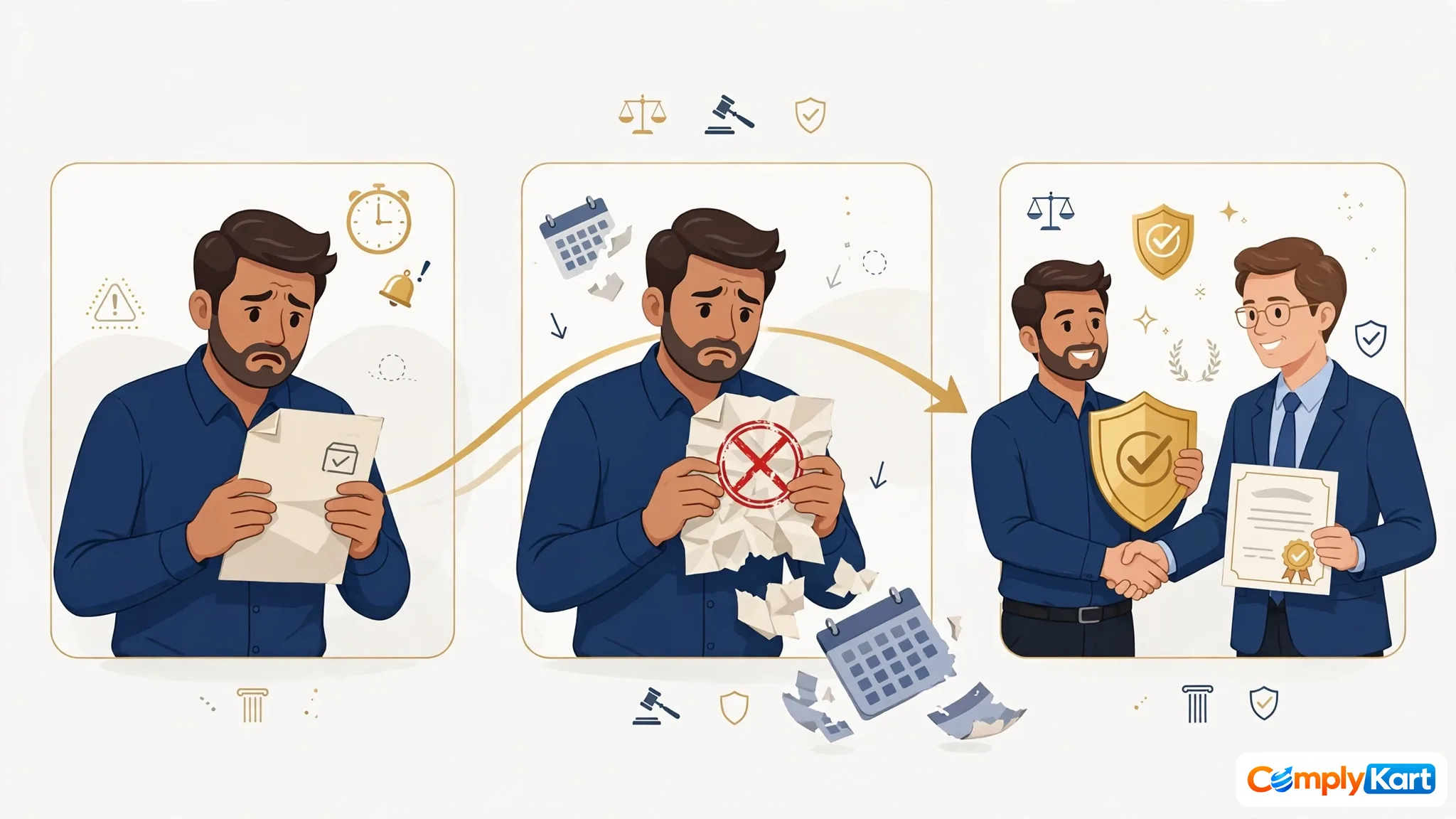
Most founders I meet use the three words interchangeably. They say "I want to patent my brand name" or "I will copyright my new machine." Both sentences are wrong, and the mistake only shows up months later, when the application is rejected or when a competitor copies the one thing that was never protected. This guide sorts the three out in plain language: what each one covers, how long it lasts, what it costs to file in India, and which one to file first.
Patent vs copyright vs trademark — the short answer
A trademark protects the sign that identifies you — your name or logo — under the Trade Marks Act, 1999. Copyright protects creative expression under the Copyright Act, 1957, and arises automatically on creation. A patent protects an invention under the Patents Act, 1970, and exists only if registered. Terms: ten renewable years, life plus sixty, twenty years from filing.
The one-line test
Ask yourself one question: what exactly am I trying to stop someone else from doing?
If the answer is "using my name or logo," you need a trademark. If it is "copying my book, song, photo or code," you need copyright. If it is "making or selling my invention," you need a patent. Most businesses need more than one of these — but for different assets, not for the same one.
Think of your business as a shop. The trademark is the signboard over the door: it tells customers whose shop this is. Copyright is the song playing inside and the recipe book on the counter: the creative work you made. The patent is the new oven you invented in the back room: the machine itself, and how it works. The signboard does not protect the oven. The recipe book does not protect the signboard. Different things, different locks.
What a trademark protects
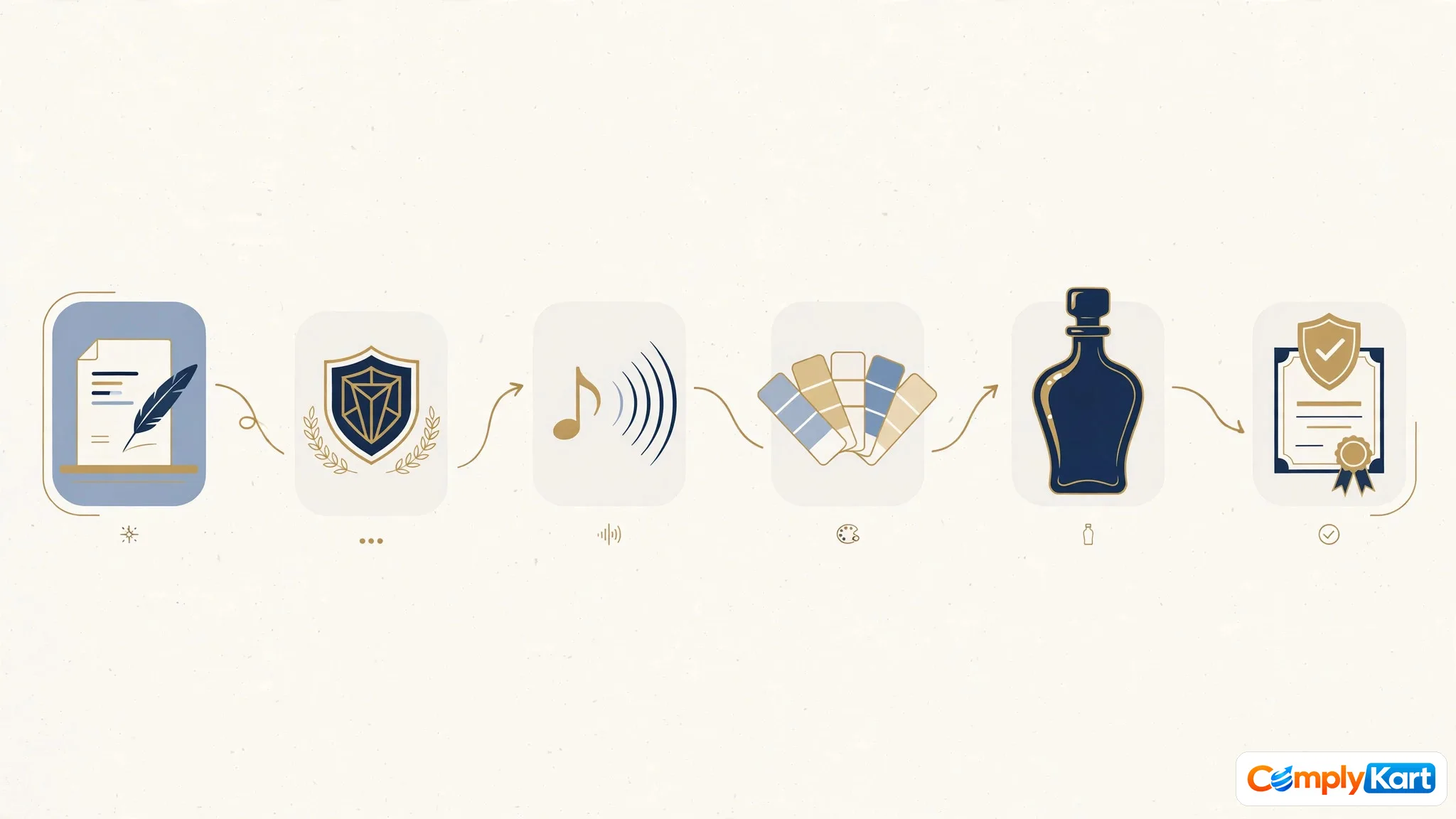
A trademark is any mark capable of being represented graphically that distinguishes your goods or services from someone else's. That is the definition in Section 2(1)(zb) of the Trade Marks Act, 1999. In practice it covers your brand name, your logo, a slogan, and — for the businesses that need them — shapes, colours and sounds. The range of marks you can register is wider than most founders realise: word marks, device marks, shape marks and sound marks all sit under the same Act.
Registration is optional. An unregistered mark still has protection through the common-law action of passing off under Section 27 — you sue because a rival is deceiving your customers. But passing off is slow, expensive and uncertain: you must prove reputation, misrepresentation and damage, case by case. A registered mark gives you the exclusive right to use it under Section 28, and an infringement action under Section 29 is a far cleaner fight. India is effectively first-to-file, so the founder who files first usually wins the name, even if the other one used it longer in a small market. File early.
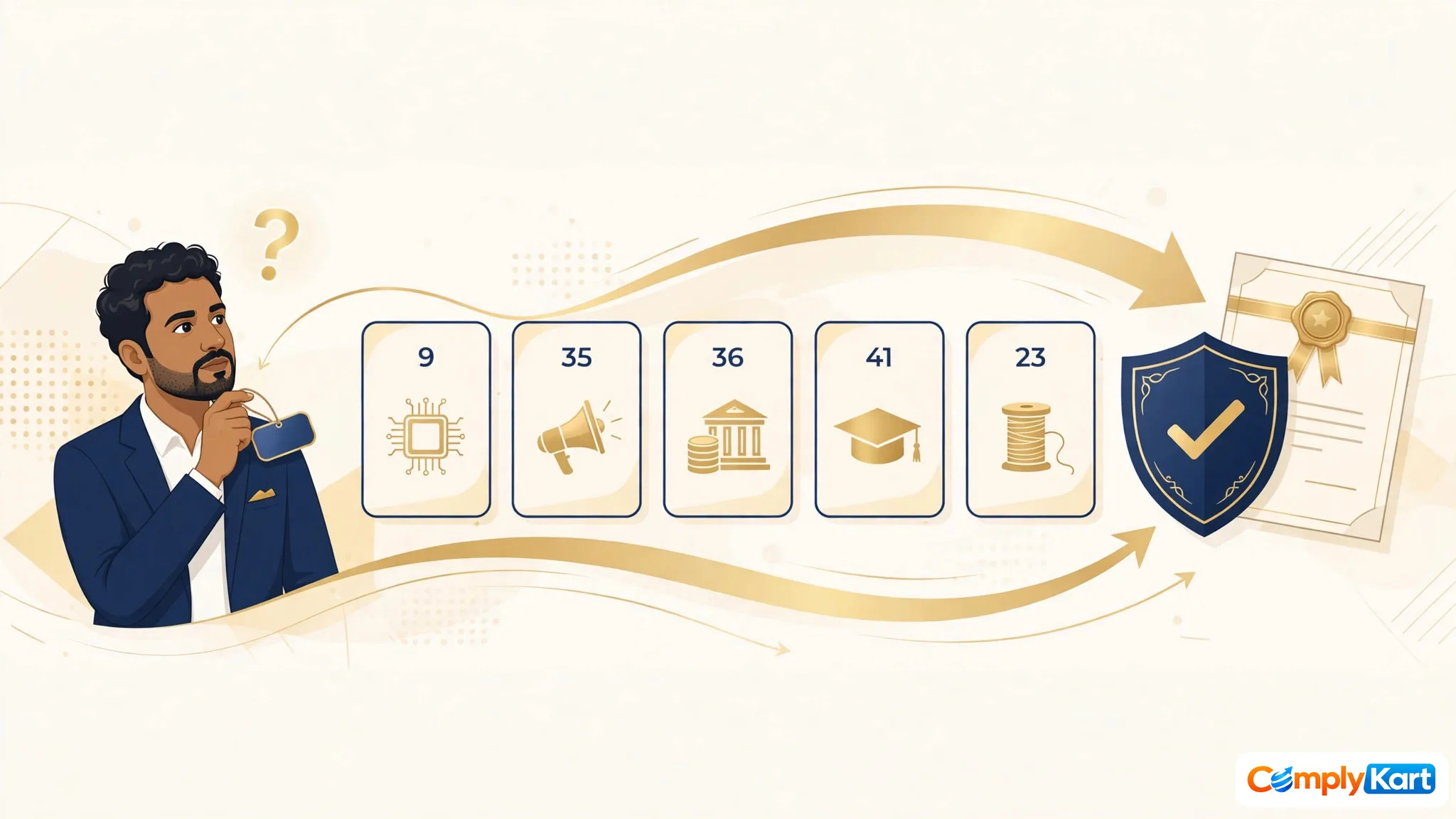
A registered trademark lasts ten years from the date you apply, under Section 25, and you can renew it in ten-year blocks forever. The government fee for filing Form TM-A online is ₹4,500 per class per mark for an individual, a DPIIT-recognised startup or a small enterprise, and ₹9,000 per class for everyone else, including companies and LLPs. Renewal on Form TM-R costs ₹9,000 per class for everyone — the concession applies at filing, not at renewal. Miss the renewal date and a ₹4,500 surcharge applies within six months; after that, restoration costs ₹9,000 on top of the renewal fee. Goods and services are split into 45 classes under the Nice Classification — 34 for goods, 11 for services — and you pay per class, so choosing the right classes matters more than most founders think.
One practical point: you can use ™ the moment you apply, but ® is a criminal offence to use before registration — Section 107 of the Act. The two symbols carry very different legal weight, and misusing ® is the kind of small mistake that hands a rival a free complaint. And if you are torn between registering the name or the logo first, the word mark usually wins: a name protects you in every font, while a logo protects only that one design.
What copyright protects
Copyright protects original creative expression. Section 13 of the Copyright Act, 1957 lists what it covers: literary works (books, articles, software code), dramatic works, musical works, artistic works (paintings, photographs, logos as artwork), cinematograph films and sound recordings. It protects the expression, not the idea. Two people can write two different books about the same idea; copyright stops one of them copying the other's words, not from writing about the same subject.
Here is the part founders get wrong most often: copyright is automatic. It arises the moment an original work is created and fixed in some tangible form. No filing, no fee, no notice is needed for the right to exist. Registration under Section 45 is optional — you apply in Form XIV under Rule 70 of the Copyright Rules, 2013 — but it is worth doing, because the entry in the Register of Copyrights is prima facie evidence of ownership under Section 48. In a dispute, that certificate shifts the burden. Without it, you are proving authorship from drafts, emails and timestamps.
The term is generous. For literary, dramatic, musical and artistic works, copyright lasts for the author's lifetime plus sixty years under Section 22. For films, sound recordings and government works, it is sixty years from publication. There is no renewal and no examination fee. The government fee is ₹500 per work for a literary, dramatic, musical or artistic work, including software; ₹2,000 per work for a sound recording and for an artistic work used on goods or services, like a logo on packaging; and ₹5,000 per work for a cinematograph film. One application covers one work only, and the Copyright Office allows thirty days for objections before the entry is made.
Copyright is handled by the Copyright Office. Trademarks, patents and designs are handled by the office of the Controller General of Patents, Designs and Trade Marks — CGPDTM, under IP India. Two different offices, two different portals, two different registers. That matters when you are budgeting time: a copyright filing and a trademark filing do not move through the same queue.
What a patent protects
A patent protects a new invention. The invention can be a product — a new type of battery, a new valve — or a process — a new way of making a material. Under Section 2(1)(j) of the Patents Act, 1970, it must pass three tests: it must be new, it must involve an inventive step (not an obvious tweak to what already exists), and it must be capable of industrial application. A bare idea fails all three. A computer programme as such faces the Section 3(k) bar — which is why software is routinely protected by copyright instead, while the method it implements is sometimes patentable when tied to hardware. Get advice before you file on software; the line is fact-specific.
Unlike copyright, a patent does not exist until you register it. And unlike a trademark, you cannot lean on a common-law right while you wait. File first, disclose later: once you have shown the invention publicly, novelty is gone and the application can fail. A provisional application buys you twelve months to develop the idea before the complete specification is due. The application is published eighteen months from the priority date unless you ask for early publication in Form 9.
A patent lasts twenty years from the date you file the application, under Section 53. After that, anyone can use the invention. That fixed clock is the bargain: twenty years of exclusivity in exchange for telling the world how it works.
The government fees are set in the First Schedule to the Patents Rules, 2003, as amended in 2024. Filing Form 1 online costs ₹1,600 for an individual, a DPIIT-recognised startup, a small entity or an educational institution, and ₹8,000 for everyone else. Requesting examination on Form 18 costs ₹4,000 or ₹20,000, and it must be filed within thirty-one months of the priority date — the 2024 amendment cut this from forty-eight months, and missing it kills the application. So the minimum official cost from filing to grant is ₹5,600 for a qualifying applicant and ₹28,000 for others, before extra pages, extra claims or professional fees. Then come renewals, payable from the third year: ₹800 a year in years three to six, ₹2,400 in years seven to ten, ₹4,800 in years eleven to fifteen, and ₹8,000 in years sixteen to twenty, for a qualifying applicant — five times that for other applicants. Add it up and the renewal bill alone runs to ₹76,800 over the life of a patent for a startup, and ₹3,84,000 for a large company. Budget for the whole twenty years, not just the filing fee.
Patent vs copyright vs trademark: the comparison
| Point | Trademark | Copyright | Patent |
|---|---|---|---|
| What it protects | Brand identity: name, logo, slogan, shape, sound | Original creative expression: books, music, art, films, software | New inventions: products and processes |
| Governing law | Trade Marks Act, 1999 | Copyright Act, 1957 | Patents Act, 1970 |
| Registration needed? | No — but far stronger registered; passing off under s.27 for unregistered marks | No — arises automatically on creation; registration is optional evidence | Yes — no patent exists without registration |
| How long it lasts | 10 years, renewable forever | Author's life + 60 years; films and sound recordings 60 years from publication | 20 years from filing date |
| Government filing fee | ₹4,500 or ₹9,000 per class (TM-A, e-filing) | ₹500–₹5,000 per work (Form XIV) | ₹1,600 or ₹8,000 (Form 1, e-filing) |
| Examination fee | Included; opposition window 4 months after journal advertisement | None — 30-day objection window only | ₹4,000 or ₹20,000 (Form 18, within 31 months) |
| Renewal | ₹9,000 per class every 10 years | None | Annual from year 3, rising by slab to ₹8,000/₹40,000 |
| Handled by | CGPDTM (IP India) | Copyright Office | CGPDTM (IP India) |
| What it stops | Lookalike brands confusing your customers | Copying of your creative work | Others making, using or selling your invention |
One asset, several rights
This is where founders lose money: the same asset often needs two rights, and one filing never covers the other.
Your logo is the classic case. As a brand sign, it is a trademark — register it and you stop rivals using a confusingly similar mark. As a piece of artwork, it is also a copyright work — register it and you have evidence of authorship if someone lifts the design itself. The two rights live side by side and neither replaces the other. The same goes for packaging: the name on the pack is a trademark, the artwork on the pack is copyright, and if the pack has a distinctive shape, that shape may need a design registration too — the design comparison explains where that boundary sits.
Software is the other overlap. Your source code is a literary work under the Copyright Act, and copyright registration at ₹500 a work is the cheapest protection a software company will ever buy. The method the code implements may be patentable if it clears Section 3(k) — but the patent protects the method, not the code, and the copyright protects the code, not the method. A rival who writes different code to do the same thing infringes the patent, not the copyright. A rival who copies your code line for line infringes the copyright, not the patent. You need to know which fight you are in before you file.
A physical product can carry all three at once: a patent on how it works, a trademark on the brand stamped on it, and copyright on the manual, the packaging artwork and the advertising film. That is not over-filing. It is three different assets, each with its own lock.
What to file first
File in the order your assets get exposed. For almost every business, that order is trademark first, copyright second, patent third.
Your brand is exposed the day you launch. It is also the asset most likely to be copied, and India is first-to-file — every day of delay is a day a competitor can register your name ahead of you. File the trademark before any public launch, in the classes you actually trade in.
Copyright is cheap and fast, so do it next for the works that matter: your code, your course content, your brand artwork, your product photographs. At ₹500 a work, there is no reason to leave the Register empty.
Patents go last in the queue only because they are the slowest and the most expensive — but "last" does not mean "late." File before you disclose the invention to anyone outside a confidentiality agreement. A single demo at a trade show can destroy novelty.
Here is what the three filings cost a DPIIT-recognised startup in government fees alone, using the schedules above:
| Filing | Form | Government fee |
|---|---|---|
| Trademark, one class | TM-A | ₹4,500 |
| Copyright, one work (software code) | Form XIV | ₹500 |
| Patent application | Form 1 | ₹1,600 |
| Patent examination | Form 18 | ₹4,000 |
| Total government fees | ₹10,600 |
That is ₹10,600 before professional fees, before extra trademark classes, and before the patent renewal years. A company filing at standard rates pays ₹9,000 for the trademark, the same ₹500 for copyright, and ₹8,000 plus ₹20,000 for the patent — ₹37,500 for the same bundle. Run the numbers for your own asset list before you start, and the compliance fee calculator will help you tally the government fees alongside your other filing costs.
Five mistakes that cost real money
Filing the wrong right. "Patenting" a brand name wastes the fee and the months. The Patent Office will reject it, and the name stays unprotected while you wait. Match the right to the asset before you file anything.
Disclosing before you file a patent. A pitch deck, a demo video, a stall at an expo — any public disclosure before filing can destroy novelty. If you must show the invention, use a written confidentiality agreement first.
Assuming copyright registration is unnecessary. The right exists without it, but proving ownership without a certificate is slow and expensive. ₹500 now is cheaper than a lawyer's letter later.
Registering the trademark in the wrong class. A trademark protects you only in the classes you filed in. A food brand registered in Class 30 has no claim against the same name on clothing in Class 25. Map your classes to your real business, not to the cheapest option.
Forgetting the renewal clocks. A trademark dies quietly at ten years if you miss the renewal, and a patent lapses if you miss a renewal year. The trademark surcharge is ₹4,500 within six months; after a year, restoration is a fresh fight. Put both dates in a calendar the day you file.
Frequently asked questions
Can I trademark something I also copyright? Yes. A logo is both a trademark and an artistic work. Register the trademark to protect the brand sign and the copyright to protect the artwork. The two rights do not conflict.
Do I need a patent if I already have a trademark? Only if you have an invention to protect. A trademark stops rivals copying your brand; it does nothing to stop them building the same machine. If the machine is the asset, you need the patent.
How long does trademark registration take in India? An uncontested application typically takes twelve to eighteen months from filing to registration. You can use ™ from the day you apply, and the registration, when granted, dates back to the application date.
Can a startup afford all three? The government fees for a startup filing one trademark class, one copyright work and one patent are ₹10,600 in total, as worked out above. Professional fees are extra, and the patent renewals are the real long-term cost. Most startups file the trademark and the copyright first and budget the patent separately.
What if someone is already using my brand name? Prior use matters, but India is effectively first-to-file, and a registered mark beats an unregistered one in most fights. Search the IP India trademark database before you file, and if a conflict shows up, talk to a professional before you spend on branding.
The three rights are not rivals. They are three different locks for three different things, and most businesses need more than one of them. Start with the signboard — the trademark — because that is what customers see first and what rivals copy first. Then protect the creative work. Then, before you show anyone the invention, file the patent. If you are unsure which of your assets falls where, a trademark filing and a copyright filing are the two cheapest places to start, and both can be filed while the patent work is still being drafted.

Comments
No comments yet — ask the first question below.
Join the discussion
Questions go straight to our expert desk. Comments appear after a quick review — no spam, no noise.