
IN BRIEF
A trademark in India is a mark that can be represented graphically and can distinguish one trader's goods or services from another's, under section 2(1)(zb) of the Trade Marks Act, 1999. The types are word, device, service, collective, certification, series, well-known and non-conventional marks — shape, colour combination, sound and smell — each protecting a different part of a brand, filed on Form TM-A in the relevant Nice class.
Most founders file a trademark the way they buy a lock — one lock, one door, job done. Then a competitor uses a similar-sounding name, or copies the logo's colours, or starts selling with the same jingle, and the founder discovers the lock only covered the front door. The windows were open all along.
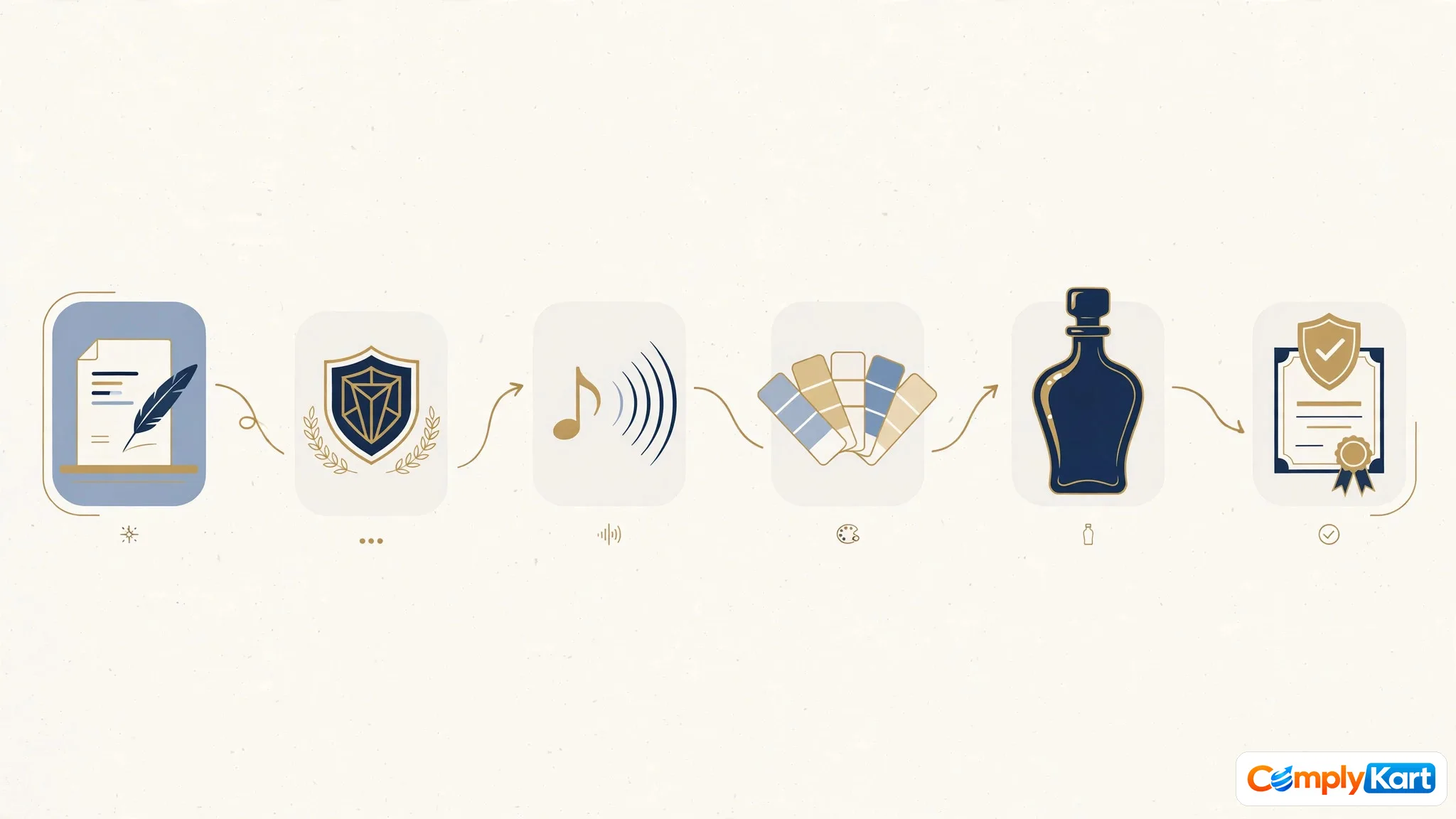
Indian trademark law does not give you one kind of protection. It gives you a shelf of them. A word mark guards the name. A device mark guards the logo. A sound mark guards the jingle. A shape mark guards the bottle. Each one protects a different part of the brand, each one is filed separately, and each one costs separately. Pick the wrong type and you pay for protection you do not have.
What are the types of trademarks in India?
A trademark in India is any mark that can be represented graphically and can distinguish one trader's goods or services from another's (Trade Marks Act, 1999, s.2(1)(zb)). The types are word, device, service, collective, certification, series, well-known, and non-conventional marks — shape, colour combination, sound and smell — each filed on Form TM-A in the relevant class.
Two tests decide whether anything qualifies at all. First, can it be drawn, written or recorded clearly enough to go on the register and be published in the Trade Marks Journal? Second, does it actually tell customers who the goods or services come from? A mark that fails either test is not a trademark, whatever it looks like. Everything below is an application of those two tests to a different part of a brand.
Think of your brand as a person walking into a room. The name is what people call them. The face is what people recognise. The voice is what people hear before they turn around. The signature colour is the jacket they always wear. The silhouette is the shape people spot from across the street. Trademark law lets you protect each of those separately — and the mistake is assuming that protecting one protects them all.
Types of trademarks at a glance
| Type | What it protects | One real example | The law |
|---|---|---|---|
| Word mark | The name, word or slogan itself, in any font or style | TATA, AMUL, Google | s.2(1)(m) |
| Device mark | One specific logo, symbol or design exactly as drawn | Nike swoosh, Apple logo | s.2(1)(m) |
| Service mark | A mark for services rather than physical goods | A bank's name in class 36 | s.2(1)(zb) |
| Collective mark | A mark owned by an association, used by its members | CA (ICAI), Darjeeling Tea | ss.61–68 |
| Certification mark | A mark certifying origin, material, quality or method | Woolmark, ISI, Hallmark | ss.69–78 |
| Series mark | Several similar marks of one owner, in one registration | McDonald's "Mc" family | s.15(3) |
| Well-known mark | A famous mark, protected even for unrelated goods | Marks on the Registrar's well-known list | s.2(1)(zg), s.11 |
| Shape / 3D mark | The shape of goods or their packaging | Toblerone's triangular prism | s.9(3), s.2(1)(zb) |
| Colour mark | A combination of colours identifying one trader | A two-colour packaging pattern | s.10 |
| Sound mark | A distinctive jingle or sound | Yahoo yodel (2008) | Rule 26(5) |
| Smell mark | A scent identifying the goods | None registered in India | — |
Word marks: the name itself
A word mark protects a word, a set of letters, a numeral or a slogan — on its own, independent of any font, colour or styling. Register "TATA" as a word mark and you own the word as a brand identifier, however it is written. That is why it is usually the first filing a business makes.
The strength of a word mark depends entirely on how distinctive the word is. Invented words — "ZARA", "AMUL" — are the strongest. Ordinary words used in an unrelated field — "APPLE" for computers — work because nobody expects a computer company to sell fruit. Descriptive words are the trap: a word that simply describes the goods, like "Cotton Comfort" for bedsheets, will run into section 9(1)(b) and the examiner will refuse it unless you can show years of use have made the public associate it with you alone. File the invented name first. File the descriptive one only after it has earned its distinctiveness in the market.
Device marks: the logo, exactly as drawn
A device mark protects a logo, label or design as an image. It can include words as part of the artwork — the stylised way "AMAZON" is written, the golden arches, the Nike swoosh. But the protection is narrow in one specific way: it covers the logo as represented. Change the font, redraw the symbol, recolour the artwork, and the new version is a different mark.
That narrowness is the whole point of filing a word mark alongside it. The word mark protects the name in every style; the device mark protects the visual identity customers recognise at a glance. One without the other leaves a gap: a competitor using your name in a different font does not infringe your device mark. If you are choosing between the two and can only afford one filing this quarter, file the word mark first. Names travel further than pictures. Our comparison of the two, word mark vs logo mark: which to register first, works through that choice with examples.
A combination mark — word and device filed together in one application — is the third option, and it is the one to be careful with. It costs one fee instead of two, but it protects only the combination. If you later use the word alone, the combination registration does not cover it. Two separate filings cost more and protect more. That is the trade, and it is worth stating plainly before anyone chooses the cheaper route.
Service marks: the same law, for services
Before the 1999 Act, Indian trademark protection covered goods only. The Act changed that by extending the same definition — "goods or services" in section 2(1)(zb) — to services. A service mark distinguishes one provider's services from another's: a bank, a hospital, a software company, a coaching platform, a restaurant chain.
There is no separate form and no separate procedure. You file the same Form TM-A, in the service classes — classes 35 to 45 cover advertising, finance, education, hospitality, legal services and the rest. A coaching platform belongs in class 41, a fintech in class 36, a restaurant in class 43. The trademark class finder is the quickest way to check which class your service actually sits in before you file.
Collective marks: owned by the group, used by the members
A collective mark belongs to an association, not to a single business. Its job is to distinguish the goods or services of the association's members from those of everyone else. Sections 61 to 68 govern them, and the association — not a partnership firm — must file regulations explaining who may use the mark and how.
The examples are all around you. The "CA" mark belongs to the Institute of Chartered Accountants of India; only its qualified members may use it. Darjeeling Tea is a collective mark of the Tea Board's registered producers. The Confederation of Indian Industry's "CII" mark works the same way. The owner of a collective mark usually does not trade in the goods itself — it polices the standard and lets members carry the badge. If your business is a single company, a collective mark is not your filing. If you run an association, a cooperative or a producer group, it may be the only filing that fits.
Certification marks: a stamp, not a brand
A certification mark is easy to confuse with a collective mark, and the difference matters. A certification mark does not say who made the goods. It says the goods have been certified — for origin, material, mode of manufacture, quality, accuracy or some other characteristic — by the proprietor of the mark. Sections 69 to 78 govern them, and the proprietor must not itself trade in the certified goods.
Woolmark certifies products are made of 100% wool. The ISI mark certifies a product conforms to an Indian standard set by the Bureau of Indian Standards. Hallmark certifies the purity of gold and silver jewellery. AGMARK certifies agricultural produce against a government grade standard. The FSSAI logo on a food packet is the certification mark most Indians see every day. A certification mark is a trust device, not a brand asset — you apply for one when you are the body setting the standard, not when you are the business meeting it.
Series marks: one registration, a family of marks
Section 15(3) lets one owner register several marks that resemble each other in material particulars but differ only in matters of a non-distinctive character — as a series, in one registration. The classic example is McDonald's "Mc" prefix: McVeggie, McPuff, McMuffin, McFlurry. The shared element does the distinguishing work; the differing words are not distinctive on their own.
The practical case is a brand with variants: the same name in different colours, the same name with different numerals for different sizes, the same prefix across a product line. Filing them as a series saves a separate application for each variant, but the test is strict — the marks must resemble each other in the respects that matter, and differ only where it does not. If the variants are genuinely different marks, they need genuinely separate filings.
Well-known marks: famous enough to cross classes
Ordinarily a trademark protects you only in the class you filed in. A well-known mark breaks that rule. Under section 2(1)(zg) and section 11, a mark known to a substantial segment of the public is protected even when someone else uses it for completely different goods — the protection follows the fame, not the class.
You no longer need a court order or a dispute to get on the list. Under Rule 124, anyone can apply directly to the Registrar on Form TM-M, with a statement of case and evidence of use, promotion, market recognition, registrations and enforcement history. The government fee is ₹1,00,000. The evidence burden is the real cost: the Registrar wants proof that the public actually knows the mark, not just that the business is proud of it. A 2026 SOP from IP India guides how to organise that evidence; the route itself has not changed.
Shape marks: the bottle, the box, the silhouette
A shape mark protects the three-dimensional shape of goods or their packaging — the contour of a bottle, the triangular prism of a Toblerone bar, the shape of a perfume flask. The Act's definition expressly includes "the shape of goods, their packaging", and the application is filed with at least five different views of the shape so the Registry can see it from every side.
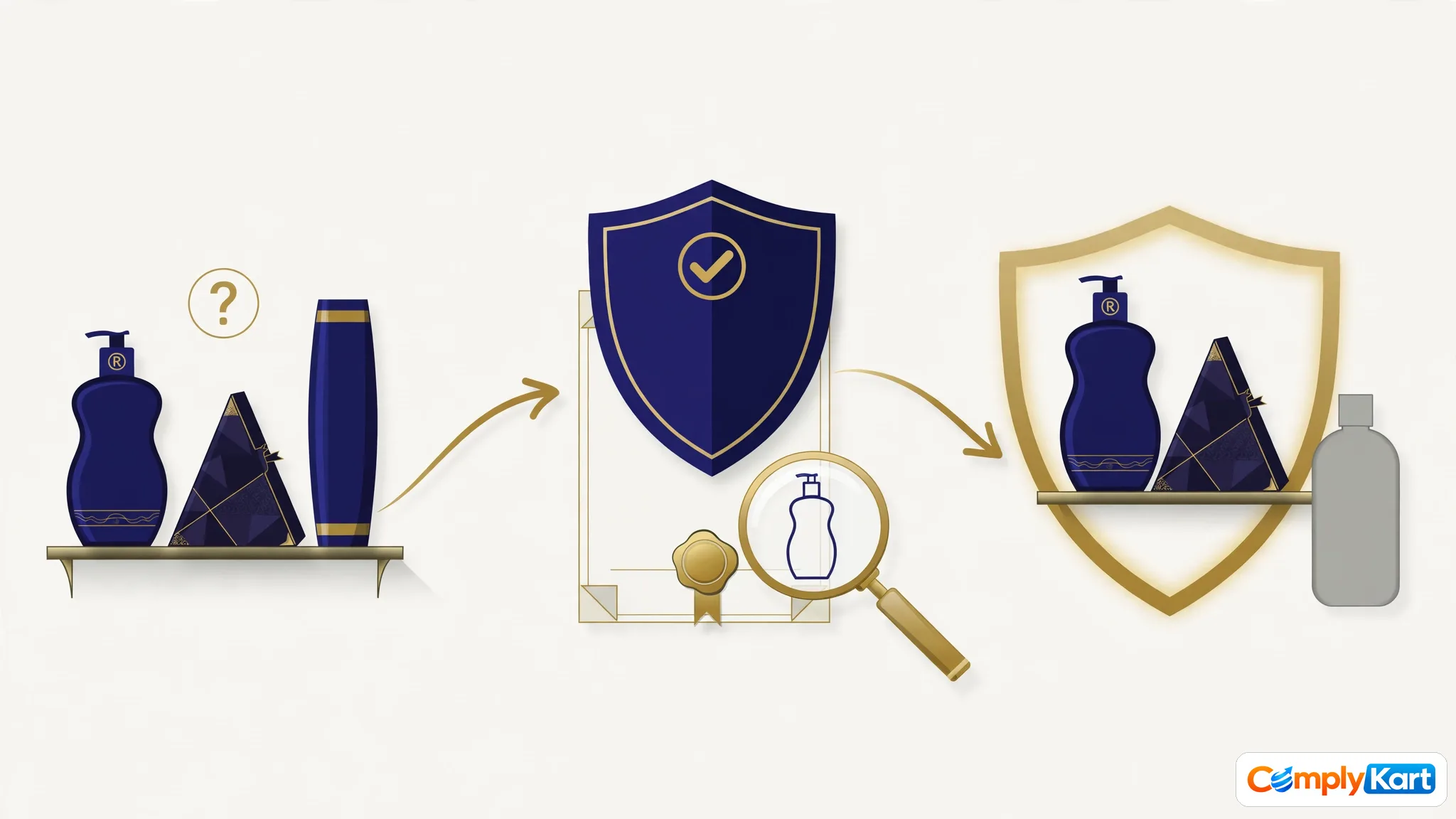
Shape marks are the hardest conventional filing to win, for two reasons. Section 9(3) bars shapes that result from the nature of the goods, shapes necessary for a technical result, and shapes that give substantial value to the goods — and that bar cannot be cured by long use. And the Delhi High Court in Knitpro International v Examiner of Trade Marks set the secondary-meaning threshold for shape marks "quite high": the public must recognise the shape alone, without the name or logo attached, as pointing to one trader. Read our full guide to trademarking product packaging, shape or design separately from the brand name before spending on a shape filing — it works through the Knitpro test and the section 9(3) bars. Where the shape is really the asset, design registration is often the faster, surer first step.
Colour marks: combinations, not single colours
A combination of colours can be a trademark if it has acquired a strong association with one trader — a specific two-colour pattern used consistently on packaging, for instance. Section 10 allows a mark to be limited to a combination of colours, and a mark registered without a colour limitation is treated as registered for all colours.
A single colour is a different story. The Act makes no express provision for registering one colour on its own, and the Registry and courts follow the colour-depletion theory: there are only so many colours, and letting one trader own one would starve the rest of the market. Cadbury's purple is the example everyone quotes. In India, do not plan a filing around a single colour. Plan it around a combination that customers actually recognise as yours, and be ready to prove it with years of consistent use.
Sound marks: the jingle has a form to fill
Sound marks are the most practical of the non-conventional types, because the Rules give them a clear filing route. Under Rule 26(5) of the Trade Marks Rules, 2017, a sound mark is filed by submitting the sound in MP3 format, of not more than thirty seconds, accompanied by a graphical representation of its notations. The jingle must be reducible to musical notes — a melody can be notated; a dog barking or a car honk cannot, and an onomatopoeic description will not do.
India's first registered sound mark was Yahoo's three-note yodel, granted in 2008. ICICI Bank followed as the first Indian entity to register a sound mark, with the notes of its corporate jingle. Britannia's four-note jingle and others have joined since. If your jingle is a melody, it is filable; if it is a noise, it is not. File it before it becomes famous enough for someone else to copy.
Smell marks: the honest answer is not yet
A smell mark would protect a scent that identifies the goods — the smell of fresh-cut grass on tennis balls, a floral fragrance on tyres. The definitions in the Act do not expressly exclude smell. But no smell mark has been registered in India, and the reason is the same two tests from the start of this article: a verbal description of a scent — "balsamically fruity, with a hint of cinnamon" — is neither precise nor objective enough to define the scope of a monopoly, and there is no equivalent of an MP3 file for smell.
That is worth saying plainly because several guides list smell marks alongside the others as though they were equally available. They are not. If a scent is central to your product, protect it another way — through trade-secret discipline, through the packaging and shape, through the brand around it — and do not budget for a smell filing.
What does each type cost?
Every type is filed on Form TM-A, and the government fee is charged per class, per mark. E-filing costs ₹4,500 for an individual, a startup or a small enterprise, and ₹9,000 in all other cases. Physical filing costs ₹5,000 in the small-entity band. The fee is the same for every type; what changes is how many marks you file, and in how many classes.
Three worked stacks, all e-filing, one class:
| Brand situation | Filings | Small entity / startup | Company |
|---|---|---|---|
| Solo founder, name + logo | Word mark + device mark | ₹9,000 | ₹18,000 |
| D2C brand, name + logo + packaging shape | Word + device + shape | ₹13,500 | ₹27,000 |
| Services brand, name in two classes (e.g. 41 + 42) | Word mark × 2 classes | ₹9,000 | ₹18,000 |
Add the well-known route only if the fame is real: ₹1,00,000 on Form TM-M, plus the evidence work. And remember the renewal clock: registration lasts ten years under section 25, renewable on Form TM-R at ₹9,000 per class per mark. A brand that files three marks in two classes is not paying ₹9,000 — it is paying ₹54,000 as a company, and ₹54,000 again every ten years. That is the number to budget, not the headline fee.
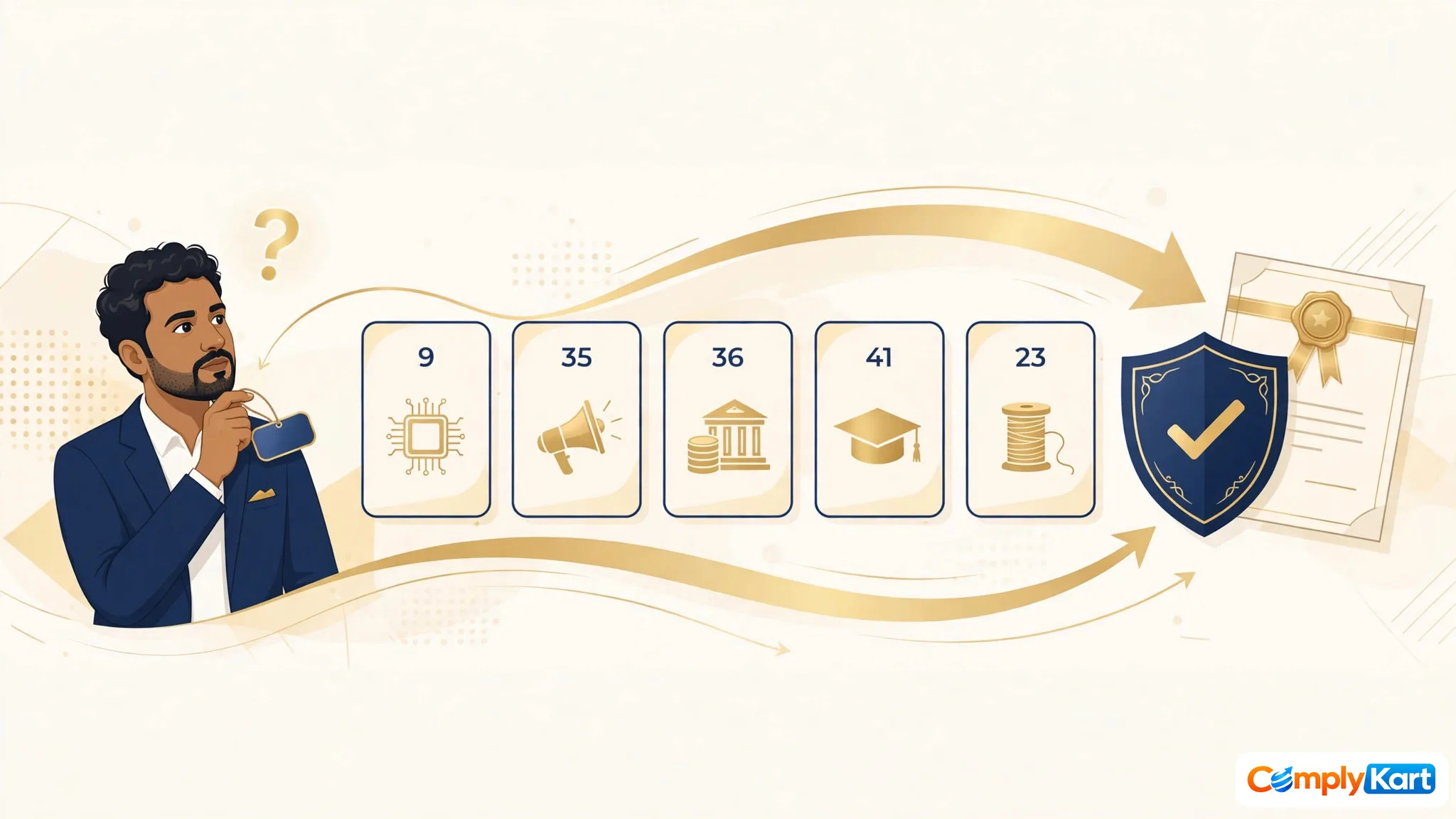
For the full fee picture — including objection, opposition and renewal costs — see our trademark registration fees guide, and check your class before you file with the trademark class finder. Class choice is where most first filings go wrong; our class guides for 9, 35, 36, 41 and 23 cover the five most-searched classes in detail.
Which trademark type should you file first?
Three questions settle it. First, which brand element carries the commercial weight — the name customers type, or the logo customers recognise? Second, who controls the use — you alone, an association's members, or a certifying body? Third, how distinctive is the feature — invented, arbitrary, or descriptive?
| Your situation | First filing |
|---|---|
| The brand name is the main asset | Word mark |
| The logo has unique artwork and strong recognition | Device mark |
| Both name and logo matter independently | Word mark and device mark, filed separately |
| You sell services, not goods | Service mark in classes 35–45 |
| You run an association or producer group | Collective mark (ss.61–68) |
| You set a standard others must meet | Certification mark (ss.69–78) |
| Your product line shares one prefix or pattern | Series mark (s.15(3)) |
| Your mark is famous across India | Well-known application (Rule 124, TM-M) |
| Your jingle is a melody people hum | Sound mark (Rule 26(5)) |
| Your packaging shape is the recognition | Shape mark — after reading the Knitpro test |
Before you file anything, run a public search on the IP India portal. A search costs nothing and catches the identical or similar mark that would have cost you the filing fee and a year of waiting. File the word mark first, add the device mark when the logo is final, and treat shape, colour and sound as second-round filings.
What changed in 2026
The law itself has not changed. The Trade Marks Act, 1999 and the Trade Marks Rules, 2017 still govern registration, and the 2026 developments are supplementary — procedure and guidance, not a rewrite. Three are worth knowing. IP India rolled out e-KYC for the professionals who represent brand owners, with the final deadline extended to 30 September 2026 — check yours has completed it, or they may struggle to file for you. A revised draft of the Trade Marks Office Practice and Procedure Manual went out for comments on 21 August 2026: draft guidance, not law, but a preview of how examiners will approach your application. And the Registry published draft guidelines on AI use in proceedings on 16 October 2026, proposing a declaration on every filing about whether AI was used, with penalties for fake citations. A special disposal drive for pending oppositions began on 31 August 2026 — a reminder that the opposition clock is strict: four months to oppose, two months to answer. None of this changes which type you file. All of it changes how carefully the filing needs to be done.
Five mistakes founders make with trademark types
1. Filing only the logo. The device mark protects the artwork, not the name. A competitor can use your name in a different font and your registration will not stop them.
2. Filing a descriptive word and expecting it to pass. "Best Sweets" or "Cotton Comfort" describes the goods. Section 9(1)(b) will refuse it unless years of use have made it distinctive. File the invented name instead.
3. Filing a shape that does the job. A shape that is necessary for a technical result, or that gives the goods their value, is barred by section 9(3) — and no amount of use cures it.
4. Filing in the wrong class. A coaching platform in a goods class, a restaurant in class 35 instead of 43, a D2C brand in one class when it trades in two. The class decides what you own. Check it before you pay.
5. Using ® before registration. The ® symbol is for registered marks only. Using it on an unregistered mark is an offence under section 107. Use ™ while the application is pending.
Frequently asked questions
Which trademark type should a startup file first?
The word mark, in almost every case. The name is what customers search, type and ask for, and a word mark protects it in any font or style. Add the device mark once the logo is final, and treat shape, colour and sound as second-round filings.
Can I file a word mark and a device mark together?
You can file them as one combination mark for one fee, but it protects only the combination — the word with that artwork. Filing them separately costs two fees and protects each element on its own. Most brands that can afford it file separately.
How much does it cost to register all the types?
Each type is a separate Form TM-A at ₹4,500 (individual, startup or small enterprise) or ₹9,000 (others) per class, per mark. A company filing word, device and shape marks in one class pays ₹27,000 in government fees. A well-known application is a separate ₹1,00,000 on Form TM-M.
Is a service mark different from a trademark?
Not in law. The Trade Marks Act, 1999 covers "goods or services" in the same definition, and a service mark is filed on the same Form TM-A — the only difference is the class: services sit in classes 35 to 45.
Can I trademark my brand's colour alone?
Not practically. The Act makes no express provision for a single colour, and the Registry follows the colour-depletion theory — one trader cannot own a colour outright. A combination of colours that customers associate with you is the filing that works, with evidence of acquired distinctiveness.
The shelf is there for a reason. A brand is never just a name, and the law knows it. File the name first, file the face second, and file the voice, the colour and the shape when each one has earned its place. Getting the types right costs a few thousand rupees and one careful afternoon. Getting them wrong costs a year of waiting and the discovery that the part of your brand everyone recognises was never yours on paper. If you want the filings handled, trademark registration with ComplyKart covers the search, the class check and the filing — the order above is the order we would file in.



Comments
No comments yet — ask the first question below.
Join the discussion
Questions go straight to our expert desk. Comments appear after a quick review — no spam, no noise.