
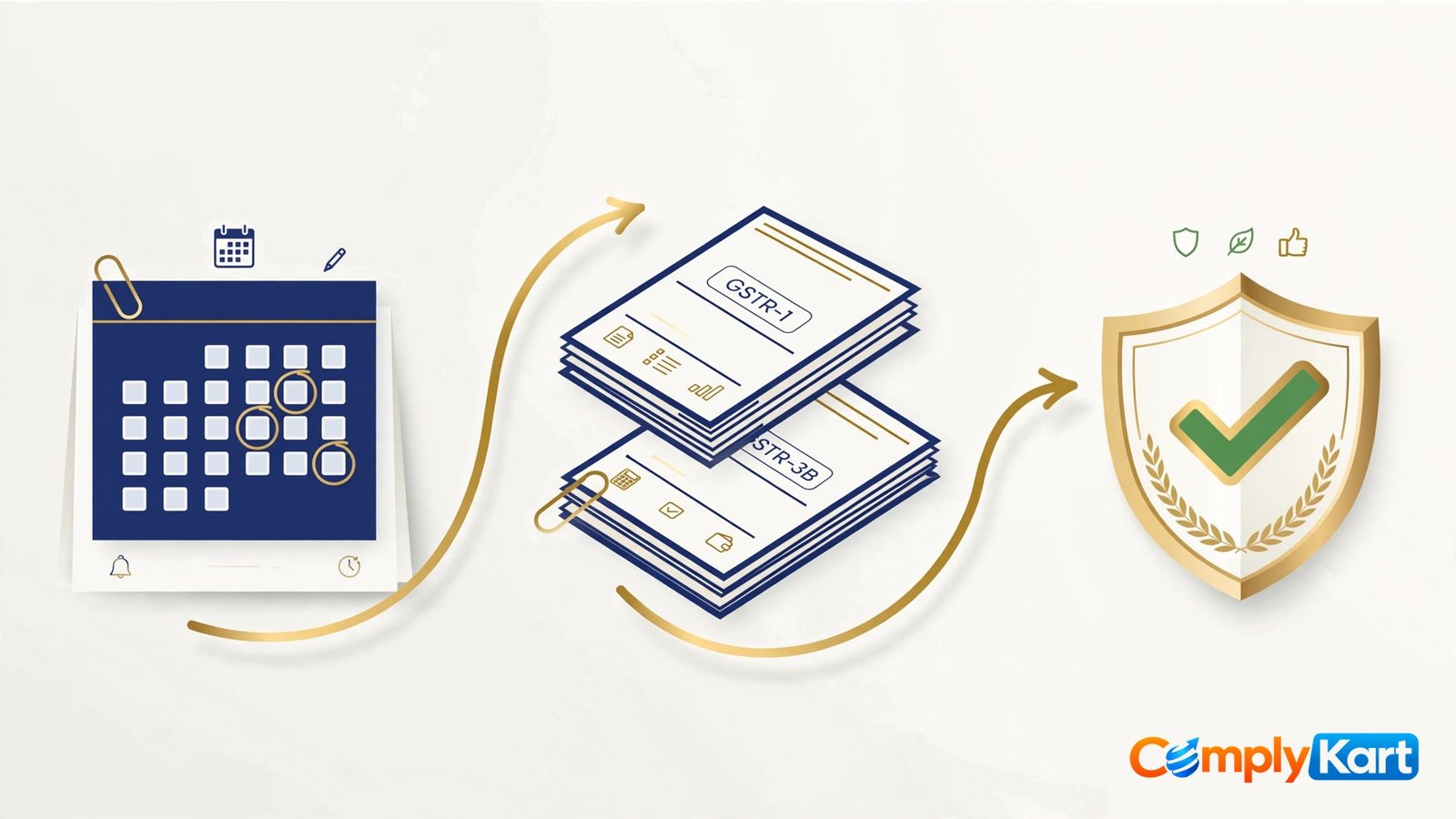
GST return filing is a monthly rhythm: GSTR-1 (sales) by the 11th and GSTR-3B (summary plus payment) by the 20th of the following month. A late GSTR-3B draws ₹50 per day (₹20 for nil returns), capped at ₹2,000–₹10,000 by turnover, plus 18% annual interest on late tax paid. Claim only the input tax credit your GSTR-2B shows — mismatches get flagged automatically.
- GSTR-1 is due the 11th and GSTR-3B the 20th of the next month; QRMP taxpayers file quarterly (GSTR-1 by the 13th, GSTR-3B by the 22nd/24th).
- Late GSTR-3B fees: ₹50 per day (₹20 per day for nil returns), capped at ₹2,000, ₹5,000, or ₹10,000 by turnover slab.
- Interest runs at 18% per annum on net cash liability paid late, and 24% on wrongly availed and utilised credit.
- FY 2025-26 ITC cut-off: 30 November 2026. The 57th Council's late-fee waiver is a recommendation, not law.
GST compliance is a rhythm, not an event — and the businesses that struggle aren't the ones with complicated transactions, they're the ones that never learned the calendar. This guide is the calendar, the rules behind it, and the fixes for when the portal misbehaves.
Which GST returns do I need to file?
GSTR-1 — your sales, due the 11th. Invoice-wise outward supplies: B2B line by line, B2C in consolidated slabs. No tax is paid here — but your buyers' purchase records flow from this, which is why getting it right matters beyond your own filing.
GSTR-3B — the summary and the payment, due the 20th of next month. This is where tax changes hands: declare outward supplies, claim input tax credit, discharge reverse charge, and pay the net amount via the electronic ledgers. File even with zero transactions — a nil return is still a return.
QRMP — quarterly for small taxpayers. Turnover up to ₹5 crore? Opt for quarterly filing: GSTR-1 by the 13th of the month after the quarter, GSTR-3B by the 22nd or 24th depending on your state. Tax is still paid monthly via PMT-06. The Invoice Furnishing Facility (IFF) lets you upload B2B invoices monthly by the 13th so buyers don't lose credit.
Composition dealers — CMP-08, due the 18th of the month after each quarter, plus the annual GSTR-4 by 30 April. Simpler returns, but you can't claim input tax credit — know the trade-off before you opt in.
GSTR-9 — the annual return, due 31 December. Mandatory if your aggregate turnover exceeds ₹2 crore in the financial year (taxpayers up to ₹2 crore are exempt under Notification 15/2025). It reconciles everything you filed during the year.
GSTR-9C — the reconciliation statement, due 31 December, for turnover above ₹5 crore. It's self-certified now — no CA sign-off required — but it's still a line-by-line reconciliation of your annual return against your books. For FY 2025-26, the portal opened GSTR-9 and 9C filing in October 2026 with the due date showing as 31 December 2026.
What is GSTR-2B and how does ITC matching work?
Before you touch GSTR-3B each month, open GSTR-2B — the auto-drafted statement of input tax credit available to you, generated from your suppliers' GSTR-1 filings. The rule is simple: claim only what 2B shows as eligible, then chase vendors for whatever's missing. Claim credit your supplier never reported and you're building a mismatch the department's systems will flag.
My monthly routine: lock the eligible credit from 2B, strip out blocked credits (motor vehicles, food, personal use — Section 17(5)), reverse common credit under Rule 42 for exempt supplies, handle reverse charge (pay in cash first, then claim), and only then draft 3B.
Watch the ITC cut-off too. For FY 2025-26, the last date to avail eligible credit is 30 November 2026 or the date you file the annual return, whichever is earlier, under Section 16(4). Miss it and the credit is gone — no extensions, no exceptions.
What are the late fees for filing GST returns late?
File GSTR-3B late and the portal charges ₹50 per day — ₹20 per day for nil returns. The caps depend on your turnover:
- Turnover up to ₹1.5 crore: capped at ₹2,000 per return (₹500 for nil returns)
- ₹1.5 crore to ₹5 crore: capped at ₹5,000
- Above ₹5 crore: capped at ₹10,000
Two things people get wrong: the late fee sits in next month's return, which you cannot file until the fee is paid — one late month chains into the next. And beyond the daily fee, the department has in some cases invoked Section 125's general penalty for late filing. File on time.
One development to watch: the 57th GST Council (October 2026) recommended waiving late fees for taxpayers up to ₹5 crore turnover who file by the end of the month in which the return was due. As of now that's a recommendation, not law — no notification has been issued. The current rules apply in full until one is.
How much interest applies on late GST payment?
Pay tax late and interest runs at 18% per annum on the net cash liability — liability minus available credit, not the gross amount, computed day by day. Wrongly availed and utilised credit is worse: 24%. That gap is the cost of sloppy ITC claims, entirely avoidable with the 2B discipline above.
Do I need to file GST returns in months with no sales?
A month with no sales still needs a GSTR-3B and a GSTR-1 — file them as nil. Three quiet months, three unfiled returns, and suddenly the portal won't let you file the current month until the backlog plus late fees is cleared. Nil filing takes minutes; treat the 11th and 20th like rent.
How do I fix common GST portal errors?
The GST portal has moods. The classic: the emSigner "failed to establish connection" error — run the utility as administrator, accept the local certificate, allow JavaScript, and retry. A recent one: some taxpayers saw GSTR-1 and GSTR-3B showing as pending after filing, which disabled the annual-return option. That's a portal-side glitch — don't re-file; wait for the fix or raise a grievance ticket.
DRC-01C notices flag mismatches between your GSTR-1 and 3B, or 2B and 3B. Answer with workings attached — ignoring it can freeze subsequent filings until the discrepancy is addressed.
What is the difference between GSTR-9 and GSTR-9C?
GSTR-9 summarises your year — what you reported, month by month. GSTR-9C reconciles that summary against your books and explains the differences. Start early: differences found in October are fixable, ones found on 30 December are not. And FY 2025-26 spans two rate regimes (rates changed 22 September 2025), so check old-rate and new-rate supplies are classified correctly.
The whole system rewards one habit: file every return on its date, reconcile monthly, never let a backlog start. Businesses that do spend a few hours a month on GST; the rest spend weeks digging out of holes — plus late fees, interest, and notices.
Frequently asked questions
Can I file GSTR-3B without filing GSTR-1?
Technically the portal lets you, but don't make a habit of it. Your GSTR-1 feeds your buyers' GSTR-2B — skip it and their input tax credit stalls, which means angry phone calls and, eventually, lost customers. The 11th-then-20th order exists for a reason: report sales first, then pay on the summary. Follow the order and the return practically writes itself.
What happens if I miss the ITC cut-off date?
The credit is gone — no extensions, no exceptions. For FY 2025-26, eligible input tax credit must be availed by 30 November 2026 or the annual return filing date, whichever is earlier, under Section 16(4). Reconcile monthly and you will never be the person discovering a six-figure credit died in November.
I filed a nil return late — do I still pay late fees?
Yes, but at the lower rate: ₹20 per day instead of ₹50, capped at ₹500 for the smallest turnover slab. Nil filing takes minutes, so a late nil return is the most avoidable penalty in GST. Set a recurring reminder for the 11th and the 20th and treat it like rent — non-negotiable, even in dead months.
What is a DRC-01C notice and should I worry about it?
It is the system's way of saying your numbers don't line up — typically GSTR-1 versus 3B, or 2B versus 3B. Answer with your workings attached; ignoring it can freeze subsequent filings until the discrepancy is addressed. Most DRC-01Cs trace back to sloppy ITC claims — preventable with the monthly 2B discipline above.
Is the 57th GST Council's late-fee waiver in force yet?
No. The Council recommended waiving late fees for taxpayers up to ₹5 crore turnover who file by the end of the month in which the return was due — but that is a recommendation, not law, and no notification has been issued. Current late-fee rules apply in full until one is. Do not plan around relief that hasn't been notified.
If you'd rather hand the calendar to someone who lives in it — monthly filings, ITC matching, annual returns, the notices — our GST team handles exactly that, for businesses in every state. One conversation and you'll know where your compliance stands today.




Comments
No comments yet — ask the first question below.
Join the discussion
Questions go straight to our expert desk. Comments appear after a quick review — no spam, no noise.