
GST on Gold Jewellery in India: Rates on 18, 22, 24 Carat Explained
Walk into any jewellery store this wedding season and the price tag tells you only half the story. The other half is tax — and on gold, the tax works differently from almost everything else you buy. Two rates, not one. A split bill. And a set of rules that survived the biggest GST overhaul in years without a scratch.
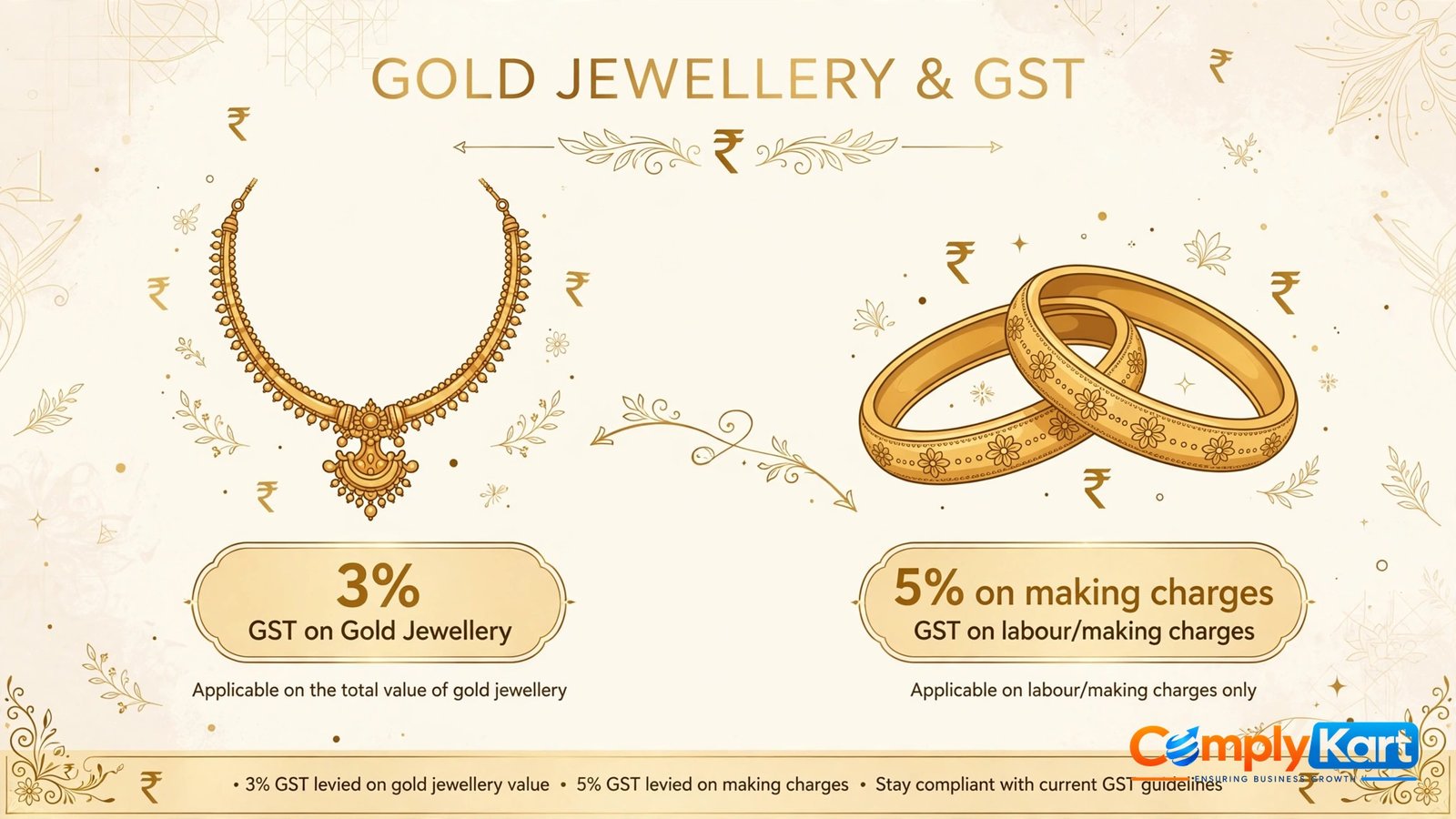
The short answer: Gold jewellery in India carries 3% GST on the metal value and 5% GST on making charges — two separate lines on your bill, identical for 18, 22 and 24 carat. The 56th GST Council meeting on 3 September 2025 — the one that collapsed the old four-slab structure into 5% and 18% — left gold exactly where it was. Coins and bars stay at 3% too.
Why does gold get its own special GST rate?
Almost everything in India now falls into the 5% or 18% GST slabs (with 40% for luxury and sin goods). Gold sits outside that framework at 3%. The reason is practical, not sentimental: gold is the one commodity where a higher tax rate pushes buyers straight into the unorganised market. The Council has always treated bullion as a sensitive category, and GST 2.0 kept that thinking intact.
What this means for you is simple. When the government cut GST on soaps, electronics and insurance from September 22, 2025, jewellery prices did not move on account of tax. Your gold bill looks exactly like it did before the reform. (If you're a jeweller who hasn't yet taken GST registration, the threshold rules apply to you like any other trader — and our GST registration cost guide walks through what that actually costs.)
How does the GST split work on a jewellery bill?
This is where most buyers get confused, so let's walk through a real bill. Say you buy a necklace where the gold itself is worth ₹1,00,000 and the making charge is ₹5,000.
Two separate tax lines appear. First: 3% on ₹1,00,000 — that's ₹3,000. Second: 5% on ₹5,000 — that's ₹250. Your total comes to roughly ₹1,08,250 before any other charges the jeweller adds.
Notice what the jeweller did: they billed the metal and the labour as two distinct components. That split isn't a courtesy. It reflects how the law treats them — the gold as goods at 3%, the craftsmanship as a service (job work) at 5%. Every line on that bill must also follow the GST invoice format — 16 mandatory fields, no exceptions. Making charges were taxed at 18% when GST launched in 2017; the rate was brought down to 5% years ago, and the September 2025 reform left it there.
Does carat change the GST rate?
No — and this is worth stating plainly because jewellers' sales talk sometimes implies otherwise. The 3% rate applies to gold of any purity: 24 carat (pure gold, mostly coins and bars), 22 carat (the standard for jewellery), and 18 carat (common in diamond-studded and lightweight pieces). Carat changes the price of the metal. It does not change the tax rate.
What carat does change is the making charge. Intricate 18-carat diamond jewellery typically carries higher making charges than a plain 22-carat bangle — and since making charges attract 5% GST, the tax on the labour component rises with the craftsmanship, not the purity.
Exchanging old gold: the part nobody explains
Here is where the bill gets interesting. When you exchange old jewellery for new, the jeweller does not charge you 3% GST on the full value of your old gold. Under the margin scheme for second-hand goods, GST applies only to the margin — the difference between what the jeweller pays you and what they eventually sell it for.
In practice, most jewellers adjust the old gold's value against your new purchase and tax only the new gold and the fresh making charges. If your jeweller tries to charge full GST on the exchange value of your old ornaments, ask them to show the margin-scheme working. That single question has saved buyers real money.
What jewellers often get wrong
I have seen three recurring mistakes on the seller's side, and each one lands on the buyer's bill or the jeweller's compliance record.
First, charging 5% on the entire bill. Some jewellers apply 5% across gold value plus making charges, either from habit or confusion. The metal is 3%. Always. If your bill shows a single 5% line on everything, the arithmetic is wrong.
Second, burying the making charge. A few sellers quote an "all-inclusive" price without splitting metal value and making charges. Without the split, you cannot verify the tax — and the jeweller cannot prove they applied the right rates if questioned. Insist on the two-line bill. It is your right, and it is their obligation.
Third, GST on the exchange bonus. Festival-season "zero deduction" or "full value" exchange offers are marketing, not tax law. The margin scheme still governs what the jeweller pays tax on. A bonus on exchange value does not create a fresh GST liability on your old gold.
A quick word on import duty
GST is not the only tax baked into gold prices. The Union Budget 2024–25 cut the Basic Customs Duty on gold from 12.5% to 5%, and with the agriculture cess at 1% plus 3% IGST, the total tax on imported gold fell from around 15% to roughly 9%. That cut is a large part of why domestic gold prices softened through 2025. When someone tells you gold got "cheaper this year," the customs duty cut — not GST — is usually why.
Before you buy this season
Three checks, thirty seconds each. One: the bill splits gold value (3% GST) and making charges (5% GST) into separate lines. Two: the rate is the same whether the tag says 18, 22 or 24 carat. Three: on exchange, you are taxed on the new purchase, not penalised on the old.
Gold GST: quick answers
Is GST on gold the same for 18, 22 and 24 carat?
Yes. The 3% rate applies to gold of any purity — carat changes the metal's price, never the tax rate. What does change with carat is usually the making charge, which carries its own 5% GST.
How much GST do I pay on making charges?
5%. Making charges are treated as job-work services, taxed separately from the 3% on the gold itself. If your bill shows a single blended rate on everything, ask the jeweller to split it — the two-line bill is your right.
Do I pay GST when exchanging old gold jewellery?
Not on the old gold's full value. Under the margin scheme for second-hand goods, GST applies only to the jeweller's margin — in practice, you're taxed on the new gold and the fresh making charges, with the old gold's value adjusted against your purchase.
Did GST 2.0 change the tax on gold?
No. The September 2025 reform collapsed most goods into 5% and 18% but left gold untouched at 3% on metal value and 5% on making charges. If your jewellery bill looks different this year, the cause is gold prices or customs duty — not GST.
I'm a jeweller — what registrations do I actually need?
At minimum, GST registration once you cross the threshold — and if you're launching fresh, the new Rule 14A fast-track route may get you registered in 3 working days. Building a brand name worth protecting? Get trademark registration before a competitor files first. And run your annual compliance cost through our free calculator so the year's filings hold no surprises.
Gold will always be an emotional purchase in India. The tax on it doesn't have to be a mysterious one. And if you're a jeweller reading this and your billing format still doesn't split the two components cleanly, fixing it now beats explaining it to an officer later — that's the kind of cleanup our team handles every week.





Comments
No comments yet — ask the first question below.
Join the discussion
Questions go straight to our expert desk. Comments appear after a quick review — no spam, no noise.