
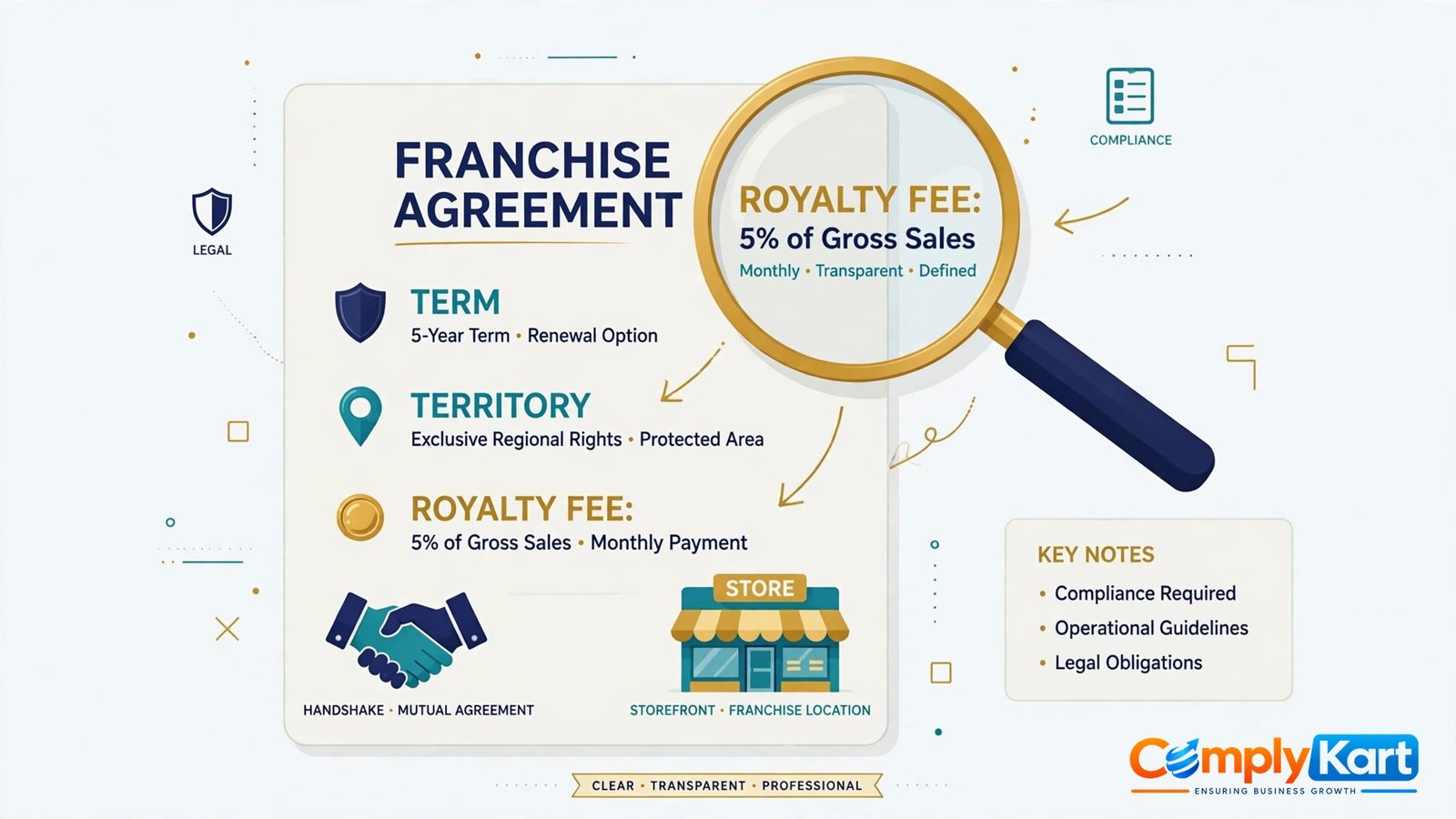
Here is the single most important thing to know about franchising in India: there is no franchise statute. No Franchise Act, no mandatory disclosure law, no cooling-off period written into legislation. Your entire relationship with the franchisor rests on one document — the franchise agreement — interpreted under the Indian Contract Act, 1872 and the relevant intellectual property laws. That makes reading it properly not just advisable but essential — and the agreement is only half the homework; the other half is diligence on the franchisor.
The short answer: since no franchise-specific law protects you, the agreement must nail down territory, term and renewal, the IP licence, every fee, termination rights, and post-term restrictions — and it must be properly stamped for the state where it will operate. Read the dispute-resolution and unilateral-amendment clauses twice, and have the whole document reviewed by someone who reads franchise agreements for a living before you commit a rupee.
What must a franchise agreement in India contain?
A well-drafted franchise agreement covers, at minimum, these heads. If any of them is missing or vague, treat that as a problem to fix before signing.
Grant and territory. What exactly are you allowed to do, and where? The territory clause should define your exclusive zone with precision — pin codes, radius, or mapped boundaries — not a vague "your area." If exclusivity isn't stated, you don't have it.
Term and renewal. Most franchise terms in India run 5–9 years. Read the renewal clause carefully: does renewal happen automatically, at the franchisor's discretion, or on renegotiated terms? Some agreements let the franchisor rewrite the fee structure at renewal. You want renewal terms locked in, or at least a cap on how much they can change.
Intellectual property licence. This is the heart of the deal — your right to use the brand's trademarks, trade dress, recipes or systems. The clause should confirm the franchisor actually owns the IP being licensed (more on verifying this below) and spell out what happens to your signage and materials if the agreement ends. If the ownership paperwork looks thin, get an independent trademark search and verification done — it takes an afternoon and settles the question.
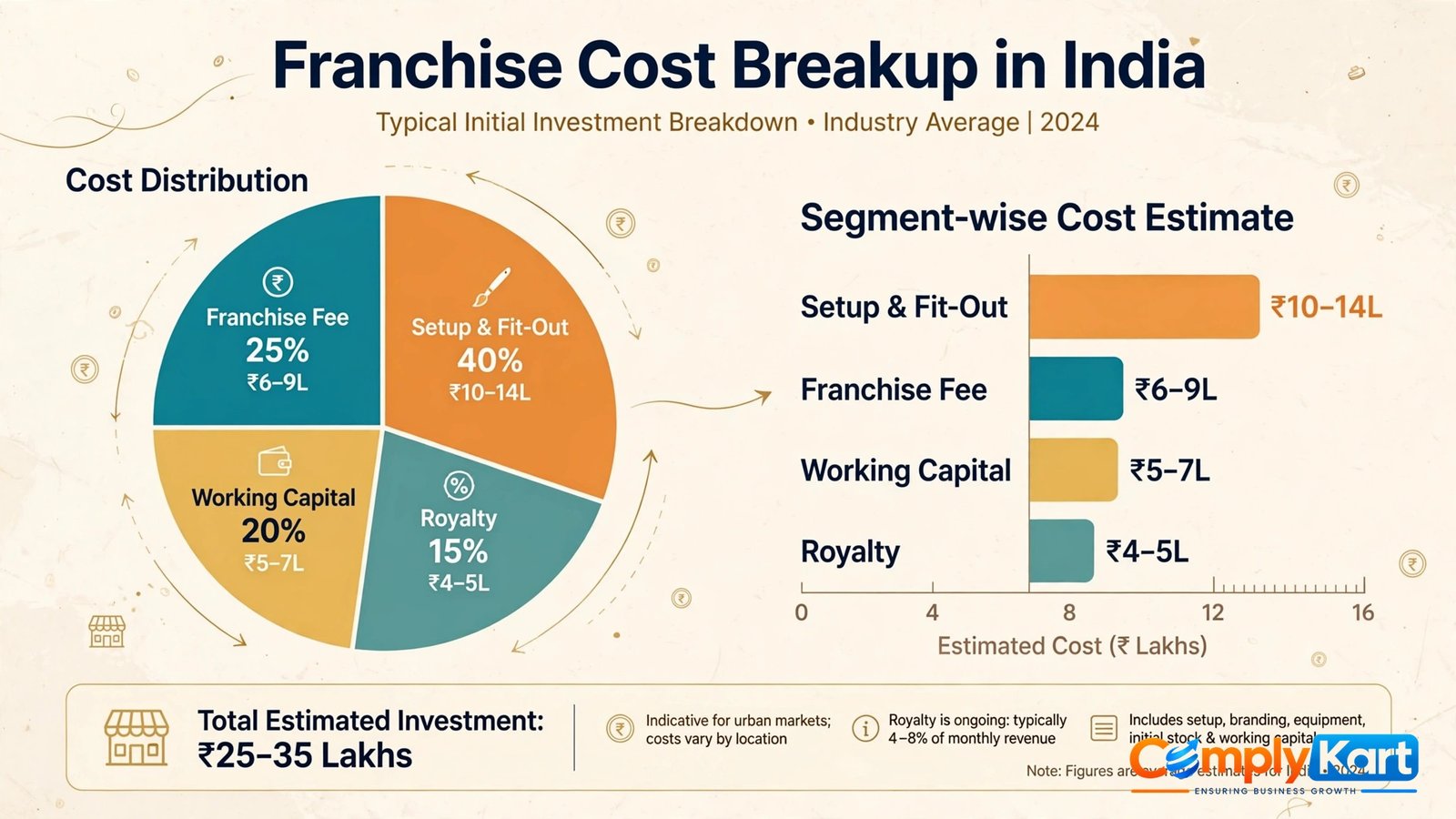
Fees and royalty. Every payment obligation in one place: franchise fee, royalty rate and base (gross vs net revenue), marketing fund contributions, late-payment interest, and audit rights. If the franchisor can audit your books, the agreement should say how often and who bears the cost. Beyond the franchisor's payments, the company itself carries annual ROC and tax compliance costs — estimate those separately so the full burden is visible. And for what the whole investment looks like beyond the paperwork, our cost guide breaks down the real numbers.
Termination. Both sides' rights to end the agreement — for breach (with what cure period?), for insolvency, and without cause (with what notice?). Pay special attention to what you owe on early termination and how long the post-termination restrictions last.
Non-compete and non-solicitation. Most agreements restrict you from running a competing business during the term and for 1–2 years after. Indian courts enforce reasonable restraints but not sweeping ones — a clause banning you from the entire food industry for five years is unlikely to survive a challenge, but don't sign hoping a court will save you. Negotiate it down now.
Operations manual and brand standards. The manual is usually incorporated by reference, which means it forms part of your obligations even though it isn't stapled to the agreement. Check whether the franchisor can update it unilaterally — if they can, they can effectively rewrite your cost structure mid-term by mandating new equipment, new suppliers, or new store formats. The agreement should either freeze the manual version you signed against or require your consent for material changes.
Does a franchise agreement need stamp duty and registration?
Franchise agreements attract stamp duty as commercial agreements, and the rate varies by state — in Maharashtra, for instance, the duty structure differs from Delhi's. An unstamped or under-stamped agreement is still valid between the parties, but it can't be admitted as evidence in court without paying the deficit plus penalty. For a document this important, that's a risk not worth taking. Get the stamping done in the state where the agreement will be performed, and take advice on whether registration adds protection in your case.
Dispute resolution: read this clause twice
Almost every franchise agreement pushes disputes to arbitration, usually seated in the franchisor's home city. That's not inherently unfair — arbitration under the Arbitration and Conciliation Act, 1996 is faster than civil courts — but check three things: who appoints the arbitrator (a sole arbitrator named by the franchisor is a red flag; a neutral appointment mechanism is what you want), the seat and language of arbitration, and whether there's any interim relief mechanism if you need urgent orders. Also note the governing law — it should be Indian law for an India-operated franchise.
What are the red flags in a franchise agreement?
1. Unilateral amendment rights. If the franchisor can change the operations manual — and through it, your cost obligations — without your consent, your financial projections are built on sand.
2. Vague performance targets with termination attached. "Maintain brand standards" is fine. "Achieve quarterly sales targets failing which the franchisor may terminate" — without the targets defined — is a trap.
3. No exit except for franchisor breach. If you can't walk away without proving the franchisor did something wrong, you're locked in. A fair agreement gives both sides a no-fault exit with reasonable notice.
4. IP ownership that's assumed, not stated. The agreement should warrant that the franchisor owns the trademarks and that they're registered or applied for in India. If the brand's trademark is still "pending" or — worse — opposed, your entire business rests on a shaky foundation.
5. Post-termination payments without end dates. Some agreements demand royalty-like payments after termination for years. A short, defined tail is normal. An open-ended one is not.
Frequently asked questions
Is registering a franchise agreement mandatory in India?
Not in the way a sale deed must be registered — but stamp duty is non-negotiable. An unstamped or under-stamped agreement can't be admitted as evidence in court without paying the deficit plus penalty. Get it stamped in the state where the agreement will be performed, and take advice on whether registration adds protection in your case.
Can the franchisor terminate the agreement without notice?
Only if the agreement lets them. Check the cure period for breach — a fair agreement gives you time to fix defaults before termination kicks in — and watch for vague performance targets tied to termination rights. A no-fault exit with reasonable notice, available to both sides, is the mark of a balanced document.
Are post-term non-compete clauses enforceable in India?
Reasonable restraints generally are — a 1–2 year restriction in a defined territory is one thing; a clause banning you from an entire industry for five years is unlikely to survive a court challenge. But don't sign an overbroad clause hoping a judge will fix it later. Negotiate it down before you sign.
Who pays stamp duty on a franchise agreement?
Whoever the agreement says pays — in practice it's often the franchisee, and the rate varies by state. What matters more than who pays is that it's actually done, correctly, in the right state. An unstamped agreement is a problem you discover at the worst possible moment: in a dispute.
What if the franchisor's trademark is still pending registration?
Then your brand rights rest on an application that may never become a registration — and if it fails, your signage, menus and identity go with it. Verify the registration status independently before signing; a proper trademark search costs little and answers the question definitively.
Get it reviewed before you sign
A franchise agreement is typically 40–80 pages of dense drafting, and the clauses that hurt you most are never the ones in bold. Because no franchise-specific statute protects you in India, the contract is your only shield — which means its quality is everything. Have it reviewed by someone who reads franchise agreements for a living, not just any lawyer, and negotiate the red flags before you commit a single rupee. If you'd like our team to go through yours line by line, that's precisely what we do.



Comments
No comments yet — ask the first question below.
Join the discussion
Questions go straight to our expert desk. Comments appear after a quick review — no spam, no noise.