
IN BRIEF
GST on health and life insurance premiums is the goods and services tax charged on what you pay your insurer. Since 22 September 2025, individual life and individual health insurance — term, endowment, ULIP, annuity, family floater, senior citizen and critical illness cover — are exempt from GST under CBIC Notification No. 16/2025-Central Tax (Rate), dated 17 September 2025. Group and general insurance still carry 18% GST.
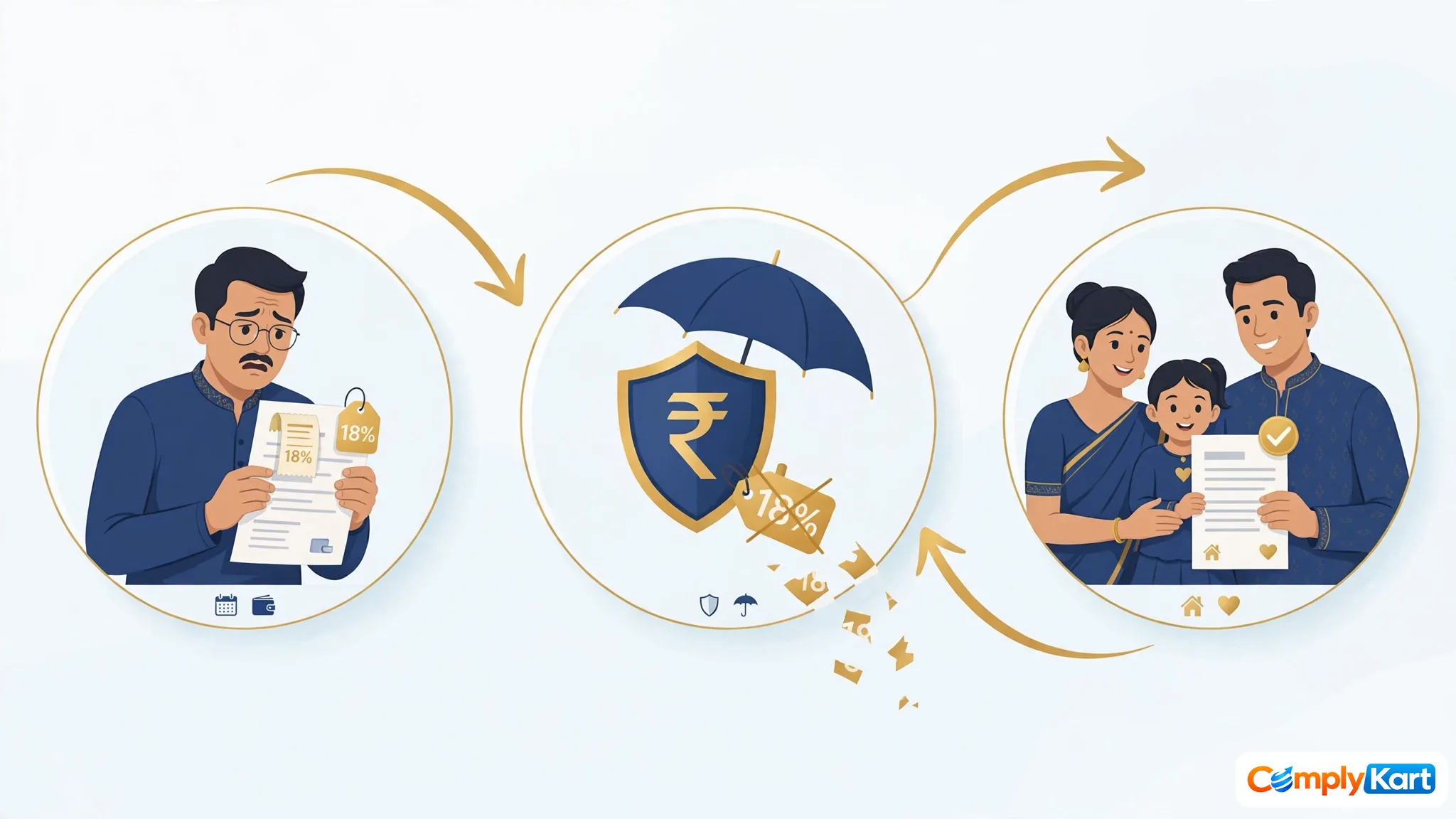
Your term insurance renewal notice arrived last month. Same cover, same insurer, same ₹20,000 premium — but the total at the bottom read ₹20,000, not ₹23,600. No GST line. Nothing missing, nothing wrong. That missing ₹3,600 is the GST 2.0 insurance exemption doing its job.
The short answer: since 22 September 2025, individual life and health insurance premiums in India carry no GST at all. Term, endowment, ULIP, annuity, family floater and senior citizen policies are all exempt. Group policies and motor, fire and marine cover still attract 18% GST.
What changed on 22 September 2025?
The 56th GST Council recommended the exemption on 3 September 2025, and it took effect through CBIC Notification No. 16/2025-Central Tax (Rate), dated 17 September 2025 — part of the wider GST 2.0 rate changes that moved most goods and services to 5% and 18% slabs. Before that date, insurance was one of the few things in your household budget that carried the full 18% slab. Health insurance, term life — 18% on the whole premium. Traditional savings plans worked differently: GST applied only to a slice of the premium, so an endowment plan cost 4.5% GST in the first year and 2.25% on renewals, and a single-premium annuity cost 1.8%. ULIPs attracted 18% on the charges — the mortality and fund-management part — not on the money actually invested.
From 22 September 2025, the whole individual category went to zero. Not 5%. Zero. Here is the before-and-after in one place:
| Policy | Before 22 Sep 2025 | From 22 Sep 2025 |
|---|---|---|
| Individual term life | 18% | Exempt — 0% |
| Individual endowment / money-back / whole life | 4.5% first year, 2.25% renewals | Exempt — 0% |
| ULIP | 18% on charges | Exempt — 0% |
| Single-premium annuity | 1.8% | Exempt — 0% |
| Individual health, family floater, senior citizen, critical illness, top-up | 18% | Exempt — 0% |
| Reinsurance of the above | 18% | Exempt — 0% |
| Group life / group health (employer cover) | 18% | 18% — unchanged |
| Motor, fire, marine, liability, commercial | 18% | 18% — unchanged |
One word in that table deserves attention: exempt, not nil-rated. Both mean you pay 0% GST. But they are not the same thing in law, and the difference is exactly why the saving question got complicated. A nil-rated supply is still a taxable supply, so the supplier keeps input tax credit. An exempt supply is not — and Section 17(2) of the CGST Act blocks input tax credit on inputs used for exempt supplies. The notification made these policies exempt, so insurers must reverse the credit they used to claim on commissions, brokerage, office rent, TPA fees and IT services.
Which policies are exempt — and which are not?
The test is who is insured, not what the policy is called. The notification covers insurance provided to the insured "where the insured is not a group" — an individual, or an individual and their family. A family floater qualifies because the family is insured under one individual contract. So do senior citizen policies and critical illness riders on your own policy.
A group policy does not. If your employer buys a group mediclaim for staff, the insured is a group, and 18% GST still applies — same for group term, group personal accident and any commercial policy. The product label does not save it: a "health" policy bought by a company for its employees is taxed; the same cover bought by you for your family is not.
Two edge cases worth knowing. First, a top-up or super top-up you buy yourself is exempt; one bundled into an employer group plan is not. Second, reinsurance of exempt individual policies is itself exempt — the notification added a separate entry for it — so the relief runs through the whole chain, not just the retail policy.
Will you actually save the full 18%?
This is the question every policyholder asked in September 2025, and the honest answer has two parts. On your bill, yes — the GST line is gone, so a ₹20,000 term premium now costs ₹20,000 instead of ₹23,600. That part is not in dispute.
Behind the bill, though, something changed for insurers. Because the policies are exempt rather than nil-rated, insurers lost the input tax credit on the costs of selling and servicing those policies — the 18% GST they pay on agent commission, brokerage, office rent and TPA fees now stays a cost instead of being set off. In September 2025, several reports estimated that this lost credit was worth roughly 2–3% of the premium, which is why some commentators put the real saving closer to 15% than the full 18% — the worry being that insurers would quietly lift base premiums to absorb the cost.
Think of it like a restaurant that stops charging you service tax but still pays tax on its groceries. The tax disappears from your bill, but the restaurant's costs have not fallen. Somebody absorbs the difference — either the restaurant's margin or, eventually, the menu price.
So did base premiums rise? The evidence so far says no. In a reply to Parliament in July 2026, the Department of Financial Services said IRDAI had confirmation from all general, health and life insurers in January 2026 that they had not revised premiums on account of the exemption and the relief had been passed on. Still worth re-checking at each renewal — a base premium can move for other reasons, and a quiet rise would eat the saving without any GST line to blame.
What a family actually saves: the worked numbers
Take a typical household. A 35-year-old with a ₹1 crore term plan paying ₹20,000 a year, plus a ₹10 lakh family floater at ₹25,000 a year.
Before 22 September 2025: term ₹20,000 + 18% GST ₹3,600 = ₹23,600. Floater ₹25,000 + 18% GST ₹4,500 = ₹29,500. Total outgo ₹53,100 a year.
After 22 September 2025: term ₹20,000, floater ₹25,000. Total ₹45,000. Saving: ₹8,100 a year, every year, for as long as both policies run. Over a 20-year term plan, that is ₹72,000 on the term cover alone — real money, and it needs no claim, no form and no phone call. It simply stops appearing on the bill.
Endowment buyers save less in percentage terms, because they were never paying 18%. A ₹2,00,000 first-year endowment premium carried 4.5% GST — ₹9,000 — and renewals carried 2.25%, or ₹4,500. Both are now zero. A single-premium annuity of ₹5 lakh carried 1.8% GST, ₹9,000, also now zero. Smaller saving, same principle.
What about a renewal that fell near 22 September 2025?
Timing caused the most confusion of the whole change, and two different answers circulated. The correct starting point is the time-of-supply rule in Section 13 of the CGST Act: for a service, tax is fixed by the earliest of the invoice date and the payment date. A renewal notice is not an invoice. So in the general position — the one in the government's own FAQ and in most insurer guidance — the payment date decides. A premium paid on or after 22 September 2025 is exempt, even if the renewal was due on, say, 15 September. Each instalment is judged by the date it is paid: monthly premiums paid before the date carried 18%; those paid after do not.
That said, a few insurers applied a due-date rule in their own FAQs. If your renewal fell in that window and your notice still shows GST, ask the insurer which rule it applied, and keep the invoice. And one thing is settled everywhere: GST already paid before 22 September 2025 is not refunded. Advance premiums paid before the date carried GST, even if the cover runs past it. There is no mechanism to claim it back.
What changes for insurance agents?
Quite a lot, and almost none of it is visible to the policyholder. The exemption covers the premium — the policy. It does not cover the agent's commission. Commission is a separate supply of intermediary services, and it is still taxed at 18%.
For most agents this changes nothing in practice, because of how the tax is collected. Insurance commission sits under the reverse charge mechanism — Notification No. 13/2017-Central Tax (Rate), entry 7 — so the insurer pays the 18% GST, not the agent. An agent whose only taxable income is commission under reverse charge does not even need GST registration, however large the commission, under Section 23(1)(b) of the CGST Act. That position is unchanged by the exemption.
What did change is the insurer's side of the same transaction. The insurer used to claim input tax credit on the GST it paid on commission. Now, because the policies are exempt, that credit must be reversed. Several private life insurers responded by cutting distributor commission by roughly 18% from 1 October 2025, according to trade reports at the time; LIC was reported not to have cut agents' commission. If you are an agent, check your commission statement rather than assuming the old rate. And note the TDS side: commission paid to an individual agent attracts 2% TDS above ₹20,000 a year, under Section 393(1) of the Income-tax Act, 2025 — the successor to Section 194D of the 1961 Act.
Agents should also know the SAC codes for their own paperwork. Life insurance services sit under SAC 997132 and accident and health insurance under SAC 997133, both within heading 9971. The codes matter for invoicing and for GSTR-1 reporting on the commission side — not for the exempt premium itself.
What changes for insurers — and for employers?
For insurers, the work is mostly compliance plumbing. Every input that used to carry credit — commission, brokerage, rent, TPA charges, IT services — must now be apportioned between exempt individual policies and still-taxable business, and the credit on the exempt share reversed under Section 17(2) and Rules 42 and 43 of the CGST Rules. Insurers that run both individual and group books have to keep the two cleanly separated, because the credit position is now opposite on each side.
For employers, the position today is still the old one: 18% GST on group health and life cover, and input tax credit blocked under Section 17(5)(b) unless the cover is obligatory under a law. But watch this space. On 8 October 2026, the 57th GST Council recommended amending Section 17(5) to remove the block on health and life insurance, among other items. That is a recommendation, not law — it needs an amendment to the CGST Act and a notified effective date before any employer can claim the credit. Until that happens, the existing block governs, and any employer budgeting on the ITC should wait for the notification, not the headline.
Does the GST change affect your 80C and 80D claims?
No — but the amount you claim changes, because the amount you pay changed. Life insurance premiums still count toward the ₹1.5 lakh deduction under the old tax regime. Health premiums still count toward the ₹25,000 limit for self and family, rising to ₹50,000 where the insured person is a senior citizen, with a separate ₹25,000 or ₹50,000 limit for parents — under Section 80D of the Income-tax Act, 1961, now Section 126 of the Income-tax Act, 2025, from 1 April 2026. The deduction is what you actually paid. Since you no longer pay GST, the figure you claim is the base premium alone. On the family example above, the 80D claim drops from ₹29,500 to ₹25,000 — the deduction shrinks by the GST you no longer pay, which is exactly as it should be. You are not worse off. You simply stop claiming tax you never paid.
Two conditions to remember. Both deductions live only in the old tax regime — on the default new regime, neither applies. And the health premium must be paid by a mode other than cash, the same rule as before. If you need help working out which regime leaves you better off, our income tax return filing team runs that comparison every season.
What to check on your next renewal notice
Five things, and it takes two minutes:
- The GST line should be absent — or zero — on an individual policy. If a term, endowment, ULIP, annuity or individual health renewal still shows 18% GST, raise it with the insurer before paying.
- The base premium should match last year, apart from age or sum-assured changes. A base premium that has quietly risen by a few percent has eaten part of your saving.
- Check the policy type on the notice, not the product name. A "family health" plan bought through your employer is a group policy and correctly carries 18%.
- For instalment premiums, check each receipt. The exemption follows the payment date, so a monthly premium paid after 22 September 2025 should show no GST.
- Keep the pre-September receipts. GST paid before the exemption is not refundable, but the receipts are still your proof of payment for 80C and 80D claims for that year.
Five mistakes people are still making
Assuming group cover is now free of GST. It is not. Employer group mediclaim and group term still carry 18%, and the 57th Council's ITC recommendation is not law yet.
Expecting a refund of GST paid before 22 September 2025. There is none. Advance and multi-year premiums paid before the date carried GST, and no refund mechanism exists.
Reading the renewal due date as the tax date. The payment date — or the invoice date, if earlier — fixes the rate. A premium due on 15 September but paid on 25 September is exempt in the general position, though a few insurers applied a due-date rule, so check the invoice.
Claiming the old, GST-inclusive premium under 80C or 80D. Claim what you paid. The deduction follows the payment, not last year's figure.
Forgetting the agent's side. If you are an agent, your commission is still taxed at 18% under reverse charge and the insurer still pays it — but check whether your commission rate itself changed after 1 October 2025.
Frequently asked questions
Is GST on health insurance really zero now?
For individual and family floater policies, yes — 0% since 22 September 2025, under Notification No. 16/2025-Central Tax (Rate). Group and employer-sponsored health policies still carry 18% GST, and motor, fire and other general insurance is unchanged.
Can I get a refund of the GST I paid on premiums before 22 September 2025?
No. Premiums paid before the exemption took effect carried GST at the old rates, and there is no refund mechanism for them. The exemption applies only to premiums paid on or after 22 September 2025.
Does the exemption apply to ULIPs and annuities too?
Yes. Individual ULIPs, endowment and money-back plans, whole-life plans and single-premium annuities are all covered. Before the change, ULIPs attracted 18% on charges and annuities 1.8%; both are now exempt.
Do insurance agents still pay GST on their commission?
The commission is still taxed at 18%, but under reverse charge the insurer pays it, not the agent. An agent whose only taxable income is such commission does not need GST registration. TDS of 2% applies on commission above ₹20,000 a year.
Will employers get input tax credit on group insurance soon?
Not yet. The 57th GST Council on 8 October 2026 recommended removing the Section 17(5) block on health and life insurance ITC, but a recommendation is not law. Employers can claim the credit only after the CGST Act is amended and an effective date is notified.
The position has settled: individual life and health cover is GST-free, group and general cover is not, agents' commission is still taxed, and employers are still waiting on the ITC change. The saving is real — ₹8,100 a year on an ordinary family example — but it only stays real if you check the renewal notice. If your next notice still shows GST on an individual policy, or the base premium has crept up, that is the moment to ask questions, not to pay quietly. And if the GST side of your business needs a steady hand, our GST registration team and the compliance fee calculator are a reasonable place to start.
Sources: CBIC Notification No. 16/2025-Central Tax (Rate), 17 September 2025 (notification text via TaxGuru); PIB release on the 56th GST Council recommendations, 3 September 2025; CBIC GST rate-change FAQs, 16 September 2025; Lok Sabha Unstarred Question No. 1323, 27 July 2026 (Department of Financial Services reply on premium pass-through); PIB release on the 57th GST Council recommendations, 8 October 2026. Position stated as of 9 November 2026.





Comments
No comments yet — ask the first question below.
Join the discussion
Questions go straight to our expert desk. Comments appear after a quick review — no spam, no noise.