

Without a Letter of Undertaking, you lend the government your working capital every quarter — for free. GST law gives every exporter two routes to the same zero-rated destination, and almost every exporter picks the one that protects cash.
The short answer: A Letter of Undertaking (LUT) filed in Form GST RFD-11 lets an exporter supply goods or services abroad — or to an SEZ unit or developer — without paying IGST, under Section 16(3) of the IGST Act and Rule 96A of the CGST Rules. It is free to file, valid for one financial year, and renewed yearly.
What are the two export routes?
Route 1 — pay IGST, then claim a refund. You charge IGST on the export invoice, pay it, and claim it back later. For goods, the shipping bill on ICEGATE doubles as the refund claim.
Route 2 — file an LUT, pay nothing upfront. Furnish Form RFD-11 before exporting, raise zero-rated invoices, and claim the unutilized ITC through Form RFD-01.
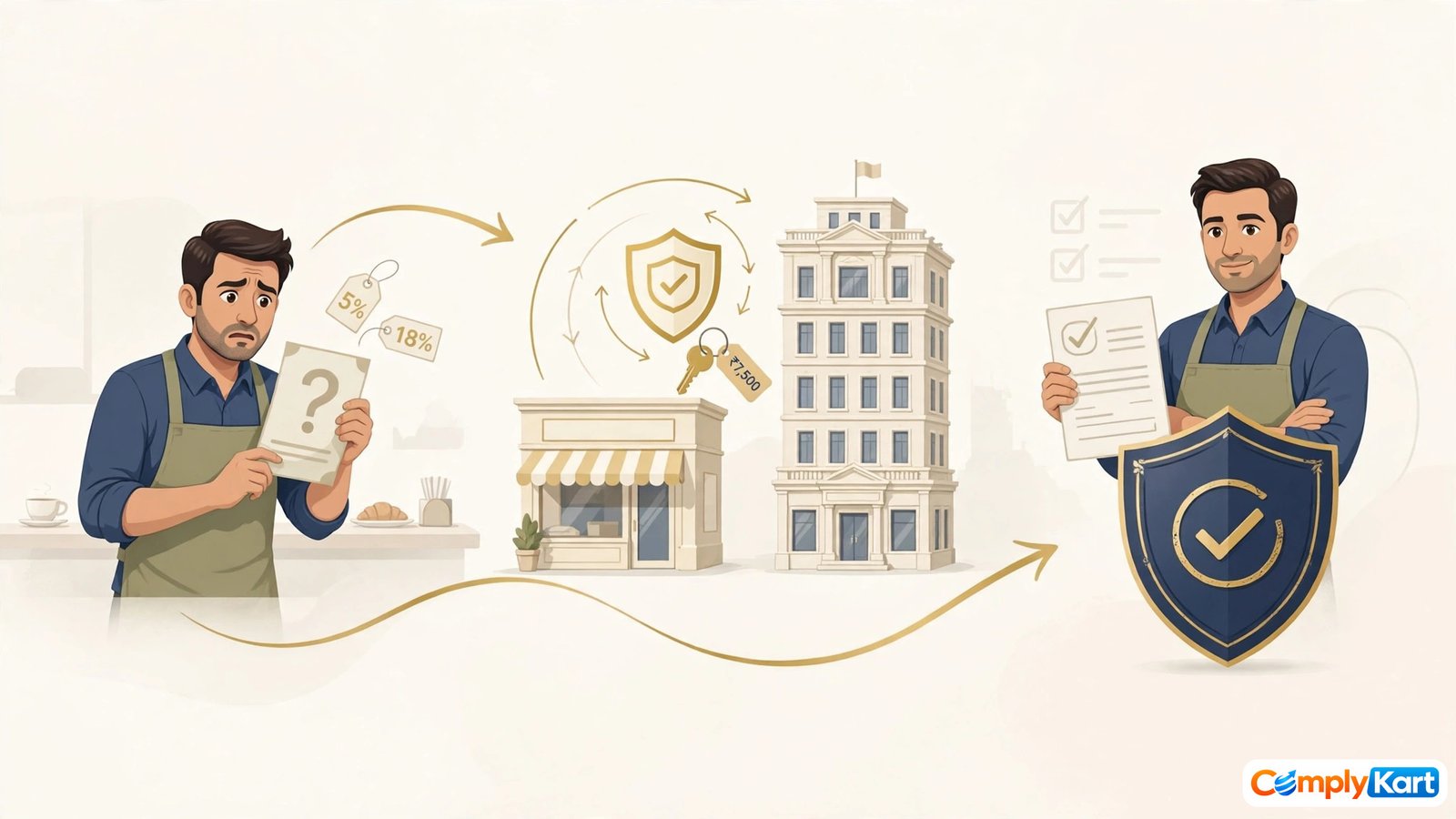
On a ₹1 crore export at 18%, route 1 parks ₹18 lakh with the government until the refund lands. Route 2 keeps it in your account from day one. Route 1 is like paying the full restaurant bill and waiting weeks for the cashback. Route 2 is the membership that lets you walk out without paying at the table. Same meal. Very different cash position. That is the entire economic argument for the LUT — a cash-flow instrument wearing a compliance costume.
Who can file an LUT?
Any GST-registered exporter — goods or services — plus SEZ suppliers; the same RFD-11 covers both. One exclusion: prosecuted for tax evasion over ₹2.5 crore, and you file an export bond with a bank guarantee instead (Notification 37/2017-CT). First-time exporters, IT firms, freelancers — all eligible.
How do you file Form GST RFD-11?
Online, in fifteen minutes: GST portal → Services > User Services > Furnish Letter of Undertaking → pick the FY → choose LUT (not bond). Your GSTIN auto-populates; add two witnesses (name, address, occupation), sign with DSC/EVC, submit. The portal generates an ARN immediately — download it; banks, forwarders and refund officers ask for it all year.
You declare that you will export within the prescribed timelines and pay IGST with interest if you breach them. Cost: zero government fee. If you already have GST registration and an Import-Export Code, the LUT is the cheapest form in the stack. To budget the full compliance cost around your exports, run the numbers through our compliance fee calculator.
How long is an LUT valid?
One financial year — 1 April to 31 March, no auto-renewal. File a fresh RFD-11 every year before your first export invoice of the FY. The portal lets you file mid-year, but it doesn't backdate: invoices raised between 1 April and your filing date were raised without a valid undertaking, so IGST was technically payable on them, with interest from the invoice date. Treat 31 March as a hard deadline: set a mid-March reminder and check your DSC hasn't expired. File on 28 March and you never think about it again.
The refund side: two different machines
Under LUT (no IGST paid): claim a refund of unutilized ITC through Form RFD-01 — the GST refund application. The amount follows the Rule 89(4) formula: your net ITC multiplied by the share of zero-rated turnover in total turnover. For goods, the export value used is the lower of the FOB value in the shipping bill and your invoice value.
With IGST paid: for goods, skip RFD-01 — the shipping bill itself is the refund claim, refunded by customs through ICEGATE once it validates against your GSTR-1. Note: if you paid IGST on an export, you can't also claim unutilized ITC on that same supply. One lane per invoice.
90% provisional refund is released within 7 days of acknowledgement (Rule 91), the balance after scrutiny. Acknowledgement comes within 14 days — 3 for IGST-paid zero-rated refunds. The full refund must be sanctioned within 60 days of a complete application; beyond that, 6% p.a. interest accrues to you (Section 56).
What the LUT commits you to
Rule 96A sets two clocks: goods exported within 3 months of the invoice date; service proceeds realized within 1 year. Miss them and IGST plus 18% interest becomes payable within 15 days of expiry — and the LUT facility is withdrawn until you pay. For services, chase receivables by the calendar: an overdue invoice is a GST exposure, not only a collection problem. Keep GSTR-1 Table 6A matching your shipping bills line for line — SB005/SB006 ICEGATE mismatches stall most refunds.
What must your export invoice say?
The endorsement "Supply meant for export under bond or letter of undertaking without payment of integrated tax" on every zero-rated invoice, and the supply reported in Table 6A of GSTR-1. Both cost nothing; skipping either invites a notice.
Mistakes that cost exporters real money
- The April gap. First FY invoice on 2 April, LUT filed 20 April — every invoice in between carries IGST plus interest exposure.
- The lapsed LUT. The filer left in March; nobody renewed. Make renewal a named responsibility.
- Shipping bill vs GSTR-1 mismatch. One wrong letter or port code, and the refund sits in ICEGATE error limbo.
- Proceeds stuck abroad past a year. For services, Rule 96A's 1-year clock doesn't pause because your client is "processing payment."
- Mixing the two lanes. Paying IGST when you had a valid LUT, then filing a confused ITC claim. One lane per invoice, every time.
An LUT takes fifteen minutes and zero government fees, and protects lakhs in working capital every quarter. File before 1 April, watch the two clocks, keep Table 6A clean. If you'd rather not handle the RFD-11, witnesses, DSC signing and yearly renewal yourself, ComplyKart files it for you — see our LUT filing service. And if your footprint spans warehouses in multiple states, our GST multistate registration guide covers the Master TRN route.
FAQs
Can I file an LUT after I have already exported this financial year?
Yes, any time — but it won't backdate. Invoices raised before filing were made without a valid undertaking, so IGST was technically payable on them, with interest from the invoice date.
Does the LUT cover supplies to SEZ units and developers?
Yes — Section 16 treats SEZ supplies as zero-rated alongside exports, and the same RFD-11 covers both.
I am a freelancer with overseas clients. Do I need an LUT?
Yes — services are fully covered, and without one you'd have to charge IGST on foreign invoices and claim it back. For the registration side, see our GST registration guide for freelancers.
What if my export payment doesn't arrive within a year?
Rule 96A requires realization within one year of the invoice. Miss it and IGST plus 18% interest becomes payable within 15 days, and the LUT facility is withdrawn until paid. Track receivables against invoice dates.
Is there any fee for filing an LUT?
Nothing — the portal is free, and eligible filers need no bank guarantee. You pay only a professional's fee if someone files it for you.




Comments
No comments yet — ask the first question below.
Join the discussion
Questions go straight to our expert desk. Comments appear after a quick review — no spam, no noise.