
IN BRIEF
ISO 14001 for factories is a certified environmental management system: a documented way of tracking every way the plant touches the environment, obeying the Water Act 1974 and Air Act 1981 consent conditions, and proving it with records. It applies to any factory whose buyers, tenders or regulators ask for proof of environmental management, and it does not replace the consent to operate from the state pollution control board.
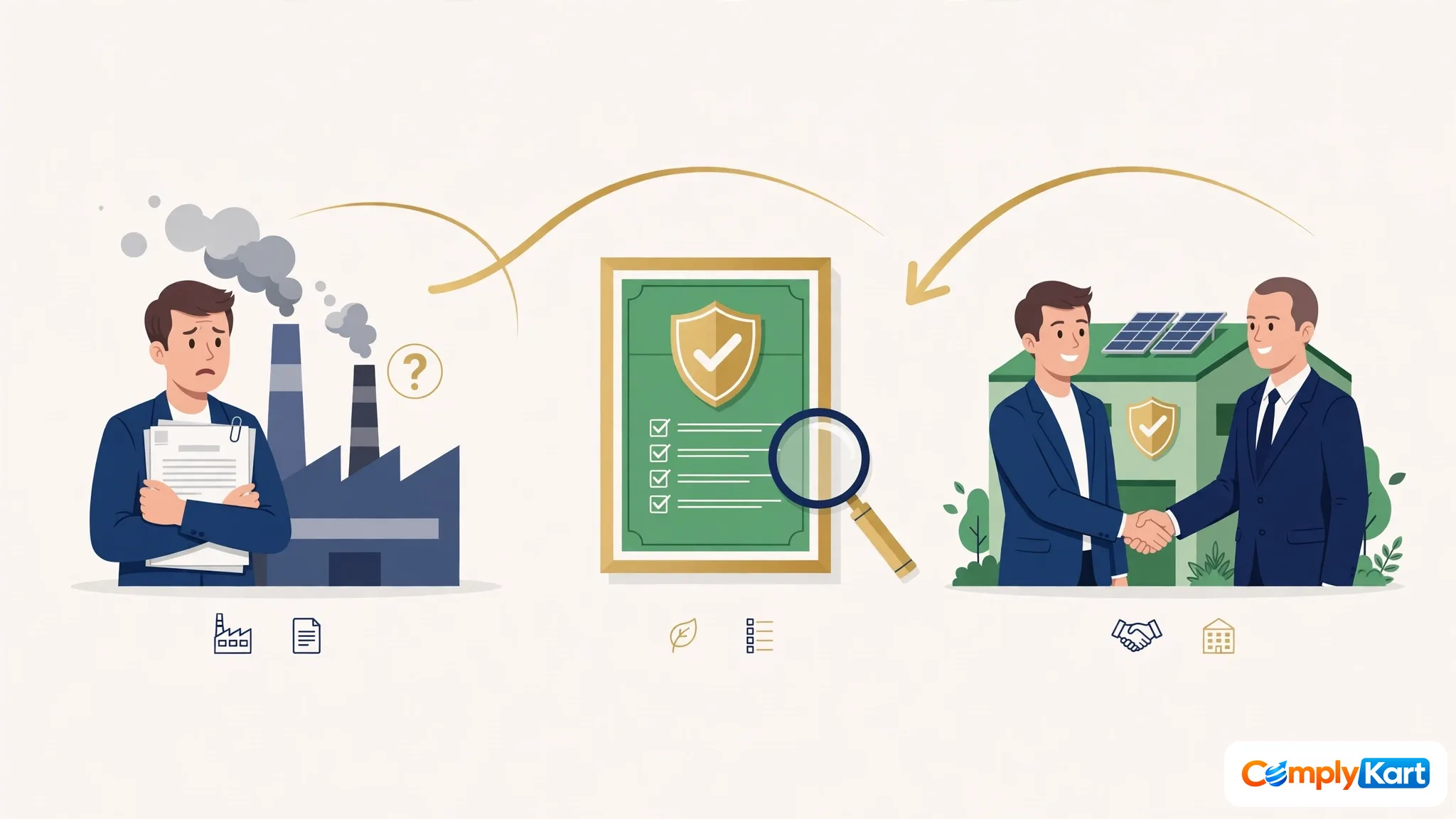
Two different people can walk into your factory in the same month and ask for two different papers, and mixing them up is the costliest mistake in this whole subject. The pollution board inspector wants your consent to operate. Your biggest buyer wants your ISO 14001 certificate. Both papers are about the environment. They are not the same paper, and neither one replaces the other.
The short answer: ISO 14001 for a factory is a certified environmental management system — a documented way of tracking every way the plant touches the environment, obeying the laws that apply to it, and proving it with records. It does not replace the consent to operate from your state pollution control board, which is the legal permission to run the plant at all. A factory usually needs both: the consent keeps the plant open, and the certificate keeps the buyers coming.
Why does the pollution board ask for a consent, not a certificate?
Under the Water (Prevention and Control of Pollution) Act, 1974 and the Air (Prevention and Control of Pollution) Act, 1981, a factory must take consent from its state pollution control board — the SPCB — in two stages. Consent to Establish comes before construction begins. Consent to Operate comes before production begins. Each consent carries conditions: limits on what the stack may emit and what the drain may discharge, how often you must monitor, and what records you must keep.
Boards sort industries by pollution potential into Red, Orange and Green categories, with White-category units largely exempt from consent. A Red-category chemical unit faces far heavier conditions than a Green-category assembly unit, and that category also shapes what any later audit will look at. Operating without a valid consent invites closure directions and environmental compensation — a penalty the National Green Tribunal framework calculates per day of violation. No certificate from any private body shields a plant from that.
Think of it this way. The consent is the permission slip to switch the machines on. ISO 14001 is the logbook that proves every day those machines ran clean. An inspector checks the permission. A buyer reads the logbook. You need the permission first, and the logbook is what turns a compliant plant into a plant a buyer trusts.
What does a buyer's audit actually check?
When a large customer or a tender committee asks for ISO 14001, they rarely read the standard. They check four things, and a factory owner should know them before the auditor arrives.
First, the scope line on the certificate. The certificate names the organisation, the site and the activities audited. A certificate covering your head office does not cover your plant, and a certificate for fabrication does not cover a new chemical process added last year. Buyers read the scope line because it tells them what was actually audited.
Second, validity and surveillance. An ISO 14001 certificate runs for three years, with a surveillance audit roughly once a year. A certificate whose surveillance is overdue is a certificate a careful buyer will not accept, even if the printed expiry date is still in the future.
Third, accreditation. Buyers who know the market look for a certification body accredited by NABCB, the National Accreditation Board for Certification Bodies under the Quality Council of India, within the IAF multilateral arrangement. A certificate from an unaccredited body is the paper behind the suspiciously cheap quotes — it may look identical in a tender file and fail the first verification check.
Fourth, the records behind the system. This is where factories pass or fail, and it is the part no certificate alone can fake. A buyer audit will ask for your legal register, your waste records, your effluent treatment plant logs and your monitoring reports, and will compare them against your consent conditions. A plant that cannot produce last month's ETP log has a documentation problem, not a certificate problem.
What a factory's system actually contains
Two registers do most of the work, and both were explained in plain words in our ISO 14001 certification cost and process guide. The aspects-and-impacts register lists every activity that interacts with the environment and the change it causes: the boiler stack's emissions, the effluent leaving the treatment plant, the diesel generator's smoke and noise, the solvents in storage, the solid waste leaving the gate. Each entry gets a scored judgement of significance, and the significant ones get controls.
The legal register lists every environmental obligation that applies to the plant and how you meet it — your consent conditions, the emission and effluent limits inside them, the monitoring frequency, the waste rules covering what you generate. Consent conditions are not static; boards revise norms over time, and the register is where a revision gets caught instead of surfacing as a violation at renewal.
Around those two registers sit the operating controls: how the ETP is run and checked each shift, how chemicals are stored and spilled material handled, how waste is segregated and handed to authorised recyclers, what happens in an emergency like a spill or a power failure at the treatment plant. Then come the internal audit, where your own team checks the system before an outsider does, and the management review, where the plant head looks at the findings and decides what changes.
The certification itself runs in two stages. Stage 1 is a documentation review — the auditor reads your system on paper. Stage 2 is the on-site audit — the auditor walks the plant, talks to operators, and checks records against reality. Pass both and the certificate issues.
Which edition will your certificate name?
ISO published ISO 14001:2026 on 15 April 2026, replacing the 2015 edition. Certificates issued against the 2015 edition remain valid through the IAF transition window, which runs to around April 2029, and certification bodies are expected to stop issuing new certificates against the 2015 edition around October 2027. For a factory certifying now, the practical point is simple: certify against the 2026 edition directly, so you are not paying for a transition audit within a few years. Ask your certification body in writing which edition your certificate will name, before you sign anything.
How long does it take, and what does it cost?
Honest answer: it depends on how much of the system already exists. A factory with a running ETP, a valid consent and filed monitoring reports moves much faster than a plant building records from scratch. Published guides disagree — some quote weeks after implementation, others months for a mid-sized unit — and the gap is really about readiness, not about the audit. Plan in months if your records are thin, and treat any promise of a certificate in days as a warning sign, not a selling point.
On cost, the same two-bill split from our cost guide applies. Our ISO 14001 certification consultancy costs ₹9,999 for up to 25 employees and ₹19,999 for 26 to 100 employees, and that is the consultancy fee only. The certification body's audit fee is extra at actuals, quoted per site, headcount and scope. The full split, with a worked three-year example, is in the cost guide linked above.
Five mistakes factories make with ISO 14001
- Certifying the wrong site. The certificate names one site and one set of activities. A second unit or a new process outside the scope is not covered, however impressive the framed certificate looks.
- Buying the cheapest paper. An unaccredited ₹8,999 certificate fails buyer verification and tender scrutiny. The money is not saved; it is spent twice, once on the paper and once on doing it properly.
- Letting the consent lapse. ISO 14001 never substitutes for a consent to operate. A plant with a certificate and an expired consent is a plant an inspector can still shut.
- Treating the audit as the system. A system that only wakes up the week before the surveillance visit produces clean audit weeks and dirty months. Buyers who check records month by month can see the difference.
- Skipping the legal register update. A consent renewal with tighter limits, a new waste rule, a revised monitoring frequency — each one belongs in the register the day it arrives, not at the next audit.
Where does this leave your factory?
Get the consent position clean first: valid consent to operate, conditions understood, monitoring reports filed. Then build the system that makes the next consent renewal, the next buyer audit and the next tender question easier rather than harder. Factories that do it in that order find the certificate is the easy part — the system behind it is what their buyers were actually buying.
Does ISO 14001 replace my pollution-board consent? No. The consent, under the Water Act 1974 and the Air Act 1981, is the legal permission to operate. ISO 14001 certifies the management system that keeps the plant inside that permission and proves it with records.
Can a small factory afford ISO 14001? The consultancy starts at ₹9,999 for up to 25 employees, with the certification body's audit fee extra at actuals. The total depends on site size and scope, and the cost guide linked above works a three-year example you can check.
Will buyers accept a certificate from any certification body? Careful buyers check accreditation. A body accredited by NABCB under the IAF arrangement is what tenders and export customers usually ask for, and it is the check that exposes non-accredited paper.
How long is the certificate valid? Three years, with a surveillance audit roughly once a year and a recertification audit at the end of the cycle. A missed surveillance leaves the certificate effectively unusable with serious buyers, whatever the printed expiry date says.
Should a factory certify to the 2015 or the 2026 edition? New applicants should certify to ISO 14001:2026 directly. Certificates to the 2015 edition remain valid through the transition window to around April 2029, but certifying to the outgoing edition now means a transition audit later.
If quality certification is also on your buyer's list, our ISO 9001 certification page covers the quality standard, and many factories audit the two together to save a visit. Our compliance fee calculator can help you map the recurring filings that sit alongside any certification. Start with the consent, build the registers, and let the certificate follow the work.





Comments
No comments yet — ask the first question below.
Join the discussion
Questions go straight to our expert desk. Comments appear after a quick review — no spam, no noise.