
IN BRIEF
ISO 45001 certification is independent proof that an organisation runs a documented occupational health and safety management system under ISO 45001:2018, identifying hazards, controlling risks, consulting workers, and obeying the safety laws that apply to it. It applies to any employer, from a small factory to a large construction company, and it certifies the management system, not any single machine, product, or site licence.
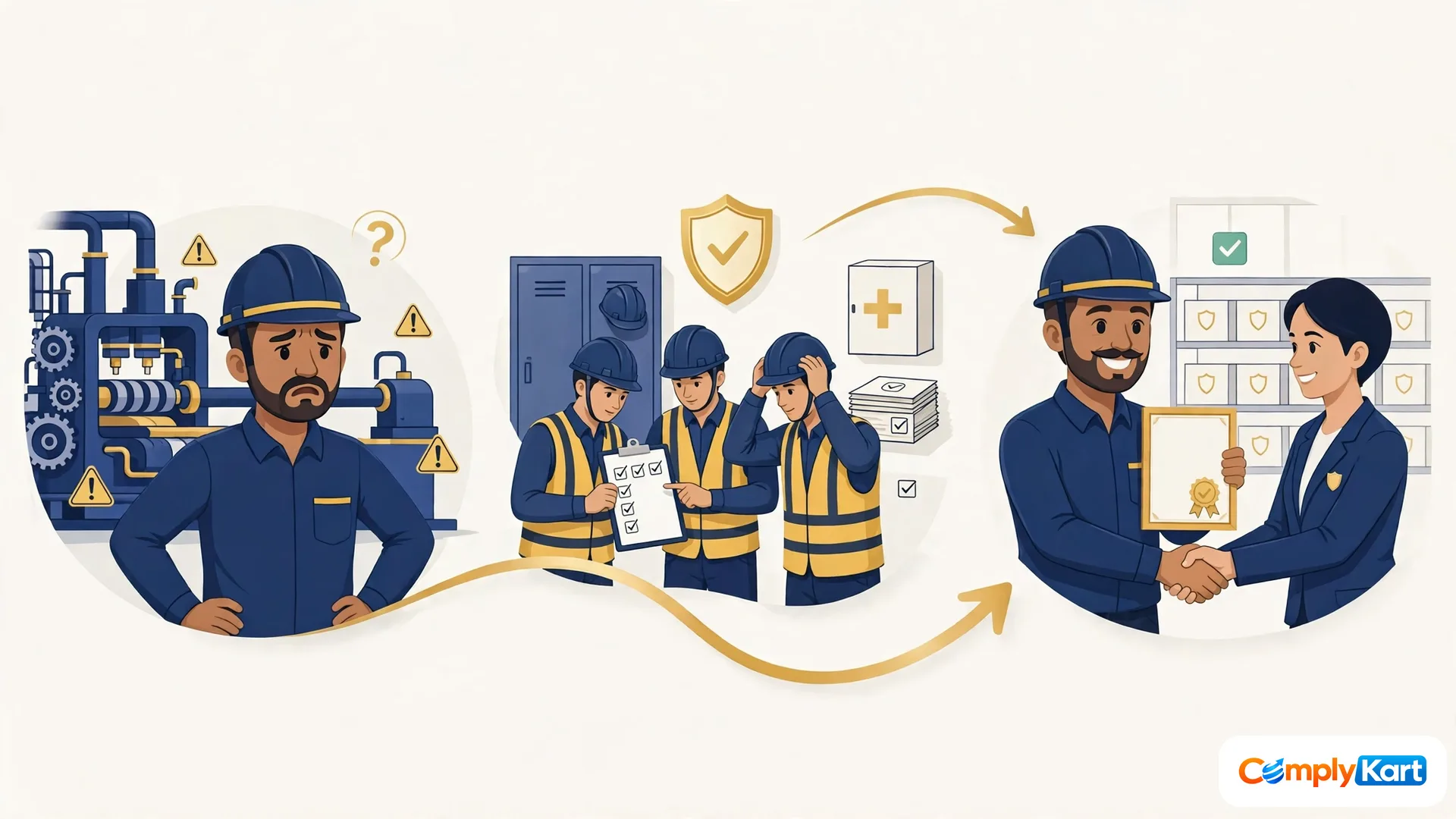
A safety poster on the wall costs almost nothing. It also proves almost nothing. An auditor does not ask whether your workers have seen a poster. He asks who found the hazard, what control was put in place, who was trained on it, and where the record sits. That gap — between a poster and a system — is what ISO 45001 is about.
The short answer: ISO 45001:2018 is the international standard for an occupational health and safety management system. Certification means an independent body has audited your system and found it working: hazards identified, risks controlled, workers consulted, and the safety laws that apply to you tracked and obeyed. The certificate runs for three years, with a surveillance audit each year.
What does ISO 45001 actually certify?
It certifies a system, not a machine and not a building. ISO 45001:2018 replaced OHSAS 18001, which was withdrawn in March 2021, and it remains the current edition of the standard. It applies to any organisation, whatever its size or trade. A ten-person fabrication unit and a thousand-person construction company can both hold it, because the standard asks the same question of both: how do you find what can hurt people here, and what do you do about it before it does?
Think of a fire extinguisher. A poster above it says “in case of fire, use this”. A system checks the extinguisher every month, trains the shift to use it, runs a drill, writes down what went wrong in the drill, and fixes it. The poster is a wish. The system is the monthly check, the training record, and the drill note. Auditors certify the second thing, not the first.
That distinction matters in India because safety law already demands much of the same work. The Factories Act, 1948 and the factory rules of your state set duties on machinery guarding, hazardous processes, health checks, and accident reporting. For construction, the Building and Other Construction Workers Act, 1996 adds its own duties. ISO 45001 does not replace any of that. It gives you one organised way of meeting it, with records an inspector, a buyer, or a tender committee can actually read.
What does ISO 45001 certification cost?
There are two bills, and every honest quote separates them. The first is the consultancy — someone building the system with you: hazard register, legal register, procedures, training, and the internal audit. The second is the certification body's audit fee — the independent body that audits the system and issues the certificate. A single “all-in” price that never names the certification body deserves a second question.
Our consultancy prices are fixed and live on our ISO 45001 certification page: ₹9,999 for up to 25 employees and ₹19,999 for 26 to 100 employees. That is consultancy only. The certification body's audit fee is extra, charged at actuals, because it depends on your headcount, your sites, and how risky the work is. A single-site office and a three-site chemical plant do not take the same audit days, and no serious body prices them the same.
For a sense of the second bill, one Indian guide's published benchmark for standalone ISO 45001 certification puts initial certification at ₹30,000 to ₹60,000 for a small unit under 50 people, ₹50,000 to ₹90,000 for a medium unit of 50 to 250 people, and ₹90,000 to ₹1,80,000 or more for a large or complex unit over 250 people, with annual surveillance fees of roughly ₹15,000 to ₹25,000, ₹25,000 to ₹40,000, and ₹40,000 to ₹70,000 or more in the same bands. Another guide's bands run lower. Treat both as benchmarks, not quotes. The only figure that binds is the written quote from the certification body for your scope.
Put the two bills together for a small unit and the three-year picture looks like this — an illustration, not a quote. Consultancy ₹9,999, plus an illustrative first-year audit fee of ₹45,000 (the middle of the small-unit band), plus two surveillance audits at an illustrative ₹20,000 each, comes to ₹94,999 over three years. Change the audit fee to the body's actual quote and the total moves with it. That is the whole point of splitting the bills: you can see which part you are paying for, and challenge either part separately.
What does the system actually contain?
Five pieces do most of the work, and an auditor will test each one on site, not just on paper.
First, hazard identification and risk assessment. Clause 6.1.2 of the standard requires a process for finding hazards and judging risk — routine work and non-routine work, your own workers and contractors, visitors, and the plant itself. The output is a hazard register: each hazard, who it can hurt, how likely and how serious, and the control chosen. The hierarchy runs in a fixed order: remove the hazard if you can, substitute something safer, engineer it out, change how the work is done, and only then rely on personal protective equipment. A register that lists gloves as the control for a machine that could be guarded will not survive Stage 2.
Second, the legal register. Clause 6.1.3 requires you to identify the safety laws that apply and keep track of them. For a factory that means the Factories Act, 1948, your state factory rules, and any licence conditions on the site. For a construction company it means the construction workers' law as well. The register is not a copy of the Acts. It is a short list: which law, which duty, who owns it in your company, and how you check compliance. When a rule changes, the register is where the change lands.
Third, worker consultation and participation. Clause 5.4 is the clause auditors probe hardest, because it is the easiest to fake and the hardest to fake well. The standard requires workers to be consulted and to take part in building the system — in hazard identification, in choosing controls, in incident investigation, and in reviewing performance. A safety committee that meets, keeps minutes, and can show a worker suggestion that changed a control is evidence. A poster and a toolbox talk once a quarter are not.
Fourth, operational controls and emergency preparedness. Clause 8.1 covers the day-to-day controls: permits for hot work and confined spaces, contractor control, maintenance of safety-critical equipment. Clause 8.2 covers emergencies: what happens when the alarm goes, who calls whom, where people assemble, and whether the drill proved it. An auditor will ask for the last drill record and then ask a worker on the floor where the assembly point is. The two answers have to match.
Fifth, internal audit and management review. Clauses 9.2 and 9.3 require you to audit your own system and then sit down, at the top, and review whether it is working — incidents, near misses, audit findings, legal changes, and what needs to change. This must happen before the certification body arrives. A company that has never audited itself is not ready for Stage 2, whatever its documents say.
How does the certification process run?
The route is the same two-stage audit used across the ISO management standards, and it helps to know the stages before you pay anyone.
- Build the system. Gap check against the standard, then hazard register, legal register, procedures, training, and records. This is where the consultancy time goes.
- Audit yourself. Internal audit, then management review. Close the findings. A system with no internal audit record is not ready for an external auditor.
- Stage 1 — the readiness review. The certification body reviews your documents and checks you are ready, typically over one to three days. Gaps found here must be closed before Stage 2.
- Stage 2 — the certification audit. Auditors visit the site, interview workers, watch the work, and sample records, typically over two to five days depending on size and risk. Findings raised here must be closed before the certificate is issued.
- Decision and certificate. The body's certification committee decides, and the certificate is issued for three years.
- Surveillance, then recertification. A surveillance audit roughly once a year in years one and two, and a full recertification audit before the three years end.
How long does all of it take? One Indian guide puts the typical journey at two to four months from a standing start through both stages, with preparation taking one to four months depending on readiness. I would read that as a range for a unit that already runs basic safety discipline, not a promise. A plant starting from zero documents, or one with several sites, takes longer. Anyone promising a certificate in days is selling paper, not a system — and the accreditation check below is how you catch that.
Who needs ISO 45001 most?
Any employer can hold it, but three kinds of business feel the pull first. Factories, where machinery, chemicals, noise, and dust create the hazards the standard was written for. Construction companies, where working at height, heavy machinery, and subcontractor chains make the principal employer's duties hard to prove without a system. Warehouses and logistics operations, where forklifts, loading bays, and contractor drivers mix every day. Mines, oil and gas, and heavy engineering sit in the same group, under their own sector regulators as well.
Offices are not excluded. Ergonomic strain, fire evacuation, and contractor safety on your premises all sit inside the same framework, and ISO 45003:2021 adds guidance on psychological health and safety — workload, harassment, and remote-work strain — for companies that want to cover that ground too. It is guidance that sits alongside ISO 45001, not a separate certificate your buyer will ask for by name.
Buyers and tenders are the other driver. Government and large private buyers increasingly ask for ISO 45001, sometimes as a qualifying condition, sometimes as a scoring item. Our companion guide for factories explains the same dynamic on the environmental side — the buyer checks the scope line, the surveillance status, and the accreditation behind the certificate before trusting it. The same four checks apply here, and the next section is about the one that catches most bad paper.
How do you check the certificate will be accepted?
Ask for the certification body's accreditation, and check it yourself in three steps. First, get the body's name in writing. Second, look it up in the directory of the National Accreditation Board for Certification Bodies (NABCB), which works under the Quality Council of India, or confirm its accreditor is a signatory to the International Accreditation Forum's multilateral arrangement. Third, when the certificate arrives, check that its scope line names your organisation, your sites, and your activities — a certificate covering the head office does not cover the plant, and a certificate for fabrication does not cover a new process added last year.
Non-accredited certificates are the cheap end of this market, and they fail exactly where they are needed: a tender committee or an export customer checks the accreditation and sets the bid aside. Our ISO 14001 guide for factories walks through the same check for environmental certification, and the logic is identical. If the price looks far below the audit-fee bands above and the body cannot be found in an accreditation directory, you are not buying certification. You are buying a printout.
Five mistakes that cost real money
- Buying the certificate before building the system. The audit will find it, the certificate will not survive surveillance, and you will pay twice — once for the paper, once for the system.
- Writing the hazard register in a meeting room. If the workers who do the job were not in the room, the register will miss the hazards that actually hurt people, and the auditor will hear it from the floor.
- Treating contractors as someone else's problem. The standard covers workers under your control, including contractors. A contractor accident on your site is your system's failure, not theirs alone.
- Letting the legal register go stale. A rule changes, nobody updates the register, and the next audit finds a duty you stopped tracking a year ago.
- Skipping surveillance. A certificate with a missed surveillance audit is paper with an expiry date on it. Serious buyers check surveillance status before they check anything else.
Does ISO 45001 replace a factory licence or an inspector's visit? No. It helps you meet the duties the Factories Act, 1948 and your state factory rules already place on you, and it proves that with records. Licences, inspections, and accident reporting duties continue exactly as before.
Can a small unit afford ISO 45001? The consultancy starts at ₹9,999 for up to 25 employees and ₹19,999 for 26 to 100 employees, with the certification body's audit fee extra at actuals. The worked example above puts a small unit at roughly ₹94,999 over three years on illustrative audit fees — the body's written quote is the figure to budget against.
How long does certification take? One Indian guide puts the typical journey at two to four months, depending on readiness. Units starting from zero documents or running several sites should expect longer, and no honest provider promises a fixed date before the gap check.
Do workers really have to be consulted, or is that paperwork? Clause 5.4 requires consultation and participation, and auditors test it by talking to workers and reading committee minutes. A system built without worker input is the most common reason Stage 2 findings pile up.
Does ISO 45001 cover mental health at work? ISO 45003:2021 gives guidance on psychological health and safety, including workload and harassment, and sits alongside ISO 45001. It is guidance for building a fuller system, not a separate certificate most buyers ask for.
If worker safety is already a tender condition or a buyer question for you, start with the gap check: hazard register, legal register, and one honest conversation with the people on the floor. Our ISO 45001 certification page sets out the consultancy prices and what the work covers, and our ISO 9001 certification page covers the quality standard many companies audit alongside it to save a visit. Our compliance fee calculator can help you map the recurring filings that sit alongside any certification. A poster tells people to be careful. A system shows them how — and proves it the next time anyone asks.




Comments
No comments yet — ask the first question below.
Join the discussion
Questions go straight to our expert desk. Comments appear after a quick review — no spam, no noise.